From pilot project to every desk
Picture a company where every single person has a tireless assistant that drafts, codes, summarizes, and researches on demand. That is no longer a thought experiment. In Gallup's Q2 2026 workforce study, 52% of US employees said they used AI in their role, more than double the 21% of 2023, and 15% now reach for it every day.
So the question in the title is not hypothetical. It is already happening, quietly, across millions of desks. And the honest answer is stranger than the sales pitch: handing everyone an assistant does not simply make work faster. It rewires who does what, where expertise comes from, and where a company is most exposed.
This post follows the evidence to that answer: how fast assistants spread, what controlled studies actually measure, how an ordinary workday changes, who gains the most, and the new risks that arrive alongside the gains.
Adoption went mainstream, fast
Workplace AI stopped being a minority habit in the span of two years. Here is the climb in any-use among US employees.
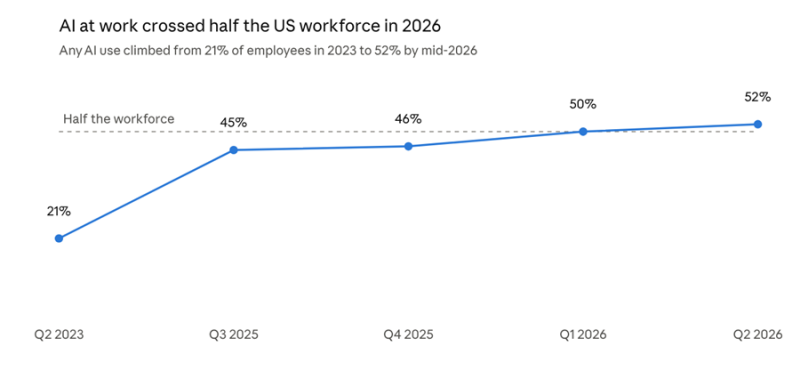
Gallup quarterly workforce studies · US employees, any AI use at work
The breadth outruns the depth. About 30% of employees use AI a few times a week and 15% daily, so most of that majority is occasional rather than constant. Use also clusters by role: roughly 85% of technology employees used AI at work in 2026, far above many frontline jobs. The direction, though, points at everyone.
What the studies actually measure
The headline results are large, and they come from controlled experiments rather than vendor demos. The pattern is consistent: assistants help most with drafting, coding, and structured analysis, and the size of the gain swings with the task.
| Study | Task | Measured effect |
|---|---|---|
| GitHub Copilot trial (2023) | Build an HTTP server in JavaScript | 55.8% faster completion |
| BCG and Harvard field experiment (2023) | 18 realistic consulting tasks | 12.2% more tasks, 25.1% faster, ~40% higher quality |
| Professional writing study (Noy & Zhang, 2023) | Business writing tasks | ~40% faster, ~18% higher quality |
| Customer support study (NBER) | 5,179 live support agents | 14% more issues resolved per hour |
| Google engineer trial | Complex enterprise coding task | ~21% less time |
Two caveats travel with these numbers. The effect is often invisible to the people getting it: in the Copilot trial, both groups guessed around a 35% gain when the real figure was 55.8%. And most studies measure speed and output, not whether the finished work was correct, which is where the trouble starts.
How a normal workday changes
Stack the studies together and a picture of the day emerges. The assistant rarely replaces the job. It absorbs the connective tissue around it.
• Writing and email: first drafts, summaries, and replies arrive in seconds, so the work shifts from composing to editing.
• Meetings: notes, transcripts, and action items are produced automatically, which ends the post-meeting scramble but makes the recap only as reliable as the person who reviews it.
• Coding: developers accept roughly a third of suggestions and spend more time reviewing generated code than typing it.
• Research and analysis: a first pass at a document, dataset, or market scan appears quickly, then a person checks and reshapes it.
The common thread, documented in a Microsoft and Carnegie Mellon survey of knowledge workers, is a move from doing the task to overseeing it: less time on execution, more on prompting, curating, and verifying. The job starts to look less like production and more like editing.
The uneven reality
The gains are real but jagged, and where a worker sits matters more than the averages suggest.

The clearest finding is that assistants lift the least-experienced workers the most. In the NBER customer-support study, the 14% average gain hid a 34% jump for novice and lower-skilled agents while top performers barely moved. The BCG experiment showed the same shape, with the lowest-scoring consultants gaining the most. An assistant narrows the gap between a beginner and an expert by handing the beginner a competent first draft.
But the frontier is jagged. In that same BCG study, consultants who used GPT-4 on a task deliberately built to sit outside the model's competence were 19 percentage points less likely to reach the right answer, because the polished output read as convincing even when it was wrong.
And more capability does not always mean more speed. A 2025 METR trial found experienced open-source developers took about 19% longer on familiar tasks when using AI tools, even though they felt faster, because reviewing and correcting suggestions cost more than it saved. The assistant's value depends on the match between the task and what the model is genuinely good at, not on raw horsepower.
The risks that arrive with the gains
Three problems scale right alongside the productivity.
Skill and judgment. The Microsoft and Carnegie Mellon survey found 62% of knowledge workers reported less critical thinking on routine tasks when they trusted the assistant, and the researchers warned that under-used cognitive skills can become atrophied and unprepared for the moments they are needed. Notably, the effect flipped with self-confidence: people sure of their own expertise scrutinized AI output more, not less.
Accuracy and over-trust. Assistants produce fluent text whether or not it is correct, and fluency is persuasive. The BCG result is the cautionary case: coherent, confident, and wrong. In high-stakes work, an unverified answer that looks finished is more dangerous than an obvious error, because nobody stops to check it.
Security and shadow AI. When companies are slow to provide tools, employees bring their own. Verizon's 2026 Data Breach Investigations Report found use of unapproved AI tools tripled in a year, from 15% to 45% of employees, and IBM's 2026 breach research tied shadow AI to 43% of security incidents, up from 20%. Roughly four in ten pieces of data pasted into AI tools contain sensitive information. The pattern is not malicious. It is ambitious employees reaching for the best available tool when an approved one is missing.
What it does to the organization
When every employee has an assistant, the unit of change is not the individual but the team.
The work shifts from production to review. If first drafts are cheap, the bottleneck moves to judgment: deciding what is worth doing, catching the confident error, and owning the result. Roles tilt toward editing, direction, and verification. Entry-level work, which was often where people learned by producing those first drafts, gets compressed, and that raises a real question: how do juniors build expertise when the assistant does the reps for them?
Management changes too. Output per person rises unevenly, so measuring contribution by volume stops working. The scarce skill becomes knowing which tasks to delegate and which to keep, and that judgment is hard to hire for and easy to lose. Meanwhile the gap between employee adoption and company governance is wide: Gallup found 52% of employees using AI while only 47% said their organization had integrated it. That gap is exactly where shadow AI grows.
A short playbook for leaders
The evidence points to a few practical moves.
1. Provide a good tool, fast. Shadow AI shrinks sharply once an approved option exists; one healthcare study saw unauthorized use drop by about 89% after a sanctioned tool was offered. Enablement beats prohibition.
2. Match the tool to the task. Aim assistants at drafting, summarizing, and coding, where the research shows real gains, and keep a human firmly in charge of high-stakes calls that sit past the model's competence.
3. Make verification the job. Treat output as a draft to be checked, not an answer to be shipped. The workers who stayed sharp were the ones who questioned and refined what they got.
4. Protect the learning path. Decide deliberately where juniors still do the reps by hand, so expertise keeps forming even as the assistant handles the routine.
5. Govern the data. Set clear rules on what can go into which tools before an incident forces the conversation.
So what happens when every employee has a digital assistant? Not the clean productivity windfall the demos promise. The ceiling rises and the floor gets shakier at the same time. The best work gets faster and the weakest workers get stronger, while judgment turns into the scarce resource, juniors lose the reps that once built expertise, and a confident wrong answer can travel further than it ever could before. The companies that pull ahead will not be the ones that adopt the most tools. They will be the ones that treat the assistant as a brilliant, tireless, occasionally reckless junior collaborator, and build the habits of direction and verification that such a collaborator demands. The tool is now universal. The advantage is in how you hold it.
Post Comment
Share your thoughts about this article.
Be the first to post a comment!