Table of Content
- Why Has the Warehouse Become the Bottleneck in E-commerce?
- What Does a Warehouse Management System Actually Do?
- How Does a WMS Improve Inventory Accuracy and Visibility?
- What Is the Impact on Picking and Packing Productivity?
- Where Do Robotics and AI Fit In?
- How Much Can a WMS Reduce Operating Costs?
- Can a WMS Make Returns Less Painful?
- How Does the Warehouse Connect to Last-Mile Delivery?
- What Does the Data Layer Deliver?
- How Does This Translate Into Customer Experience?
- What E-commerce Operators Gain From a Modern WMS
- What Should You Look For When Choosing a WMS?
E-commerce has spent a decade compressing the gap between “order placed” and “order delivered,” and most of the attention has gone to what happens on the road. But every fast delivery starts inside a building. Before a driver can complete a dense multi-stop route, someone has to locate the right item among thousands of SKUs, confirm it is physically in stock, pick it without error, pack it, label it, and get it onto the correct truck before the carrier cutoff. When any of those steps slips, the fastest last-mile network in the world cannot recover the lost time.
The volume passing through that building keeps climbing. According to the U.S. Census Bureau, American e-commerce sales reached roughly $1.23 trillion in 2025, growing more than 5% year over year and accounting for about 16.4% of all retail. Those orders are smaller, more frequent, and less predictable than the pallet-sized shipments most warehouses were designed for, and each one arrives with a delivery promise attached.
A warehouse management system (WMS) is the software layer that turns that pressure into a repeatable process. It decides where inventory is stored, how orders are released, which picker takes which path, how every item is verified, and how the finished parcel reaches the carrier. The business impact shows up in inventory accuracy, cost per order, labor productivity, peak-season resilience, returns, and the reliability of the delivery promise itself. Here is what the data looks like.
Why Has the Warehouse Become the Bottleneck in E-commerce?
Fulfillment faces its highest operational pressure inside the four walls, because customer expectations have shortened while order profiles have grown more fragmented.
The delivery promise is made at the dock door
Two-day and same-day shipping are framed as transportation achievements, but the transportation leg is largely fixed by geography and carrier schedules. What a retailer genuinely controls is the interval between an order hitting its system and the parcel leaving its dock. In a manually run fulfillment center that interval expands unpredictably: a picker searches for a mislocated item, a packer discovers a shortage the inventory record never flagged, a wave misses the 4 p.m. carrier pickup and rolls to the next day. The customer sees none of this, only a tracking number that did not move. A WMS exists to make that internal interval short and, more importantly, consistent, because a promise kept 99% of the time is a competitive asset and one kept 85% of the time is a customer-service liability.
SKU proliferation and the single-unit order
Traditional distribution moved cases and pallets to a few hundred stores on a predictable schedule. E-commerce moves individual units to hundreds of thousands of doorsteps across catalogs of tens of thousands of SKUs plus size, color, and bundle variants. Every additional SKU adds a location to manage, a replenishment rule to maintain, and another chance for a picker to grab the wrong item. Spreadsheets and paper pick lists that worked at 200 orders a day collapse quietly at 2,000, and the failure mode is not an outage but a steady rise in mis-ships, overtime, split shipments, and emergency freight that erodes margin one order at a time.
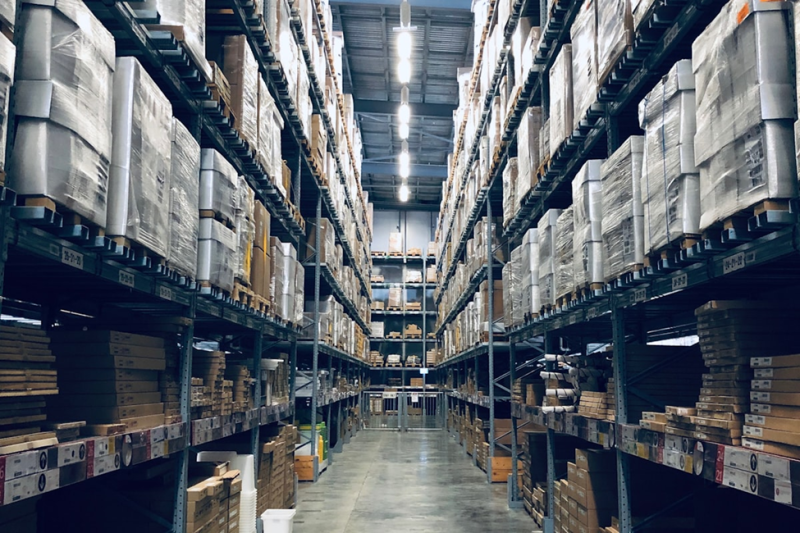
Every rack position, bin, and tote is a system-managed location. Without software directing the flow, SKU growth turns storage into a search problem.
What Does a Warehouse Management System Actually Do?
A WMS is the operating system of the building. It starts at the dock, recording each receipt against a purchase order, assigning cartons and pallets a license-plate identifier, and directing putaway to a location chosen for the item’s velocity and size. From that point the system knows where every unit sits and updates the record with every scan. As orders arrive from the storefront, marketplaces, or order management system, the WMS groups them into waves or batches, allocates inventory to each line, generates optimized pick tasks, and pushes them to handheld scanners, voice headsets, pick-to-light displays, or mobile robots. At the packing station it verifies the scanned items against the order, recommends the right carton, prints the label, and records the shipment so the carrier manifest and tracking notification are generated automatically. When a return comes back, the same system receives it, grades it, and decides whether it goes to stock, refurbishment, or liquidation.
Modern platforms add labor management, slotting engines that re-map fast movers to accessible locations, yard and dock scheduling, and cartonization that trims dimensional-weight charges. Equally important is what sits around the WMS: continuous data exchange with the ERP, the order management system, the transportation management system and carrier APIs, and the selling channels where demand originates. Cloud deployment has made that integration layer practical for mid-market brands and 3PLs that cannot fund a multi-year implementation.
How Does a WMS Improve Inventory Accuracy and Visibility?
Inventory accuracy is the foundation every other metric rests on, and in most operations it is weaker than leadership assumes. An analysis of warehouse management challenges by Goramp puts industry-average accuracy at only 85% to 90%, with shrinkage costing facilities about 1.4% of revenue, while scan-verified and RFID-enabled operations report accuracy above 99.5%. At 90%, one in ten location records is wrong: pickers are sent to bins that do not hold what the system claims, packers discover shortages at the last moment, and planners buy against stock that does not exist. That gap is the difference between a storefront that sells only what it can ship and one that regularly oversells and cancels orders after payment.
85–90%
Industry-average inventory accuracy in warehouses relying on manual or lightly automated processes, compared with 99.5%+ in scan-verified, RFID-enabled operations.
A WMS attacks the problem structurally. System-directed putaway means goods are stored where the record says, because the task cannot close without scanning the destination. Every subsequent move, pick, pack, and adjustment is scanned, so shelf and record stay synchronized in real time. Cycle counting replaces the disruptive wall-to-wall count with small daily counts prioritized by value and velocity. And because accurate available-to-promise quantities reach every channel within seconds, the storefront, marketplace listing, and wholesale portal work from the same number. The financial effect compounds: safety stock falls when on-hand figures are trustworthy, working capital is released from buffer inventory, and year-end write-offs shrink.
What Is the Impact on Picking and Packing Productivity?
Order picking is the largest cost center in the building. As NetSuite notes in its guide to order picking, the activity is widely reported to account for 50% to 55% of warehouse operating costs, with workers sometimes walking miles in a shift. The reason is geometry: in a picker-to-part operation most of a picker’s time goes to travel between locations, not to picking. Any process that shortens walks, reduces trips, or removes searching converts directly into lower labor cost per order and higher throughput from the same headcount.
This is where the WMS delivers its most measurable returns. Instead of releasing orders in arrival sequence, the system batches orders that share locations, assigns pickers to zones, and sequences each pick path to minimize distance. According to picking-strategy research compiled by Optioryx, route optimization alone cuts travel distance by 20% to 30%, batching alone by 15% to 25%, and combining the two in software typically achieves a 30% to 55% reduction. Those are productivity gains that do not depend on anyone walking faster, which is the only kind that survives peak season.
Packing becomes a verification step rather than a trust exercise. Each item is scanned into the carton and checked against the order, cartonization selects the smallest box that fits, and weight checks flag any parcel that deviates from what its contents should weigh. The result is the perfect order: right items, right quantity, right package, right label, on time. Every fraction of a percent of improvement is a reshipment, a return, and a support ticket avoided.
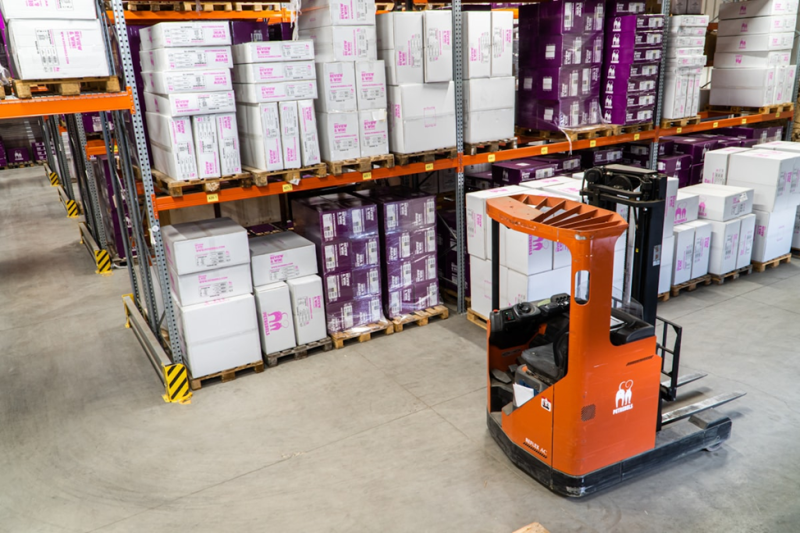
Picking consumes more than half of warehouse operating cost. System-sequenced pick paths and batching reduce travel distance by 30% to 55% when combined.
How Does a WMS Change Labor Management?
Labor is the largest controllable cost in fulfillment and the hardest input to secure, with high turnover, seasonal surges, and a persistent shortage of experienced associates. Any process that depends on an individual’s memory of the floor is fragile by design. Zebra Technologies’ latest Warehousing Vision Study found that 63% of warehouse leaders plan to implement AI software and augmented reality within five years and 64% plan to increase modernization spending, while frontline associates themselves view technology as something that makes work easier and safer rather than as a threat.
A WMS with a labor management module changes the daily reality of the floor. Because every task is system-directed and scan-confirmed, a new associate is productive on day one instead of after weeks of shadowing, which is what makes seasonal hiring feasible at scale. Managers see productivity by individual, zone, and task in real time and rebalance labor as bottlenecks form rather than after the shift. Engineered standards give every job a fair expected time, task interleaving assigns a putaway to a worker who would otherwise walk back empty-handed, and the operation stops depending on the handful of people who “know the floor.”
Where Do Robotics and AI Fit In?
The most visible example of what the warehouse is becoming sits inside Amazon’s network. The company has deployed more than one million robots across more than 300 facilities and introduced a generative AI foundation model, DeepFleet, to coordinate the fleet and improve robot travel time by around 10%. Those robots stow inventory, carry shelving pods to pickers, sort packages, and move carts to outbound docks, and Amazon’s newest large fulfillment centers launch with this technology as standard. The lesson is not that every brand needs a million robots; it is that the benchmark for cost to serve is now set by a warehouse run as a software-orchestrated system in which people, machines, and inventory placement are optimized together.

Robotic arms, autonomous mobile robots, and goods-to-person systems only pay off when a warehouse execution layer decides what each machine and each person does next.
For mid-sized operators, robotics is arriving through leasable autonomous mobile robots, goods-to-person shelving, and robotic arms that handle a growing share of small-item picks. None of these deliver value in isolation. An AMR that does not know which orders are urgent, or a robotic arm working from a stale inventory record, simply automates inefficiency. The WMS, increasingly paired with a warehouse execution layer, assigns work across humans and machines and balances the load in real time. AI adds intelligence on top: models re-slot inventory as demand shifts, predict replenishment before a pick face runs empty, flag anomalies, and forecast labor by hour so managers staff for the volume that is actually coming.
How Much Can a WMS Reduce Operating Costs?
The cost of poor warehouse control is larger and more diffuse than most income statements show. Inventory research compiled by Xorosoft indicates that carrying costs typically consume 20% to 30% of average inventory value each year, that global inventory distortion from stockouts and overstocks exceeds $1.7 trillion, and that the WMS market is projected to grow from roughly $4 billion in 2026 to about $16 billion by 2033. A brand holding $5 million in stock is spending $1 million to $1.5 million a year simply to own it, and any excess held to compensate for inaccurate records is pure cost.
A WMS pulls several levers at once. Labor per order falls as travel, searching, and rework are engineered out. Mis-shipments decline once packing is scan-verified, and each one avoided saves the outbound freight, the return, the replacement, and the support time: an operation shipping 500,000 orders a year at a 1% error rate absorbs about 5,000 failures, roughly $100,000 at a conservative $20 each, which drops to $20,000 at 0.2%. Slotting improves space utilization and defers expansion. Expedited freight, almost always a symptom of late release rather than a transportation problem, falls when waves reliably clear before cutoffs. And the largest saving is often the working capital released when safety stock can be cut because the record is finally trustworthy.
How Does a WMS Handle Peak Season and Multi-Channel Demand?
E-commerce demand is spiky in a way few industries experience. McKinsey’s analysis of logistics automation notes that serving online retailers means coping with volumes that easily double around the holidays, and cites Alibaba’s logistics arm processing 812 million orders on a single Singles’ Day, eight times its normal throughput. Few brands approach that scale, but the pattern is universal: Prime Day, Black Friday, and the run-up to Christmas compress weeks of volume into days, and an operation that is adequate in June breaks in November, quietly, as cycle times stretch and cutoffs are missed.
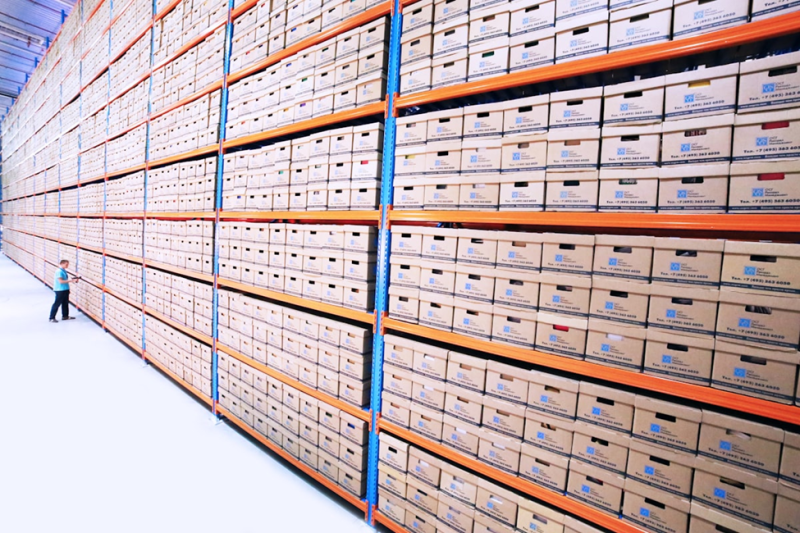
Peak volume can multiply daily throughput several times over. A WMS that plans waves against carrier cutoffs and absorbs temporary labor keeps service levels intact.
A WMS is built for the surge. Wave planning releases work in blocks sized to floor capacity and sequenced against each carrier’s departure, so orders that must ship today are picked first. Dynamic slotting moves the season’s hot sellers into forward locations before the rush. System-directed tasks let hundreds of temporary associates produce accurate work within days. Capacity dashboards show orders allocated, picked, packed, and shipped against target in real time, enabling intervention hours before a cutoff is missed. For brands selling across their own store, Amazon, Walmart, and wholesale accounts, channel-specific labeling and compliance rules apply automatically, and multi-node operations route each order to the facility that holds the stock closest to the customer. Peak volume is absorbed without a proportional rise in cost, errors, or cycle time, which is what makes growth profitable rather than merely larger.
Can a WMS Make Returns Less Painful?
Returns are among the most expensive and least controlled processes in e-commerce. The National Retail Federation’s 2025 Retail Returns Landscape projects $849.9 billion in returns for the year, with an estimated 19.3% of online sales sent back, well above in-store rates. The same research finds 82% of consumers consider free returns important and that roughly 9% of returns are fraudulent. Customers treat generous returns as table stakes, a meaningful share of what comes back is not what it claims to be, and every unprocessed return is inventory that cannot be resold and a refund that cannot be reconciled.
19.3%
Estimated share of online sales returned in 2025, according to NRF. Each unit must be received, graded, dispositioned, and, ideally, made sellable again within days.
A WMS brings outbound discipline to reverse logistics. A return is scanned against the original order, confirming what was expected, what arrived, and whether weight or serial number matches. Disposition rules decide, item by item, whether it returns to a pickable location, goes to refurbishment, to liquidation, or to disposal, so decisions are consistent and fast. Restockable items reach a sellable location within hours, which matters for seasonal and fashion goods whose value decays weekly. Refunds trigger automatically when the receipt scan clears, and reason codes reveal patterns, such as a SKU with a sizing problem or a supplier shipping defective lots, that let the business fix root causes.
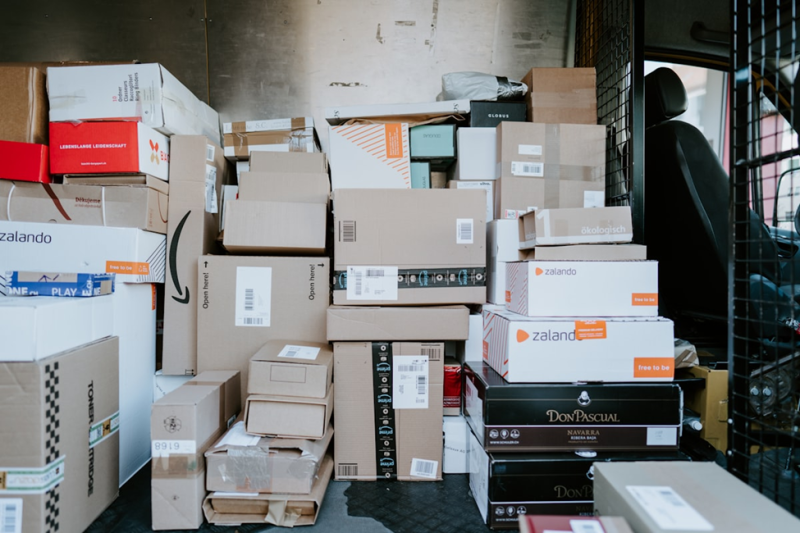
Nearly a fifth of online purchases come back. Without system-directed disposition, returned stock piles up as unsellable inventory and unreconciled refunds.
How Does the Warehouse Connect to Last-Mile Delivery?
The warehouse and the delivery fleet are usually run by different teams and systems, yet the customer experiences them as one promise, and the handoff between them is where a surprising amount of performance is lost. If waves are released without regard to route departure times, drivers wait at the dock. If cartons are staged out of stop sequence, loading takes longer and the driver spends the day digging through the van. If the manifest sent to the carrier is incomplete, the route is planned around parcels that never board. A well-integrated WMS aligns wave cutoffs to departures, stages parcels in reverse stop order, and passes complete shipment data to the transportation system the moment each parcel closes.
The delivery leg has its own economics, and they are substantial. As we explored in our earlier analysis of the business impact of using a route planner with multiple stops in e-commerce logistics, last-mile delivery represents the majority of shipping cost, and stop density, first-attempt success, and per-stop cost determine whether a delivery operation makes money. Those gains depend entirely on what happens upstream: a perfectly optimized route cannot compensate for a parcel picked wrong, packed late, or loaded out of order. The best results come from treating fulfillment and delivery as one continuous flow, with the WMS and the route planner exchanging data so the promise shown at checkout is one the building can keep and the fleet can execute.

The dock is where two systems meet. Aligning wave release and load sequencing with route departures removes dwell time that neither team sees on its own dashboard.
What Does the Data Layer Deliver?
Warehousing is an enormous and growing expense. McKinsey has estimated that companies spend around $350 billion a year on warehousing worldwide, and in its analysis of improving warehouse operations digitally it notes the figure keeps rising as pick sizes shrink and SKUs proliferate, pressuring margins and service levels at once. Its central observation is that trial and error is not an option, because no business can shut down a live warehouse to experiment. That is the argument for a data-rich WMS: it is the only way to see what is happening on the floor at the level of the individual task, and therefore the only way to improve it deliberately.
The metrics leadership cares about are all products of the transaction log: dock-to-stock time, order cycle time, pick accuracy and perfect-order rate, units per labor hour, cost per order, inventory turns, space utilization, and on-time ship rate against carrier cutoff, the leading indicator of on-time delivery. A modern WMS surfaces these on a live dashboard rather than in a monthly export, so a supervisor can see a zone falling behind at 10 a.m. and act. The same data feeds simulation and digital-twin tools that let planners test a new slotting scheme or a goods-to-person system virtually before committing capital.

Order cycle time, pick accuracy, cost per order, and on-time ship rate are all products of the WMS transaction log. Seeing them live is what makes same-day intervention possible.
How Does This Translate Into Customer Experience?
Customers do not evaluate a warehouse. They evaluate whether the right product arrived on the promised day and whether the brand told them the truth along the way. Expectations are demanding: a 2026 summary of research on warehouse management for e-commerce cites AlixPartners data showing U.S. consumers expect free delivery in about 2.7 days, and a ShipBob survey finding 69% of brands targeting two- to three-day domestic delivery. Meeting that standard consistently is impossible without a fulfillment operation that ships accurately and on schedule.
The customer-facing benefits follow directly. Accurate inventory means the storefront never sells what it cannot ship, so the post-purchase cancellation email disappears. Scan-verified packing means the wrong item almost never arrives. Reliable cycle times mean the promised date at checkout is calculated from a cutoff the warehouse actually hits. Automatic carrier handoff means tracking updates within minutes, cutting the “where is my order” inquiries that dominate support volume. Fast, transparent returns turn friction into a reason to buy again. Each is a retention lever, and retention is where e-commerce margin is made: acquisition costs keep rising, while a customer whose last three orders arrived correctly and on time is inexpensive to keep.

The only warehouse metric the customer ever sees is whether the right parcel showed up on the promised day. Everything upstream exists to make that moment routine.
What E-commerce Operators Gain From a Modern WMS
E-commerce operators face growing volumes, rising labor and inventory costs, higher return rates, and customers who expect faster, more reliable delivery every year. A WMS addresses those pressures at the source. Key benefits include:
1. Higher inventory accuracy. Scan-verified movements and cycle counting push accuracy toward 99.5% or better, eliminating oversells and write-offs.
2. Lower cost per order. Optimized pick paths, batching, cartonization, and reduced rework cut labor, packaging, and freight cost on every shipment.
3. Faster, more consistent order cycle times. System-directed waves aligned to carrier cutoffs shorten order-to-ship time and keep it stable under load.
4. Improved labor productivity and faster onboarding. Directed tasks and real-time productivity visibility raise units per hour and make seasonal staffing practical.
5. Reliable peak-season performance. Wave planning, dynamic slotting, and capacity dashboards absorb multiples of normal volume without proportional cost or errors.
6. Efficient returns processing. Automated receipt, grading, and disposition put returned stock back on sale within hours and trigger refunds on receipt.
7. Better carrier and last-mile coordination. Clean shipment data, sequenced loading, and aligned cutoffs let route planning teams execute on what the warehouse actually ships.
8. Data-driven continuous improvement. Live metrics and simulation replace intuition in layout, slotting, staffing, and automation decisions.
Together these gains convert the warehouse from a cost center that limits growth into an operational advantage that funds it.
What Should You Look For When Choosing a WMS?
The WMS market is mature but evolving quickly. The 2026 Gartner Magic Quadrant for Warehouse Management Systems highlights the trends reshaping the category: buyers are moving from feature checklists toward cloud-native, composable platforms that emphasize usability and rapid time to value, with labor management, slotting, yard management, and performance analytics expected as standard, and vendors are embedding machine learning, generative and agentic AI, vision systems, and deep robotics integration so warehouses can orchestrate human and automated work from one platform. Long-standing leaders include Manhattan Associates, Blue Yonder, SAP, and Infor, alongside specialists serving mid-market brands and 3PLs.
A practical evaluation comes down to a few questions. Does it integrate natively with your storefront, marketplaces, order management system, ERP, transportation system, and carriers? Can it manage multiple facilities and 3PL locations under one inventory view and route orders to the best node? Are labor management, slotting, and cartonization included or priced separately? Is it ready to orchestrate mobile robots and goods-to-person systems if you add them in two years? How long does implementation take, and what is the five-year total cost of ownership including subscription, integration, hardware, and training? And does the vendor’s roadmap match where your business is heading? A system that answers those questions well is not simply warehouse software; it is the foundation on which every delivery promise the business makes will rest.
Build a Fulfillment Operation That Scales
E-commerce rewards operations that ship accurately, predictably, and at a cost that protects margin as volume grows. A warehouse management system is the engine that makes all three possible at once, and the upstream condition for everything a delivery network can achieve downstream.
Start by benchmarking your current inventory accuracy, order cycle time, and cost per order, then evaluate WMS platforms against those numbers. The gap between where your operation stands today and what a system-directed warehouse can deliver is, in most cases, the clearest growth opportunity on the balance sheet.
Post Comment
Share your thoughts about this article.
Be the first to post a comment!