Stop reading tool reviews written by people who get paid when you click "Buy."
We did something different. We dug through thousands of real user reviews on G2, Capterra, Trustpilot and Reddit's SEO communities to find out which SEO tools people actually love, which ones they quietly regret paying for, and which $279 tool keeps beating $500-a-month platforms.
And 2026 is not the year to trust an old review. Adobe completed its acquisition of Semrush on April 28, 2026, for $1.87 billion. Ahrefs launched a $29 Starter plan in January and rewrote its seat pricing in March. Nearly every tool on this list changed its prices this year.
The 10-second answer:
- All-in-one powerhouse: Semrush
- Backlink king: Ahrefs
- Best bang for your buck: SE Ranking
- Easiest for beginners: Moz Pro
- Content machine: Surfer SEO
- Technical audit legend: Screaming Frog
Now let's see what real users say when nobody is paying them to be nice.
How We Ranked These (No Vendor Was Harmed, or Consulted)
We ignored feature counts and AI badges. We ranked on four things only:
- Review sentiment across G2, Capterra and Trustpilot in 2026
- Community verdicts from Reddit's r/SEO community, where nobody earns a commission
- Search intent: what people really want to know when they Google each tool
- Verified 2026 pricing, because almost every plan changed this year
One pattern stood out immediately. Reddit users keep recommending Google Search Console plus Screaming Frog because raw crawl and performance data stop AI tools from guessing around basic technical problems. The community trusts data, not hype. So did we.
And before any tool: Google's own SEO Starter Guide still says it best. Creating content that people find compelling and useful will likely influence your website's presence in search results more than any of the other suggestions in the guide. No subscription changes that.
The 2026 Scorecard (Save This Table)
| Rank | Tool | Best For | 2026 Starting Price | Real User Rating | #1 Complaint |
|---|---|---|---|---|---|
| 1 | Semrush | All-in-one marketing | ~$139/mo | 4.4/5 (G2) | Price and plan confusion |
| 2 | Ahrefs | Backlinks and link building | $29/mo (limited), $129/mo full | 4.5/5 (G2) | Credit system, no free trial |
| 3 | SE Ranking | Agencies and SMBs on a budget | ~$103/mo (annual) | 4.7/5 (G2) | Smaller backlink index |
| 4 | Moz Pro | Beginners | $49/mo | 3.6 to 4.3/5 | Weekly updates, thin data |
| 5 | Surfer SEO | Content optimization | $49/mo (annual) | 3.3 to 3.6/5 (independent) | Price climbs fast |
| 6 | Screaming Frog | Technical audits | Free, or $279/yr | 4.9/5 (Capterra) | Desktop only |
Prices verified from reviews published July to October 2026. Confirm on the vendor site before buying.
Semrush
The Giant That Adobe Just Bought for $1.87 Billion
Why it's here
Semrush is used by over 28 million users globally, from scaling startups to the Fortune 500. In 2026 it also became an Adobe company, adding search engine optimization, generative engine optimization, and agentic search optimization capabilities to Adobe's customer experience portfolio.
What people are really asking
Three questions dominate 2026 searches: Is it worth the price?, Semrush vs Ahrefs?, and What happens now that Adobe owns it? The short answers: yes if you use more than SEO, Ahrefs is cheaper for pure link work, and Adobe says Semrush customers of all sizes can expect continued investment and an expanded product roadmap as Adobe and Semrush fully integrate. Watch that promise closely.
What real users say
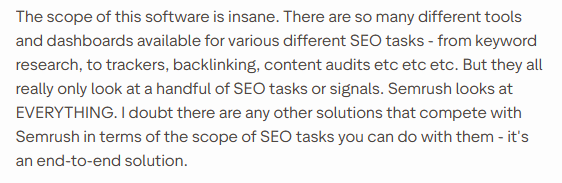
Love: Semrush users appreciate the dashboard for its user-friendly design and comprehensive display of key metrics like domain authority, organic traffic, and backlinks, and find the competitive analysis feature invaluable for gaining insights into competitors' strategies, keywords, and backlinks. Even a practitioner who left for Ahrefs admits Semrush has the more intuitive interface.
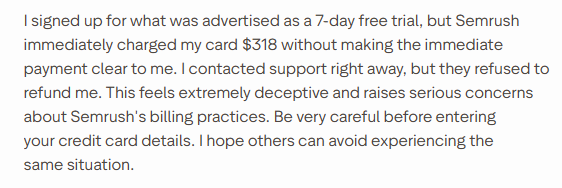
Hate: Price, every single time. Semrush users often mention its high pricing, which can be a deterrent for smaller businesses. On G2, proportionally more Semrush reviewers flag pricing complexity and a steep learning curve than Ahrefs reviewers do. Accuracy gets side-eye too: in one five-day comparison, Semrush and Moz both gave organic traffic data far lower than actual traffic, with Semrush off by 1,573 users against GA4.
2026 pricing (it changed, again)
Semrush restructured its plans in 2026 into SEO, Starter, Pro+, and Advanced, starting at $117.33 a month billed annually, with AI search visibility features bundled into every tier. Monthly, the SEO plan is $139 a month, then $199, $299, or $549 for the SEO + AI Search tiers. Semrush offers a 7-day free trial, so you can test it on your own site at semrush.com before paying a cent.
Case study: 120 pages, 20,000 visitors a month
An independent SEO built an entire content strategy with Semrush data fed into an AI assistant via MCP. The outcome: the website has about 120 indexed pages and brings in over 20,000 visitors a month. Daily rank updates showed whether content changes were improving visibility in LLMs, AI Overviews, and organic search results.
Verdict: If you need SEO, PPC, content, local and social in one login, buy it. If you need three or four marketing functions in one place, Semrush's higher sticker is usually cheaper than the stack it replaces.
Ahrefs
The Backlink Beast With a $29 Secret Door
Why it's here
Semrush is breadth; Ahrefs is depth. Semrush is an all-in-one marketing suite; Ahrefs is a link-and-research specialist with the larger referring-domain index. It is still independent and bootstrapped, which users increasingly see as a feature.
What people are really asking
"Ahrefs pricing," "Ahrefs credits explained," and the brutally honest "does Ahrefs suck?" A daily user answered the last one: No, but the complaints behind that search are real. The interface is dense and the learning curve is steep, the price climbs fast once you add seats and historical data.
What real users say
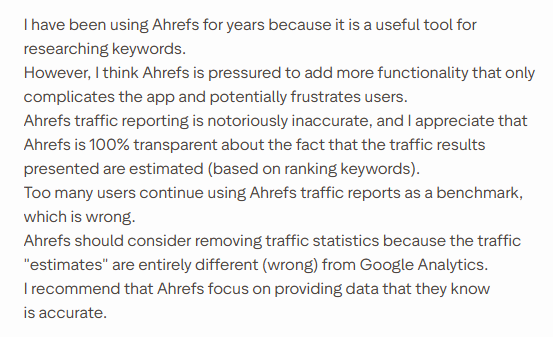
Love: Accuracy. In the same traffic test that embarrassed Semrush, Ahrefs provided the closest organic traffic average to Google Analytics 4, off by just 25 users. Support gets rare praise: Ahrefs users single out support by name, one giving a big shout-out to a named rep, rare for enterprise SaaS. On G2 it holds 4.5 out of 5 from 714 reviews, a smaller but slightly more satisfied review base.
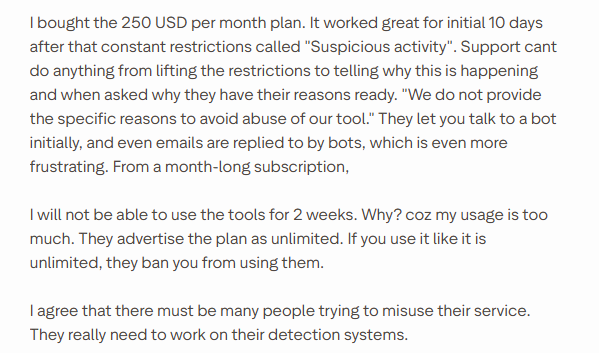
Hate: Credits. Ahrefs users criticize its pricing structure, citing the convoluted credit system and high costs as significant drawbacks. There's also a sneaky reporting quirk: its 2026 reporting counts an AI Overview citation as position #1, which quietly flatters your visibility. And Ahrefs offers no discounts or free trial on its core plans.
2026 pricing (read the seat math twice)
Ahrefs Starter launched in January 2026 at $29/month with 1 project and 100 credits, a new entry point rather than a price cut. Lite is $129/month. The trap is team size: additional seats cost $49 (Lite) to $149 (Advanced) per seat per month since March 2026, so a 5-person agency on Standard pays $249 plus 4 seats at $99, roughly $7,740 a year. If you only want to check your own site, Ahrefs Webmaster Tools is free for verified domains.
Case study: One feature, more client wins than any other
An agency SEO running multiple client campaigns says Ahrefs delivers the most comprehensive backlink analysis and content research capabilities available, and that the Content Explorer alone has generated more client wins than any other feature across platforms.
Verdict: Solo SEOs and link builders, this is your tool. If you only need SEO and backlinks, Ahrefs is the cheaper real-world spend because you are not paying for PPC modules you will not open.
SE Ranking
The Highest-Rated Tool on This List Costs Half as Much
Why it's here
This is the tool people switch to the day they notice they're paying Semrush prices for features they never open. SE Ranking has grown from a position-tracking startup in 2013 into an all-in-one AI SEO platform used by over 1.5 million SEO professionals.
What people are really asking
Search intent for "SE Ranking" is mixed: some users want pricing and plan details, others want an editorial review with pros and cons, and many compare it to Semrush and Ahrefs. Most expect specifics on rank tracking accuracy and AI search features.
What real users say
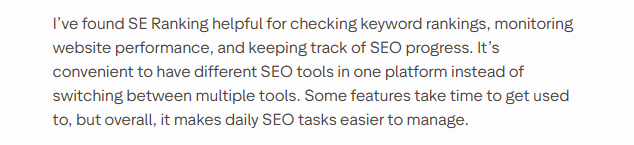
Love: Value, loudly. On G2 (4.7/5, 1,800+ reviews), the most frequently cited positive is the price-to-feature ratio. Agency owners consistently report that SE Ranking delivers 80 to 90% of what they previously used Semrush or Ahrefs for at roughly half the cost, and white-label reporting is called out as a specific differentiator. The AI tracking math is brutal for rivals: Semrush charges $99 per month per domain for its AI Visibility Toolkit as a standalone add-on, while SE Ranking includes the core GEO tracking capability in its base plans.
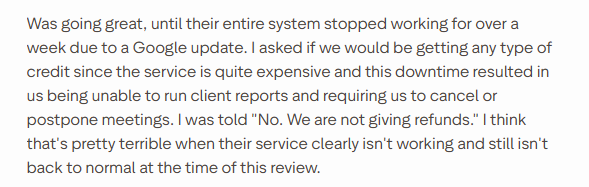
Hate: Depth and creeping prices. Compared to Semrush (25B+ keywords) and Ahrefs (backlinks), SE Ranking's 5.4B keywords and 2.2B domains may feel limiting for heavy enterprise or link-focused research. Long-term users report consistent price increases over the past four years. And the content module is metered by article and the optimisation depth doesn't match Surfer SEO or Clearscope.
2026 pricing
Core is $129/month ($103.20 billed annually), Growth is $279/month ($223.20 annually), plus white-label reporting via the $69/month Agency Pack. The old $65 Essential lineup was retired. Any review quoting $65 is stale. The 14-day full-access trial at seranking.com requires no credit card.
Case study: 90% of the suite, less than half the bill
The evidence is the migration pattern itself. One agency reviewer put it plainly: if you need a full SEO suite but can't justify Ahrefs or Semrush pricing, SE Ranking delivers 90% of the functionality at less than half the cost, including rank tracking, site audits, competitor analysis, and backlink checking.
Verdict: Agencies and SMBs doing client reporting and local SEO, this is the smartest money in the category.
Moz Pro
Great First SEO Tool, Terrible Last One
Why it's here
Moz invented Domain Authority, the metric everyone still quotes. Moz Pro is the gentlest on-ramp into SEO software, and in 2026 it added a few things the giants haven't matched for beginners.
What people are really asking
"Is Moz Pro worth it," "Moz vs Semrush," "Moz Pro pricing." The subtext is almost always a small business owner wondering if the cheaper tool is enough.
What real users say
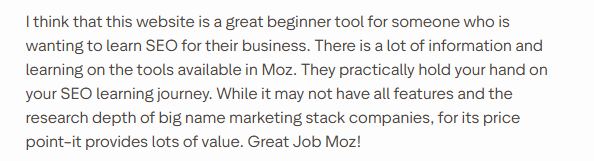
Love: Simplicity and teaching. Users describe a more intuitive and user-friendly interface than other SEO tools and a great option for an in-house team of mid-level SEOs who aren't looking to dive deeply into the super nitty-gritty stuff. After a 30-day test, one reviewer listed four 2026 standouts: DA as the industry's shared authority metric, the most beginner-accessible interface in the category, the lowest entry price point, and ChatGPT visibility tracking plus keyword prompt suggestions that neither Ahrefs nor Semrush replicates.
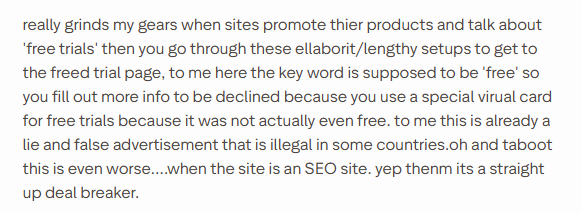
Hate: Speed and depth. Rankings and site crawls update weekly, not daily, and the keyword and link index sometimes lags competitors like Ahrefs or Semrush. The quote that sums it up: Moz Pro is really good at being your first serious SEO tool, but struggles to be your last one. And limits bite early: tracked-keyword and site limits at the Standard tier feel restrictive quickly, pushing budget-conscious users toward Medium sooner than planned.
2026 pricing
Starter costs $49 a month for one user, one campaign and 50 tracked keywords, with no AI tracking. Standard at $99 raises that to three campaigns and 300 keywords, extra campaigns cost $10 a month. Medium is $179, Large is $299. Branded reports start on Medium, and each extra user costs $49 a month. The free MozBar extension and limited free tools are available on moz.com if you want to kick the tires first.
Case study: The keyword difficulty trap
A 30-day hands-on test found Moz showing KD 35 versus an actual 57 to 58 in competing tools for the same keyword. Plan content on Moz's KD alone and you may chase keywords that are twice as hard as they look. Cross-check anything competitive.
Verdict: Learning SEO or running a small content site? Start here. Just know you'll probably graduate.
Surfer SEO
Users Love the Editor and Hate the Invoice
Why it's here
Surfer SEO doesn't pretend to be a full platform. It's a content editor that scores your draft against top-ranking pages, plus a content audit, AI writer, and new-for-2026 AI-answer tracking.
What people are really asking
"Is Surfer SEO worth it," "Surfer SEO pricing," "is the content score accurate." Every version of the question is really: will the score make me rank?
What real users say

Love: The workflow. Surfer offers one of the best connected workflows for researching, writing, optimizing, and refreshing search-led content, and its Content Editor is excellent. After four years of use, one reviewer still calls it one of the most balanced options if you want an all-in-one content optimization workflow. Agencies report content ranking faster after optimization with Surfer.

Hate: Two things, and they're big. First, the score is not a crystal ball: the most consistent finding across r/SEO and r/juststart is that Surfer's content score is a useful proxy but not a reliable ranking predictor. Users report hitting 75+ scores on competitive keywords and seeing little movement. Second, money: pricing dissatisfaction is the most common complaint across Trustpilot in 2026. One German reviewer titled their exit review "From €66 to over €230". Non-English teams struggle too: agencies working with Spanish and German sites often mention grammar issues and less accurate term suggestions.
2026 pricing
Discovery is $59 monthly or $49 annual (120 documents, 10 tracked pages, 1 seat), Standard $119/$99 (360 documents, 3 seats), Pro $219/$182 (adds internal linking and daily AI prompt tracking), Peace of Mind $359/$299. The gotcha: credits do not roll over on monthly billing, so a quiet month is money burned. Surfer runs a 7-day Pro trial on surferseo.com, which is long enough to see whether the editor fits your writers.
Case study: 1M+ weekly clicks (vendor-published, read with care)
Surfer's own case studies are the flashiest on this list, so treat them as best-case. Still: Hostinger scaled SEO to 1M+ weekly clicks with Surfer, and Planable achieved 10x content growth and a 176% traffic increase in six months. The community's take is that these wins come from publishing volume with Surfer as a quality gate, not from chasing a score of 100 on one page.
Verdict: If content volume is your bottleneck, buy it. Just budget for a research tool too, because almost every team still pays for Ahrefs or Semrush alongside it.
Screaming Frog
The $279 Tool That Embarrasses $500/Month Suites
Why it's here
A desktop crawler whose pricing model has barely changed in a decade, described by professionals with the reverence usually reserved for free software. Screaming Frog SEO Spider has been around since 2010 and is the de facto standard tool for site audits across agencies, in-house teams, and freelancers.
What people are really asking
"Screaming Frog free vs paid," "Screaming Frog price," "Screaming Frog vs Sitebulb." People already know it's good. They want to know if they need to pay.
What real users say
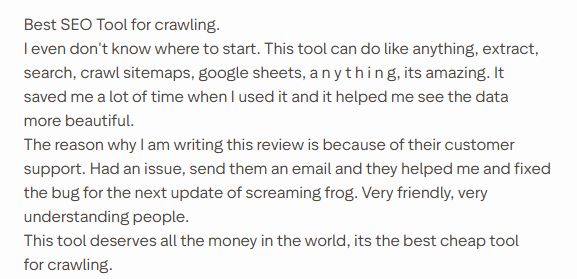
Love: Everything, apparently. It scores 4.9/5 on Capterra, the highest rating of any tool here. Typical review: there are no major cons with Screaming Frog based on my experience, and for the price I've got no complaints. Another: the depth of data it surfaces, redirects, canonicals, hreflang, log files, structured data, has no real peer at this price point.
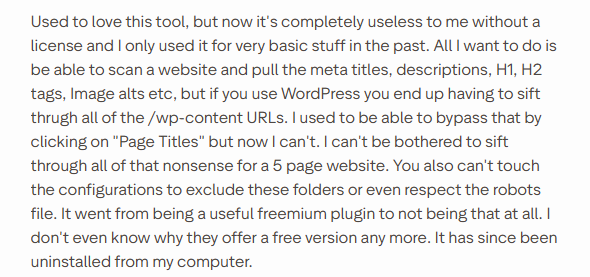
Hate: It lives on your laptop. The desktop app model means no collaborative dashboards or scheduled cloud crawls without additional tooling, and it's not ideal for non-technical users who may struggle with the technical interface. Big crawls also eat RAM, because Screaming Frog runs on your machine.
2026 pricing
Gloriously simple. Screaming Frog SEO Spider costs $279 per user per year (£199 / €245), with volume discounts from five licences. The free version you can download from screamingfrog.co.uk crawls up to 500 URLs. The paid license removes the URL cap and unlocks Google Analytics integration, Google Search Console connection, PageSpeed Insights data, scheduled crawls, and custom extraction.
Case study: $50K recovered from a single crawl
One agency's audit found $50K in lost revenue from crawl errors, an annualized recovery of $50,400 against a Screaming Frog license cost of $250. Broken redirects and orphaned pages never show up in keyword tools. They show up in a crawl.
Verdict: If you touch technical SEO, you own this. Period.
5 Costly Mistakes People Make When Choosing SEO Software
Reading hundreds of regret-filled reviews, the same five mistakes appear again and again.
1. Trusting a 2024 review in 2026. Plan names have changed three times since 2022, making older reviews and even vendor docs contradictory. Semrush, Ahrefs, SE Ranking and Surfer all restructured this year.
2. Comparing entry prices instead of seat prices. Entry tiers look similar. Per-user costs are not. Ahrefs seats run $49 to $149 per month, Moz charges $49 per extra user, Semrush starts at $45. Model your real headcount first.
3. Treating traffic estimates as facts. Ahrefs and Semrush organic traffic numbers aren't accurate against GA4. Use them to compare sites to each other, never as absolute numbers in a client deck.
4. Chasing a content score instead of a reader. Content scores can encourage over-optimization. Google's own guidance (linked above) still ranks usefulness above everything else.
5. Paying $500 a month before buying the $279 crawler. Technical errors silently kill rankings. Most practitioners say the cheapest tool on this list delivers the fastest ROI.
The $300-a-Year Stack That Still Wins in 2026
Can't afford $139 a month? Here's the stack experienced SEOs on Reddit recommend before touching a premium suite:
| Layer | Tool | Cost | Why |
|---|---|---|---|
| Performance data | Google Search Console | Free | Real clicks and impressions, straight from Google |
| Technical audit | Screaming Frog (paid) | $279/yr | Unlimited crawls, JavaScript rendering, GSC integration |
| Keyword and competitor research | Ahrefs Starter | $29/mo | Credit-limited, but real Ahrefs data |
| Your own site's backlinks | Ahrefs Webmaster Tools | Free | Free for your own verified site |
Total: roughly $630 a year, or about $52 a month, for a stack that covers crawling, performance, keywords and backlinks. Upgrade to SE Ranking or Semrush only when client reporting or team seats force you to.
Which Tool Is Right for YOU? (Pick Your Situation)
| Your situation | Pick | Why |
|---|---|---|
| Solo blogger, under $100/mo | Moz Pro or Ahrefs Starter | Lowest entry; Moz for guidance, Ahrefs for data |
| Freelance link builder | Ahrefs Lite | Best backlink index, no PPC bloat |
| Agency with 5+ clients | SE Ranking Core + Agency Pack | White-label reports and AI tracking included |
| Marketing team doing SEO + PPC + social | Semrush | Replaces a whole stack, 7-day trial |
| Content team publishing 20+ pieces/month | Surfer Standard + a research tool | Best editor, needs research data from elsewhere |
| Anyone doing technical SEO | Screaming Frog | $279/year, unmatched crawl depth |
For a neutral background on why these tools exist and how search ranking works, the Wikipedia overview of search engine optimization is the cleanest vendor-free primer to share with clients or new hires.
The Bottom Line
In 2026 the difference between SEO tools is fit, not features. Semrush and Ahrefs earn their premium if you use their depth. SE Ranking is the highest-rated all-in-one tool because it charges less for most of the same output. Moz Pro is the friendliest start. Surfer owns content optimization but needs a research partner. And Screaming Frog, at $279 a year, is the single best purchase in SEO.
Whatever you pick: take the free trial, connect your own Search Console, and judge the tool on your site, not on someone else's case study.
Post Comment
Share your thoughts about this article.
Be the first to post a comment!