AI music generation hit an inflection point in 2026. Tools that turn a single descriptive prompt into a full song with vocals, lyrics, and arrangement crossed from novelty to legitimate production resource. Suno alone hit a $2.45 billion valuation and roughly 2 million paid subscribers by February 2026 per TechCrunch and Chartlex coverage, and Udio settled major label disputes with Universal Music Group and Warner Music Group in late 2025. The technical ceiling has lifted enough that the harder question is no longer can it sound good, but which tool fits which use case.
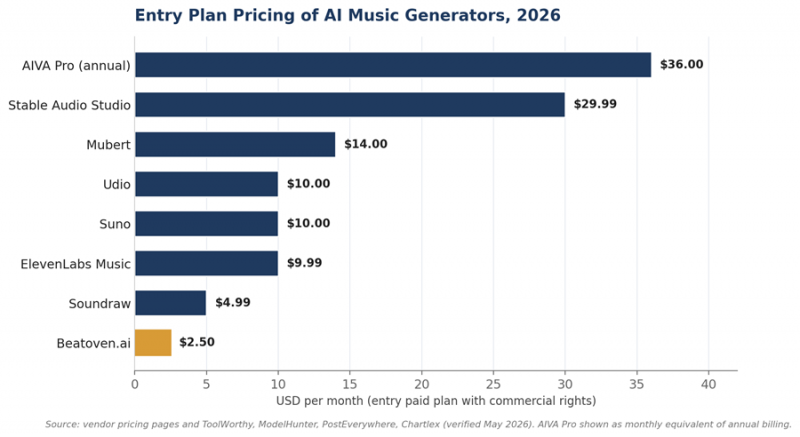
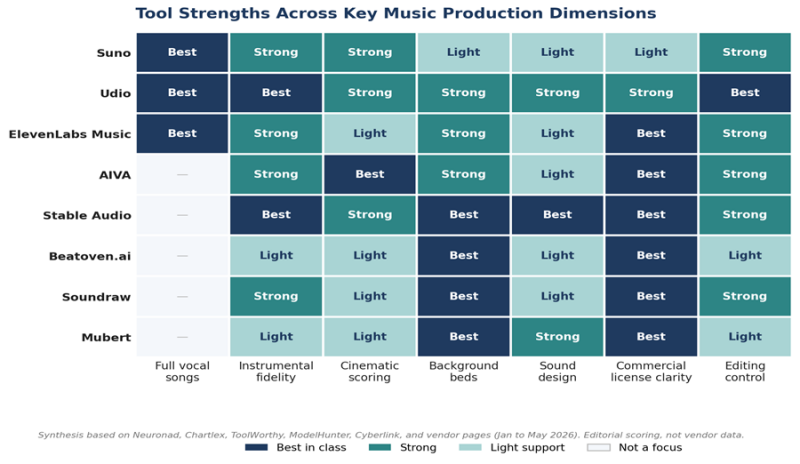
The eight tools profiled below cover the full landscape of what is currently possible: vocal-driven full songs, instrumental fidelity, cinematic scoring, background beds for video, sound design, and royalty-free creator workflows. Each entry below covers what the tool does best, what it costs, and where the licensing trail is clean enough for commercial work. Pricing was verified against vendor pages and aggregator coverage between January and May 2026, with sources cited inline throughout.
What Separates Strong Tools From Weak Ones
Selection rested on five criteria. Audio quality and prompt fidelity covers whether the output actually matches what the prompt described and holds up under repeat listening. Licensing clarity covers whether the paid tier grants commercial use and whether the training data was licensed. Editing control covers whether a single section can be fixed without regenerating the entire track. Workflow fit covers whether the tool produces what creators actually need, from 30-second backgrounds to full songs. Pricing transparency covers whether the value-per-output stays sustainable at real usage levels.
Sources cross-checked included Neuronad, Chartlex, ToolWorthy, ModelHunter, Cyberlink, Get AI Perks, The AI Rankings, Somio, and individual vendor pricing pages, all verified between January and May 2026. Tools without a free trial, without commercial-use rights on any tier, or with downloads suspended due to active litigation were either flagged or excluded. The final eight cover full-song generation, instrumental-only tools, cinematic scoring specialists, and content-creator workflows.
Snapshot of the Eight Tools
The matrix below frames each pick against the dimensions that decide most subscription choices: primary strength, entry-tier pricing, whether commercial rights are included, and what the free tier offers.
| Tool | Primary strength | Entry paid | Commercial rights | Free tier |
|---|---|---|---|---|
| Suno | Full vocal songs at scale | $10 / mo | Paid plans only | 50 daily credits, no commercial use |
| Udio | Instrumental fidelity, stem editing | $10 / mo | Paid plans, UMG and Warner settled | Limited free generations |
| ElevenLabs Music | Vocal realism, licensed training | $9.99 / mo | Pro plan, licensed corpus | Free tier with daily generations |
| AIVA | Cinematic and classical scoring | €33 / mo (annual) | Pro transfers full copyright | Free tier with restrictions |
| Stable Audio | Sound design, instrumental beds | $29.99 / mo | Studio plan, licensed training | Limited free generations |
| Beatoven.ai | Mood-based background for video | $2.50 / mo | Perpetual license on downloads | Unlimited previews |
| Soundraw | Slider control for creators | $4.99 / mo | Creator plan, channel safelisting | Limited free generations |
| Mubert | Real-time ambient and electronic | $14 / mo | Paid plans only | 25 free tracks per month |
Pricing verified through ToolWorthy, PostEverywhere, Chartlex, ModelHunter, Cyberlink, and vendor pages between January and May 2026. Tiers and credits adjust periodically; figures reflect the most recent confirmed snapshot.
Suno
Vocal-Driven Songs at Scale
PRICING $10 / mo Pro · commercial use on paid tiers · free tier without commercial rights
Suno is the category leader by every measurable scale, and any serious Suno AI review has to start with that market position. The platform hit a $2.45 billion valuation in November 2025 per TechCrunch and Chartlex coverage and crossed roughly 2 million paid subscribers by early 2026. The v5.5 release in March 2026 added voice cloning, custom model fine-tuning, and Suno Studio, a full digital audio workstation, per Neuronad and Get AI Perks reporting.
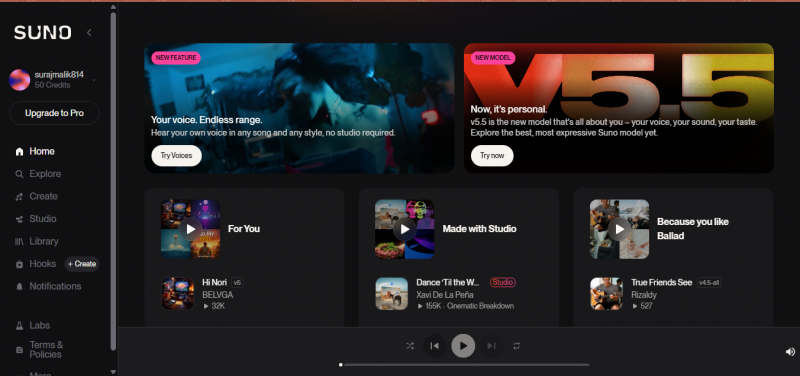
The strength is full-song generation in a single pass. A descriptive prompt produces vocals, instrumentation, and arrangement in 30 to 90 seconds. The interface is consumer-friendly enough for beginners while the Studio environment opens up serious editing for producers. Voice cloning launched in March 2026 and requires up to 4 minutes of source audio per AI Singer testing, with mixed user reports on perceived vocal accuracy.
Two caveats matter for commercial work. Suno settled with Warner Music Group in late 2025 but the Sony Music lawsuit remains active per Chartlex, with a fair-use ruling expected summer 2026. Free-tier output does not carry commercial rights, and upgrading later does not grant retroactive rights to free-tier tracks per Get AI Perks documentation. Paid tiers resolve both points but require ongoing subscription.
Udio
Instrumental Fidelity and Editing Control
PRICING $10 / mo Standard · UMG and Warner settled · stem editing and inpainting included
Udio sits at the audiophile end of the vocal-song spectrum. Output runs at 48 kHz stereo per Neuronad coverage, with what reviewers consistently describe as the strongest instrumental detail among consumer AI music tools. The platform competes head-to-head with Suno on quality and pulls ahead on instrumental complexity, particularly for jazz, classical, and ambient work per Get AI Perks comparison.
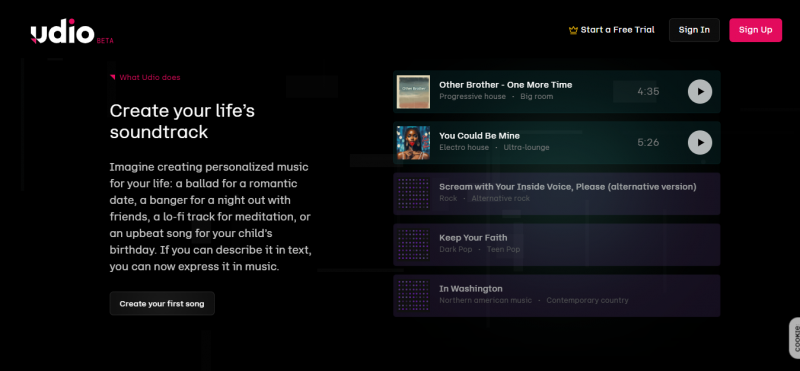
The differentiating tools are stem editing and inpainting. Inpainting lets a producer select a specific section of a track and regenerate just that portion, similar to how image editors handle generative fill. Stem downloads are available on paid tiers and matter for producers who need to drop vocals into a different mix or replace a bassline without losing the rest of the production.
The licensing trail cleared up in late 2025. Universal Music Group settled with Udio in October 2025 per Chartlex and Neuronad, and Warner Music Group followed shortly after. A jointly licensed UMG and Udio streaming platform is scheduled for launch in 2026. The platform operates with standard creator licenses on paid plans, which makes Udio the cleaner pick than Suno for projects that need a defensible commercial path.
ElevenLabs Music
Licensed Voice and Songcraft
PRICING $9.99 / mo Pro · fully licensed training data · API-ready for developers
ElevenLabs entered the AI music market with Eleven Music in August 2025, building on its established reputation for industry-leading text-to-speech and voice cloning. The platform produces full vocal songs from descriptive prompts and integrates with the broader ElevenLabs voice ecosystem, which appeals to content creators already using the company for narration, dubbing, or character voices.
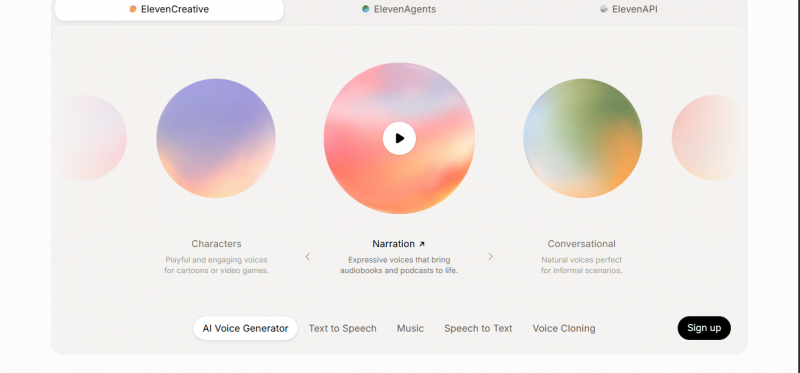
The licensing story is the clearest among vocal-capable tools. ElevenLabs trained on licensed data and has paid over $11 million to voice and music creators through its opt-in marketplace per Chartlex coverage. That model removes the litigation exposure Suno still carries on Sony and gives API customers a defensible path for production deployment.
The trade-off is breadth. ElevenLabs Music is newer than Suno and Udio and offers fewer specialized features like inpainting or DAW integration. Quality on pop, rock, and contemporary production has reached competitive levels per ModelHunter testing, but classical and complex jazz work still favors AIVA or Udio respectively. For creators inside the ElevenLabs ecosystem, the integration value adds up quickly.
AIVA
Cinematic Scoring With Full Copyright
PRICING €33 / mo Pro on annual · full copyright transfer · 30 sec to 10 min tracks
AIVA has been active since 2016, the longest-tenured tool in this comparison. Its Lyra foundation model produces tracks from 30 seconds to 10 minutes in length per Somio testing, with the workflow oriented toward cinematic and classical composition rather than pop songs with vocals. Output is instrumental only, which is the point for film, game, and ad-music work.
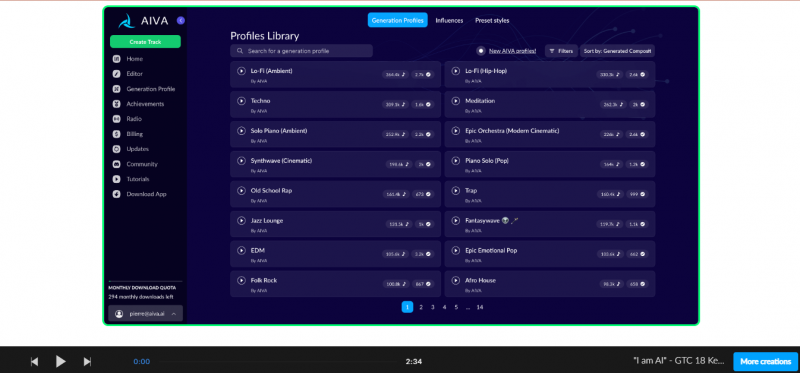
Two AIVA features matter for professional work. The platform offers full copyright transfer to the user on the Pro plan (€49 monthly or €33 monthly on annual billing per multiple May 2026 source pages). That ownership structure is rare among AI music tools and matters for film, game, and ad work where rights need to be settled cleanly before delivery. Influence-based composition lets users guide tracks by uploading reference works or specifying musical influences.
AIVA’s training corpus draws heavily on public domain classical music per Chartlex, which sidesteps the litigation exposure that Suno still carries. The trade-off is genre. Pop, rock, hip-hop, and vocal-heavy contemporary work are not AIVA’s focus. For film scoring, game music, ad beds requiring orchestral depth, and educational content, AIVA’s specialization is worth the higher subscription cost.
Stable Audio
Sound Design and Licensed Training
PRICING $29.99 / mo Studio · 100% licensed training data · Max tier at $89.99 / mo
Stable Audio (developed by Stability AI) takes a different position than the song-generation tools. The 2.5 model focuses on instrumental beds, sound design elements, and ambient texture rather than full pop songs. Training data is fully licensed per Chartlex and The AI Rankings coverage, with content from AudioSparx and other partners forming the corpus.
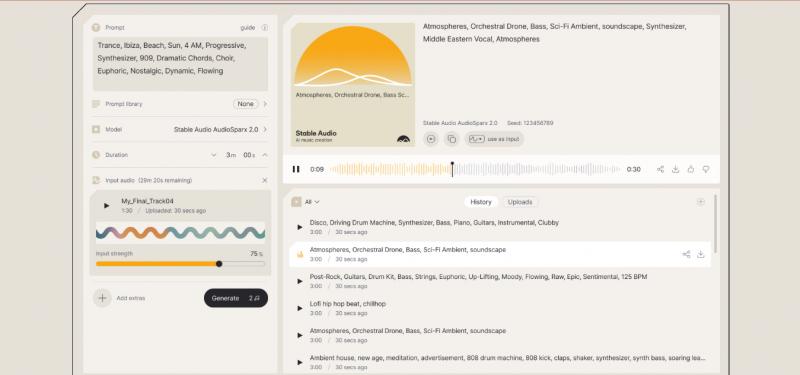
The Studio tier at $29.99 monthly per ToolWorthy unlocks the full feature set including longer generations and commercial use rights. The Max tier at $89.99 monthly adds enterprise-grade output and higher monthly limits, which suits production houses generating sound elements at scale. The platform reads more like a music production tool than a consumer song-maker, which matches its audience of game developers, film sound designers, and ad-tech producers.
The licensing clarity is the headline draw. Where Suno’s training data remains in active litigation, Stable Audio’s licensed corpus removes that risk for commercial customers. The trade-off is that vocal songs are not the focus, and anyone wanting a finished pop track with lyrics will hit the ceiling quickly on Stable Audio compared with Suno or Udio.
Beatoven.ai
Mood-Based Backing for Video
PRICING $2.50 / mo · perpetual license on downloads · YouTube content ID safe
Beatoven.ai targets content creators directly. The workflow is mood and emotion driven: pick a video genre, set the emotional arc, and the tool generates background music matching that emotional shape per PostEverywhere coverage. Pricing starts at $2.50 monthly, the cheapest paid option in this comparison with commercial rights included.
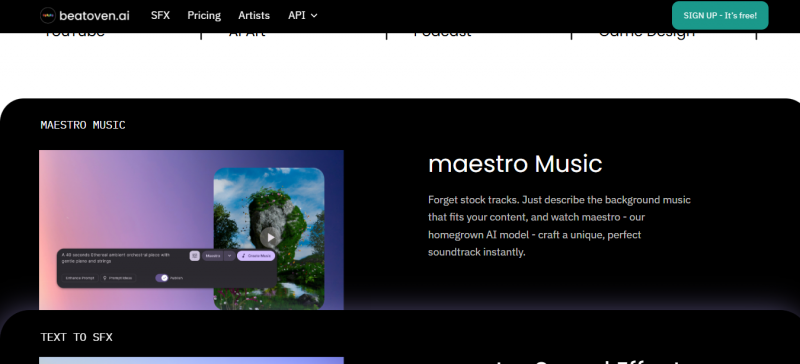
The licensing structure is unusually clean. Every download carries a perpetual royalty-free license per Cyberlink and PostEverywhere coverage, which means a track purchased today remains usable indefinitely on the original creator’s content. That removes the ongoing-subscription cliff that catches creators on other platforms when subscriptions lapse and tracks have to be replaced retroactively.
The trade-off matches the price. Beatoven.ai is not built for vocal songs, polished pop production, or cinematic depth. Generated tracks read as competent background music rather than standout compositions, which is exactly the point for creators who need music underneath voiceover or B-roll without distracting from the primary content.
Soundraw
Slider Control for Creators
PRICING $4.99 / mo Creator · YouTube channel safelisting · slider-based section control
Soundraw sits between Beatoven’s automation and Stable Audio’s production depth. The interface gives users slider control over instrumentals: energy level per section, tempo, key, mood, and length all adjustable after generation. That control closes the gap between AI generation and traditional production where creators need a chorus more energetic than a verse per ToolWorthy testing.
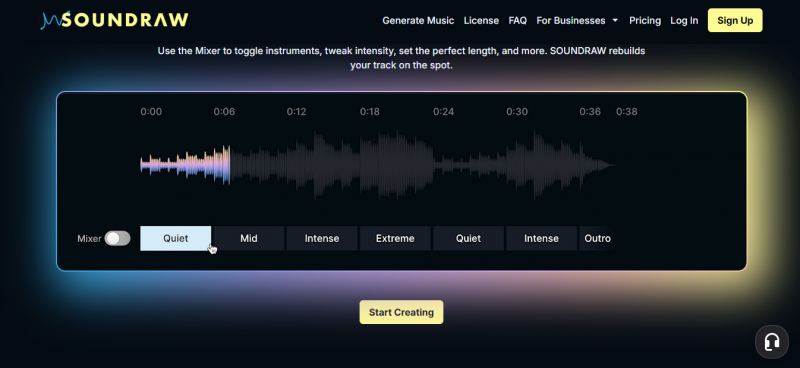
The Creator plan at $4.99 monthly per PostEverywhere includes commercial use rights and YouTube channel safelisting, which protects against content ID claims on monetized uploads. That last feature matters for creators publishing weekly or daily to monetized channels where copyright strikes carry real consequences for revenue and reach.
Vocal song generation is not in scope. Soundraw produces instrumental beds, background music, and creator-focused stems but does not generate vocals at all. For creators whose content style requires music underneath rather than music as the focus, the combination of control, safelisting, and modest pricing is hard to beat.
Mubert
Real-Time Ambient and Electronic
PRICING $14 / mo · real-time generation · 25 free tracks per month
Mubert specializes in real-time AI music generation, particularly for ambient, electronic, and lo-fi backgrounds per ToolWorthy coverage. The platform offers 25 free tracks per month and entry paid pricing around $14 monthly, with commercial rights available on paid tiers.
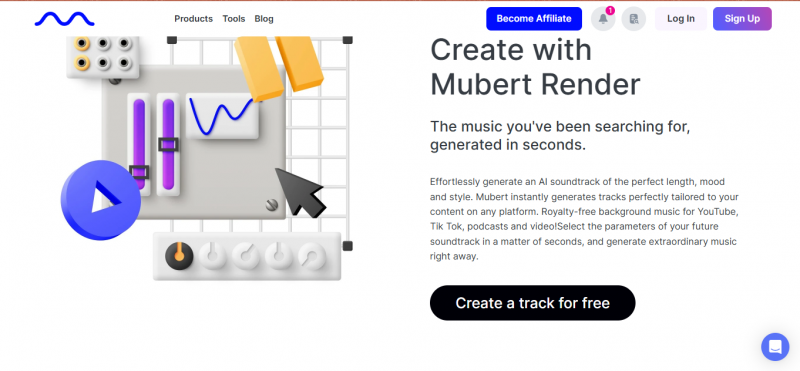
The standout use case is podcast and streaming backgrounds. Mubert’s output leans into ambient electronic textures, lo-fi study music, and instrumental loops that work well underneath voice content. The real-time generation pipeline produces tracks that can stream alongside live audio without the copyright concerns associated with using commercial music underneath live or recorded voice.
Mubert is not a tool for vocal songs or cinematic scoring. The output sits firmly in the background-music niche, and creators looking for foreground music or production-grade depth will find it limiting. For the “need calm music behind a podcast” use case framed by ToolWorthy coverage, the workflow is among the fastest options on this list.
Matching Tools to Production Needs
The right tool follows from the project’s central constraint. Creators making vocal songs at scale, especially in pop, rock, or contemporary genres, find Suno’s combination of speed and quality hard to beat despite the unresolved Sony litigation. Producers needing studio-grade instrumental detail, stem editing, and a cleaner licensing trail are better served by Udio after the UMG and Warner settlements. ElevenLabs Music fits creators who already work in the ElevenLabs voice ecosystem and want a unified pipeline for narration and song generation under one bill.
For specialized work, the picks diverge sharply. Film composers, game music designers, and ad producers needing cinematic depth and ownership clarity belong with AIVA. Sound designers and production houses working on game audio, film sound, or ad-tech needs get the most from Stable Audio’s licensed corpus and longer-form output. Content creators producing video backgrounds, podcasts, or social media work find the strongest value in Beatoven.ai (cheapest, cleanest license), Soundraw (slider control with channel safelisting), or Mubert (ambient and electronic specialist), depending on which control surface matters most for the project.
Copyright Reality Check Before Subscribing
AI music sits in active legal territory and the answer to “can the output be sold or streamed” depends entirely on the tool’s training data and licensing terms. Tools trained on licensed corpora (Stable Audio, AIVA, ElevenLabs Music, Beatoven.ai, Soundraw, Mubert) carry the lowest commercial risk per The AI Rankings and Chartlex coverage. Tools that settled with major labels (Udio with UMG and Warner) have cleared specific litigation but operate under settlement-defined constraints. Suno remains in active litigation with Sony Music, with a ruling expected in summer 2026.
Three practical checks reduce risk on commercial work. First, verify the specific paid tier includes commercial-use rights, since free tiers usually do not (Get AI Perks notes that upgrading later does not grant retroactive rights to free-tier output). Second, read the tool’s license terms before publishing on YouTube, Spotify, or Apple Music, since each platform has different content ID and detection systems. Third, for sync licensing, label deals, or large-scale distribution, prefer tools with clean training-data provenance (Stable Audio, AIVA, ElevenLabs Music) over tools still working through litigation.
Closing Read
AI music generation in 2026 covers a meaningfully broader range of use cases than even a year earlier. Vocal-song generation reached production quality on Suno and Udio. Instrumental and cinematic work matured through AIVA and Stable Audio. Creator-focused tools like Beatoven.ai, Soundraw, and Mubert closed the gap between AI output and content workflows that need music underneath rather than as the focus. The right pick depends less on which tool sounds best in a vacuum and more on which combination of quality, control, pricing, and licensing fits the project at hand. Picking that combination consciously, rather than defaulting to the most-marketed tool, is the difference between a clean release and a takedown notice.
Post Comment
Share your thoughts about this article.
Be the first to post a comment!