Google and ChatGPT stopped competing for the same job roughly two years ago. This document sets out what the 2026 data shows, where each platform wins, what each costs, and how to choose between them by task.
Summary
Neither platform is categorically better. They solve different problems. Google is the stronger tool for locating information that already exists; ChatGPT is the stronger tool for producing information that does not yet exist.
Use Google when the answer already lives on a specific page and you need to find it. Use ChatGPT when the answer has to be assembled, explained or written for you.
The two platforms differ structurally, not just in quality:
| ATTRIBUTE | CHATGPT | |
|---|---|---|
| What it is | Search engine with an AI layer | Conversational AI assistant |
| Core mechanic | Points you to sources | Generates an answer directly |
| Output | Ranked links plus AI summary | A written response to your prompt |
| Unit of work | The query | The conversation |
| Revenue model | Advertising | Subscriptions, plus ads on free tiers |
| What you do | The reading | The checking |
Three findings from the 2026 data drive everything that follows: Google's lead remains very large but is eroding at the informational edge, ChatGPT wins on depth of engagement rather than volume, and the AI assistant market is no longer a single-vendor race.
Market Share and Usage Data
Market Share Estimates
Published estimates of Google's share of global queries range from 77% to 90%. ChatGPT's range is 9% to 18%. The spread reflects methodology rather than measurement error: analysts disagree about whether an AI prompt counts as a query, and that single decision moves Google's share by more than ten percentage points.
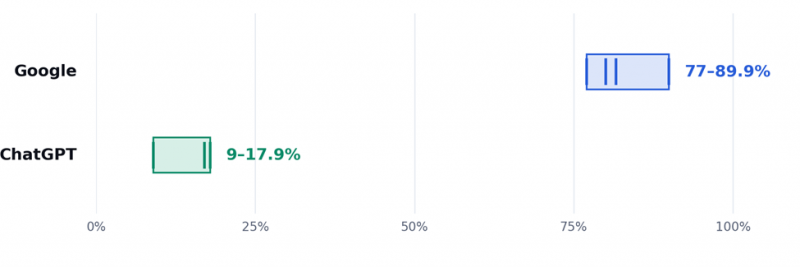
Figure 1. Share of global queries. Bars show the full range across five 2026 estimates; ticks mark individual sources. Sources: PageTraffic (Jan 2026), Sedestral (Feb 2026), First Page Sage (Q2 2026), StatCounter and Similarweb analyses (Mar–May 2026).
BEFORE QUOTING ANY FIGURE
Every market share number depends on what the analyst counts as a query. Treat any single statistic as one methodology's answer rather than the truth, and state the range when the figure matters.
Session Duration
Session length is the clearest single signal that these are different products. A typical Google session runs about five minutes; a typical ChatGPT session runs about fourteen. People look things up on Google. They work inside ChatGPT.
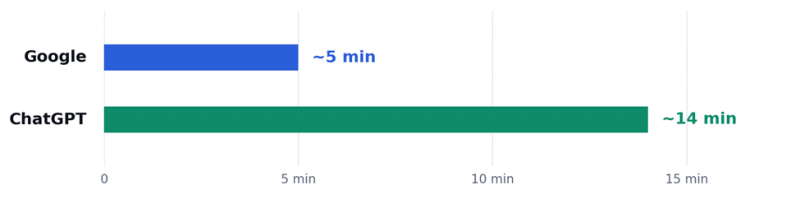
Figure 2. Typical session duration. Source: PageTraffic session-duration analysis, January 2026.
AI Assistant Traffic Share
Within the AI assistant category, ChatGPT's dominance is narrowing quickly. Two independent estimates covering the same twelve-month window show its share of AI chatbot web traffic falling from roughly 87% to between 64.5% and 68%. Gemini quadrupled its share over the same period, driven largely by distribution rather than by benchmark wins.
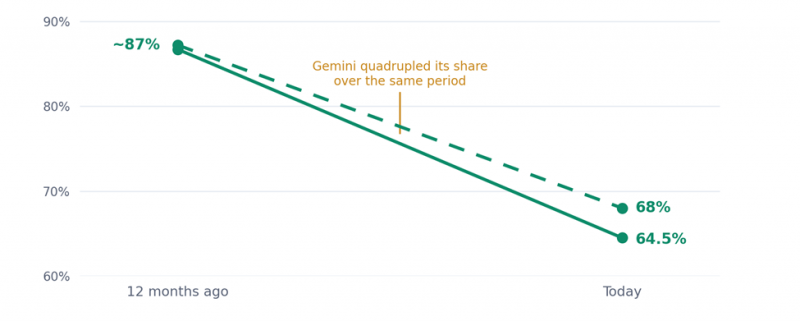
Figure 3. Share of global AI chatbot web traffic. Sources: Similarweb via ALM Corp (Jan 2025 to Jan 2026); QuickSEO and Similarweb (May 2026).
ChatGPT remains the category leader by a wide margin. It is no longer a monopoly.
Key Usage Figures
| FIGURE | PLATFORM | DETAIL |
|---|---|---|
| 1 billion | ChatGPT | Monthly active users, reached May 2026 — the fastest application in history to that mark |
| 750 million | Gemini | Monthly active users, driven by integration into Search, Android and Workspace |
| 4.9 billion | Google Search | Monthly users — still an order of magnitude ahead of any assistant |
| 2.5 billion | ChatGPT | Prompts processed per day |
Model Release Timeline: February to July 2026
Model names change faster than most users can track. What the release timeline shows is a strategic split: OpenAI shipped a flagship model, Google shipped efficiency models, and Google's own flagship window passed without a release.
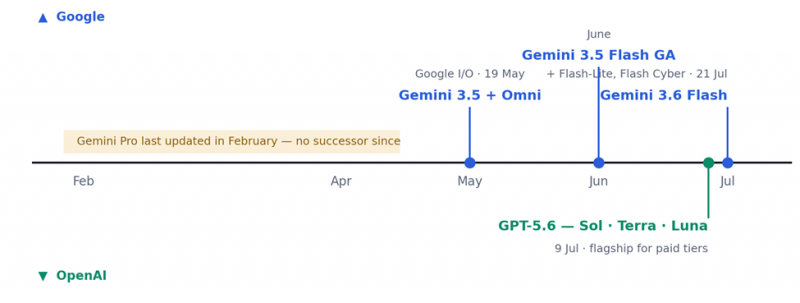
Figure 4. Flagship model releases, February to July 2026. Google above the line, OpenAI below. Sources: Google I/O 2026 announcements, Google Cloud blog (May 2026), TechCrunch and Axios coverage of the 21 July release, OpenAI GPT-5.6 documentation.
Practical translation for a non-technical buyer: Google is optimising for cost and large-scale agent workloads, while OpenAI is defending the capability frontier. On everyday questions the gap is now small enough that workflow fit matters more than benchmark scores.
Platform Strengths
Where Google Wins
• Time-sensitive and local queries. Flight status, opening hours, live scores, cheapest option nearby. The index refreshes continuously and the local dataset is unmatched.
• Transactional queries. When money is about to move, you want listings, reviews and a link to a seller. Google's share here is stable, and growing on shopping and local.
• Verification. You get sources you can open. For legal, medical or financial questions, five reputable pages beat one confident paragraph.
• Distribution. Gemini is already inside Search, Android, Gmail, Docs and Photos. No new application, no new subscription. This advantage is easy to underrate.
Where ChatGPT Wins
• Anything you have to write. Emails, reports, summaries, difficult messages. Google points you at a template; ChatGPT produces a draft in your tone.
• Multi-step reasoning. Comparing several options against your specific constraints is a synthesis task. Search results cannot do it for you.
• Iteration. Refining a search means starting over. Refining a conversation means asking for it shorter, or for a non-technical reader. Each turn costs less than the last.
• Questions that cannot be keyworded. Interpersonal, ambiguous or embarrassing questions have no good search query.
Task Comparison Matrix
| TASK | BETTER TOOL | REASON |
|---|---|---|
| Breaking news | Live indexing beats a training cutoff | |
| Local search and navigation | Maps, hours, reviews, contact details | |
| Buying something | Prices, listings, side-by-side comparison | |
| A fact you will cite | You can open and check the source | |
| Drafting text | ChatGPT | Produces the finished artifact, not advice about it |
| Explaining a concept | ChatGPT | Adapts depth to your level on request |
| Debugging code | ChatGPT | Iterative exchange on your actual error |
| Summarising a long document | ChatGPT | Handles the whole input in one pass |
| Brainstorming | ChatGPT | Generates and reshapes options quickly |
| Learning a broad new topic | Both | ChatGPT to orient, Google to verify |
Rule of thumb. If you would be uncomfortable being wrong, finish in Google. If you would be annoyed doing it by hand, start in ChatGPT.
Pricing Comparison
Google's free tier is more generous, because advertising subsidises it. ChatGPT's paid tiers buy more depth per conversation. Below roughly an hour of use per week, neither is worth paying for.
ChatGPT Plans
| TIER | PRICE | WHAT YOU GET |
|---|---|---|
| Free | $0 | Limited messages on a previous-generation model. Now shows ads in the US. |
| Go | $8 / month | More messages, uploads and memory. Does not unlock the flagship model. May include ads. |
| Plus | $20 / month | The tier most professionals want: flagship access, deep research, coding agent, video. |
| Pro | $100 / month | Roughly five times the usage limits of Plus. |
| Pro | $200 / month | Adds unlimited video generation and the heavier agent features. |
| Business | ~$25–30 / seat | Admin controls, shared workspace, model governance. |
Google Plans
| TIER | WHAT YOU GET |
|---|---|
| Free | Standard chat and basic multimodal use, plus AI summaries inside Search at no cost. |
| AI Pro | Strong general-purpose use across Gemini and Workspace. |
| AI Ultra | Top reasoning mode, deep research, video generation, and a very large context window for long documents. |
Google has not published tier pricing in a form comparable to OpenAI's, so prices are omitted here rather than estimated. Confirm current rates directly with the provider.
WHAT THE PRICING PAGE DOES NOT TELL YOU
On ChatGPT, the plan you pay for does not guarantee which model answers you. Automatic routing sends hard prompts to the flagship and routine prompts to something lighter, and by default the interface does not show you which. The price is fixed; the value per query is not.
Limitations and Failure Modes
ChatGPT
Confident wrongness. It will produce a fluent, well-structured and entirely plausible answer that is simply incorrect, and it signals uncertainty far less clearly than it should. It is weakest on recent events and on niche local detail.
Mitigation. Ask for sources, then open them. If it cannot name one, treat the claim as unverified.
Answers buried under advertising and search-optimised filler, plus AI summaries that have had their own accuracy failures. The shift to summarised answers is also draining traffic from the sites that produced the underlying information.
Mitigation. Scroll past the summary for anything that matters. The primary source is still below it.
Both failure modes point the same direction: verify anything consequential.
Selection Criteria
Three questions resolve most cases in about ten seconds.
| QUESTION | IF YES / FIRST OPTION | IF NO / SECOND OPTION |
|---|---|---|
| Do I need a source, or an answer? | Source → Google | Answer → ChatGPT |
| Will I need to refine this? | One shot → Google | Back and forth → ChatGPT |
| Is the information newer than a week? | Fresh → Google | Stable → Either |
A fourth question governs the subscription decision: where does your work already live? If your day runs through Gmail, Docs and Sheets, Google's assistant has a structural advantage that no benchmark score will overcome. If you work across many tools and mostly need writing and reasoning, ChatGPT is the cleaner fit.
Verdict
Scored by category, the comparison splits evenly. Google takes the retrieval categories; ChatGPT takes the production categories.
| CATEGORY | WINNER | MARGIN |
|---|---|---|
| Real-time and breaking information | Decisive | |
| Local search and navigation | Decisive | |
| Shopping and transactional queries | Decisive | |
| Source verification and citation | Clear | |
| Free tier value | Clear | |
| Ecosystem integration | Clear | |
| Reach and scale | Decisive | |
| Long-form writing and drafting | ChatGPT | Decisive |
| Multi-step reasoning and synthesis | ChatGPT | Clear |
| Coding assistance | ChatGPT | Narrow |
| Document summarisation | ChatGPT | Clear |
| Conversational iteration | ChatGPT | Decisive |
| Unstructured or hard-to-phrase questions | ChatGPT | Decisive |
| Depth of engagement per session | ChatGPT | Decisive |
Final tally: Google 7, ChatGPT 7. A category count is not a score. Weight these by how you actually spend your time — someone who researches and buys all day should read this as a Google win, and someone who writes and codes all day should read it as a ChatGPT win.
Verdict by User Type
• Most people, most of the time: Do not choose. Use Google to retrieve and ChatGPT to produce. The cost of running both is zero at the free tier.
• You will pay for exactly one subscription: Choose by ecosystem, not by benchmarks. Heavy Gmail, Docs and Android users get more marginal value from Google. People who write, code or work across many tools get more from ChatGPT Plus.
• If accuracy is non-negotiable: Google, and open the sources. Neither tool should be trusted unverified on legal, medical or financial questions.
• If you are optimising for time saved: ChatGPT. The session data shows where the deep work happens, and drafting is where the hours actually go.
Overall
Verdict: Google for retrieval. ChatGPT for production. There is no single winner, and the question itself is the mistake.
Google will not be replaced. It has lost ground on informational queries and will keep losing some, but its grip on local, commercial and navigational search is firm and in places growing. ChatGPT will not be displaced from writing and reasoning work by a search box. The realistic outcome is a split market, not a handover.
The people getting the most out of these tools in 2026 are not the ones who picked a winner. They are the ones who stopped asking which is best and started asking which is right for the task in front of them.
Post Comment
Share your thoughts about this article.
Be the first to post a comment!