Table of Content
Comparison articles freeze two products at a moment and score them. That method fails badly here, because the most useful thing about this matchup is its direction of travel. One app was a curiosity fifteen months ago and is now a default. The other raised its price while that happened. This is the chronology, and the scorecard comes at the end where it belongs.
Dates and features verified July 2026 against reporting from TechCrunch, Social Media Today and platform trackers. CapCut does not publish a public price list and sets rates in-app by region, device and promotion, so its figures come from current third-party reporting.
January 2025: the accident that started it
On 19 January 2025 every ByteDance app disappeared from the Google Play Store and the App Store in the United States. CapCut went with them. The outage lasted roughly 48 hours before an executive order delayed enforcement and service returned.
Forty-eight hours is not long enough to break a habit. It was long enough to reveal one. Millions of creators discovered that their entire editing workflow sat inside an app they did not control, subject to a regulatory dispute they had no part in.
Adam Mosseri announced on Threads the same day that Instagram would ship a standalone editing app. The timing was not subtle, and Meta did not pretend otherwise.
19 JAN 2025 CapCut vanishes from US app stores. Meta announces Edits within hours.
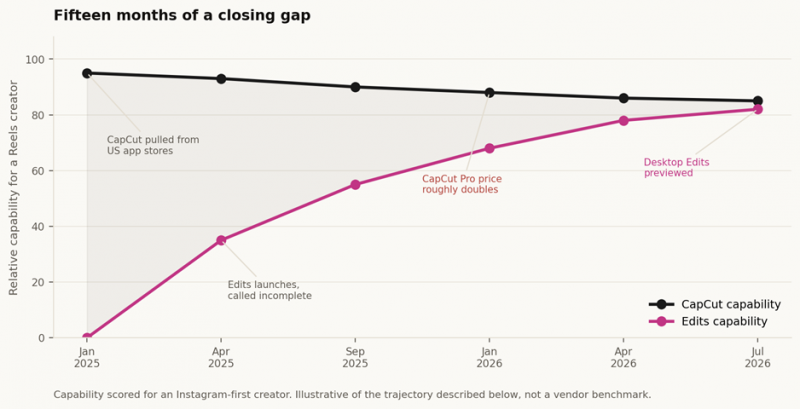
Figure 1. The trajectory this article traces, from the January 2025 outage to July 2026.
April 2025: an app that could not do much
Edits shipped on 22 April 2025 for iOS and Android after a two-month delay. It gathered more than five million users in four days, which says more about the appetite for a CapCut alternative than about the app itself.
Meta described the first version as explicitly incomplete, which was accurate. It had a timeline, clean exports with no watermark, and direct publishing to Instagram. It did not have keyframes, beat markers, a teleprompter, or anything resembling CapCut trend template library.
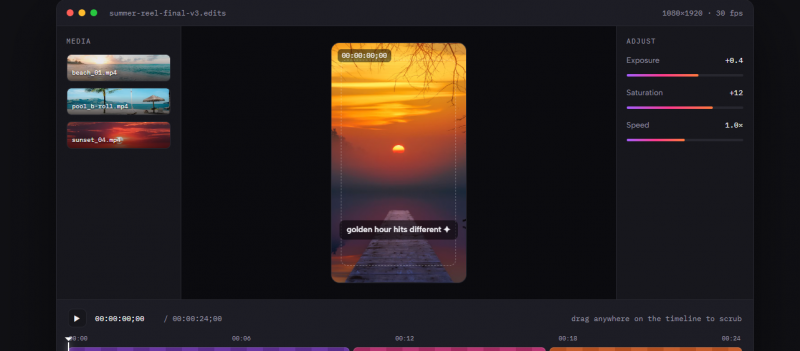
Reviewers at the time reached a near-unanimous verdict: promising for beginners, insufficient for anyone serious. That verdict was correct in April 2025 and is the reason so many articles published then are now misleading.
22 APR 2025 Edits launches. Five million users in four days. Feature set thin.
| AT LAUNCH, EDITS HAD | AT LAUNCH, EDITS LACKED |
|---|---|
| Multi-track timeline | Keyframes and beat markers |
| Clean export, no watermark | Teleprompter |
| Direct Reels publishing | AI object segmentation |
| Basic camera and green screen | A meaningful template library |
| Project management | Freeze frame and reverse play |
Mid 2025: the feature drops begin
What happened next surprised most observers. Meta added more than 130 features to Edits over twelve months, at a cadence closer to weekly than quarterly.
June 2025 brought the teleprompter, which displays a scrolling script positioned directly below the front-facing camera with adjustable speed and text size. Standalone teleprompter apps commonly sell for around $59.99. Restyle followed, offering more than fifty AI presets for changing the look of a clip.
Then came the pieces that make an editor credible rather than convenient: AI object segmentation for masking subjects without manual rotoscoping, keyframes, beat markers, freeze frame, reverse play, lip sync and cut silences.
JUN 2025 Teleprompter and Restyle ship. Edits stops being a toy.
One addition deserves separate attention. Safe zone overlays show creators exactly where the Instagram interface will cover their text. That is information only Meta possesses, and no third-party editor can replicate it at any price. It is a small feature that demonstrates the structural advantage of owning the destination.
Late 2025: CapCut changes the price
While Edits was closing the feature gap from below, CapCut moved its own price ceiling upward. Between late 2025 and early 2026 the company restructured its subscriptions without a formal public announcement.
The old Pro tier at roughly $9.99 a month was renamed Standard. A new Pro tier appeared above it at approximately $19.99 a month, or $179.99 a year. On annual billing that is close to a 130 percent increase, and existing annual subscribers were reported to roll onto the new rate around February 2026.
FEB 2026 Existing CapCut annual subscribers move to the higher rate.
| WHAT CHANGED | BEFORE | AFTER |
|---|---|---|
| Top tier price | About $9.99/mo | About $19.99/mo or $179.99/yr |
| Tier structure | Single Pro tier | Standard, then Pro above it |
| 1080p and higher export | Widely available | Moved behind the paywall |
| Free cloud storage | 1GB included | Discontinued |
| Pro cloud storage | 100GB | 1TB |
None of this made CapCut a worse editor. Its template library remained the best in the category and still is. What changed was the argument. A $9.99 tool competing against a limited free app is an easy purchase. A $19.99 tool competing against a capable free app has to make a case.
2026: the year the question got hard
By early 2026 the feature drops had accumulated into something that no longer read as a lightweight alternative. Edits added imported audio saving, automatic loudness matching, more than two hundred sound effects, caption transcript search and replace, word highlighting, saved fonts and text styles, and eleven new effects.
It also added the workflow pieces that matter to people publishing regularly: drafts shared via direct message for approval, collaborative stickies, side-by-side Reels engagement comparison, and detailed export progress.
APR 2026 Edits passes 130 features added in twelve months. Still free.
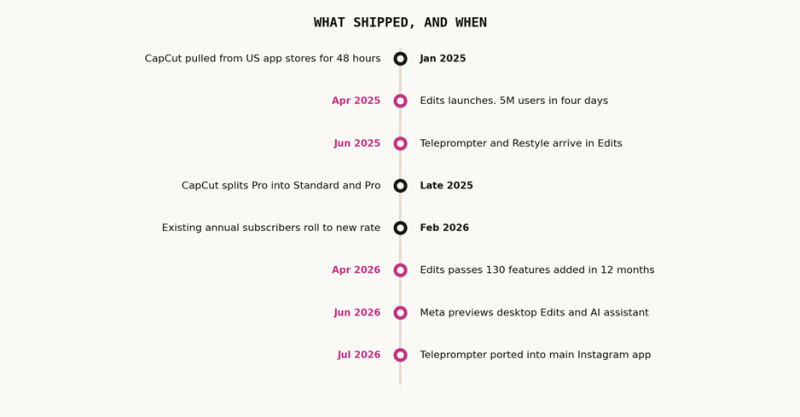
Figure 2. The eight events that moved the answer, January 2025 to July 2026.
The clearest signal came from Instagram itself. In 2026 the teleprompter was ported out of Edits and into the main Instagram app, appearing in the Reels creation menu alongside audio, effects and green screen. Meta does not move features into its flagship app unless they have proven themselves.
June 2026: Meta comes for the last advantage
Through all of this, CapCut held one advantage Edits could not answer. CapCut runs on Windows and Mac with project sync across devices. Edits was phone only, and Meta had signalled nothing about changing that.
On 11 June 2026, at an invite-only creator event in Los Angeles, Meta previewed a desktop version of Edits alongside an AI assistant that analyses a creator Instagram performance data to suggest video ideas and trending audio.
11 JUN 2026 Meta previews desktop Edits and an AI assistant. Described as coming soon.
The wording matters and deserves care. Meta described the desktop version as coming soon rather than available. The AI assistant entered testing with a small group of creators at that event. A Beta tab and expanded audience insights launched to everyone the same day, but desktop Edits was a preview, not a release.
Anyone choosing an editor today should treat desktop editing as a CapCut advantage that still holds. It is simply an advantage with a visible expiry date, and that changes how much weight it deserves in a decision you will live with for a year.
| CAPABILITY | STATUS IN JULY 2026 | PRACTICAL READ |
|---|---|---|
| Desktop Edits | Previewed, not shipped | CapCut still wins today |
| Edits AI assistant | Testing with small group | Not yet a buying factor |
| Beta tab | Shipped to all users | Early access to experiments |
| Expanded audience insights | Shipped to all users | Widens the analytics lead |
| Edits paid tier | Does not exist | Meta has hinted at future AI paywalls |
The scorecard
Six criteria, weighted for an Instagram-first creator, scored out of one hundred. The weighting is stated openly because it is doing most of the work.
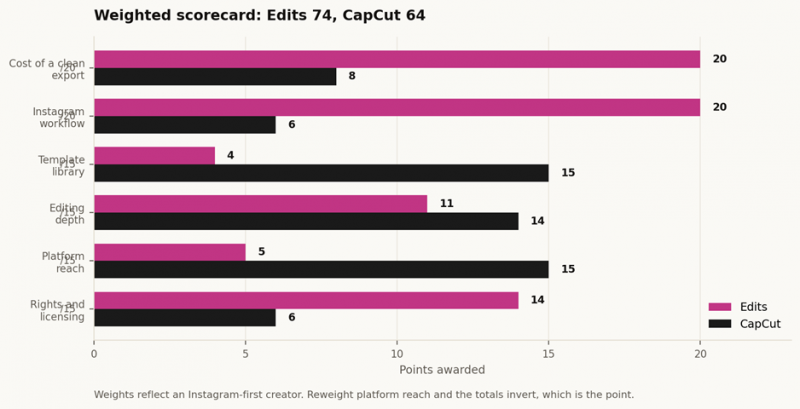
Figure 3. Weighted scoring across six criteria. Edits 74, CapCut 64.
| CRITERION | WEIGHT | EDITS | CAPCUT |
|---|---|---|---|
| Cost of a clean export | 20 | 20 | 8 |
| Instagram workflow | 20 | 20 | 6 |
| Template library | 15 | 4 | 15 |
| Editing depth | 15 | 11 | 14 |
| Platform reach | 15 | 5 | 15 |
| Rights and licensing | 15 | 14 | 6 |
| Total | 100 | 74 | 64 |
Cost of a clean export, 20 to 8. Edits exports 4K HDR with no watermark on every project at no cost, and has no paid tier at all. CapCut free tier is usable but locks 4K behind Pro and puts a watermark on some premium templates. Reaching feature parity costs $19.99 a month, or roughly $2 to $3 more through app stores.
Instagram workflow, 20 to 6. Direct publishing to Reels, built-in analytics ranking your ten most recent Reels by views, side-by-side engagement comparison, safe zone overlays and an inspiration feed. CapCut scores for exporting cleanly to Instagram and nothing more.
Template library, 4 to 15. CapCut takes this outright. Its library tracks viral formats continuously and remains the single strongest reason to keep the app installed. Edits has templates and lets users publish their own, but the gap is not close.
Editing depth, 11 to 14. Closer than most people expect. Edits now has keyframes, beat markers, AI segmentation, lip sync and cut silences. CapCut retains the edge on audio control, with advanced beat detection and waveform visualisation, plus a deeper effects library.
Platform reach, 5 to 15. CapCut publishes to TikTok, Instagram, YouTube and WhatsApp and runs on desktop today. Edits is mobile only and built around one destination. This is CapCut most durable win, though the June preview puts a clock on part of it.
Rights and licensing, 14 to 6. CapCut terms of service, updated 15 April 2026, grant a perpetual, worldwide, sub-licensable licence over uploaded content, applying to free and paid users alike. Its materials licence also grants no rights to built-in music, making CapCut stock audio the most common licensing mistake in commercial work.
What the score does not settle
Seventy-four to sixty-four is a real result but a fragile one, and pretending otherwise would be dishonest. Two of the six weights are carrying the outcome.
Move platform reach from 15 to 30 for someone publishing to TikTok, Instagram and YouTube, and reduce Instagram workflow to 5 because they are not Instagram-first, and CapCut wins comfortably. The scorecard is not a claim about which app is better in the abstract. It is a claim about which app is better for a creator whose video is going to Reels.
The same applies in reverse. An Instagram-first creator who never touches a desktop and never cross-posts would reasonably weight platform reach at five, which pushes the gap wider than ten points.
| IF YOU ARE | REWEIGHT | LIKELY WINNER |
|---|---|---|
| Instagram-first creator | As scored above | Edits, comfortably |
| Multi-platform publisher | Platform reach to 30 | CapCut |
| Desktop editor | Platform reach to 25 | CapCut, until desktop Edits ships |
| Template-driven creator | Template library to 30 | CapCut |
| Client and brand work | Rights and licensing to 25 | Edits |
| Budget-constrained | Cost to 35 | Edits, decisively |
The finding worth carrying away is not the total. It is that a score of 74 to 64 was unthinkable fifteen months ago and is defensible now, achieved by one app shipping 130 features while the other doubled its price. Neither of those movements has obviously stopped.
If desktop Edits ships as previewed and the AI assistant reaches general availability, CapCut most durable advantage narrows to its template library alone. That would still be a real advantage. It would just be a much narrower one than the position it held in January 2025, when it was simply the app everybody used.
Fifteen months ago the honest answer was CapCut, without much hesitation. Today it is Edits for Instagram work and CapCut for everything else, and the direction of travel suggests that sentence will need rewriting again before long.
Verdict
Edits wins on points, 74 to 64, and it is the correct default for anyone whose video is going to Instagram. CapCut remains the better tool for template-driven content, desktop editing and multi-platform publishing, and those are real needs rather than consolation categories. Install both. Neither costs anything on its free tier, and the combination covers more ground than either alone.
Why Edits takes it. Two criteria decide the margin, and both are structural rather than incidental. Cost of a clean export runs 20 to 8 because Edits has no paid tier and exports 4K HDR with no watermark, while CapCut charges $19.99 a month to match that. Instagram workflow runs 20 to 6 because direct publishing, built-in analytics and safe zone overlays come from Meta owning the destination, and no third-party editor can replicate them at any price.
Why CapCut still deserves the install. Its template library is the strongest single asset either app holds, and Edits has not come close to matching it. Add desktop editing, advanced beat detection and genuine cross-platform reach, and CapCut wins three of six criteria outright. A creator who works from a laptop or publishes to TikTok is not choosing the loser by picking it.
The one caveat that overrides the score. If you edit footage a client owns, read CapCut terms before uploading. The April 2026 terms grant a perpetual, worldwide, sub-licensable licence over uploaded content on free and paid tiers alike, and the built-in music carries no commercial rights at all. That is a legal question rather than a feature comparison, and it does not appear anywhere in a scorecard.
The finding worth carrying away is not the total. It is that a score of 74 to 64 was unthinkable fifteen months ago and is defensible now, achieved by one app shipping 130 features while the other doubled its price. Neither of those movements has obviously stopped.
If desktop Edits ships as previewed and the AI assistant reaches general availability, CapCut most durable advantage narrows to its template library alone. That would still be a real advantage. It would just be a much narrower one than the position it held in January 2025, when it was simply the app everybody used.
Fifteen months ago the honest answer was CapCut, without much hesitation. Today it is Edits for Instagram work and CapCut for everything else, and the direction of travel suggests that sentence will need rewriting again before long.
Post Comment
Share your thoughts about this article.
Be the first to post a comment!