Old posts don't just sit there quietly. They rank, they rot, or they drag your whole site down. This guide starts with the warning signs, defines what an audit really is, then walks the full workflow: preparation, the 7 steps, the decision framework, and how to measure the results.
5 Signs You Need a Content Audit
Before any definitions, check whether this even applies to you. If two or more of these sound familiar, your site is overdue:
• Traffic is flat or leaking even though you keep publishing. New posts add visits; decaying old posts quietly subtract them.
• You can't say what your bottom 30% of pages do. On most aging sites, the bottom third of pages together earn under 1% of traffic and serve no purpose.
• Two of your own posts fight for the same keyword. This is cannibalization: both pages rank worse than one merged page would.
• Your oldest guides mention dead tools, old prices, or last year's screenshots. Readers notice before you do, and they leave.
• You publish faster than you maintain. If nothing has ever been updated, deleted, or merged, maintenance debt is compounding.
The 60-second self-test Sort your pages by organic traffic over the last 12 months. If the bottom 30% of pages together earn less than 1% of your traffic and hold no backlinks or conversions, keep reading. This guide is for you. |
What Is a Content Audit?

A content audit is a systematic review of all the content on a website to evaluate how each page performs and decide what to keep, update, consolidate, or delete. You list every URL, attach real data to it (traffic, rankings, backlinks, conversions), and give every page a job or show it the door.
Key takeaways 1) A content audit is a data-backed review of every page on your site. 2) Every page gets one of four actions: keep, update, consolidate, or delete. 3) The inventory (the list) is step one; the audit is the judgment. 4) Refreshing old content is usually faster than writing new content and often lifts rankings sooner. 5) Run a full audit once or twice a year. |
If a content pillar strategy decides what you create, a content audit decides what you fix. The two are partners: pillars point forward, audits look back. Skipping audits while publishing weekly is like adding rooms to a house and never checking the foundation.
Why it pays off
Old content is your fastest win Updating a page already ranking on page two usually moves faster than publishing new. The page has age, links, and indexed history working for it. |
Dead weight drags everything Thin, outdated, or duplicate pages waste crawl attention and dilute topical focus. Pruning concentrates authority on pages that deserve it. |
It catches quiet decay Rankings rarely collapse; they leak. A 30% traffic loss spread over a year triggers no alarm, but shows instantly in a spreadsheet sorted by change. |
It exposes cannibalization When two pages target the same keyword, both rank worse. Audits surface the overlaps so you can merge them into one stronger page. |
CLEARING THE CONFUSION
Audit vs Inventory: The Difference
These two terms get swapped constantly, but they're different stages of the same job. Short version: the inventory tells you what you have; the audit tells you what to do about it.
| Aspect | Content inventory | Content audit |
|---|---|---|
| What it is | The list: every URL with basic details (title, type, date, author) | The judgment: evaluating each item against data and goals |
| Output | A spreadsheet of what exists | An action per page: keep, update, consolidate, delete |
| Skill needed | Mostly mechanical (crawler + export) | Analytical (reading data, making calls) |
| Relationship | Step one of the audit | Everything after step one |
Teams that stop at the inventory end up with a very organized list of problems and zero fixes.
Before You Start: Goal, Type, Tools, Metrics
Pick one goal
An audit for "recover lost search traffic" and an audit for "align content with our new product" look at different columns. Write one sentence stating what this audit should achieve. Every judgment call later refers back to it.
Pick the audit type that matches the goal
| Type | Question it answers | Data it uses |
|---|---|---|
| SEO audit | Which pages rank, which decayed, which compete with each other? | Search Console, rankings, backlinks, keywords |
| Quality audit | Is each page accurate, current, complete, and readable? | Manual review, editorial checklist, freshness dates |
| Conversion audit | Do pages move readers toward signups, sales, or leads? | Analytics goals, CTA clicks, form completions |
| Brand / compliance audit | Does content match current messaging, pricing, and legal requirements? | Brand guidelines, product docs, legal review |
First time? Start with SEO The SEO audit is the most data-driven, the easiest to prioritize, and its wins (traffic recovery) fund the patience for the others. |
Gather the tools
• A crawler (like Screaming Frog) to list every indexable URL.
• Google Search Console for impressions, clicks, CTR, and positions.
• An analytics tool for traffic trends and conversions.
• An SEO suite (Ahrefs, Semrush) to pull backlinks and rankings faster.
• A spreadsheet where all of it meets. This is the audit's workbench.
Know the metrics that change decisions
You don't need forty columns. These are the ones that actually flip a page from one action to another:
| Group | Metric | What it tells you |
|---|---|---|
| Search | Organic traffic (12 months) | Whether the page earns visits at all, and the trend direction |
| Search | Ranking keywords + positions | Near-miss pages at positions 5 to 20 that an update could lift |
| Search | Backlinks / referring domains | Pages you must never delete without a redirect |
| Search | Impressions vs clicks (CTR) | Pages seen in search but not clicked: title and meta problems |
| Engagement | Engagement time / scroll depth | Whether visitors actually read or bounce instantly |
| Engagement | Freshness (last updated date) | Content older than 18 to 24 months is due for review in most niches |
| Engagement | Internal links pointing in | Orphan pages that nothing links to rarely rank |
| Business | Conversions / assisted conversions | Pages that quietly drive signups deserve protection and expansion |
| Business | Alignment with a pillar | Pages that fit no pillar are candidates for pruning |
The 7-Step Content Audit Process
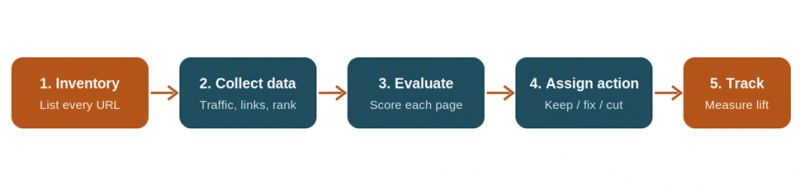
Fig 1. The audit workflow at a glance. The 7 steps below expand each stage.
STEP 1
Confirm the goal and the scope
Restate the one-sentence goal from your preparation, then decide the scope: whole site, one section, or one pillar's content. On large sites, a finished audit of one category beats a stalled audit of everything.
STEP 2
Build the inventory
Crawl the site to list every indexable URL, or export from your sitemap and CMS. For each URL, capture the title, content type, publish date, last updated date, and the pillar or category it belongs to.
STEP 3
Pull the performance data
Attach the decision metrics to each URL: 12 months of organic traffic, ranking keywords and positions, backlinks, engagement, and conversions. Search Console and analytics cover most of it; an SEO suite fills in backlinks and positions faster.
STEP 4
Assign one action per page
Run every page through the keep / update / consolidate / delete framework (full details in the next section) and record the action as a spreadsheet column. No page leaves this step without a decision.
STEP 5
Prioritize by effort vs impact
Don't fix top to bottom. Pages ranking at positions 5 to 20 with declining traffic are usually the fastest wins, because a solid refresh can push them onto page one. Deletions and redirects are quick too. Full rewrites come last.
STEP 6
Execute the actions properly
Updates: refresh facts, add missing subtopics, improve the title, update the date honestly. Consolidations: merge the content, keep the strongest URL, 301 redirect the others. Deletions: redirect any URL with backlinks or history to the closest relevant page; only let truly worthless pages return a 410 or 404.
STEP 7
Log the ship date and move to measurement
Record when each batch of fixes went live. That timestamp is what makes the before-and-after comparison in the next section possible.
The Keep / Update / Consolidate / Delete Framework
This is the heart of the audit: the rule that turns a spreadsheet of data into a to-do list. Map each page's traffic against its quality, and it lands in exactly one box:
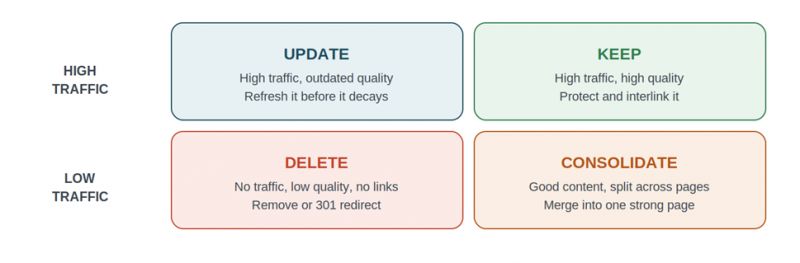
Fig 2. The four-action matrix: every audited page lands in one box.
• Keep: strong traffic, strong quality. Leave the content alone; strengthen its internal links and protect its rankings.
• Update: real traffic but stale content: old facts, dead tools, missing subtopics, weak titles. Refresh before decay accelerates.
• Consolidate: decent content spread across two or more overlapping posts competing for the same keyword. Merge into the strongest URL and 301 the rest.
• Delete: no traffic, no backlinks, no conversions, no pillar fit. Remove it, redirecting anything with history to the closest relevant page.
The tiebreaker When a page sits between boxes, backlinks decide. A page with referring domains is never deleted outright; it gets updated or redirected so the link value survives. |
CLOSING THE LOOP
After the Audit: Measuring Results
An audit without measurement is a chore. An audit with measurement is a case study you can repeat. Three habits close the loop:
• Compare at 60 to 90 days. For every touched page, compare traffic, positions, and CTR against the pre-fix baseline. Search engines need weeks to recrawl and re-rank, so earlier checks mislead.
• Report the wins in plain numbers. "14 updated posts, average position moved from 11 to 6, organic traffic to those pages up 38%" is the sentence that gets the next audit approved.
• Schedule the next one before you forget. A full audit once or twice a year, plus a light quarterly check on your highest-value pages, keeps decay from ever piling up again.
WATCH OUT
Mistakes That Break Audits
• Deleting pages that have backlinks. A "useless" old post with 40 referring domains is an asset. Redirect it or update it; never just remove it.
• Auditing without a goal. Forty columns of data with no question to answer produces analysis paralysis, not action.
• Stopping at the inventory. A tidy list of every URL changes nothing until each row has an action assigned and executed.
• Judging pages on traffic alone. A low-traffic page that converts readers into customers, or supports a pillar page, can matter more than a high-traffic post that converts nobody.
• Changing dates without changing content. Bumping "last updated" on an untouched post misleads readers and gains nothing durable in search.
• Doing everything at once. On large sites, audit section by section. A finished audit of one category beats a stalled audit of everything.
Final Verdict
Are Content Audits Worth the Effort?
Yes, and usually with better returns than new content. A refreshed page that already sits on page two carries existing age, links, and indexed history into the update, so it typically climbs faster than a brand-new post starting from zero. For any site older than a year, the audit spreadsheet is a list of the cheapest wins available.
The real value is the four-action discipline. Without the keep, update, consolidate, delete framework, "improving old content" turns into aimless tinkering. With it, every page on the site has an explicit job or an explicit exit. That clarity is what separates an audit from a cleanup mood.
Expect the audit to be the easy part. Building the inventory and pulling the data takes days. Executing the updates, merges, and redirects takes weeks. Budget for that gap up front, and prioritize by effort versus impact so the highest-return fixes ship first instead of last.
One caution: the thresholds in this guide (18 to 24 month freshness, positions 5 to 20 as quick wins, once or twice a year cadence) are sensible defaults, not laws. A news site and an evergreen how-to site age at completely different speeds. Borrow the process, then let your own traffic data set the numbers.
Run an audit this month if Two or more of the warning signs at the top of this guide sound familiar: flat traffic, a purposeless bottom 30%, keyword cannibalization, outdated guides, or publishing faster than you maintain. Start with the SEO audit. |
Hold off for now if Your site has fewer than 20 pages or is under six months old. There isn't enough data or decay to judge yet. Spend that energy on building out your content pillars first, then audit once history accumulates. |
Post Comment
Share your thoughts about this article.
Be the first to post a comment!