Table of Content
For decades, synthetic voices sounded like machines because they were built rule by rule. Then deep learning taught computers to generate speech from scratch. This guide explains how it works, why it matters, and where it is going, in plain language.
What neural TTS actually is
Neural text-to-speech (neural TTS) is an AI method that turns written text into natural-sounding speech using deep neural networks. These networks have learned the rhythm, tone, and sound of human speech from thousands of hours of real recordings.
The key idea is that the speech is generated. Instead of gluing together pre-recorded clips, a neural TTS system builds speech from scratch. It predicts pitch, stress, pauses, and pronunciation the way a person would. That single change is why the voice reading your audiobook or the assistant on your phone no longer sounds mechanical.
You have almost certainly heard neural TTS today without noticing. That is the point. The technology works best when you cannot tell it is there.
Why older voices sounded robotic
To see how big the change is, it helps to know what came before. Older synthesis used two main approaches, and both had a ceiling.
Concatenative synthesis
Engineers chopped a voice actor's recordings into tiny fragments, then reassembled them into new sentences. When a needed fragment was missing or the joins did not match, you got the choppy, uneven sound of an old GPS unit.
Rule-based and parametric synthesis
Instead of recordings, this approach encoded speech as a set of hand-written rules and statistical settings for pitch and duration. It was flexible and compact, but flat. Someone had to explicitly tell the system how speech works, and human speech is too subtle to fully spell out.
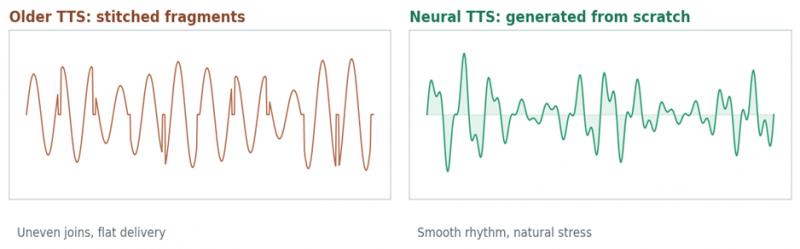
Figure 1. Older systems stitched fragments together, which produced uneven joins and flat delivery. Neural TTS generates a smooth signal with natural rhythm and stress.
THE CORE DIFFERENCE Older systems split the job into separate stages: text analysis, acoustic modeling, and waveform generation. Each stage was hand-built and each could add errors. Neural TTS learns pacing, stress, and tone directly from real recordings, and often runs the whole conversion through a single model. |
Inside the pipeline: text to waveform
Even end-to-end systems pass through three steps in concept. Understanding them makes the whole field easy to follow.
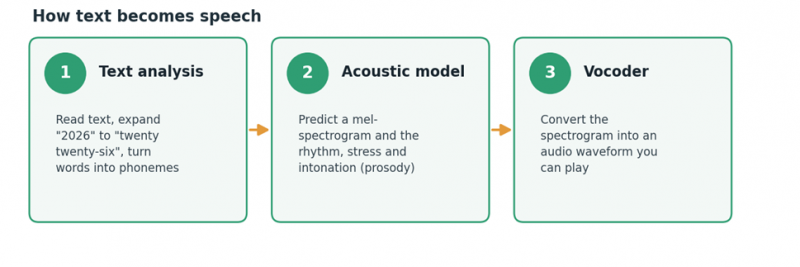
Figure 2. The three conceptual steps that turn written text into audio.
Step 1: Text analysis
The model reads the input and works out how to say it, not just what the words are. It expands abbreviations and numbers, so "Dr." becomes "doctor" and "2026" becomes "twenty twenty-six". It then converts words into phonemes, the smallest units of sound.
Step 2: Acoustic modeling
This is the heart of the system. An acoustic model, usually a Transformer or a similar network, predicts a mel-spectrogram. That is a visual map of how the audio's frequencies change over time. This is also where prosody lives, meaning the rhythm, stress, and intonation that make speech sound alive rather than read out.
Step 3: Vocoding
A neural vocoder turns the spectrogram into an actual audio waveform you can hear. The vocoder does much of the work for perceived quality, which is why HiFi-GAN became a popular default in production systems.
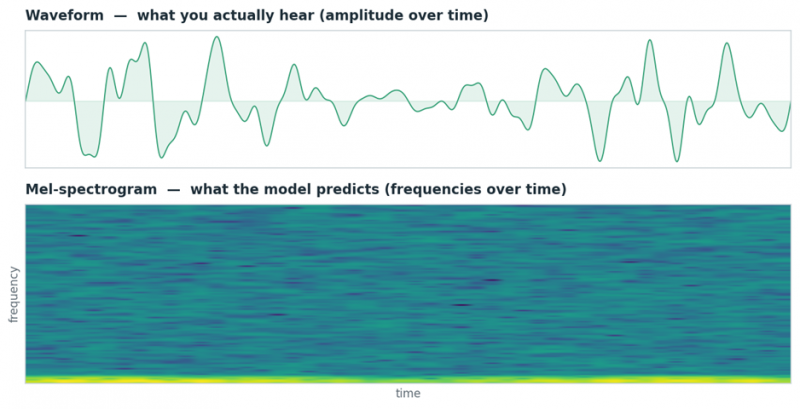
Figure 3. The same speech shown two ways. Neural TTS predicts the mel-spectrogram (bottom), then a vocoder converts it into the waveform you hear (top).
Developers can guide step one with SSML (Speech Synthesis Markup Language). This is a simple markup that controls pronunciation, pauses, emphasis, and speaking rate. It is how an app forces a brand name or an acronym to come out right.
The models that made it possible
Modern speech synthesis is a story of a few landmark models. Each one solved a problem that the previous model exposed.
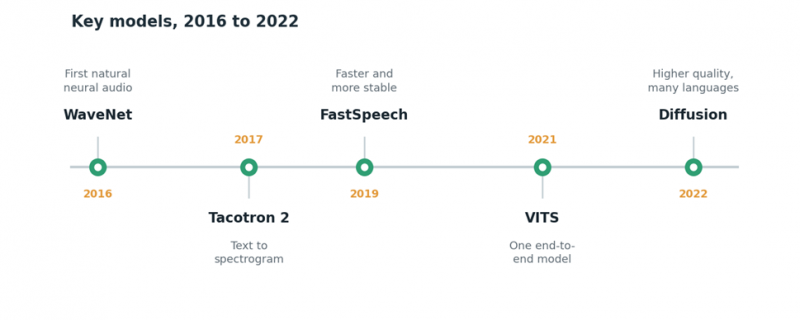
Figure 4. The main neural TTS models from 2016 to 2022.
• WaveNet (2016). Modeled audio one sample at a time and produced far more natural speech, but was slow to generate.
• Tacotron and Tacotron 2 (2017 to 2018). Mapped text directly to spectrograms, replacing fragile hand-built pipelines and reaching near-human quality.
• FastSpeech (2019). Dropped the slow step-by-step loop for a duration predictor, which fixed speed and stability issues.
• VITS (2021). Combined text encoding, alignment, and waveform generation into one model with no separate vocoder. It became the backbone of open-source TTS and voice cloning.
• Diffusion and foundation models (2022 onward). Methods borrowed from image generation pushed quality further, while large pre-trained models began handling many languages and voices from one system.
TWO DESIGN STYLES Two-stage systems such as Tacotron 2 make a spectrogram, then convert it. They are easier to inspect but slower. End-to-end systems such as VITS learn everything at once, which is faster and scales better. The field has broadly moved toward the second style. |
Measuring quality: the MOS scale
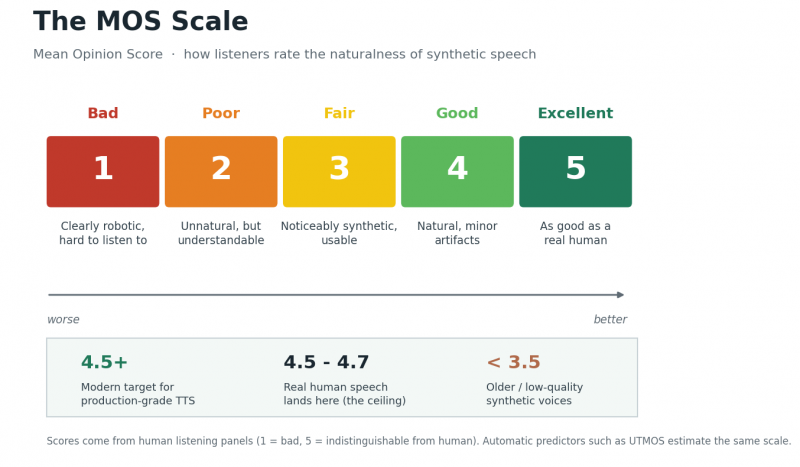
How do you score a voice? The standard is the Mean Opinion Score, or MOS. Human listeners rate how natural the audio sounds on a scale from 1 (bad) to 5 (as good as a real human).
• A score of 4.5 or higher is the modern target for production-grade TTS.
• A score of 4.5 to 4.7 is roughly the ceiling, because even recordings of real human speech land in that range.
• Because real listening panels are slow and costly, researchers often use automatic predictors such as UTMOS, which are trained on crowd ratings.
More and more, teams also use blind head-to-head tests, where listeners simply pick which of two clips sounds better. These preference tests resist the score inflation that vendor-reported numbers tend to have.
4.5+ MOS target for production-grade synthetic voice | 0.1 to 0.3 MOS gap now separating the best open-source and top commercial models CodeSOTA, 2026 | under 90 ms End-to-end latency the fastest real-time engines can reach MarkTechPost, 2026 |
The 2026 model landscape
Two things define the moment. Quality has largely leveled off near the human ceiling, and the number of good options has grown fast. The real trade-off is no longer natural versus robotic. It is quality versus speed versus cost.
| MODEL | REPORTED MOS | BEST FOR |
|---|---|---|
| ElevenLabs (Eleven v3) | about 4.3 | Highest naturalness; audiobooks and narration |
| Google Studio / Gemini Flash | about 4.1 | Broadest language coverage (50+ languages) |
| OpenAI TTS | about 3.9 | Best price-to-quality ratio for general use |
| Sesame CSM (open-source) | about 4.7 | Leading open-weight quality |
| Cartesia Sonic 3.5 | not published | Real-time agents; about 82 ms latency |
| Amazon Polly (Neural) | about 3.3 | Low cost; AWS-native deployments |
MOS figures are compiled from independent 2026 benchmarks (TokenMix, CodeSOTA, Solo Unicorn). Scores vary by test set, so treat them as directional, not exact.
One notable point: the quality gap between open-source and paid models has nearly closed. The best open-weight system sits within a few tenths of a MOS point of the top paid service. What cloud providers still sell is infrastructure, meaning uptime, language breadth, compliance, and scale, rather than raw naturalness.
Where neural TTS is used
The uses run from essential accessibility tools to entertainment.
• Accessibility. Screen readers for people with visual impairments or reading difficulties. This is the original and still most important use.
• Voice agents and phone systems. Support lines and conversational AI that need to sound human under real, messy call conditions.
• Audiobooks and narration. Long recordings produced without a studio, an actor, or a schedule. Here quality matters most and speed does not.
• Media and dubbing. Translating video into many languages, sometimes keeping the original speaker's voice.
• Gaming. Dialogue that can be generated on the fly instead of a fixed set of recorded lines.
• In-car assistants. Increasingly run on the device itself for low delay, safety, and privacy.
TTS VERSUS SPEECH-TO-SPEECH These are different. Text-to-speech takes a script and produces a voice, with no recording session. Speech-to-speech takes a real person's performance, keeps the breath and emotion, and changes only the voice identity. Same result, different starting point. |
Market size and growth
Analysts disagree on the exact size, mostly because they define the market differently. But every serious estimate points the same way: up, and fast.
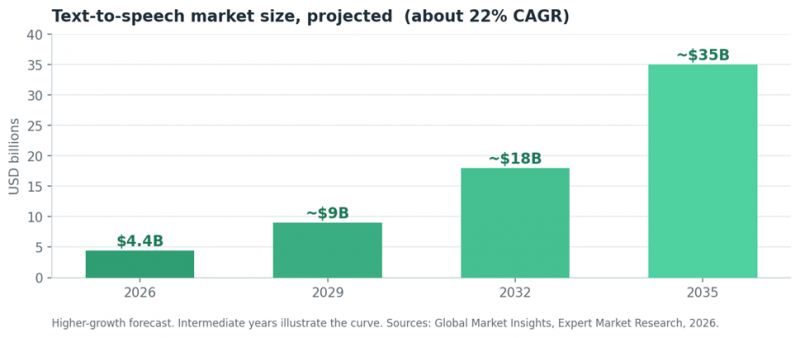
Figure 5. Higher-growth forecasts project the TTS market rising from about 4.4 billion dollars in 2026 toward about 35 billion dollars by 2035.
$4.4B Text-to-speech market value in 2026 Mordor Intelligence, 2026 | 22.4% Projected yearly growth rate on the higher-growth forecasts Global Market Insights, 2026 | $35B Projected market size by 2035 GMI / Expert Market Research |
The growth drivers are consistent across reports: better neural networks, stricter accessibility rules that turn compliance into steady demand, cheaper edge-AI hardware, and an aging population that relies on voice interfaces. The neural and custom-voice segment is singled out as the fastest-growing voice type, which means the flat, robotic era is being actively retired.
One related area to watch is voice cloning. It was valued at about 2.4 billion dollars in 2025 and is projected to reach about 9.6 billion dollars by 2030. It is also the part of the field that raises the sharpest questions.
Risks: cloning, consent, and deepfakes
The same ability that lets a model copy a voice from a few seconds of audio can be turned against people. This is not hypothetical. It is already changing how the industry operates.
• Security risk. Fake speech can fool voice-based security and erode trust, which pushes companies toward vendors with strong consent and detection tools.
• Consent as an advantage. Licensing synthetic-voice rights has opened new revenue for vendors that can secure consented voice data and defend against unauthorized cloning.
• Regulation is arriving. Rules such as the EU AI Act are creating real work around disclosure and provenance of synthetic voices.
WHAT THIS MEANS FOR YOU If you plan to use neural TTS, choosing a model is now the easy part. The lasting questions are about governance: whose voice is this, who agreed to it, and can a listener tell it is synthetic? The best providers increasingly compete on those answers, not just on MOS. |
Final verdict
Neural TTS has crossed the line from a useful feature to a mature technology. The old robotic sound is gone, and for most listeners the best systems are now hard to tell apart from a real person. That shift is settled, not still in progress.
Because quality has leveled off near the human ceiling, the choice of model no longer comes down to which one sounds natural. Almost all of the leading options do. The real decision is about fit. Pick for your main constraint: quality for audiobooks and narration, low delay for live voice agents, price for high-volume general use, and language coverage for global products. The gap between paid and open-source systems has nearly closed, so the paid services now compete mainly on infrastructure, meaning uptime, scale, language breadth, and compliance.
The hard part has moved from engineering to governance. The same technology that clones a voice from a few seconds of audio also enables fraud and impersonation, and regulation is arriving to match. If you deploy neural TTS, the questions that will matter most are whose voice you are using, who consented to it, and whether a listener can tell the audio is synthetic.
BOTTOM LINE Neural TTS is ready for production today. Choose a model by matching it to your main constraint rather than chasing the highest quality score, test it on your own text before committing, and treat consent and disclosure as core requirements, not afterthoughts. Get those three things right and the technology delivers. |
Post Comment
Share your thoughts about this article.
Be the first to post a comment!