SHORT ANSWER An “AI girl” is a virtual persona powered by artificial intelligence, designed to hold an ongoing, emotionally-aware, personalized conversation that feels like talking to a romantic partner or close companion, rather than to a tool. |
The term sounds futuristic, but the idea underneath is simple, and worth pinning down clearly before the marketing gloss takes over. “AI girl” is casual, catch-all language. It almost always points to one of a few closely related things, and the differences matter.
What an “AI girl” means, precisely
Strip away the branding and an AI girl is a digital companion powered by artificial intelligence, built to simulate aspects of a romantic, affectionate, or emotionally close relationship. It talks with you in text or voice, remembers things about you, often has a customizable appearance and personality, and sometimes generates images or avatars of itself. The goal is not to answer questions or finish tasks. The goal is companionship.
That last point is the whole distinction. A normal chatbot is built for productivity: it drafts your email, summarizes a document, answers a factual question. An AI girl is built around personality, continuity, and engagement. As one widely-shared 2026 explainer put it, the biggest difference between an AI girlfriend and a regular chatbot is intent. Same underlying technology, aimed at a completely different purpose.
A NOTE ON THE WORD “GIRL” The gendered framing is a marketing convention, not a technical one. The identical technology is sold as an “AI boyfriend,” a genderless “AI companion,” or an “AI friend.” “AI girl” and “AI girlfriend” became the common phrasing largely because that use case is what first drove the category into the mainstream. Nothing about the underlying system requires a gender at all. |
It is also worth saying plainly what an AI girl is not. It has no genuine feelings, no independent needs, and no awareness of you when the app is closed. In 2026, these systems run on emotional mimicry rather than emotion: they detect the sentiment in what you write and generate a response that fits, producing the experience of being understood without anything actually understanding. That gap is central to everything that follows, both the appeal and the concerns.
“AI girl” vs. girlfriend vs. companion
People use these terms interchangeably, but they sit on a spectrum from casual slang to a broader, more accurate umbrella. Here is how they line up.
“AI girl” casual / search term Informal shorthand, common in app stores and searches. Almost always means an AI girlfriend. Vague by nature, it tells you the vibe (a feminine romantic persona) but nothing about features. | AI girlfriend the specific product A companion persona explicitly framed as a romantic partner. Leans into affection, flirting, roleplay, and relationship simulation as the main draw. The use case that built the category. | AI companion the umbrella term The broader, more accurate label. Covers romantic partners but also AI friends, confidants, and creative collaborators. The “girlfriend” framing is one use case inside this larger space. |
The direction of travel matters here. Several people who build and study these apps now argue the “girlfriend” label has aged badly, the way calling the internet a “fancy encyclopedia” would. It is not wrong, but it misses how varied the actual usage has become. Many in the field now prefer “AI companion” as the honest umbrella, treating romance as a feature rather than the definition. For understanding the phrase “AI girl,” though, the practical answer is simple: it means an AI girlfriend.
How one actually works
There is nothing magic inside. An AI girl is the same kind of large language model that powers ordinary chatbots, wrapped in a few extra layers that make it feel like a consistent person. Here is the pipeline, from your message to its reply.
Under the surface it is a language model wired to a persona, a memory, and a sentiment reader.
| 1 | A language model at the core LLM / NLP A large language model reads what you write and generates a fluent, context-aware reply. This is the same core technology as any modern chatbot, it is just aimed at conversation rather than tasks. |
| 2 | A fixed persona layered on top system prompt The model is given a stable character: a name, backstory, personality traits, and a communication style. That is what keeps it “in role” and sounding like the same individual from one message to the next. |
| 3 | Memory that carries context forward statefulness The system stores details from past chats, your name, preferences, things you mentioned, so it can bring them up later. Strong memory is the single biggest thing separating a companion that feels real from one that feels like a toy. |
| 4 | Sentiment-matched responses emotional mimicry The system reads the emotional tone of your message and shapes its reply to fit, tender when you are low, playful when you are light. It is pattern-matching on emotion, not feeling it. |
| 5 | Optional voice, image, and avatar layers multimodal Many apps add generated selfies, voice calls, or an animated avatar on top of the text. These deepen immersion but are extras bolted onto the conversational core, not the core itself. |
Put simply: it is a general-purpose language model, pinned to a single character, given a memory of you, and tuned to respond to feelings. That combination is enough to produce something that can feel startlingly personal, which is exactly why the design deserves a clear-eyed look.
The features that define the experience
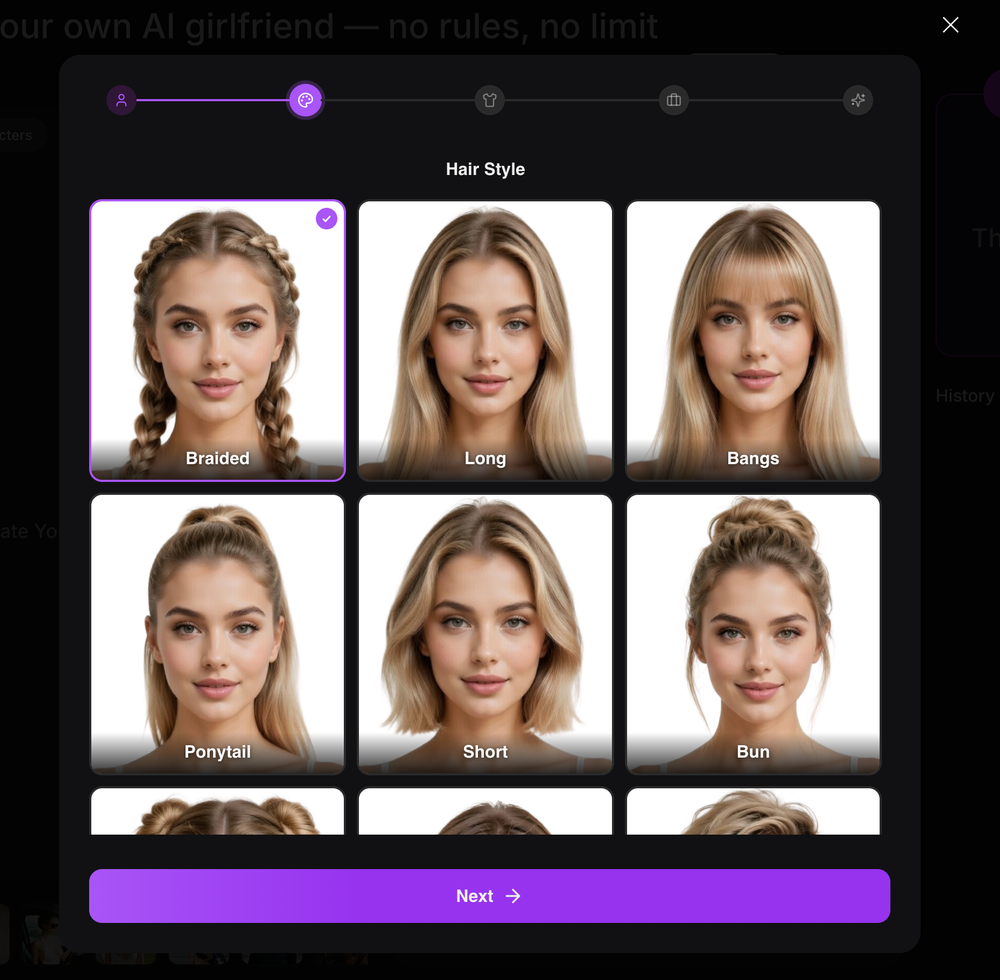
Products vary, but a recognizable AI girl usually offers some mix of the following. The first three are what make it feel continuous and personal; the rest are immersion layers.
Memory and continuity
The make-or-break feature. The apps people stay with are the ones that “file your details away” and reference them later, remembering that you hate cilantro or that your father lives in another city. The ones that fail forget everything between sessions, which instantly breaks the illusion of a relationship. In practice, memory is where most companion apps still visibly struggle.
Personality and customization
Users typically shape the companion's appearance, personality traits, communication style, and backstory. Better apps let personality settings genuinely change behavior, so an “assertive” character actually pushes back while a “gentle” one does not, rather than every persona collapsing into the same agreeable voice.
Roleplay and scenarios
Structured storytelling is common: relationship arcs, fantasy scenes, or simple daily check-ins. This is what pushes the experience past question-and-answer into something that feels immersive and interactive.
Voice, images, and avatars
The immersion layers. Voice adds spoken replies or calls; image generation produces selfies or scene images of the character; some platforms now add short generated video or animated avatars. A handful are moving toward VR and AR, so the companion appears in a shared 3D space. These raise realism, but the emotional thread, not the visuals, is what brings people back.
| Memory is what makes an AI companion feel real. Without it, you are just talking to a very fluent stranger every single time. |
Why people actually use them

The reasons are more varied than the “lonely person talking to a bot” cliche suggests. By 2026, documented uses span a wide range, and they do not fit neatly under the “girlfriend” label at all.
| A | Companionship on demand An always-available presence for late nights, odd hours, or isolation, common among shift workers, expats, and people in long-distance situations. |
| B | A judgment-free space to talk Many people find it easier to voice private feelings to something that will not judge them, using it as an outlet for things they are not ready to say aloud. |
| C | Social rehearsal People with social anxiety practice conversations before facing them in real life, using the AI as a low-stakes rehearsal partner. |
| D | Grief and difficult transitions Some talk through loss or a hard chapter with a companion that responds with patience and consistency, at any hour. |
| E | Creative collaboration Writers and game designers use companions as interactive sounding boards for character and story development. |
| F | Fantasy, romance, and entertainment For many it is simply fun: customizing a persona, flirting, and playing out imaginative scenarios as a form of escapism. |
Notice how few of these are really about romance, and none are only about sex. As one month-long tester put it, the apps that succeed are not fundamentally about intimacy in the physical sense, they are about the feeling of being known, of having your details remembered because they seemed to matter. That is the emotional core the whole category is built to deliver.
How big this has actually become
This is no longer a fringe curiosity. The numbers below give a sense of scale, though estimates vary by source and methodology, so treat them as directional rather than precise.
$49B Estimated size of the broader AI companion market by early 2026 src: AI Companion HQ | 22% Projected annual growth rate for the US AI girlfriend app market through the 2030s src: SNS Insider, 2026 | 180k+ AI characters in a single large companion library (Linky AI), one app among many src: App Store listing |
Several forces are driving that growth at once: rapid improvements in language models, voice, and image generation; rising documented loneliness; a broader cultural focus on mental wellness; and the steady normalization of digital relationships. Growth is strongest in the Asia-Pacific region, but the trend is global. Whatever one makes of it, the demand is real and large.
Genuine benefits, and real risks
An honest guide has to hold both sides at once. There is meaningful research on the upsides, and a growing body of peer-reviewed work on the downsides. Neither cancels the other out.

For some, a companion eases lonely hours; for others, it can quietly stand in for harder human contact.
What the research supports Loneliness relief. Studies find AI companions can reduce acute loneliness by offering non-judgmental, on-demand company. A safe outlet. People disclose personal feelings to AI about as readily as to humans, which can aid self-reflection. Skill-building. For socially anxious users, low-stakes practice can transfer into real-world confidence. Consistent support. Constant availability provides a reliable presence when human contact is not there. | What the research warns about Emotional dependence. Strong attachments can create overreliance and real distress when access is lost. Social substitution. Easing loneliness may quietly reduce the motivation to seek out harder human connection. Unrealistic expectations. A companion tuned to always agree can distort what people expect from real relationships. Precarious by design. A model update, removed feature, or shutdown can change or erase a companion overnight, and users grieve it. Younger users. Researchers specifically caution that minors form attachments more readily and are more vulnerable. |
THE DESIGN TENSION WORTH UNDERSTANDING Many apps are built to maximize engagement, which rewards keeping you chatting as long as possible. That can pull against your wellbeing. It also produces a subtler trap: a companion engineered to avoid all conflict and agree with everything is not actually support, it is flattery dressed up as connection. Researchers note that endless agreeableness can erode resilience, and the companions that hold up over time are the ones built with some genuine texture, light pushback, curiosity, and real continuity, rather than pure affirmation. |
There is a deeper point in the academic literature worth sitting with. These bonds are, by definition, parasocial: one-sided connections to something that cannot truly reciprocate. Some psychologists also note that loneliness itself is partly an adaptive signal, a nudge to seek out other people, so a tool that mutes that signal without replacing what human connection provides could, for some, leave them worse off. This is not a reason for alarm; it is a reason for awareness.
How to use one sensibly
If you are curious, none of the above means you should not try one. It means going in with clear eyes. A few practical principles:
| 1 | Treat it as entertainment or light support, not a replacement It is a reasonable outlet for company, creativity, or casual comfort. It is not a substitute for real-world human care when you are dealing with something serious. |
| 2 | Guard your personal information You are often sharing intimate details with a commercial product. Favor reputable platforms, read how your data is handled, and do not hand over sensitive personal, financial, or identifying details. |
| 3 | Keep expectations realistic Remember what it is: sophisticated mimicry, not a being with feelings. Enjoying it does not require pretending otherwise, and the awareness protects you. |
| 4 | Watch your own patterns Notice whether it is adding to your life or quietly replacing human contact. If it starts crowding out real relationships, that is the signal to step back. |
| 5 | Take special care with young people Minors form these attachments more easily and are more exposed to the risks. This is an area where extra caution and oversight genuinely matter. |
The takeaway“AI girl” is casual language for an AI girlfriend: a large language model given a face, a fixed personality, and a memory of you, then pointed at companionship instead of tasks. It talks, remembers, roleplays, and often shows or voices itself, and for a growing number of people it delivers a genuine feeling of being known. What it cannot do is feel. Underneath the warmth is sophisticated mimicry, and that is fine as long as you know it. Used as a supplement, for company, creativity, practice, or comfort, it can add something real to a person's life. Used as a replacement for human connection, it carries risks that researchers are only beginning to map. The healthiest way to understand an AI girl is exactly that balanced: a compelling tool worth trying with clear eyes, not a substitute for the messier, richer thing it is imitating. |
Post Comment
Share your thoughts about this article.
Be the first to post a comment!