OpenFuture AI indexes a staggering catalog of AI tools, but a bigger list is not always a better answer. Depending on whether you want adoption data, task based search, education, or community judgment, one of these six alternatives will get you from a messy problem to a tested shortlist faster.
| QUICK ANSWER, IF YOU ONLY READ ONE BOX | ||
BEST OVERALL REPLACEMENT There's An AI For That Task based search across one of the largest catalogs in the category, built around the question you actually have. | BEST FOR HARD DATA Toolify The only major directory that layers traffic estimates and popularity trends onto its listings, showing what people really use. | BEST HUMAN CURATION FutureTools A hand filtered collection with upvotes and editor picks, trading raw volume for a far better signal to noise ratio. |
Why Tool Discovery Broke, and Where OpenFuture AI Fits
The problem these directories exist to solve is real and getting worse. The AI tool market has grown so fast that finding the right image generator, coding assistant, or marketing platform now means wading through thousands of lookalike products competing for the same searches.
| MARKET CONTEXT: The number of commercially available AI tools grew 68 percent between early 2025 and 2026, passing 14,200 tracked products. |
OpenFuture AI is one popular answer to that chaos, and before weighing alternatives it deserves a fair reading on its own terms.
The Subject: OpenFuture AI, a Massive Free Index, Light on Judgment
OpenFuture AI is a free, web based directory that aggregates and categorizes AI products at enormous scale, indexing more than 40,000 tools across upwards of 70 categories with daily updates. Its pitch is comprehensiveness: if a tool exists, OpenFuture probably lists it, organized into browsable verticals that make broad market scans quick and cost nothing. For a first pass over an unfamiliar category, that breadth is genuinely useful, and the daily update cycle means new launches surface fast.
The weakness, identified consistently by independent reviewers, is curation. Listings tell you a tool exists and roughly what it claims, but the directory offers little help judging whether it is any good: no meaningful usage data, thin editorial filtering, and limited evaluation depth compared to review platforms. The practical guidance from reviewers who tested it lands the same way this guide does: use OpenFuture AI for initial discovery, then lean on a second source with stronger signals for the actual decision. This article is about choosing that second source, or replacing the first one entirely.
WHAT IT DOES WELL Huge catalog above 40,000 tools, free access with no account, 70 plus browsable categories, daily updates that catch new launches early, and fast scanning for unfamiliar markets. | WHERE IT FALLS SHORT Thin curation and evaluation depth, no adoption or traffic signal, listings that describe claims rather than verify quality, and little help separating the 40,000th tool from the 40 that matter. |
How We Judged the Alternatives
Every alternative below was weighed on the same four questions, because these are the four ways a directory earns its place in a real workflow. The percentages show how heavily each factor counted in the rankings.
35% Signal Quality Does the directory help you judge tools, through usage data, reviews, votes, or editorial filtering, or does it only confirm they exist? | 25% Findability How fast can you get from a task in your head to a relevant shortlist, through search, filters, and category design? | 25% Coverage and Freshness How much of the market does it see, and how quickly do new launches and dead tools get reflected? | 15% Depth Per Listing Once a tool catches your eye, how much does the page actually tell you: pricing, use cases, alternatives, and context? |
Six Better Ways to Discover AI Tools, Ranked
Each entry below is a full dossier: what the platform is, how it behaves in real use, the specific discovery job it wins, and the caveat you should know before relying on it.
There's An AI For That
BEST FOR: task first discovery at maximum breadth
SCORES Signal 8.4 · Findability 9.4 · Coverage 9.2
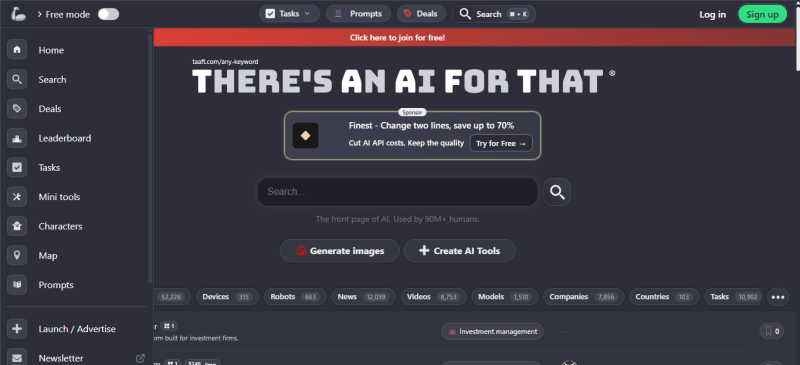
There's An AI For That, universally shortened to TAAFT, reorganized the entire directory concept around a single insight: nobody wakes up wanting to browse a category, they wake up with a task. Its core interface is a search across tens of thousands of tools indexed by the job they perform, so typing what you are trying to do, summarize legal documents, remove image backgrounds, clean a mailing list, returns tools mapped to that exact task rather than a broad category page you still have to dig through. Around that core sit the discovery layers: a daily feed of newly added tools, followable categories, alternatives listed on every tool page, and community signals that surface which entries people engage with, which is why competitor trackers consistently list it as the top alternative in this space.
In practice, TAAFT is the closest thing the category has to a default starting point. Its catalog rivals the largest indexes in raw volume, independent roundups describe the combination of task based filtering and deep catalog as the most practical discovery experience available, and the site rewards both quick lookups and slow browsing. Its limits are the honest costs of scale: listing quality varies since the long tail is enormous, the popularity signals reward attention rather than verified results, and sponsored placements sit alongside organic results, so the shortlist it hands you still deserves a validation pass somewhere with harder evidence.
| WATCH OUT: Featured and promoted slots are part of the business model, so treat top placement as visibility, not as a quality verdict. |
Toolify
BEST FOR: adoption data and market research
SCORES Signal 8.8 · Findability 8.0 · Coverage 9.5
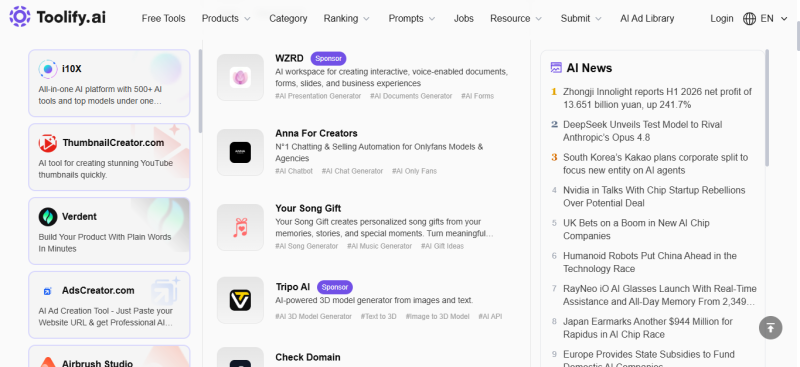
Toolify's differentiator is the one thing OpenFuture AI most conspicuously lacks: evidence of use. Alongside tens of thousands of listings organized across hundreds of categories, Toolify attaches estimated monthly visits and popularity trends to tools, which converts a directory from a list of things that exist into a rough map of what people actually adopt. Reviewers describe it as built more like a research directory than a bookmark list, with tool pages, rankings, alternatives pages, and discovery paths designed for understanding a category before picking a product, and its daily updated catalog is repeatedly cited as the deepest in the field, the strongest source for long tail vendor discovery.
The workflow it rewards is comparative. If you are evaluating AI website builders or image tools, scanning Toolify shows which names recur, which are growing, and which are ghost towns, before you spend an hour on anyone's landing page. The honest caveats: traffic estimates are directional rather than precise, the interface is denser and more utilitarian than the polished curation sites, and the same reviewers who praise its scanning power note the risk of staying surface level, mistaking a fast market scan for an actual evaluation. Used as the data layer in a discovery stack, though, nothing else in the category matches it.
| WATCH OUT: Visit estimates are third party approximations, so use them to rank interest between tools, not as exact usage figures. |
FutureTools
BEST FOR: human curation and a clean daily feed
SCORES Signal 8.6 · Findability 8.4 · Coverage 7.2

FutureTools, built by AI YouTuber Matt Wolfe, takes the opposite bet from the mega indexes: a smaller catalog where a human has actually looked at the submissions. Tools arrive through a filtered pipeline rather than automated scraping, each listing carries a concise description with pricing model and category, and the community layer, upvoting favorites and sorting by most upvoted or newest, does real work in surfacing quality. An editor's picks selection flags tools the curator personally rates, and a daily AI news feed sits alongside the directory, making the site double as a lightweight way to stay current on the industry without following a dozen newsletters.
The experience is what curation buys: filters that drill to exactly the kind of tool you want, listings you can trust to be real products rather than landing page vapor, and a signal to noise ratio the 40,000 tool indexes cannot approach. The cost is the mirror image. Coverage is a fraction of what TAAFT or Toolify sees, niche and brand new tools may simply not be listed yet, and the curation reflects one team's taste, which leans toward creator and productivity tooling. As a primary feed for staying current and a trustworthy first filter, it is excellent, while exhaustive market scans still need a bigger net.
| WATCH OUT: If a specialized tool is missing here, that means unreviewed, not bad, so absence should send you to a larger index rather than end the search. |
Product Hunt
BEST FOR: launch day energy and maker contact
SCORES Signal 8.2 · Findability 7.0 · Coverage 7.8
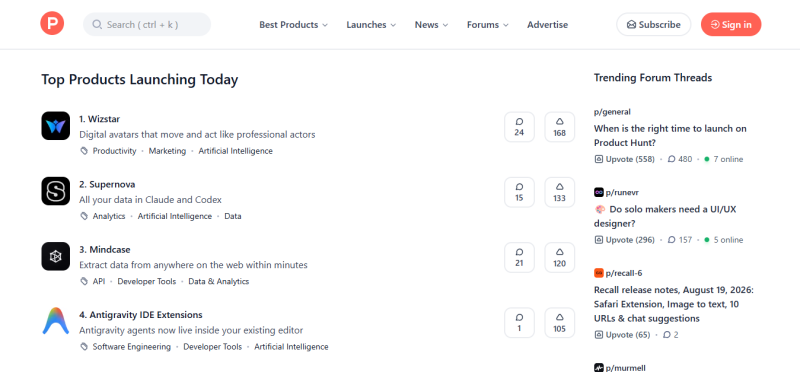
Product Hunt is not an AI directory, it is the internet's launch stage, and that difference is exactly its value. Every day, new products, now overwhelmingly AI products, launch to a community that upvotes, questions, and critiques them in public, with the makers themselves in the comments answering. For discovery, this delivers something no static directory can: context. You see how a tool positions itself, what early users challenge, how the team responds under pressure, and whether excitement survives contact with real questions. Historical launch pages, complete with comment threads and upvote counts, remain a rich research archive for tools years after their debut.
Its weaknesses as a directory follow from not being one. Search and category browsing are secondary to the daily feed, coverage is limited to products that chose to launch there, and upvotes measure launch day marketing energy at least as much as product quality, a dynamic the community itself openly debates. AI products also now compete in an extremely crowded feed, so worthy niche tools can sink without a trace. Use Product Hunt as the qualitative layer, the place to watch a tool meet its first skeptical audience, rather than as a catalog you search exhaustively.
| WATCH OUT: Launch metrics reward marketing muscle, so a modest upvote count on a niche tool says little, while the comment threads almost always say a lot. |
AlternativeTo
BEST FOR: escaping a tool you already know
SCORES Signal 8.5 · Findability 8.2 · Coverage 7.5
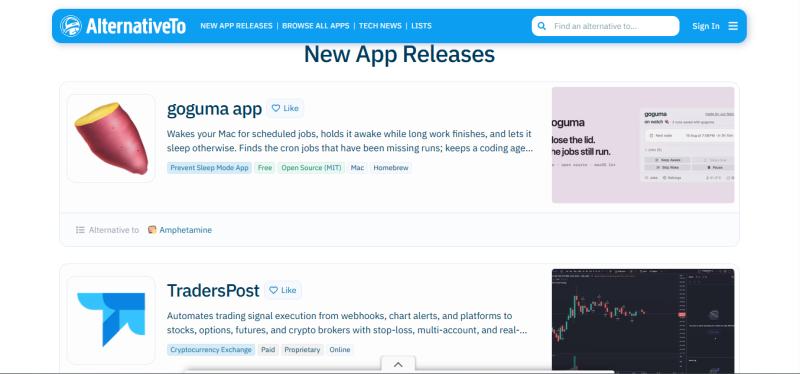
AlternativeTo answers a different question than every other entry here, and it is often the question you actually have. Instead of asking what exists in a category, you start from a tool you already know, the one that got too expensive, changed its terms, or almost fits, and the crowd shows you what people switched to. Its crowdsourced database spans all software rather than AI alone, with likes, user reviews, platform filters, and comment threads comparing options, refined by one of the largest and longest running communities in software discovery. For AI tools specifically, that heritage means mature entries carry years of user commentary that no young AI directory can match.
The all software scope cuts both ways. Coverage of brand new AI launches trails the dedicated indexes, sometimes by months, and the AI categorization is coarser than a specialist directory's seventy verticals. But the reference point workflow is uniquely honest: recommendations come from users describing real migrations, not from submission forms, and seeing an AI tool ranked against its non AI predecessors often reveals whether the AI version genuinely wins or just markets better. As the second opinion in a discovery stack, it routinely catches what the AI only sites miss.
| WATCH OUT: Crowd rankings favor established tools with large user bases, so a superior newcomer may sit far down a list purely on age. |
Futurepedia
BEST FOR: learning a category before choosing in it
SCORES Signal 7.4 · Findability 8.0 · Coverage 6.8
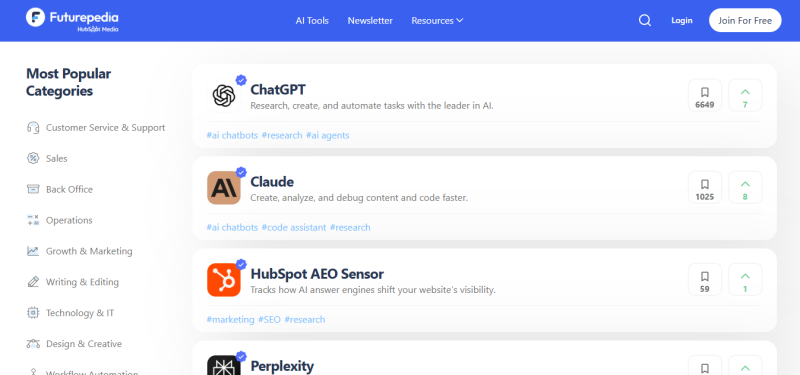
Futurepedia was one of the earliest AI directories to break out, and it built its reputation on being more than a list: detailed tool profiles covering features, use cases, and user reviews, buyer style guides, a well regarded weekly newsletter, and a YouTube channel that together make it the directory closest to an education platform. Independent comparisons still recommend it as the best starting point when you know your workflow gap but not the vendor landscape, because its business friendly presentation and explanatory content teach you the shape of a category, what these tools do, what they cost, and what separates them, before you commit to evaluating anyone.
The reason it ranks last among these six is trajectory rather than concept. Reviewers assessing the field in 2026 describe a competitive position that has eroded: categories that have not evolved with the market, a slower update cadence, and listings that skew toward well known tools while the fast growing long tail of specialized options goes uncaptured. For a newcomer orienting in a mainstream category, it remains genuinely useful and pleasant to read. For finding what launched last month, or the niche tool nobody has profiled yet, the fresher indexes above will serve you better.
| WATCH OUT: Treat its shortlists as a syllabus rather than a census, and cross check any specific search against a larger, fresher index before deciding. |
Detailed Comparison Table
The full field side by side, including OpenFuture AI as the baseline, across the factors that decide which tab you should open first.
| Factor | OpenFuture AI | There's An AI For That | Toolify | FutureTools | Product Hunt | AlternativeTo |
|---|---|---|---|---|---|---|
| Core idea | A maximal free index of the AI market, organized into browsable categories and updated daily | Task based search that maps tens of thousands of tools to the specific job you type in | A research grade index that attaches traffic estimates and popularity trends to its listings | A hand filtered collection with community upvotes, editor picks, and a daily AI news feed | A daily launch stage where new products meet a voting, questioning community in public | A crowdsourced map of what users switch to, built from reference tools and real migrations |
| Catalog scale | More than 40,000 tools across 70 plus categories, among the largest raw counts anywhere | One of the deepest catalogs in the category, rivaling the biggest indexes in volume | Tens of thousands of listings across hundreds of categories, repeatedly cited as the most comprehensive | Deliberately smaller, a curated fraction of the market chosen for quality over completeness | Large but launch dependent, covering products that chose to debut on the platform | Vast across all software, with AI as one strand and new AI launches arriving more slowly |
| Quality signal | Thin, with listings describing claims and little to separate strong tools from weak ones | Community engagement and popularity signals, useful but tilted toward attention | The strongest hard signal here: estimated monthly visits and trend lines showing real adoption | Human review before listing plus community upvotes, the best editorial filter in the field | Public upvotes, comment scrutiny, and maker responses, rich context with a marketing bias | User reviews, likes, and migration stories from one of software discovery's oldest communities |
| Freshness | Daily updates that surface new launches quickly across the whole market | A daily feed of new additions, consistently among the fastest to list new tools | Daily updates through submissions and automated discovery, fast on the long tail | Frequent but gated by human review, so new tools arrive at curation speed | Real time by definition, since launch day is the product's moment on the site | Slower for brand new AI tools, with entries maturing as the community adopts them |
| Depth per listing | Basic descriptions and category tags, enough to know a tool exists and roughly what it claims | Task mappings, alternatives, and engagement stats on each tool page | Tool pages with rankings, alternatives, traffic context, and discovery paths between related products | Concise vetted descriptions with pricing model, category, and any special offers | Launch pages with maker commentary, community questions, and a permanent discussion record | Feature lists, platform details, user reviews, and direct comparisons against each alternative |
| Best discovery job | A fast first scan of an unfamiliar market where breadth matters more than judgment | Going from a task in your head to a relevant shortlist in under a minute | Ranking a category by real world adoption before shortlisting two or three names | Staying current on quality launches without wading through the long tail | Watching how a specific tool holds up under public questions from early users | Finding what people who left your current tool actually moved to |
| Cost and access | Free, browser based, no account required | Free to browse, with sponsored placements funding the platform | Free to browse, ad and submission supported | Free, with community features open to all | Free, with accounts needed to vote and comment | Free, with accounts for reviews and likes |
| Main weakness | Volume without verdicts, leaving all evaluation work to you | Variable long tail quality and promoted slots mixed into results | Directional data that can make surface scans feel like evaluations | Coverage gaps on niche and very new tools outside its curation taste | Launch metrics that reward marketing energy over product substance | Age weighted rankings that can bury superior newcomers |
Five Red Flags to Watch in Any Tool Directory
Directories are marketing channels as well as libraries, and every platform in this guide takes money from the tools it lists in some form. These habits keep the listings honest for you.
01 - Sponsored placement dressed as ranking
Featured, promoted, and top slots are usually paid. Before trusting any ordering, find the label that distinguishes advertising from organic position, and if you cannot find one, assume the worst.
02 - Descriptions written by the vendor
Most directory listings begin life as a submission form filled in by the tool's own team. Treat listing text as a claim to verify, not a review, no matter how neutral the directory's design makes it look.
03 - Dead tools still listed as alive
The AI market's churn means directories carry ghosts, products that shut down months ago. A listing with no recent activity signals, reviews, or updates deserves a direct visit to the tool's own site before it earns a place on your shortlist.
04 - Engagement metrics standing in for quality
Upvotes, visit counts, and trending badges measure attention, which correlates with marketing budgets as much as with usefulness. Use them to rank curiosity, then validate the top candidates on evidence.
05 - A single source shortlist
Every directory has blind spots shaped by its submission flow and business model. If your entire shortlist came from one site, you inherited its gaps, so a second source is not paranoia but basic hygiene.
What Independent Reviewers Actually Concluded
These findings come from named, independent evaluations of the platforms above, paraphrased faithfully. Together they read like a consensus forming in real time.
The most thorough OpenFuture AI review of 2026 landed on a two source doctrine: the directory works for initial discovery, but evaluation depth has to come from somewhere else, naming review platforms and data richer directories as the necessary second step before any real decision.
Fastio · OpenFuture AI review · June 2026
A thirteen directory evaluation that kept only nine as worth using concluded the best directory is not the one with the biggest catalog but the one that turns a messy problem into a testable shortlist, recommending There's An AI For That for maximum breadth and warning that no single directory should be trusted alone for a very specific search.
Junia · Best AI tools directories, 13 checked · March 2026
A 2026 field comparison described There's An AI For That's pairing of task based filtering with one of the deepest catalogs as the most practical discovery combination available, while naming Toolify the closest thing to a comprehensive index of AI products, the strongest source for broad scans and long tail vendor discovery.
StackBuilt · Best AI tools directories · June 2026
The same evaluations documented Futurepedia's slide: an early leader whose categories stopped evolving with the market, whose update frequency dropped, and whose listings drifted toward famous tools while the specialized long tail went uncaptured, even as reviewers still endorsed it as the best educational starting point for learning a category.
Fastio and StackBuilt · directory assessments · 2026
Toolify's core tradeoff surfaced in multiple write ups: its traffic and trend layer gives you a signal about which tools people actually use versus which ones merely exist, a layer rivals lack, but reviewers cautioned that the same fast scanning invites surface level judgments if it replaces rather than precedes hands on testing.
Fastio and Junia · Toolify assessments · 2026
On the community platforms, user commentary captured the practical split: AlternativeTo covers the full range of software while AI only directories stay narrow, which is exactly why experienced users run both, letting the crowd's migration stories check what the AI indexes promote.
AlternativeTo community · user comparison notes · 2026
Build a Three Stage Discovery Stack
The reviewers above keep converging on the same conclusion: no single directory should carry the whole job. Here is the stack that follows from everything in this guide, three stages, each using the platform that wins that stage.
STAGE 1 · SCAN Cast the wide net Start from your task on There's An AI For That, or from your category on OpenFuture AI or Toolify when you want the whole market visible. The goal of this stage is a raw list of eight to twelve candidates, gathered in minutes, with no judgment applied yet. |
STAGE 2 · VALIDATE Apply the signals Run the raw list through evidence. Check adoption and trend lines on Toolify, see whether FutureTools' curation or editor picks include them, read the launch day questioning on Product Hunt, and look for migration stories on AlternativeTo. Candidates without a pulse anywhere get cut, and the list should fall to three or four. |
STAGE 3 · DECIDE Test the finalists yourself No directory replaces contact with the product. Take the survivors to their free tiers with one real task from your actual work, the same task for each, and let the results pick the winner. An hour of hands on testing beats a hundred listings, and it is the only stage where the answer is fully yours. |
| FINAL VERDICT |
Stop Looking for a Bigger List, Start Building a Better Stack OpenFuture AI's 40,000 tool index is a genuine achievement and a real starting point, but the reviewers who tested this field all hit the same wall: size without signal just relocates the problem. The alternatives that actually improve discovery each add the judgment layer OpenFuture lacks. There's An AI For That adds task intelligence, Toolify adds adoption data, FutureTools adds human taste, Product Hunt adds public scrutiny, AlternativeTo adds migration truth, and Futurepedia adds education. The winning move is not swapping one directory for another, it is the three stage stack: scan wide on TAAFT or a mega index, validate against Toolify's data and the curated and community layers, then decide with your own hands on a real task. That workflow takes an afternoon, costs nothing, and turns the overwhelming growth of the AI market from a problem into an advantage, because the more tools exist, the more a good filter is worth. |
Post Comment
Share your thoughts about this article.
Be the first to post a comment!