I ran the same kind of scripts through both tools, saved the outputs, tracked the costs, and then checked my results against verified reviews on G2, Trustpilot, and the OpenAI Developer Community. Every claim below is tied to a specific test or a specific review source.
Quick Answer
OpenAI.fm is OpenAI's free, no-signup demo page for the gpt-4o-mini-tts model: 11 voices, editable "vibe" instructions, MP3 downloads, and the exact API code behind each output. ElevenLabs is a paid AI audio platform built on the Eleven v3 and Flash v2.5 models: 10,000+ library voices, 70+ languages, voice cloning, video dubbing, Scribe v2 transcription, and voice agents.
OpenAI.fm · Free demo of gpt-4o-mini-tts Script box, 11 voices, 5 vibe presets plus a fully editable instruction field. Output: mono MP3 at 24 kHz, generated in seconds, downloadable in one click. No cloning, no editing timeline, no account required. |
ElevenLabs · Full platform: ElevenCreative + ElevenAgents Text to speech, instant and professional cloning, dubbing with lip sync, music, sound effects, agents, and transcription. Priced on a credit system where credits roughly equal characters, from a 10k-credit free plan to an 11M-credit Business tier. |
What Is OpenAI.fm?
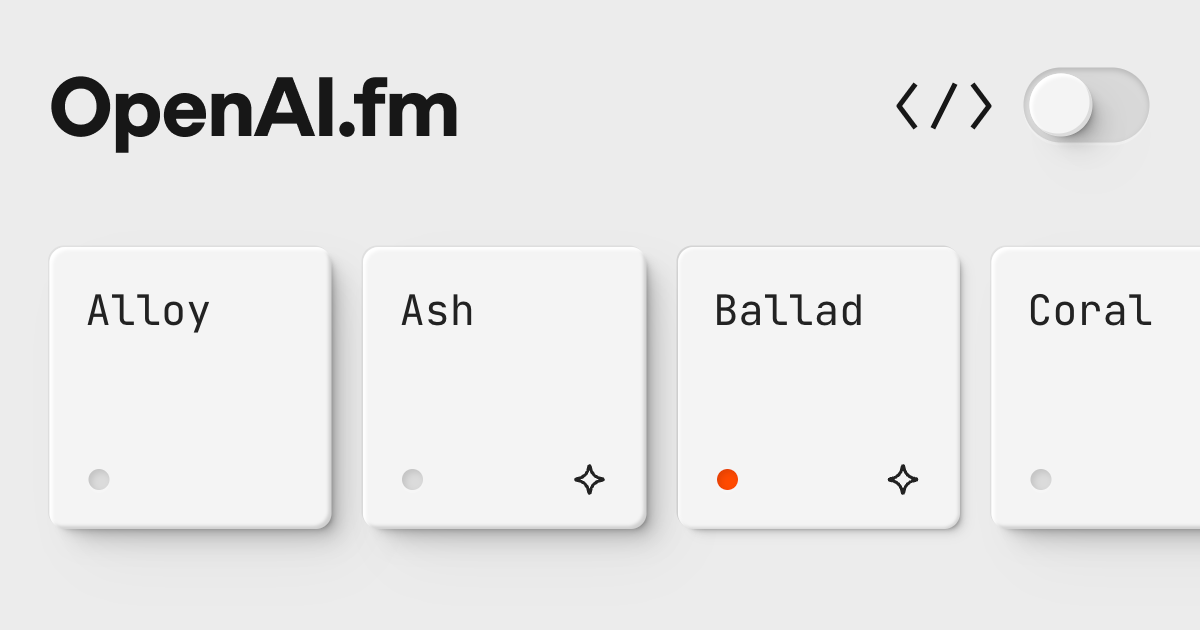
OpenAI.fm is the official interactive demo for gpt-4o-mini-tts, the text-to-speech model in the OpenAI API. The page loads with an example script, voice, and vibe already selected, so audio can be generated before creating any account. A START BUILDING link and a code button sit at the top for developers who want the API call behind their settings.
Its defining design choice is splitting the job into two separate inputs:
• Script: the exact words to be spoken.
• Voice + Vibe: how those words are delivered. Vibe presets (Calm, Emo Teenager, Dramatic, Fitness Instructor, Gourmet Chef) fill an instruction box that stays fully editable, so pacing, affect, and pronunciation can be directed in plain language. In the API this maps to an instructions field separate from the input text.
The demo offers 11 named voices (Alloy, Ash, Ballad, Cedar, Coral, Fable, Marin, Nova, Onyx, Sage, Verse) plus a shuffle option. OpenAI's own TTS documentation lists 13 built-in voices at the API level, recommends Marin and Cedar for best quality, and states the voices are currently optimized for English. Each request accepts up to 2,000 characters of text.
What Is ElevenLabs?
ElevenLabs is an AI voice platform that converts text into speech with emotion, pauses, and natural rhythm. By 2026 the product is organized into two pillars: ElevenCreative (speech, music, video dubbing, sound effects) and ElevenAgents (real-time voice and chat bots).
Its 2026 stack, in specifics:
• Eleven v3 for maximum realism, with tags for tone and emotion.
• Flash v2.5 for ultra-low latency, roughly 50% cheaper and faster than the flagship model.
• 10,000+ voices in 70+ languages via the voice library, plus voice design from text prompts.
• Instant and professional voice cloning. Professional cloning works best from one to three hours of clean microphone audio.
• Dubbing that preserves lip sync and emotional tone, and Scribe v2 transcription.
Comparison Table
| Criteria | OpenAI.fm | ElevenLabs |
|---|---|---|
| Underlying model | gpt-4o-mini-tts | Eleven v3 (quality) + Flash v2.5 (speed) |
| Cost to start | $0, no signup | Free plan: 10k credits, 1 seat, no cloning |
| Voices | 11 in the demo (13 in the API) | 10,000+ in the voice library |
| Languages | Optimized for English per OpenAI's docs | 70+ languages |
| Tone control | Free-text instruction field, separate from script | Tags and sliders per generation |
| Input limit | 2,000 characters per request | Credit-based, long scripts supported in Studio |
| Voice cloning | Not available | Instant (Starter) and Professional (Creator+) |
| Dubbing / music / agents / transcription | Not available on the demo | All included in the platform |
| Output file | Mono MP3, 24 kHz, ~33s for a short paragraph | Studio exports and API delivery |
| Commercial use | Via the paid API, ~$0.015 per minute of audio | From the $5/mo Starter plan upward |
| Editing environment | None: play, download, share, copy API code | Studio editor for fine-tuning |
| Known reliability issues | Reported slowdowns and unnatural pauses in gpt-4o-mini-tts (OpenAI Community, Jan 2026) | Pronunciation of some names/terms needs manual fixes; tone can vary across long scenes |
Teal = OpenAI.fm advantage. Indigo = ElevenLabs advantage. Figures from each tool's published documentation and plans as of mid-2026.
Pricing: OpenAI.fm vs ElevenLabs
OpenAI.fm
The browser demo is free with no account. Building with the same model through the OpenAI API is usage-priced, commonly cited around $0.015 per minute of generated audio, one of the cheapest speech models available. There are no tiers, seats, or credit balances to manage.
ElevenLabs
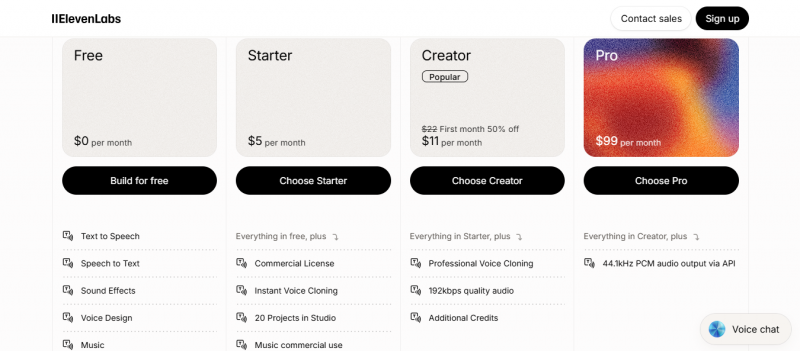
Credits roughly equal characters. Unused credits on paid plans roll over for up to two months. Commercial rights start at Starter. Flash model generations cost about half as much as the flagship model. A startup grant can give qualified AI agent builders up to 33 million characters free for 12 months.
| Plan | Monthly price | Credits / month | Voice cloning | Seats |
|---|---|---|---|---|
| Free | $0 | 10k | None | 1 |
| Starter | $5 | 30k | Instant | 1 |
| Creator | $11 first month, then $22 | 100k | Professional | 1 |
| Pro | $99 | 500k | Professional | 1 |
| Scale | $330 | 2M | Professional | 3 |
| Business | $1,320 | 11M | 3 professional clones | 5 |
OpenAI.fm Testing Steps
The full loop took under a minute per generation. Here is each step, with the source screenshot links from testing and a slot for your own.
STEP 1 · OPEN OPENAI.FM
An example script, voice, and vibe are pre-loaded
The page opens ready to play. The default script is a flight-rebooking customer service apology.
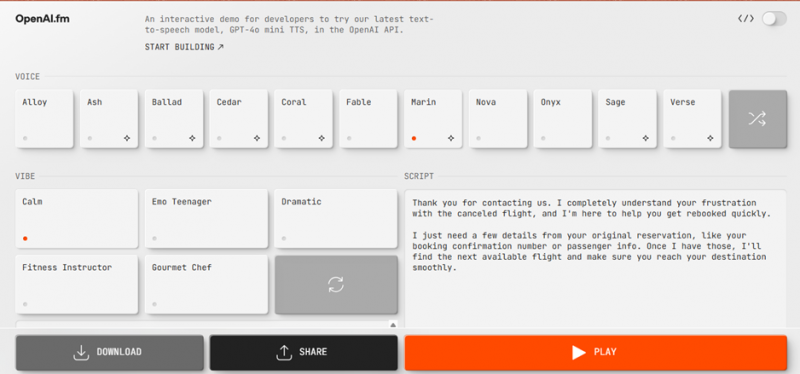
Zero-friction first impression No signup wall, no email capture, no trial popup. First audio played roughly 20 seconds after typing the URL. Against ElevenLabs' account-first flow, this is the biggest onboarding gap between the two tools. |
PICK A VOICE
11 voice cards, one orange selection dot
Alloy, Ash, Ballad, Cedar, Coral, Fable, Marin, Nova, Onyx, Sage, Verse, plus a shuffle button. The selected card shows a small orange dot.
The audition trick that saved time Keeping one script fixed and clicking through voices back-to-back exposed the differences within a single sentence. Worth knowing: OpenAI's own docs recommend Marin and Cedar for the best quality, and both are in the demo's lineup. |
PICK A VIBE OR WRITE YOUR OWN
Presets plus a fully editable instruction box
The presets are Calm, Emo Teenager, Dramatic, Fitness Instructor, and Gourmet Chef. Selecting Calm fills the box with direction about projecting quiet authority and confidence. A regenerate button swaps in fresh instruction text, and the box accepts custom directions for affect, tone, pacing, pronunciation, and emotion.
Why the split-input design matters The same script can flip from support-agent-calm to full drama without rewriting a word, because the what (script) and the how (vibe) are separate fields. ElevenLabs controls tone through tags inside the generation flow; OpenAI.fm controls it through plain-language direction that maps 1:1 to the API's instructions field, so anything dialed in here is reproducible in code. |
ENTER THE SCRIPT
The stress test: dry tech copy, moody delivery
Test input: a dense hardware explainer about Trainium, Amazon's custom AI training chip built by AWS. Settings: Cedar voice, Emo Teenager vibe.
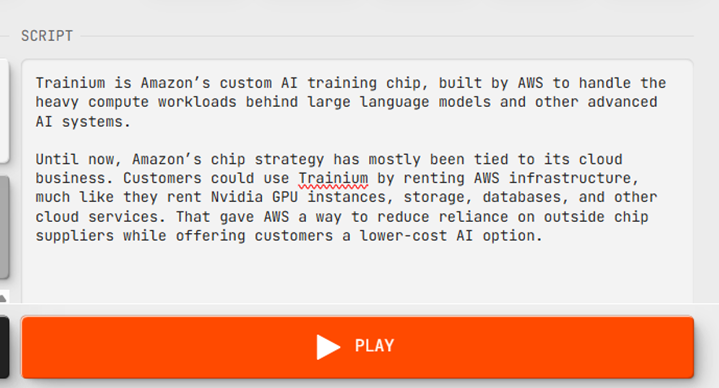
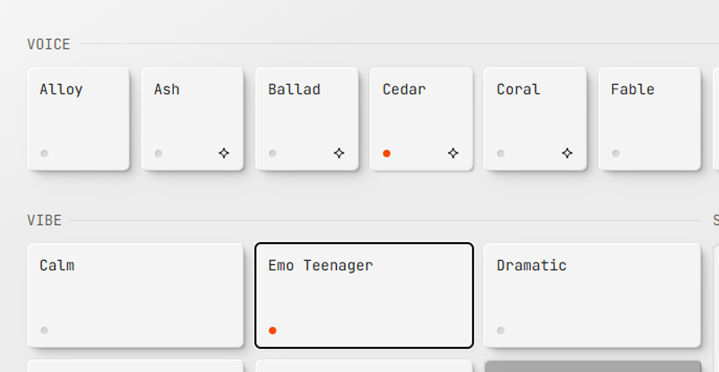
The mismatch test, and what it proved The chip explainer came out word-accurate but delivered in a moody, expressive teenage read. That mismatch is the clearest possible proof that gpt-4o-mini-tts performs text rather than reading it, which is exactly the steerability OpenAI markets for this model. |
PLAY, THEN DOWNLOAD
Orange Play button, three output options
A few seconds after pressing Play, the page read the full paragraph. The saved file: a standard mono MP3, just under 33 seconds, at a 24 kHz sample rate. The bottom bar offers Download (save the file), Share (a link to the exact setup), and the code button (the API call behind the settings).
Reading the file, not just hearing it 24 kHz mono is below studio spec, but the file dropped into a video draft with zero conversion. The code button is the quiet standout: it hands over the exact parameters to reproduce the result via the API, which turns the demo into a prototyping surface for anything built on gpt-4o-mini-tts. |
THE OPPOSITE-END CHECK
Marin voice + Calm vibe on the default support script
Switching to Marin with the Calm vibe on the flight-rebooking apology produced a steady, warm, reassuring read that could sit in front of customers. Only the voice and vibe changed between the two tests.
Where the demo's ceiling appeared Longer scripts drifted in tone across the read, unusual proper names occasionally stumbled, and non-English output was noticeably weaker, which matches OpenAI's note that voices are optimized for English. There is also no timeline editing, layering, or multi-speaker mixing anywhere on the page. It behaves exactly like what it is: a demo of one model. |
ElevenLabs Testing Steps
ElevenLabs got a longer trial: two weeks of heavy use on the Creator plan (100k credits), covering narration, cloning, voice design, dubbing, and transcription.
SIGN UP, OPEN TEXT TO SPEECH
Free account at elevenlabs.io, then into the dashboard
After signup, the Text to Speech and Voices sections are the entry point for everything: TTS, cloning, dubbing, and the Studio editor.
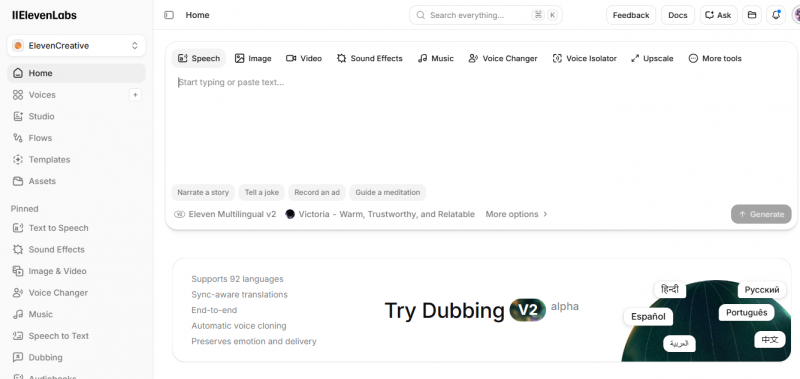
A dashboard with a learning cost The interface became comfortable only after a short period of experimenting, and on a credit-metered plan that experimenting is not free. On OpenAI.fm the equivalent learning period costs nothing; on the Creator plan every trial run consumed characters from the 100k monthly balance. |
PICK A VOICE OR BUILD A CLONE
10,000+ library voices, prompt-designed voices, or your own clone
Options at this step: browse the community voice library, design a synthetic voice from a text prompt, or clone a real one. The recommendation for professional cloning is one to three hours of clean audio recorded on a decent microphone.
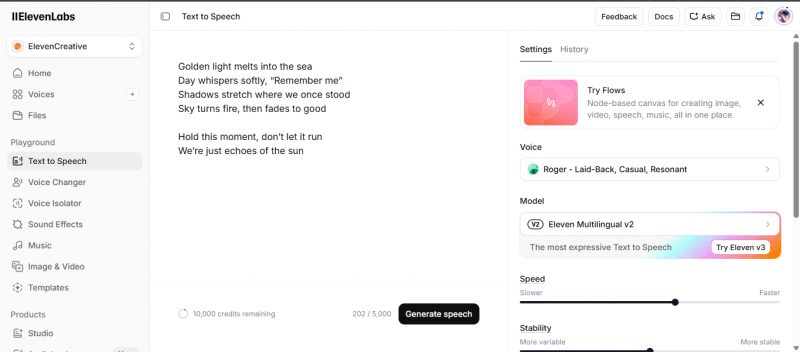
The 90-minute clone that fooled listeners A clone built from roughly 90 minutes of clean audio was convincing enough that people familiar with the original voice did not flag it until told. This capability has no equivalent on OpenAI.fm, which offers no cloning of any kind. The dependency is real though: clone quality tracked the source recording quality directly. |
PASTE THE SCRIPT, SET TAGS, GENERATE
Eleven v3 with emotion tags for the main narration test
Script pasted, tags and sliders adjusted for tone and emotion, then generated. Narration on the newest model with tags sounded like a professional voice actor reading the script, with pronunciation and numbers handled cleanly.

The Flash-drafts rule that protects credits The workflow that made the Creator plan sustainable: draft on Flash v2.5 (about half the credit cost, much faster), then render only the final take on Eleven v3. Skipping this rule in week one is exactly how the first chunk of the 100k balance disappeared. |
VOICE DESIGN FROM A TEXT PROMPT
Custom character voices for creative projects
Character voices generated from written descriptions worked well enough for in-character use in games and animation. The test paired a prompt-designed character with a prompt-designed voice.

Voices for characters who don't exist On OpenAI.fm the closest option would be picking one of 11 preset voices and steering it with a vibe. ElevenLabs generates a new voice from the description itself, which is the difference between casting from a small roster and inventing the actor. |
DUBBING AND SCRIBE TRANSCRIPTION
The platform features beyond text to speech
Video dubbing kept lip sync and emotional tone intact in the test clips. Scribe transcription stayed accurate even with background noise in the source recording.
One subscription, five workloads Dubbing, transcription, music, sound effects, and agents all sit under the same credit balance. That reframes the $22/mo Creator price: it is not $22 for TTS, it is $22 for the whole audio stack. Whether all five workloads are needed is the real purchase question, because OpenAI.fm covers exactly one of them. |
TWO WEEKS ON THE CREDIT METER
How 100k Creator credits actually behaved
Credits roughly equal characters. Week one, with freeform experimentation, drained the balance fast. Week two, with drafts on Flash, finals on v3, and no idle regenerations, the same allowance lasted comfortably. A small billing question to support was resolved quickly.
The tax on curiosity Every "let me try that once more" costs characters, so ElevenLabs effectively charges for exploration. Once scripts were planned before generating, costs became predictable. This single design choice explains most of the split in the reviews below: disciplined users rate it high, experimental users feel burned. |
Real User Reviews of Both Tools
Two weeks of testing is one data point. Below is the aggregate picture from G2, Trustpilot, and the OpenAI Developer Community, including the uncomfortable parts.
ElevenLabs on G2: 4.5/5 across 1,140+ verified reviews
| G2 rating | Ease of Use | Quality of Support | Product Direction |
|---|---|---|---|
| 4.5 / 5 (1,140+ reviews) | 8.8 / 10 | 8.3 / 10 | 9.5 / 10 positive |
G2's aggregated review themes rank the top strengths as Ease of Use (470 mentions), Quality (318), Speed (289), Features (239), and Easy Setup (218). The top complaints: Expensive (171 mentions), Needs Improvement (163), Pricing Issues (148), Missing Features (129), and Pronunciation Issues (109). 89.7% of G2 reviewers are small businesses.
G2 · VERIFIED REVIEWER · SOCIAL MEDIA ADVERTISING An advertiser using it daily for ad campaigns reports it saves time and money on voiceovers, praises the range of voices and fine-tuning, the ability to add emotion to ads, a very simple setup, easy downloads, and quick responses from customer support. |
G2 · VERIFIED REVIEWER · LOCALIZATION A team that pitched a voice-based judgment game says the platform let them present their idea clearly in a local Arabic dialect, crediting the multilingual coverage. |
ElevenLabs on Trustpilot: 900+ reviews, sharply split
TRUSTPILOT · 3D CGI ANIMATOR A creator producing CGI animation videos calls it excellent for high-quality voiceovers and emphasizes the same three things repeatedly: quality, speed, and the breadth of voice selection. |
TRUSTPILOT · ACCESSIBILITY DEVELOPER A developer building accessibility tools with audio in numerous languages says the output quality is hard to believe, keeps improving, and rates it "10/10 from me." |
TRUSTPILOT · LONG-TERM USER A returning user who cloned their own voice years ago recalls being impressed by how close the AI voice was to their real one, and how simple it was to paste a story and get an audio version. |


TRUSTPILOT · 1-STAR REVIEWER · NARRATION USER A frustrated narrator describes it as the worst AI text-to-speech experience they've had: glitch-filled narration that no remedy fixed even on plain text, no response to emails or support forms, and an AI help bot they found useless. Their sharpest line: great at taking money, lousy at everything else. |


INDEPENDENT CREATOR REVIEW (NERDYNAV) A YouTube creator credits ElevenLabs narration for reaching 6k subscribers and 8M views in 3 months, and after cross-checking Reddit, Trustpilot, and G2 against his own use, confirms the same pattern: natural voices, a quick-to-learn interface, impressive cloning from minimal samples, and reliable multilingual output with dubbing in 29 languages. |
The pattern: ratings on software review platforms sit in the high fours. Ratings on consumer platforms run lower, dragged down by credits, billing, and support access rather than audio quality. Both groups are describing the same product from different budgets.
OpenAI.fm: zero formal reviews, active developer feedback
| G2 listing for OpenAI.fm | API cost cited by developers |
|---|---|
| 0 reviews on file | $0.015 per minute of audio |
This is a fact most comparisons skip: OpenAI.fm's G2 profile has zero reviews. As a free demo, nobody is motivated to rate it. The real feedback lives in developer channels, and it cuts both ways.
INFOQ · INDUSTRY COVERAGE OF THE MODEL LAUNCH Reactions to gpt-4o-mini-tts were positive at launch, with the steerability singled out: developers can direct the model to sound like a sympathetic support agent or an engaging storyteller, tailoring speech per context without recording voice actors. |
PROMPTLAYER · TECHNICAL REVIEW OF GPT-4O-MINI-TTS The review highlights that modifying tone, emotion, speed, and accent through prompt text was previously impossible without multiple voice actors or heavy post-processing, and that at the current per-minute price the cost barrier for expressive speech has effectively collapsed. It also flags two weaknesses: occasional glitches in lengthy narrations and uneven quality across non-English languages. |
OPENAI DEVELOPER COMMUNITY · JAN 2026 FEEDBACK THREAD A developer reports the gpt-4o-mini-tts voice suddenly slowing down, with long silent pauses after each word producing unnatural articulation, and notes the speed parameter cannot fix it because it only digitally stretches or compresses the audio, further damaging authenticity. |
OPENAI'S OWN TTS DOCUMENTATION OpenAI itself states the voices are currently optimized for English and recommends Marin or Cedar for best quality, an implicit admission that the other nine demo voices and non-English output sit a tier below. |
The pattern: OpenAI.fm avoids ElevenLabs-style billing anger because it never charges the demo user. But developer threads document real model wobbles, and everyone, including its fans, treats it as a prototyping surface before a paid pipeline rather than the pipeline itself.
My Verdict
I went into this expecting to crown one winner. I came out with both tools still open in my browser, for completely different reasons.
OpenAI.fm won my bookmarks bar. Not because it has better voices, it doesn't, but because it removed every excuse between me and hearing an idea out loud. The moment that sold me was flipping the Trainium chip paragraph into an emo-teenager delivery, then turning the flight apology into a calm Marin support voice, all inside the same minute, for free. When I'm deciding what a project should sound like, nothing beats that speed. But every time I pushed it further, a longer script, a tricky name, anything beyond English, I hit the demo's ceiling, and the Jan 2026 developer complaints about slowdowns tell me that ceiling occasionally drops without warning.
ElevenLabs won my actual output folder. The v3 narration that sounded like a hired voice actor, the 90-minute clone that fooled people who know the original voice, the dubbed clip that kept its lip sync: that's shippable work, and OpenAI.fm cannot produce any of it. But I won't pretend the credit system isn't a real flaw. It punished my first week of curiosity, and 148 pricing complaints on G2 plus the Trustpilot billing anger show I'm far from alone. ElevenLabs is a phenomenal tool that makes you earn it, with discipline, planning, and a card on file.
So my personal workflow is now embarrassingly simple: I prototype voice and tone on OpenAI.fm for free, and when a script is final and worth spending credits on, I render it in ElevenLabs, drafting on Flash and finishing on v3. Treating them as rivals is the wrong frame. Treating them as a pipeline is the cheat code.
Choose OpenAI.fm if You need audio today, for free: testing an app's tone, drafting a short English voiceover under 2,000 characters, or auditioning voices before writing API code. It's also the obvious pick if you'll build on gpt-4o-mini-tts anyway, since the demo hands you the exact API call. |
Choose ElevenLabs if Your audio faces real listeners: audiobooks, YouTube narration, dubbing, agents, or cloning a real voice. Start on the 10k-credit free plan, learn the Flash-drafts / v3-finals workflow before upgrading, and budget credits like money, because they are. |
Post Comment
Share your thoughts about this article.
Be the first to post a comment!