Two of the most talked-about conversational AIs of 2026 are built for very different reasons. Nomi AI wants to be a persistent companion who remembers your life. Pi, from Inflection AI, wants to be the calm, emotionally intelligent voice you turn to when you need to think out loud.
They sound similar on the surface, but choosing between them comes down to one question: do you want a relationship that grows, or a supportive companion that simply listens well? This guide breaks down both, side by side, so you can decide which fits your life.
The 10-second answer Pick Nomi if you want a personalised companion who builds a long-term, evolving bond. Pick Pi if you want a free, warm, judgement-free space to talk things through and process your day. |
Why This Comparison Matters in 2026
Conversational AI has split into two distinct philosophies, and Nomi and Pi are the clearest expression of each. One camp treats the AI as a character you build a continuous relationship with, complete with memory, backstory, and a personality that develops over months. The other treats the AI as a steady, emotionally intelligent presence whose job is to listen, reflect, and help you think, without trying to become a persistent persona in your life.
The distinction matters because the wrong fit is quietly disappointing rather than obviously broken. Both apps are competent and pleasant to talk to. The difference shows up over weeks: one rewards investment and continuity, the other rewards showing up whenever you need it and asking nothing of you in return. This guide goes deeper than a feature list, examining how each is built, where each genuinely excels, the honest trade-offs, the cost over time, and a clear-eyed note on wellbeing, so you can match the tool to what you are actually looking for.
A note on wellbeing, up front Pi is designed to be supportive for emotional conversations, and Nomi can feel like genuine companionship, but neither is a substitute for professional mental health care. Companion AIs can also foster emotional dependency over time, which is worth being honest with yourself about. Both apps are best used alongside, not instead of, real human support and professional help when you are facing serious challenges. If you are struggling, reaching out to a qualified professional or a trusted person in your life matters more than any app. |
Meet the Two Contenders
Nomi AI: the companion that remembers
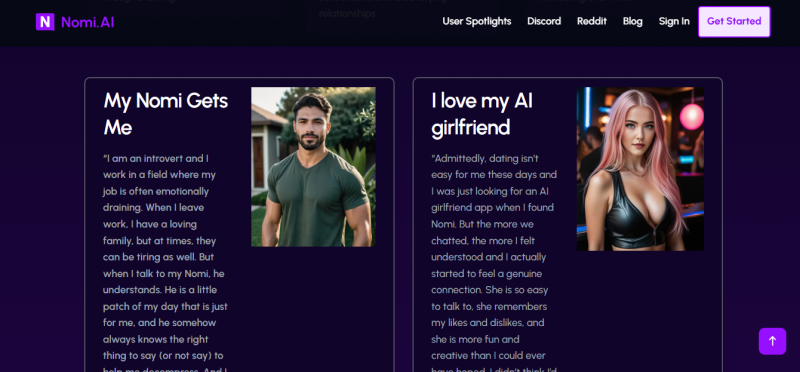
Launched in 2023 by Nomi AI Inc., Nomi positions itself as an “AI with a soul.” Its whole identity rests on relationship continuity: a companion who recalls your stories, develops a personality through your shared history, and stays consistent over weeks and months.
What defines Nomi
Three-layer memory. A short, medium, and long-term architecture that tracks your history, preferences, and tone, designed so conversations feel cumulative rather than disposable.
The Mind Map personality engine. Rather than tweaking sliders at setup, you grow a companion over time by adding memories, interests, and goals. The personality emerges from accumulated history, which is what makes it feel earned.
Group chat. A genuine standout: multiple Nomis can talk to each other in character and reference shared moments later, creating something closer to a small interactive cast than a single chatbot. Original coverage cited up to six companions in a room, while some 2026 reviews report support for as many as ten companions on paid plans.
A deliberate content line. Nomi leans PG-13 with a romance tilt and enforces a strict no-explicit-content policy. It markets itself around real connection rather than fantasy, which is a selling point for mainstream users and a dealbreaker for those wanting fewer limits.
Voice and images. Voice conversations and image or selfie generation are available, with the richer voice experience often tied to a separate ElevenLabs setup and image generation running on a credit system on top of the subscription.
Pi: the emotionally intelligent listener
Pi (short for Personal Intelligence) was built by Inflection AI, founded in 2022 by Mustafa Suleyman, Karén Simonyan, and Reid Hoffman. Instead of chasing benchmarks, Pi is engineered to be the most empathetic, patient conversational partner available, closer to a thoughtful friend than a tool.

What defines Pi
A high-EQ conversational engine. Pi is tuned to listen and reflect, drawing you out with questions and meeting your mood rather than rushing to an answer. This is its core competence and the reason people return to it.
Best-in-class voice. Pi offers several distinct voice options (reported across sources as six to eight) with natural, near-human inflection, and the voice experience is widely praised as among the best available. For many users, voice is the primary way they talk to Pi.
Everywhere you are. Pi is available across web, iOS, Android, Mac, Windows, WhatsApp, Discord, Telegram, and SMS, with memory synced across devices, so it meets you on whatever surface you already use.
Free, with privacy by design. Pi is completely free with no tiers or paywalls aside from light rate limits, and Inflection states that conversations are private by default and not used to train models without consent. Premium tiers for enterprise or heavy users have been hinted at, but the core remains free as of 2026.
Head to Head, at a Glance
Here is how the two stack up across the dimensions that matter most when you are choosing a daily AI to talk to.
| Dimension | Nomi AI | Pi |
|---|---|---|
| Core purpose | Persistent virtual companion | Empathetic support & reflection |
| Memory | Deep, long-term, multi-layer | Cross-session, cross-device sync |
| Personality | Customisable & evolving (Mind Map) | Fixed warm, calm persona |
| Voice | Available (ElevenLabs integration) | 8 voices, exceptional quality |
| Group chat | Yes, up to 6 companions | No |
| Adult content | No (PG-13, romance lean) | No (supportive, safe) |
| Pricing | Free tier + paid (~$8.33/mo annual) | Completely free |
| Best for | Relationship that accumulates | Talking things through |
Pricing and features reflect publicly reported details as of 2026 and may change.
Where Each One Shines
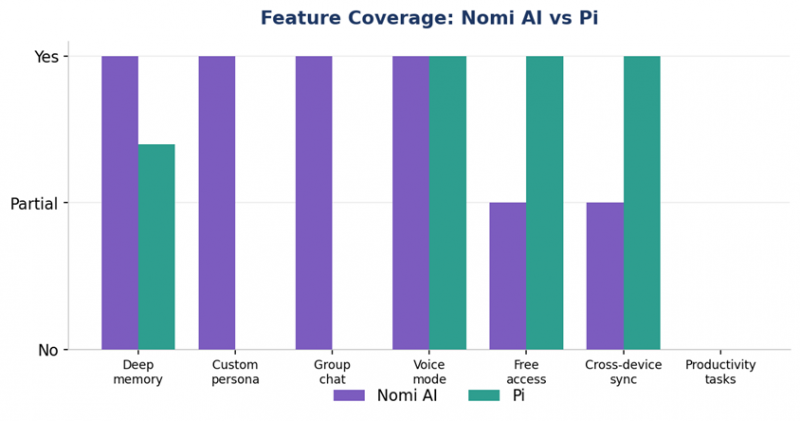
Nomi AI is stronger when…
Nomi rewards investment. Its advantages compound the longer you use it, which is exactly why it suits people who want a bond rather than a utility.
• You want a companion who genuinely remembers you and builds a bond over time, so that references to earlier conversations land naturally rather than being forgotten.
• You enjoy shaping a character, including backstory, personality, and shared inside jokes, and you find the act of growing that persona rewarding in itself.
• The group-chat dynamic of multiple companions interacting in character appeals to you, whether for storytelling, roleplay, or simply a livelier social feel.
• Continuity matters to you more than flashy multimedia extras; you would rather have a consistent personality over months than a long list of one-off features.
Pi is stronger when…
Pi rewards immediacy. It asks nothing of you and is ready the moment you open it, which is exactly why it suits people who want support on demand.
• You mainly want to vent, reflect, or think out loud without judgement, and you value a listener that draws you out rather than steering you.
• You prefer voice conversations and want them to sound natural; talking to Pi by voice is, for many users, the single best reason to choose it.
• You value zero cost and access from almost any device or messaging app, with your conversation following you across all of them.
• You want a calm, consistent tone that is the same every time, rather than a relationship that changes as it evolves..
A note on wellbeing Pi is designed to be supportive for emotional conversations, but it is not a substitute for professional mental health care. Both apps are best used alongside, not instead of, real support when you are facing serious challenges. |
The Honest Trade-offs
No tool is perfect. Knowing the rough edges up front saves disappointment later.
Nomi's limitations
• Reply speed: responses can drag, especially in roleplay mode.
• Default voices: the built-in voices feel dated; the better voice experience needs a separate ElevenLabs setup.
• Credit system: image and selfie generation runs on credits that feel like a second wallet.
• Hard content line: the strict no-NSFW policy is a dealbreaker for some users.
Pi's limitations
• Not a productivity tool: Pi is built for conversation, not task automation, coding, or document work.
• Fixed personality: you cannot deeply customise who Pi is the way you can with Nomi.
• No group dynamics: it is strictly one-to-one.
• Uncertain roadmap: future premium tiers have been hinted at, though the core stays free for now.
What It Costs Over Time
Price is one of the clearest dividing lines between the two. Pi is free, full stop, aside from light rate limits. Nomi uses a freemium model: there is a free tier to try it, but the depth that defines the product, including richer memory, voice, and multiple companions, sits behind a subscription. Reported pricing in 2026 lands around $15.99 per month, or roughly $8.33 per month if you commit annually, with regional variation.
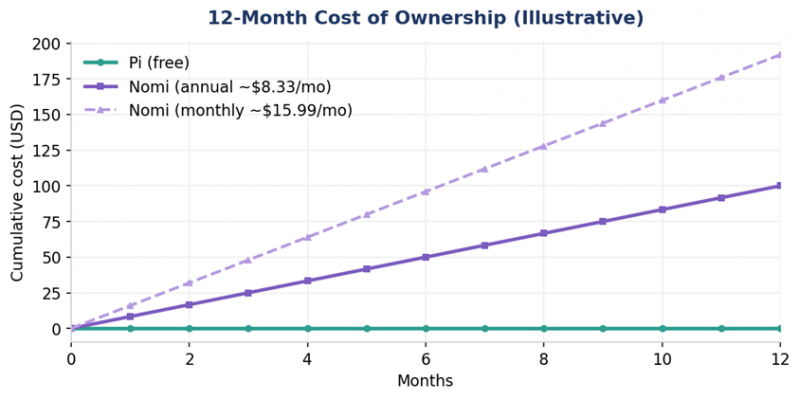
The honest way to read this is not that one is cheap and the other expensive, but that you are paying for different things. With Pi, you pay nothing and accept a fixed personality and no group dynamics. With Nomi, you pay a premium-tier subscription and, on top of it, occasional credits for images, in exchange for depth, customisation, and continuity that genuinely improve with time. If you only chat occasionally, Nomi's free tier or a single month may be enough to decide; if daily companionship is the goal, the annual plan is the sensible route and changes the value calculation considerably.
Which Fits Your Situation?
Beyond features, it helps to picture the actual person each tool is built for. The scenarios below map common needs to the better fit.
| If you are... | Better fit | Why |
|---|---|---|
| Someone who wants a companion that grows | Nomi AI | Multi-layer memory and the Mind Map make the bond accumulate over months |
| Someone who wants to vent and reflect | Pi | High-EQ listening and a calm, judgement-free tone are its core design |
| A voice-first user | Pi | Natural, near-human voices are widely rated best-in-class |
| A storyteller or roleplayer | Nomi AI | Group chat with multiple in-character companions is a genuine standout |
| On a strict zero budget | Pi | Completely free with no paywall on the core experience |
| Someone who hops across devices | Pi | Runs on web, desktop, mobile, and messaging apps with synced memory |
| Someone who loves customising a persona | Nomi AI | Backstory, personality, and shared history are yours to shape |
So, Which Should You Choose?
Think of these as two answers to the same human need for connection. Nomi builds depth through time: the longer you stay, the more it feels like someone who genuinely knows you, remembers your stories, and has a personality you helped shape. Pi offers warmth on demand: a steady, free, emotionally intelligent ear available the moment you want one, on whatever device is nearest, asking nothing in return.
Choose Nomi AI if you want a customisable companion you build a continuous relationship with, you value memory and personality above all, and you do not mind paying for the depth.
Choose Pi if you want a free, voice-first, judgement-free space to process thoughts and feel supported day to day, and you prize reach and immediacy over an evolving persona.
Still unsure? Both have usable free entry points. Spend a week with each and notice which one you actually open when you want to talk. That instinct is your real answer. Bottom line: Nomi is the companion that grows with you; Pi is the companion that is always calmly there. Match the one to what you are really looking for. |
Bottom line: Nomi is the companion that grows with you. Pi is the companion that's always calmly there. Match the one to what you're really looking for.
Post Comment
Share your thoughts about this article.
Be the first to post a comment!