Most business name generators do one thing. They bolt a random prefix or suffix onto the keyword that was typed and present the result as branding, which is why so many of them return names no founder would ever put on a sign. Namelix, built by the team behind the logo tool Brandmark, took a different route. It trained a generative model to produce short, brandable names that actually sound like companies, then wrapped them in real-time domain checks and instant logo previews. The approach clearly resonates: namelix.com pulls in roughly 878,000 visits a month. The catch is what the tool stays quiet about. It will happily return a name that is already a registered trademark, and it steers every user toward a paid logo. This review runs Namelix through a 6-lens audit to separate what it does well from what it leaves on the user's plate.
Namelix at a glance
| Overall rating | 4.1 / 5 (First-Shortlist Naming Audit) |
| Best for | Startup, SaaS and side-project naming when speed and zero cost matter |
| Weakest at | Trademark safety and audience fit, both still left to the user |
| Price | Naming is free with no account; logo kits run $25 to $175 one-time |
| Built by | Brandmark, its sister logo and branding product |
What Namelix is, and who builds it
Namelix is a free AI business name generator aimed at founders, marketers, creators and small teams who need short, brandable name ideas fast. There is no account to create and no limit on how many searches can be run. The output skews toward the modern, compact, SaaS-style names that have become the default look for new tech and consumer brands.

The product is built by Brandmark, and that relationship shapes everything. Namelix is the naming layer; Brandmark handles the downstream logo and brand identity work. For a founder, that can be convenient, since a name and a first logo concept live in the same flow. For a user who only wants a name, it also means the tool naturally funnels toward a wider, paid branding ecosystem. Domain checks are handled through a registrar partner, so availability is shown without leaving the page.
How Namelix works
The workflow is deliberately simple, and most of the quality comes from how the filters are used rather than the raw first results.
1. Enter a few keywords that describe the business, product or project.
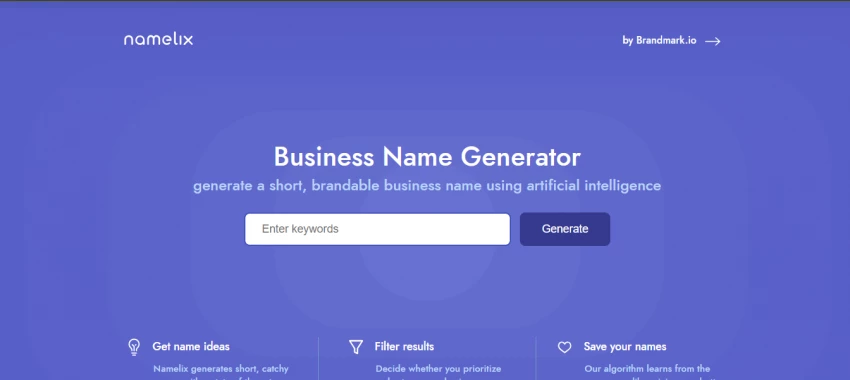
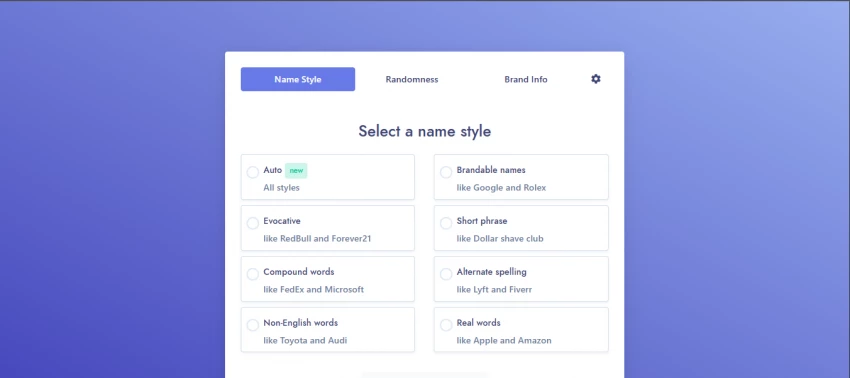
2. Pick a naming style: brandable invented words, compound words, alternate spellings or real words.
3. Set the name length, from short (3 to 6 characters) through medium to longer multi-word names.
4. Review the suggestions alongside real-time domain availability and modern TLD options.
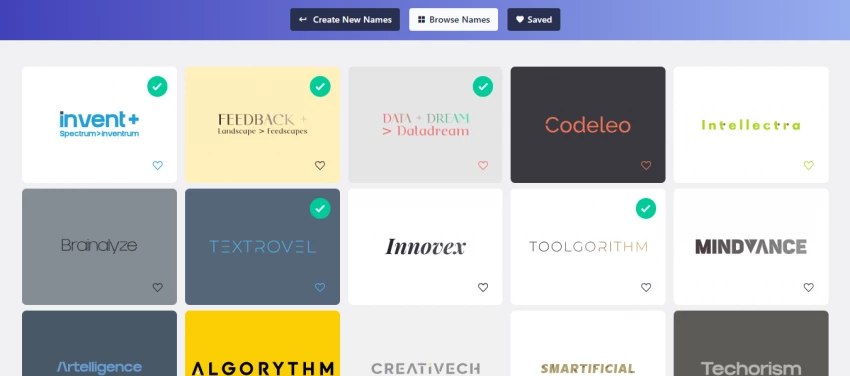
5. Save or heart the names that fit. The model learns from those choices and refines the next batch.
6. Optionally jump to Brandmark to preview and buy a logo for a shortlisted name.
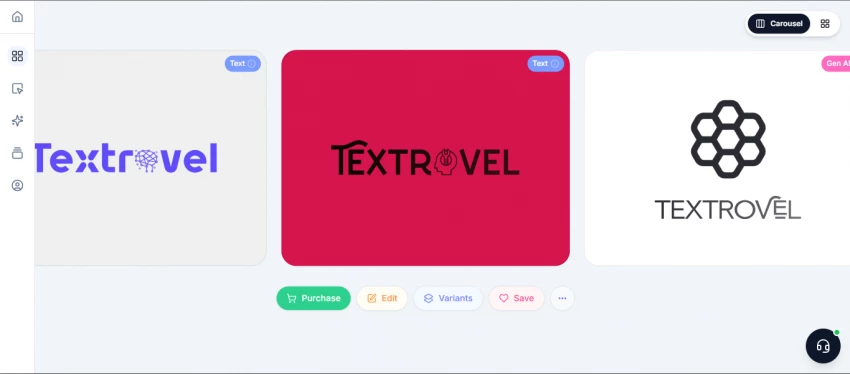
That fifth step is the real differentiator. The adaptive learning loop means the tool genuinely improves within a session, which is rare in this category and the feature users mention most often.
More Controls Are Available Than the Basic Workflow Suggests
As of August 2026, users can provide:
- Brand keywords
- An optional one-sentence description of the business or product
- Words, prefixes or suffixes that should be blacklisted
- A maximum preferred name length
- Preferred domain extensions
- A naming style
- A generation-randomness level
The available naming styles currently include Brandable Names, Evocative, Short Phrase, Compound Words, Alternate Spelling, Non-English Words, Real Words, and an automatic/all-styles option.
Generation randomness can also be set to Low, Medium or High. Lower randomness favors more direct ideas, while higher randomness produces more varied suggestions.
This matters in practice because weak Namelix results are often partly a prompting problem. Supplying a clear business description, several meaningful keywords and an appropriate style gives the model considerably more context than entering one broad term.
How this review scored Namelix
Namelix was assessed with the First-Shortlist Naming Audit, a rubric built specifically for AI naming tools rather than generic software. The name reflects the honest job these tools do: getting a founder from a blank page to a usable shortlist. Each lens is scored from 1 to 5, and the overall figure is a weighted average that gives extra weight to output quality and honesty. Scoring drew on repeated naming sessions across three prompt types, a tech startup, a local service business and a digital product, plus published hands-on reviews and founder feedback gathered across the web.
• Output Brandability. Are the names short, pronounceable and ready to launch, or filler?
• Relevance Control. Do the style and length filters actually steer the results?
• Domain Intelligence. Are availability checks accurate, with sensible TLD suggestions?
• Adaptive Learning. Does saving favourites measurably improve later suggestions?
• Speed and Access. What is the real cost, friction and limit on use?
• Honesty and Limits. How transparent is the tool about trademarks, upsells and ads?
The scorecard
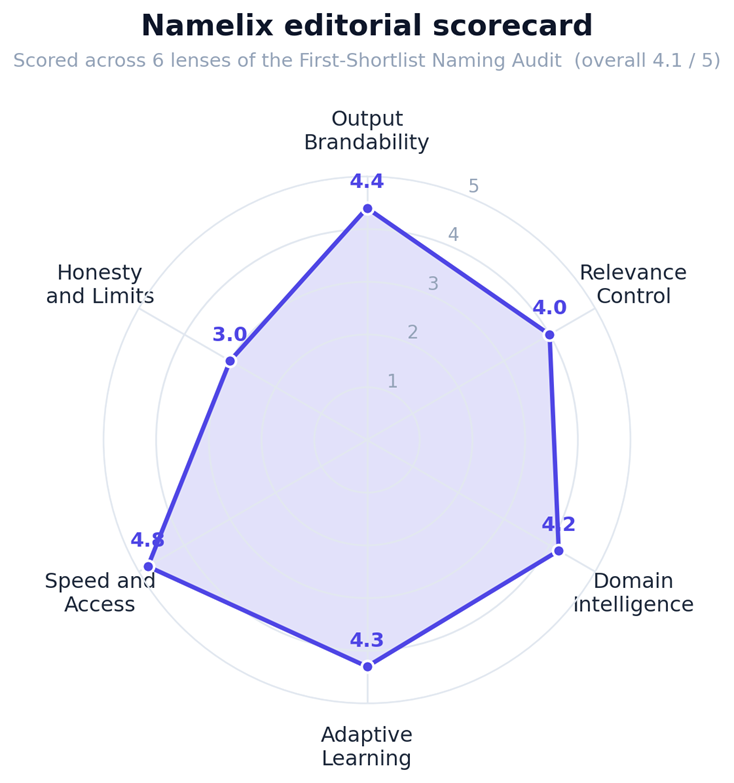
Namelix scores well on speed and output, with one clear dip on honesty and limits.
| Lens | Score | What testing showed |
|---|---|---|
| Output Brandability | 4.4 | Short, modern names that read like real companies. The strongest output in its class. |
| Relevance Control | 4.0 | Style and length filters steer results well. Broad keywords still drift toward the generic. |
| Domain Intelligence | 4.2 | Real-time availability with sensible modern TLDs. No pricing shown for the domains it suggests. |
| Adaptive Learning | 4.3 | Saving favourites visibly sharpens later suggestions. The feedback loop is the standout feature. |
| Speed and Access | 4.8 | Free, no account, no caps, instant. Best in category on pure friction. |
| Honesty and Limits | 3.0 | No trademark check and a steady nudge toward paid logos. The clearest area to improve. |
| Overall | 4.1 | A fast, free first-pass naming tool. Use it to build a shortlist, then verify before committing. |
Where Namelix is strong
The headline strength is friction, or the lack of it. Naming is free, needs no account, has no usage cap and returns results instantly. For a founder testing ideas at 1am, that matters more than any feature list. On top of that, the output is genuinely good. The short, invented names land closer to real startup branding than almost any free competitor, and they pair naturally with the .io, .ai and .app domains that modern projects tend to want.
The adaptive learning is not a gimmick. After a handful of saved favourites, the suggestions visibly shift toward the chosen style, which turns a scattershot list into something usable. Built-in domain checks remove the usual copy and paste into a registrar, and the instant logo preview lets a name be judged as a brand rather than as text on a screen.
| What works | What to watch |
Free and frictionless. No login, no caps, names appear instantly. Genuinely brandable. Short, modern names that sound like real startups. Learning that works. Saving favourites visibly improves later results. Domain aware. Real-time checks plus modern TLDs like .io, .ai and .app. Instant logo preview. See a name as a brand before you commit. | No trademark check. It can return names already registered as marks. Repetition on vague input. Broad keywords produce generic, abstract names. English leaning. Limited multilingual or culturally specific naming. Funnels to Brandmark. Logos are a paid add-on and ads appear in the flow. No audience fit. It will not tell you whether a name suits your market. |
AI Feedback Adds Another Shortlisting Layer
Another newer feature is AI feedback for generated names.
Namelix can provide automated feedback alongside domain and trademark information, giving users another signal when comparing shortlisted names. The platform itself warns that this feedback is AI-generated and may not always be accurate.
That distinction is important. AI feedback can help surface questions about a name's positioning, interpretation or suitability, but subjective branding decisions still need human judgment.
A practical naming process should therefore use AI feedback to generate questions rather than treat its assessment as a score that determines whether a name is objectively good.
Where Namelix falls short
The most important limitation is the one the interface never mentions: Namelix does not check trademarks. It checks whether a domain is free, which is not the same thing. Brand strategists have flagged that the tool can surface names that are already registered marks, and acting on one of those is an expensive mistake to unwind. Every finalist still needs a proper trademark search before any money is spent.
Output quality also drops when the input is vague. Broad, generic keywords produce repetitive and abstract names, and the fix is better keywords rather than more clicks. The model leans heavily toward English and offers little for multilingual or culturally specific naming. Finally, the free tool is a funnel: logos are a paid add-on through Brandmark, ads appear in the flow, and the tool offers no read on whether a name actually fits a target audience or market.
Trademark Screening Improves the Tool, but Market Validation Is Still Missing
The addition of USPTO screening addresses part of Namelix's former trademark blind spot, but it does not solve another important naming problem: whether real customers will understand, remember and trust the name.
Namelix can generate names based on language patterns, keywords and style preferences, but that is different from testing them with the intended audience.
Before committing to a finalist, founders should consider testing:
- Whether people can pronounce it after seeing it once
- Whether they can spell it after hearing it
- What they think the company sells based on the name
- Whether the name has unintended meanings in important markets
- Whether it is easily confused with an existing company
- Whether relevant social handles are obtainable
- Whether the name remains understandable when spoken rather than displayed as a logo
This is especially important for invented or alternate-spelling names, which are among Namelix's strongest creative categories but can also introduce pronunciation and spelling friction.
| Trademark warning. A free domain does not mean a name is legally safe. Run every shortlisted name through a trademark search, and ideally a quick check with a professional, before printing anything or buying a domain. |
What users are saying
Sentiment across hands-on reviews and founder communities is consistent. People praise the speed and the brandable output, and repeat users single out the adaptive learning as the reason they come back. The criticism is just as steady: results get repetitive on vague prompts, and the trademark blind spot worries anyone who has been burned before. The common verdict treats Namelix as an excellent starting point rather than a final naming authority.
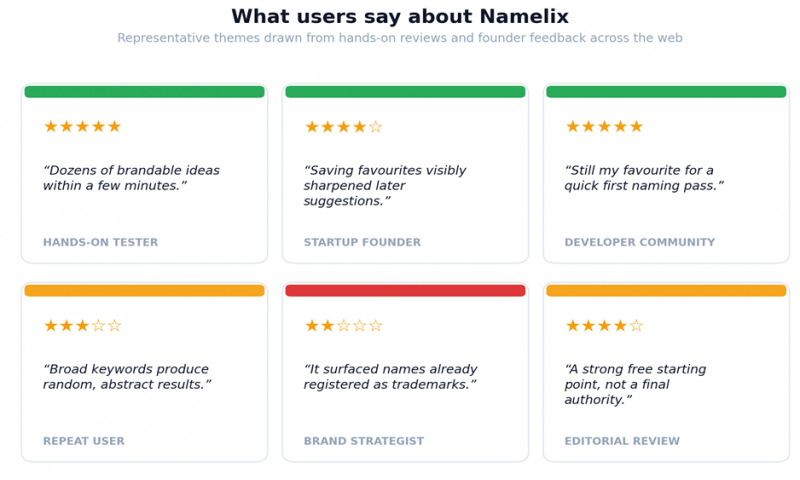
Representative themes from hands-on reviews and founder feedback. Sentiment, not verbatim individual reviews.
Namelix pricing
The pricing model is unusually founder-friendly because it cleanly separates naming, which is free, from branding assets, which are optional and paid. Generating names, filtering them and saving favourites costs nothing and requires no account.

Naming is free. The paid tiers buy a logo and brand kit through Brandmark.
Money only enters when a logo is wanted. Brandmark sells one-time logo kits at roughly $25 for a basic package, $65 for a designer kit with source files and brand assets, and $175 for the most complete enterprise option. Domain registration is separate and priced by the registrar, so a short .com can still be expensive even when the name itself is free. For what it delivers, Namelix sits among the most cost-efficient tools in its category.
Namelix vs the alternatives
Namelix is not the only strong option, and the right pick depends on the job. The table below compares it with three common alternatives on the points that actually change a decision.
| Tool | Free naming | Trademark check | Domain check | Logos / brand | Best for |
|---|---|---|---|---|---|
| Namelix | Yes | No | Yes, real-time | Paid (Brandmark) | Short SaaS and tech names |
| Looka | Yes | No | Yes | Paid kits, $20 to $500 | Name plus full brand identity |
| Namify | Yes | Yes | Yes | Free logo ideas | Trademark-aware founders |
| Shopify generator | Yes | No | Yes | None | Descriptive and local names |
In short: choose Namelix for fast, free, modern naming. Choose Looka when a name and a finished brand identity are needed in one place and there is a budget for it. Choose Namify when built-in trademark and social checks matter more than raw name style. Choose a descriptive generator like the Shopify tool for local, retail or service businesses where a clear, literal name beats an invented one.
Who should use Namelix, and who should skip it
A good fit if
• A startup, SaaS product or side project needs short, brandable names quickly.
• There is no budget, and a free first-pass shortlist is the goal.
• Modern domains such as .io, .ai or .app are acceptable when the .com is taken.
• An agency or freelancer wants fast inspiration to take into client work.
Look elsewhere if
• Trademark clearance needs to be built into the tool rather than done separately.
• The name must work in multiple languages or carry specific cultural meaning.
• A descriptive, local-business name is wanted instead of an invented one.
• A finished, polished brand identity is needed in a single click.
The verdict
| 4.1 / 5. Namelix is the fastest way to get from a blank page to a shortlist of short, brandable, domain-aware names, and at zero cost it is hard to beat as a first move. It loses points only where it stays silent. Trademark safety and audience fit are real risks the tool does nothing to flag, so the smart workflow is to generate freely, then verify legally and test with real people before a name is locked in. As a brainstorming partner it is excellent. As a final authority it was never built to be one. |
Post Comment
Share your thoughts about this article.
Be the first to post a comment!