Table of Content
- What Is CrossMarket AI?
- What Is Copy.ai?
- Side by Side Feature Comparison
- Detailed Feature by Feature Breakdown
- Pricing Breakdown: What Each Platform Actually Costs
- Use Case Suitability: Where Each Platform Wins
- Pros and Cons at a Glance
- How to Choose: A Practical Decision Framework
- A 7-question checklist before signing a contract
- Final Verdict
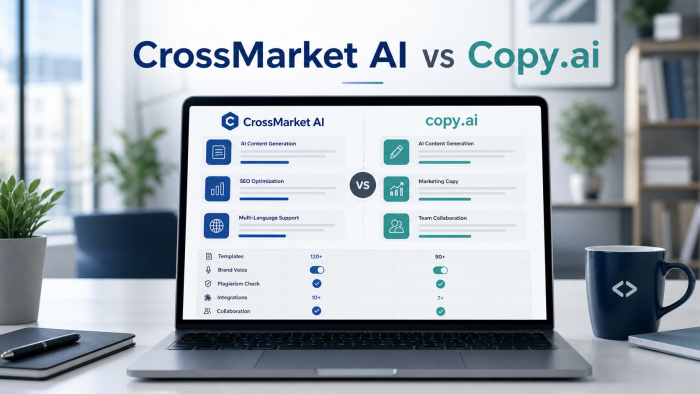
AI has reshaped how marketing teams operate. Two platforms frequently surface in buyer conversations: CrossMarket AI, positioned as a marketing and workflow automation platform, and Copy.ai, the well-known AI content generation tool that has expanded into go-to-market workflows. While both leverage artificial intelligence to accelerate marketing outcomes, they solve very different problems.
This comparison breaks down the strengths, weaknesses, pricing, and ideal use cases of each tool so marketing leaders, agency owners, and growth teams can decide which platform fits their stack - or whether both should run side by side.
Quick Verdict CrossMarket AI is the stronger choice when the priority is automating multi-channel campaigns, customer journeys, and cross-team workflows. Copy.ai is the stronger choice when the priority is producing high volumes of on-brand written content quickly. Many fast-moving teams use both: CrossMarket AI as the orchestration layer and Copy.ai as the content engine. |
Note on naming: Several unrelated products use the “CrossMarket AI” name (including a financial-trading platform). This comparison refers specifically to the marketing and workflow-automation platform positioned for go-to-market teams.
Marketing Automation vs Content Generation: Why the Difference Matters
Before comparing tools, it helps to draw a clean line between two AI categories that often get blurred.
Marketing automation, in one sentence
Marketing automation orchestrates the full lifecycle of a campaign - segmenting audiences, triggering messages across channels, scoring leads, scheduling sends, and analyzing performance - with minimal manual handoff.
Content generation, in one sentence
Content generation produces the actual creative assets - blog posts, ad copy, email bodies, social captions, product descriptions, and landing-page text - using large language models trained to mimic specific tones and structures.
The simplest mental model: content generation answers "what do we say?" while marketing automation answers "how, when, and to whom do we say it?" CrossMarket AI sits firmly in the second camp. Copy.ai built its reputation in the first camp and is now pushing into automation territory through GTM workflows.
Quick conceptual comparison
| Dimension | Marketing Automation (CrossMarket AI) | Content Generation (Copy.ai) |
|---|---|---|
| Primary purpose | Orchestrate campaigns and workflows across channels | Produce written marketing assets at scale |
| Core output | Triggered actions, segmented sends, dashboards | Drafts of blogs, emails, ads, captions, descriptions |
| Time saved on | Manual segmentation, scheduling, reporting | First drafts, ideation, copy variations |
| Buyer persona | Marketing ops, growth, RevOps leaders | Content marketers, copywriters, social teams |
| Success metric | Pipeline velocity, conversion rate, MQL volume | Words produced, content cycle time, engagement lift |
What Is CrossMarket AI?
CrossMarket AI is a workflow intelligence platform built for marketing and operations teams that need a single environment to automate processes that would otherwise span half a dozen disconnected tools. Its design philosophy is broad applicability: rather than mastering one niche, it tries to handle the repetitive, cross-functional patterns common to most modern businesses.
Core capabilities
• Workflow orchestration: Visual workflow mapping that lets teams design multi-step processes - lead capture, scoring, nurturing, and handoff - without code.
• Cross-channel campaign automation: Triggers and rules that coordinate email, SMS, push, and ad audiences from one place, with branching logic based on customer behavior.
• Customer journey mapping: AI-driven journey models that link touchpoints across channels so attribution and personalization stay consistent.
• Predictive analytics & insights: Pattern detection on engagement and conversion data, surfacing bottlenecks and recommending next-best actions.
• A/B testing automation: Experiment setup, traffic allocation, and statistical analysis handled end-to-end, freeing teams from manual test design.
• Recommendation engines: Behavioural and product recommendation logic that powers personalized content blocks across email, web, and ads.
Where it shines
Teams running complex, multi-touch campaigns across email, web, paid, and lifecycle channels gain the most. Reducing the number of point tools, unifying audience data, and removing handoffs between platforms are the typical headline wins.
Where it falls short
CrossMarket AI is not a copywriting tool. While it can plug content into automated workflows, the actual creative assets generally need to come from a dedicated content tool, an in-house writer, or an agency. Brand voice training and long-form generation are not its strengths.
What Is Copy.ai?
Founded in 2020, Copy.ai began as a focused short-form copywriting assistant and has since grown into what the company calls a GTM AI platform - combining content generation with workflow features for sales and marketing teams. The platform supports more than 90 content templates spanning blog posts, ads, emails, product descriptions, and social captions, and it works across 25+ languages.
Core capabilities
• AI content generation: Drafts long-form posts, short-form ads, emails, captions, and product descriptions from short prompts using multiple underlying LLMs.
• Brand Voice: Trains on a team's existing content so generated drafts match a defined tone, vocabulary, and style across formats.
• Workflow automation (Infobase + Workflows): Multi-step workflows that research a topic, generate outlines, write drafts, and prepare publication assets automatically.
• Templates and prompt library: Pre-built templates for common marketing content types reduce setup time for non-technical users.
• Multilingual output: Generation in 25+ languages, useful for teams running campaigns across global markets.
• Team collaboration: Shared workspaces, brand voices, and content history that let multiple writers and editors coordinate on the same project.
Where it shines
Solo marketers, content teams, and agencies that need to ship a high volume of written assets quickly find immediate value. The free tier is sufficient to test the platform on real projects, and the Pro tier removes word caps for teams pushing serious volume.
Where it falls short
Several reviewers note that long-form output frequently needs heavy fact-checking and rewriting, and that very long articles can feel formulaic without strong human editing. Third-party integration depth is also more limited than dedicated marketing automation suites.
Side by Side Feature Comparison
The chart below summarizes how the two platforms score across the six capability areas marketing buyers most often evaluate. Scores reflect publicly reported features, vendor documentation, and aggregated review patterns - they are directional rather than absolute.
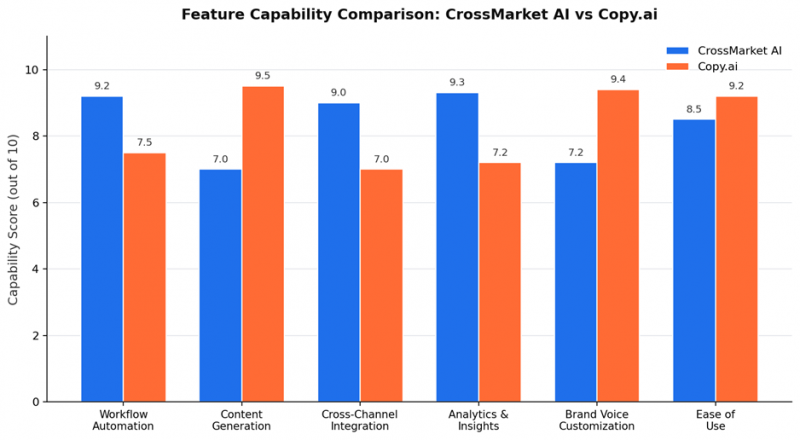
Two takeaways stand out. CrossMarket AI leads decisively in workflow automation, cross-channel integration, and analytics - the heart of marketing operations. Copy.ai leads decisively in content generation, brand voice customization, and ease of use for non-technical writers. Neither platform is meaningfully weak across the board; the gap is purpose-built specialization.
Detailed Feature by Feature Breakdown
| Feature | CrossMarket AI | Copy.ai |
|---|---|---|
| AI content drafting (long-form) | Limited - works best with external content fed in | Strong - purpose-built for blogs, articles, scripts |
| AI content drafting (short-form) | Basic templates for ads and notifications | Strong - 90+ templates across ad, email, social |
| Brand voice training | Available but secondary feature | Core feature with unlimited brand voices on Pro |
| Workflow / journey builder | Visual, multi-channel, behavior-triggered | Workflow builder for content lifecycle |
| Email + SMS + push automation | Native cross-channel orchestration | Limited - relies on integrations |
| Lead scoring & segmentation | Native predictive scoring | Not a primary use case |
| A/B testing | Automated setup and statistical analysis | Manual variants, no built-in stats engine |
| Reporting & analytics dashboards | Built-in cross-channel reporting | Basic content performance only |
| Multi-language support | Localized journey logic | 25+ languages on Pro, 95+ on higher tiers |
| Native CRM connectors | Direct CRM sync, bidirectional | Through integrations and API |
| API access | Available across paid tiers | Pro and above |
| Free tier | Limited trial / freemium | 2,000 words/month, 90+ tools, 25 languages |
Pricing Breakdown: What Each Platform Actually Costs
Pricing is one of the most common sticking points for buyers, partly because both vendors price differently and partly because real costs depend on team size, volume, and integration needs. The chart below shows indicative monthly pricing across comparable tiers, and the table that follows captures what is included at each level.
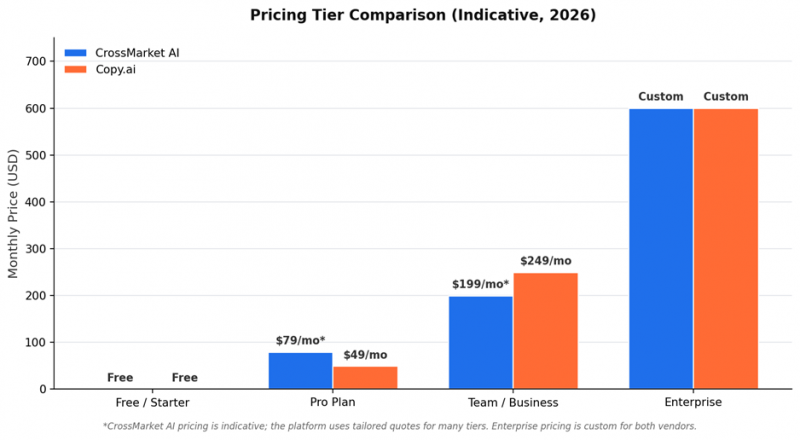
Copy.ai publishes its pricing transparently. CrossMarket AI uses tailored quotes for several tiers, so the figures shown are indicative ranges drawn from third-party reviews and category benchmarks. Buyers should always confirm with the vendor.
| Tier | CrossMarket AI | Copy.ai |
|---|---|---|
| Free / Starter | Free trial or freemium tier with limited workflow volume and integrations. | Free plan: 2,000 words/month, 1 user, 90+ writing tools, 25 languages, brand voice limited. |
| Pro / Growth | Indicative ~$79/mo (varies). Designed for small marketing teams running multi-channel campaigns. Adds advanced segmentation, A/B tests, and full analytics. | $49/mo ($36/mo billed annually). Unlimited generation, brand voices, 95+ languages, up to 5 users, API access, integrations. |
| Team / Business | Indicative ~$199/mo. Adds multi-user roles, expanded API limits, journey orchestration, and priority support. | $249/mo. Up to 20 users, all Pro features plus team collaboration, priority support. |
| Enterprise | Custom pricing. Adds SSO, audit logs, advanced governance, dedicated success management. | Custom pricing. Adds workflows at scale, SSO, dedicated CSM, custom integrations. |
Hidden cost watch-outs
For Copy.ai, watch the jump from Pro ($49) to Team ($249) - the gap is steep and doubles roughly every additional five seats. For CrossMarket AI, integration add-ons, premium support, and per-event volume can quickly inflate enterprise quotes. Always model 12-month total cost, not just the headline monthly fee.
Use Case Suitability: Where Each Platform Wins
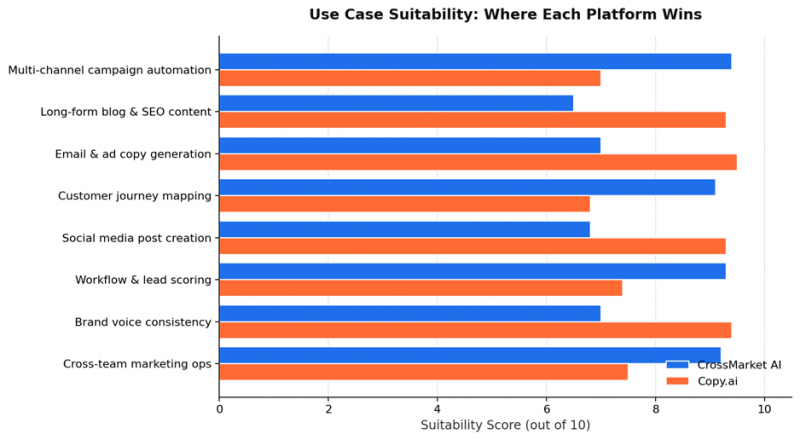
Feature parity matters less than fit-for-purpose. The chart below maps eight common marketing use cases against how well each platform handles them based on documented feature sets and review consensus.
CrossMarket AI is the better fit for
• B2B teams running coordinated email, ad retargeting, and lifecycle campaigns
• Lifecycle marketing where customer journey orchestration drives revenue
• Marketing operations consolidating tools to reduce stack sprawl
• Teams that need predictive lead scoring, segmentation, and attribution
• Mid-market and enterprise teams with cross-functional workflow needs
Copy.ai is the better fit for
• Solo marketers, founders, and freelancers producing high content volumes
• Agencies generating client-ready drafts across many brands and verticals
• Content marketing teams scaling SEO and blog production
• Social and email teams pushing daily creative in multiple languages
• Product marketing writing recurring product descriptions and one-pagers
Pros and Cons at a Glance
CrossMarket AI
| Pros | Cons |
|---|---|
| Powerful cross-channel automation in a single platform | Pricing for advanced tiers often requires sales contact |
| Strong predictive analytics and journey mapping | Limited native long-form content generation |
| Reduces tool sprawl by replacing multiple point solutions | Steeper learning curve for non-technical users |
| Good fit for B2B and lifecycle marketing | Smaller community footprint than legacy automation suites |
Copy.ai
| Pros | Cons |
|---|---|
| Unlimited content generation on Pro plan | Long-form output often requires heavy editing |
| 90+ templates for fast time-to-first-draft | Integration depth lighter than dedicated automation tools |
| Brand Voice produces consistent on-brand content | Steep jump from Pro ($49) to Team ($249) tier |
| Generous free tier for evaluation | Outputs can sound formulaic without prompt engineering |
How to Choose: A Practical Decision Framework
The right tool depends less on which platform is objectively better and more on which problem dominates the marketing roadmap right now. The decision matrix below maps common situations to the recommended choice.
| If the dominant problem is… | Recommended platform |
|---|---|
| Producing more blog posts, emails, and ad copy than the team can write | Copy.ai |
| Coordinating multi-channel campaigns and reducing tool sprawl | CrossMarket AI |
| Personalizing customer journeys based on behavior | CrossMarket AI |
| Scaling SEO content and refreshing landing pages quickly | Copy.ai |
| Both - content engine plus orchestration layer | Copy.ai + CrossMarket AI together |
| Tight budget with one user creating short marketing content | Copy.ai Free or Pro |
The combined-stack pattern
Mid-market marketing teams increasingly run both. CrossMarket AI handles segmentation, sequencing, and analytics; Copy.ai feeds content into the journeys CrossMarket AI orchestrates. The result is a content engine and an automation engine, each doing what it does best, connected through API or direct integration.
A 7-question checklist before signing a contract
1. How many marketing channels need to be coordinated in the next 12 months?
2. What percentage of work is content creation versus campaign orchestration?
3. How many users will need access, and at what frequency?
4. Which CRM, CDP, and ad platforms must connect natively?
5. What does the integration roadmap look like - own platform, third-party, or both?
6. What is the realistic 12-month total cost, including add-ons and overage?
7. Does the team have the skills to operate the platform, or is implementation help required?
Final Verdict
CrossMarket AI and Copy.ai are not really competitors - they are complementary tools that have been forced into the same buyer conversations because both put "AI" and "marketing" in their pitch. Treating them as alternatives obscures the more useful question: which problem is hurting more right now?
Teams whose biggest constraint is content velocity should start with Copy.ai. Teams whose biggest constraint is campaign coordination, attribution, or stack consolidation should start with CrossMarket AI. Teams whose biggest constraint is both should expect to evaluate them in sequence and likely run them together within the next 12 months.
The market is rewarding marketing teams that pair a strong content engine with a strong orchestration engine. Whichever combination wins inside a particular org, the underlying playbook is the same: let AI take the repetitive work, and free human marketers to focus on strategy, taste, and judgment - the parts of the job no model has yet replaced.
Bottom line For pure content generation, Copy.ai is the more direct fit at a friendlier entry price. For end-to-end marketing automation, CrossMarket AI delivers the orchestration depth Copy.ai does not aim to provide. The strongest marketing stacks in 2026 will use both, deliberately, with clear ownership of which tool handles which job. |
Post Comment
Be the first to post comment!