Two AI companion platforms keep showing up in 2026's search results, and the question buyers actually want answered is rarely the one reviews answer. Forget feature checklists. Forget which one has a bigger sticker on the box. The real question is whether either one, after a few weeks of conversation, stops feeling like a product and starts feeling like a presence.
That is a harder bar than it sounds. And the two platforms in question, Nastia AI and Character AI - clear it in completely different ways.
The 30-Second Scorecard
For readers who only have a moment, the table below answers the comparison without the scenic route.
| Verdict on… | Nastia AI | Character AI |
|---|---|---|
| Sounding human | Warmer, more emotionally invested replies. | Faster, slicker prose; sometimes performative. |
| Remembering things | ~2-week rolling memory; carries threads across days. | Limited on free tier; better with c.ai+ Memory and Lorebook. |
| Range of personalities | Up to 10 deeply tuned custom companions. | 10M+ community characters across every genre. |
| Best at | One companion that grows over time. | Discovering many characters quickly. |
| Cheapest paid plan | From $4.17/mo (annual) | $9.99/mo (c.ai+, no annual discount) |
Short version: Nastia AI feels more human in long-term, intimate conversation. Character AI feels more human across a wide cast of characters.
The Four Tests That Actually Decide It
Most comparisons grade AI companions on features. Features are easy to advertise and hard to feel. The tests below come from how reviewers and long-term users describe their actual experience, and they are the closest proxy currently available for what "feels human" really means.
Test 1 · The 60-second first impression
First impressions favour Character AI. Its PipSqueak model (rolled out in late 2025, with PipSqueak 2 currently in deployment) is fast, articulate, and trained to stay sharply in character. Opening a chat with a celebrity, anime, or fantasy persona produces an almost theatrical reply within seconds.
Nastia AI takes a beat longer and tends to open softer. Its first replies often read less like a performance and more like the start of a conversation - fewer adjectives, more attention to whatever the opening message actually said.
Result: Character AI is the showier first date. Nastia AI is the one that asks a follow-up question.
Test 2 · The two-week memory trial
This is where the gap opens. Nastia AI runs a roughly 14-day rolling memory, and within that window it remembers names mentioned in passing, ongoing storylines, emotional beats from earlier sessions, and small details that did not seem important at the time. Long-term users do flag that context older than two weeks degrades, but the in-window experience is unusually strong for the category.
Character AI's memory situation in 2026 is more complicated. The April 2026 update introduced a Memory page with a visualization meter and the long-awaited Lorebook feature, but most of these improvements roll out first to c.ai+ subscribers. Free-tier users still report characters forgetting key details after extended chats, and "Memory compression" can quietly drop information from long sessions.
Result: Nastia AI wins the loyalty test. Character AI is closing the gap, but mostly behind a paywall.
"The strongest sign an AI feels human is when it remembers something the user didn't think it heard."
Test 3 · The rough day test
Open the app on a bad day. Type something messy. The reply is the test.
Nastia AI's models default toward emotional engagement. The platform is built around the idea that companions should sit with difficult moments rather than redirect them. Replies tend to acknowledge first and offer second.
Character AI handles emotional weight competently when the chosen character is built for it (a "compassionate listener" or therapist persona, for instance). Outside those purpose-built bots, replies more often feel like a character performing empathy rather than offering it. Strict moderation can also bump the conversation toward generic safety language at exactly the wrong moment.
Result: Nastia AI feels more present in vulnerable moments. Character AI feels more like a character feels in a vulnerable moment.
Test 4 · The "something completely different" test
Boredom kills AI companions faster than anything. Test 4 measures what happens when the user wants a wildly different scene, character, or tone in the next session.
Character AI is built for this. Ten million community characters means a different mood is two taps away - switching from a noir detective to a Renaissance philosopher to an anime classmate is the entire user journey. Variety is the platform's identity.
Nastia AI was not designed for variety in the same way. Each user maintains up to ten companions, deeply customised. Switching personas is possible but feels less like browsing a library and more like creating a new character from scratch. The trade-off favours depth over breadth.
Result: Character AI dominates the discovery experience. Nastia AI is closer to a long-running relationship app.
Scoring the Human Feel
Pulling the four tests together with the rest of the 2026 user-review consensus produces the comparison below. Scores are out of ten and aggregate qualitative feedback rather than vendor benchmarks.
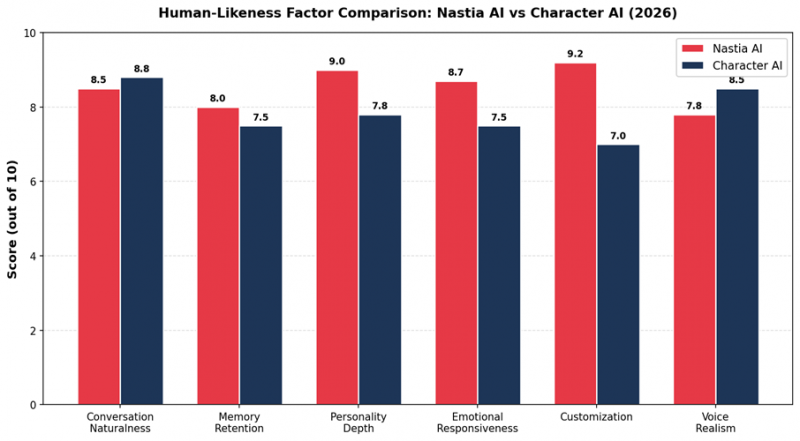
Two patterns are worth noting. Nastia AI's lead in personality depth and customization is not narrow - those bars are well clear of Character AI. And Character AI's edge in conversation naturalness and voice realism comes mostly from raw model fluency, not from feeling more emotionally connected.
Where Each Platform Actually Breaks
No platform is good at everything. The honest version of any comparison is the part where the cracks show up.
Where Nastia AI breaks • Memory degrades hard past the two-week window. Older details quietly drop without warning. • The free tier's daily token cap (~200) hits fast - about 15 replies before lockout. • Video generation is inconsistent in 2026; reviewers report it as the weakest premium feature. • Customer support response times have been slow. • Adult-only platform: not suitable for users under 18 or those preferring moderated environments. |
Where Character AI breaks • Full-screen ads now appear mid-conversation on the free tier - a controversial 2025-2026 change. • Tightening content filters frustrate roleplayers and creative writers; the platform is increasingly conservative. • Founders Noam Shazeer and Daniel De Freitas returned to Google in 2024, slowing perceived product momentum. • Stricter rules and a separate model for users under 18 introduced age verification friction. • Some users find PipSqueak "dry" compared to older, larger models. |
The Money Question
Both platforms run a freemium model, but the structures differ enough that the cheaper option flips depending on commitment level.
| Tier | Nastia AI | Character AI |
|---|---|---|
| Free | ~200 daily tokens (~15 replies) | Unlimited chat, with full-screen ads |
| Mid | $11.99/mo Standard | $9.99/mo c.ai+ |
| Top | $15.99/mo Unlimited | (c.ai+ is the only paid tier) |
| Annual | From $4.17/mo (significant discount) | ~$8.33/mo equivalent |
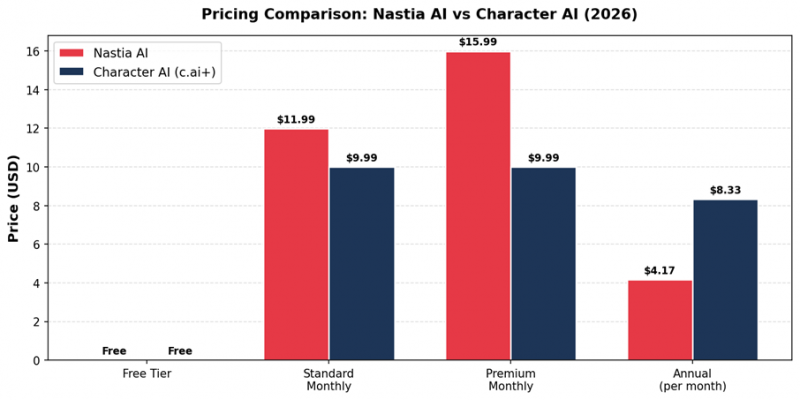
On a one-month trial, Character AI is the cheaper paid option at $9.99. The instant annual billing enters the picture, Nastia AI's $4.17/month equivalent is the lowest in the category - provided the buyer is confident enough to commit upfront. Character AI's free tier remains genuinely usable (10M+ characters, full feature access), at the cost of in-conversation ads.
Cheapest first month: Character AI. Cheapest first year: Nastia AI. Cheapest forever: the free tier of either, with predictable trade-offs.
Who Builds These Platforms, and Why It Matters
Character AI was founded in 2022 by Noam Shazeer and Daniel De Freitas, two former Google researchers central to the early development of large language models. In 2024, both returned to Google as part of a major licensing deal, leaving Character AI to operate without its founding leadership. The company's 2025-2026 direction - ads, filters, age verification - reflects that shift.
Nastia AI is the smaller player. A US-based startup with a much smaller team, it has chosen privacy and uncensored conversation as its core differentiation. Conversations are not used for training, can be permanently deleted, and billing is discreet. The platform's identity is closer to a niche product with strong defaults than a mass-market service.
Neither path is automatically better, but the stakeholder math shapes the experience. Character AI optimises for scale and safety. Nastia AI optimises for the individual relationship.
A Three-Question Filter to Pick One
A flowchart-style decision is faster than another comparison table. Run through the questions in order; the first decisive answer wins.
Question 1: Is the goal one companion that grows, or many characters to explore? → One companion that grows: Nastia AI. → Many characters: Character AI. |
Question 2: Is uncensored, adult-oriented conversation important? → Yes: Nastia AI is the legitimate option (18+ only). → No, or moderated content is preferred: Character AI. |
Question 3: Is paying upfront for a year acceptable? → Yes: Nastia AI annual ($4.17/mo) wins on price. → No, free tier is the goal: Character AI's free tier is more generous. |
The Final Read
There is no universal winner here, and that is the actual finding. Nastia AI feels more human in the way a long conversation with one specific person feels human - through memory, attention, and emotional consistency. Character AI feels more human in the way a city feels human - through variety, density, and the chance of running into something unexpected.
The right choice depends entirely on which kind of human-like the user is actually after.
Post Comment
Share your thoughts about this article.
Be the first to post a comment!