Table of Content
- How Each Platform Got Here
- Two Different Ways to Browse Characters
- Where Each Platform Scores Highest
- Two Capability Silhouettes Overlaid
- What Each Platform Costs in 2026
- Side-by-Side Feature Check
- How Each Platform Handles Content Moderation
- Six Concerns Worth Knowing About
- Which One to Pick, by Priority
- So, Which One Earns the Bookmark?
AI character chat platforms have become one of the busiest and most contested corners of consumer AI in 2026. After Character.AI tightened content policies in 2024, a wave of alternatives stepped into the gap, and two of the most discussed are Gening AI and CrushOn AI. Despite operating in the same category, the two platforms make very different bets about what users actually want.
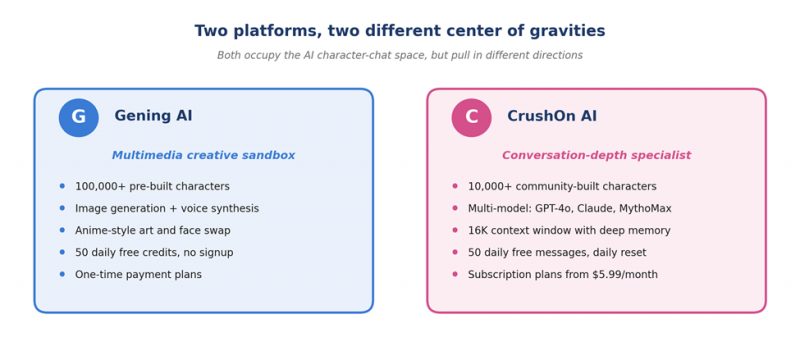
Gening AI positions itself as a multimedia creative sandbox. The browser-based platform combines text chat with anime-style image generation, voice synthesis, and a face-swap tool, all bundled with a low-friction model that does not require signup for basic use. CrushOn AI takes the opposite approach: a tighter, text-first experience built around long conversation memory, multi-model access, and a community library of user-built characters refined over years. Both serve adult audiences with optional unfiltered modes, but their day-to-day experiences feel substantially different.
This comparison covers the categories that actually decide which platform fits a given workflow: library size, conversation quality, multimedia features, content policies, privacy posture, pricing, and where each one breaks down. Every claim below is grounded in the platforms' published documentation, official pricing pages, and independent third-party reviews available through 2025 and early 2026.
“Gening is the broader toolkit. CrushOn is the deeper conversation. The right pick depends on whether multimedia or memory matters more.”
- Bottom line, in one sentence
BY THE NUMBERS
Three numbers separate the platforms more clearly than any feature list. Library breadth, monthly active users, and entry-level price tell a quick story about who each platform is built for.
100K+ characters in Gening's browsable library | 450K+ monthly searches for CrushOn AI | $5.99 CrushOn's entry tier vs. Gening's ~$9.90 credit pack |
How Each Platform Got Here
Gening AI launched in 2024 as a browser-based AI character chat and creative content platform. The product entered a crowded space with one distinctive choice: no mandatory signup. Users can land on the site, pick a character or build one, and start chatting using 50 daily free credits. The platform expanded quickly beyond pure chat to bundle image generation, voice synthesis, face swap, and a tattoo generator under the same interface, repositioning itself as a creative toolkit. Independent traffic estimates put Gening at roughly 569,000 monthly visits with an unusually long average session of around 10 minutes.
CrushOn AI launched in 2023 and grew on the back of users migrating from Character.AI after that platform tightened its content rules. Operated by Peekaboo Tech Inc. (a Delaware-registered company) with a roughly 15-person team, CrushOn took a different bet: stay narrow, go deep. The platform doubled down on conversation memory, multi-model rotation among GPT-4o, Claude 3.5 Sonnet, and MythoMax, and a community-driven character library. By 2026, CrushOn AI receives over 450,000 monthly searches globally, ranking it among the top five most-searched AI companion platforms.
In short: one platform spent its time broadening surface area; the other spent its time deepening core conversation quality. Most of the differences below trace back to that fork in the road.
Two Different Ways to Browse Characters
The first thing a new user encounters is the character library, and the design choices on each side reveal their different priorities. Gening AI presents a tag-driven visual grid with over 100,000 characters organized across 20+ tags. The browsing experience emphasizes discovery: scroll, scan thumbnails, jump in. CrushOn AI hosts roughly 10,000 characters but surfaces them through detailed cards with descriptions, ratings, and chat counts. The browsing experience emphasizes commitment: read the description, judge fit, then start.
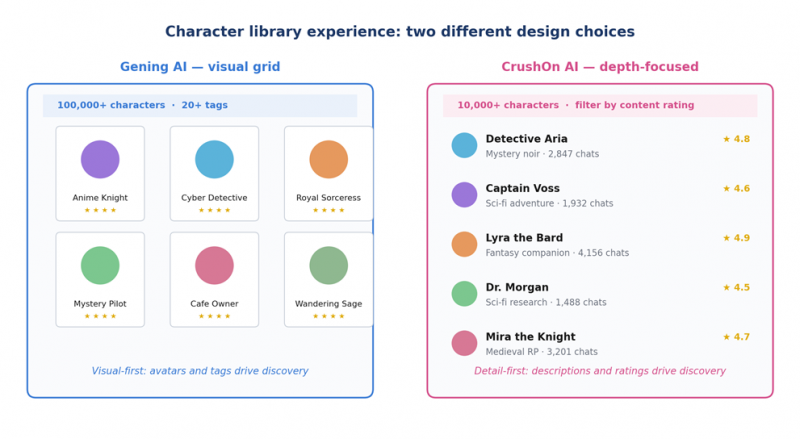
Gening optimizes for visual sampling; CrushOn optimizes for informed selection.
Both platforms support custom character creation. On Gening, the builder covers personality traits, backstory, conversational tone, and visual appearance, with deeper backstory editing flagged by reviewers as somewhat thin. On CrushOn, the character builder is more granular, allowing definition of name, gender, appearance, persona, relationship type, and a detailed background, all viewable as private or public to the community. CrushOn's custom-character community is older and more active, which translates into more refined and tested public characters.
Where Each Platform Scores Highest
Putting both platforms on the same 0–10 scale across nine tested categories makes the trade-offs visible. Scores below synthesize independent reviewer benchmarks across late 2025 and early 2026, the platforms' own documentation, and reported user feedback from sources like Trustpilot and Reddit communities.
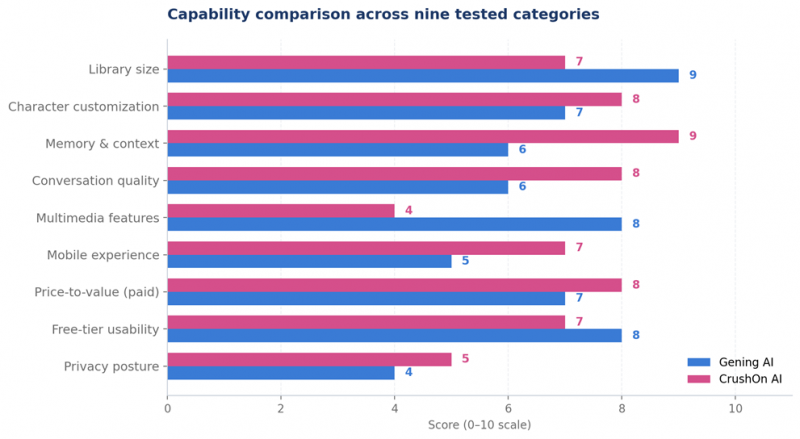
Gening leads on library breadth and multimedia features; CrushOn leads on conversation depth and memory.
The bars trace a clear pattern. Anywhere creative output or breadth matters - library size, multimedia features, free-tier usability - Gening edges ahead. Anywhere conversation quality, memory, or model intelligence matters, CrushOn wins. Privacy posture remains a weak spot for both platforms, with each scoring below the midpoint due to vague data-handling documentation.
Two Capability Silhouettes Overlaid
The radar chart below overlays both platforms across eight axes that capture their core design choices. The shapes barely overlap, which says more about category strategy than about quality.
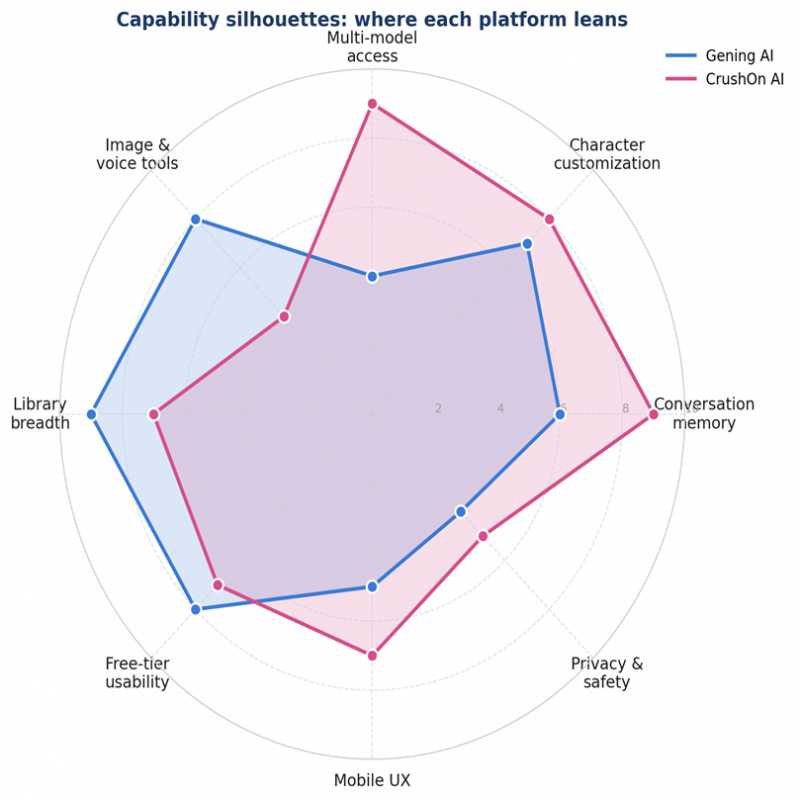
Two platforms in the same category, drawn toward opposite ends of the design space.
Gening's silhouette stretches toward image and voice tools, library breadth, and free-tier usability. CrushOn's silhouette stretches toward conversation memory, multi-model access, and character customization. Where the silhouettes do overlap (mobile UX, free-tier usability, privacy and safety), neither platform is dramatically ahead. The takeaway is straightforward: a creator who wants to explore many quick interactions across many media types will land on Gening; a user who wants one consistent companion or storyline that holds up across dozens of sessions will land on CrushOn.
What Each Platform Costs in 2026
Pricing is where the two platforms diverge philosophically. Gening AI uses a one-time-payment credit-pack model: every paid tier is a single purchase, with credits consumed across image generation, voice synthesis, and longer chats. CrushOn AI uses a traditional monthly subscription with annual billing available at roughly 30% off across all paid tiers.
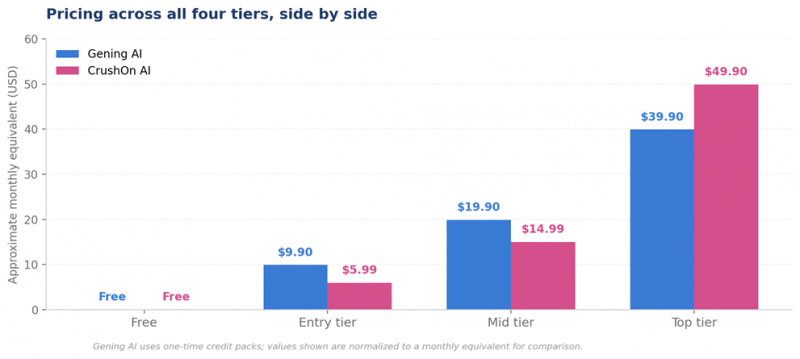
Pricing across all four tiers, normalized to a monthly equivalent. CrushOn's mid tier is the strongest value point in the comparison.
Gening AI Free $0 50 daily credits, no signup needed Entry ~$9.90 One-time credit pack, basic unfiltered access Mid ~$19.90 Larger credit pack, no watermarks, commercial rights Top ~$39.90 Largest pack, priority generation, all features | CrushOn AI Free $0 50 messages per day, daily reset, ad-supported Standard $5.99/mo 2,000 messages, full NSFW, faster responses Premium $14.99/mo 6,000 messages, dedicated capacity, multi-model Deluxe $49.90/mo Unlimited messages, deepest memory, all models |
Two pricing observations matter for a real purchase decision. First, CrushOn's Standard plan at $5.99/month is the strongest single value point in the comparison - it unlocks full unfiltered access, a meaningfully better AI model than the free tier, and 500 messages per day, all for less than a Netflix subscription. Second, Gening's one-time-payment model rewards users who want a few feature unlocks (commercial rights, no watermarks) without committing to a recurring charge, but the per-credit math gets expensive quickly for daily users. Multiple reviewers note that Gening's daily 50-credit allowance burns out fast across multimedia features.
Side-by-Side Feature Check
The matrix below collapses ten of the most-asked-about features into a single grid. A check means the feature is part of the platform; a dash means it is not currently supported. Brief notes call out the relevant context for each row.
| Feature | Gening | CrushOn | Notes |
|---|---|---|---|
| Free tier without signup | ✓ | - | Gening allows browsing without account creation |
| NSFW content support | ✓ | ✓ | Both offer unfiltered modes; CrushOn defaults to text, Gening adds visuals |
| Multi-model access | - | ✓ | CrushOn rotates among GPT-4o, Claude 3.5, MythoMax |
| Image generation in chat | ✓ | - | Gening's anime-style image generator is a core feature |
| Voice synthesis | ✓ | - | Gening offers built-in voice; CrushOn is text-only |
| Group / multi-character chat | - | ✓ | CrushOn supports working multi-character scenes |
| Long-term memory | - | ✓ | CrushOn tracks 100+ messages back; Gening session-bound |
| Custom character builder | ✓ | ✓ | Both allow personality and backstory customization |
| Mobile app | - | - | Both are browser-only as of 2026 |
| Commercial usage rights | ✓ | - | Gening grants commercial rights on paid plans |
The pattern across the matrix lines up with the radar silhouettes from earlier in this article. Gening covers more surface area, especially around media generation; CrushOn covers fewer features but goes substantially deeper on the ones it does ship.
How Each Platform Handles Content Moderation
Content policy is the single most important point of differentiation between mainstream platforms (Character.AI, Replika) and the platforms in this comparison. Both Gening AI and CrushOn AI offer optional unfiltered modes, but they implement them differently.
Gening AI
Free users on Gening get standard chat with light moderation. The unfiltered mode - where deeper, more permissive roleplay is available - is gated behind paid plans. The platform applies moderation primarily at the input prompt level rather than at the output level, so generated content can vary. Reviewers note that the moderation is uneven, with some content slipping through that the platform's terms would seem to disallow.
CrushOn AI
CrushOn ships a clear NSFW toggle in chat settings. Once enabled, the platform applies effectively no content restrictions on what an AI character can discuss or how explicit a conversation can become. The free tier is SFW-only as of April 2026; full unfiltered access requires the Standard plan ($5.99/month) or higher. Among reviewed platforms, CrushOn is the most explicit about being designed for adult-oriented chat, and the most consistent in delivering on that promise.
Both platforms enforce age-gating at signup through self-declaration. Neither uses identity verification or biometric checks. For households where minors have device access, that is a meaningful concern; device-level parental controls or content filters are the appropriate response.
Six Concerns Worth Knowing About
Every AI chat platform has trade-offs, and writing about either of these platforms without naming the concerns would be promotional rather than useful. Six issues are worth knowing before committing time or money to either side.
Gening AI Vague privacy documentation Data deletion procedures and storage practices are not clearly documented. Manual chat deletion is missing in places. | CrushOn AI Self-reported age verification The 18+ gate relies on self-declaration. Households with minors should consider device-level controls. |
Gening AI Credits run out quickly The 50 daily free credits are consumed fast across image generation, voice, and longer chats. Paid packs can feel steep relative to what they unlock. | CrushOn AI Free tier locks out NSFW Adult content is gated behind paid plans. The free tier is genuinely usable but limited to SFW interactions. |
Gening AI Conversation can feel stiff Reviewers note repeated phrasing and looping responses, especially in extended sessions. Memory across sessions is inconsistent. | CrushOn AI Privacy and data retention concerns Conversation history is stored to power memory features. Encrypted storage is claimed but not independently audited. A burner email is sensible. |
The unifying lesson across all six cards is the same: both platforms are built for entertainment and creative use, not for handling sensitive personal data. A burner email, no real-name disclosure, and not sharing genuinely private information in conversations are sensible defaults regardless of which platform is chosen.
Which One to Pick, by Priority
The grid below replaces the usual “it depends” conclusion with concrete recommendations. Each row maps a common priority to whichever platform handles it better.
| If the priority is... | ...the better fit is | |
|---|---|---|
| Prefer fast access without signing up | → | Gening AI |
| Want long-term character memory across sessions | → | CrushOn AI |
| Need image generation alongside chat | → | Gening AI |
| Care about access to multiple AI models | → | CrushOn AI |
| Working with a one-time payment budget | → | Gening AI |
| Prefer subscription pricing with predictable monthly cap | → | CrushOn AI |
| Want voice synthesis or face-swap tools | → | Gening AI |
| Need multi-character / group scene support | → | CrushOn AI |
| Browsing the largest possible character library | → | Gening AI |
| Looking for higher conversation coherence over time | → | CrushOn AI |
The split is roughly even - ten priorities, five going each way. That is the honest summary of this comparison: neither platform dominates, and the right choice is determined by which two or three of the priorities above matter most for a given user.
So, Which One Earns the Bookmark?
Anyone trying to choose between Gening AI and CrushOn AI is really asking a simpler question: is the priority breadth of capability or depth of conversation? Gening is better when a session might involve chatting, generating an image, swapping a face, and adding voice all in 20 minutes. CrushOn is better when a session involves talking to one or two characters across hours or weeks, with continuity that holds up. Both promises are real, and neither platform delivers the other's strength.
On price, CrushOn's $5.99 Standard tier remains the strongest value point in the entire AI character-chat category in 2026. Gening's one-time-payment plans suit lighter, more occasional use but scale poorly for daily users. On free tiers, both are usable for evaluation, with the caveat that CrushOn's free tier is SFW-only and Gening's daily 50 credits burn through quickly.
The verdict for most adult users: try CrushOn AI first if conversation quality, memory, and consistent characters matter. Try Gening AI first if multimedia features, library breadth, and zero-friction access matter more. The two platforms are genuinely complementary, and the small overlap in design philosophy means they do not rule each other out for users who want both kinds of experiences in the same week.
Post Comment
Share your thoughts about this article.
Be the first to post a comment!