Every active shooter timeline hides an uncomfortable arithmetic: by the time the first shot is audible, the event is already underway, and every second of notification delay is measured in ground covered by the attacker. Security teams comparing detection technology are really choosing between two different tripwires. An acoustic sensor tells you a firearm has been fired. Camera-based visual gun detection tells you a firearm has been drawn, sometimes before a trigger is ever pulled. The gap between those two moments is where most of the protective value lives, and it is the right starting point for any serious evaluation.
Both technologies emerged from the same operational problem. Human operators cannot reliably watch dozens or hundreds of camera feeds, and 911 calls typically begin only after shots are fired and panic sets in. Acoustic gunshot detection arrived first, built on arrays of microphones that recognize the impulse signature of gunfire and triangulate its origin. Computer vision came later, once deep learning made it practical for software to recognize the shape and presentation of a firearm in live video across varied lighting, angles, and distances.
The two are often framed as competitors, but agencies and campuses increasingly treat them as complementary layers with different triggers, different coverage models, and different failure modes. Vendor architectures reflect that shift: weapon detection now commonly ships alongside video analytics, visitor management, and vehicle recognition in a single public safety stack, and ROC’s public safety portfolio is a useful example to learn more about how those layers are being combined in practice. Before comparing products, though, it helps to be precise about what each layer actually detects.
How a gunshot detection system works
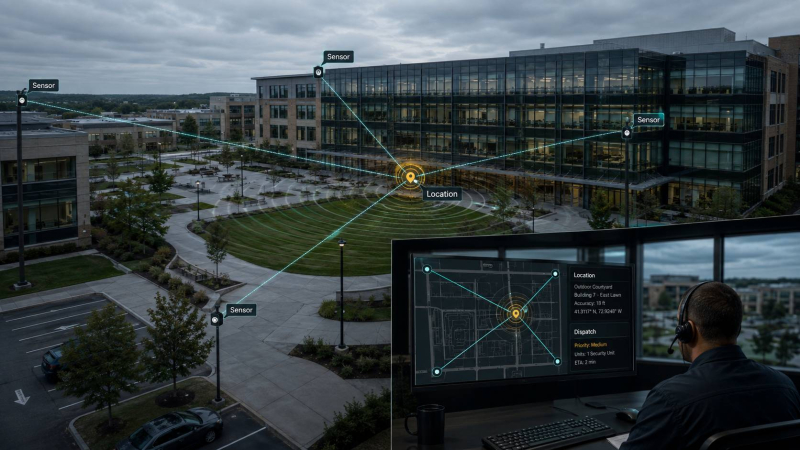
An acoustic gunshot detection system uses distributed microphone sensors, indoors or outdoors, that listen continuously for the acoustic fingerprint of a discharge: the muzzle blast and, for supersonic rounds, the crack of the projectile. When multiple sensors register the event, the system triangulates a location, classifies the sound to filter out fireworks, backfires, and slammed doors, and pushes an alert to security staff or dispatch.
Its defining strength is confirmation. A validated acoustic alert means shots have actually been fired, which justifies an immediate, full-scale response with little debate. Outdoor deployments can also cover large areas, such as a city district or an industrial perimeter, where camera coverage would be sparse or impractical.
Its defining limit is timing. A gunshot detection system is reactive by design. It cannot alert until the worst moment has already occurred, so its value concentrates in faster dispatch, more accurate location data, and better situational awareness during the response, not in prevention.
How camera-based firearm detection works
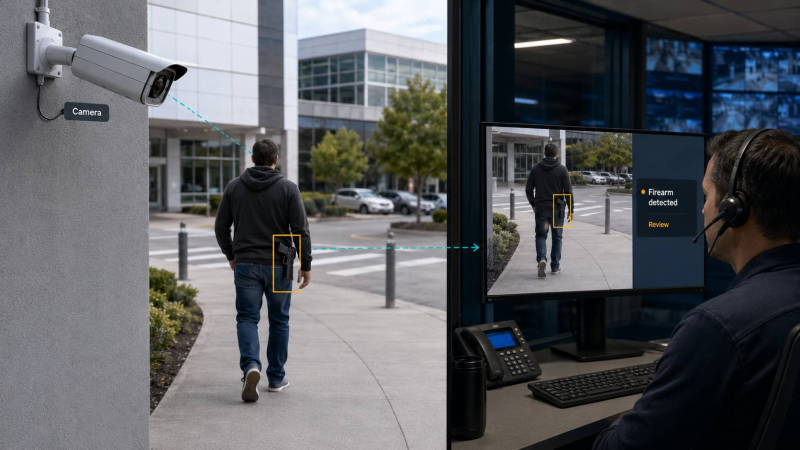
A camera-based firearm detection system analyzes live video frame by frame, using computer vision models trained to recognize exposed firearms: a pistol drawn in a parking lot, a rifle carried across a courtyard, a weapon brandished at a doorway. Modern gun detection technology runs on existing IP camera infrastructure, which matters for budgets because the cameras are usually already installed.
The critical difference is the trigger. Visual detection fires on the sight of a weapon, not the sound of one. In the common pattern where an attacker moves from a vehicle across open ground with a weapon already exposed, a visual system can generate an alert during the approach, while doors can still be locked, occupants moved, and responders staged. That pre-shot window is the core argument for visual gun detection as a preventive layer rather than a reactive one.
The honest limits: a camera cannot detect what it cannot see. Concealed weapons, unmonitored zones, poor lighting, and extreme distances all reduce effectiveness. And like any detection model, vision systems produce occasional false positives, which is why credible deployments route alerts through human verification before triggering lockdowns or dispatch.
Head-to-head: how the layers compare
| Factor | Acoustic gunshot detection | Camera-based visual detection |
|---|---|---|
| Trigger | Shot fired (reactive) | Weapon visible (potentially pre-shot) |
| Earliest possible alert | After first discharge | When a firearm is drawn or carried openly |
| Confirmation value | Very high; gunfire confirmed | Requires human verification of the alert |
| Concealed weapons | Not detected until fired | Not detected until exposed |
| Coverage model | Sensor arrays; strong outdoors over wide areas | Follows camera placement; strong at entries and chokepoints |
| Infrastructure | New dedicated sensors | Typically reuses existing IP cameras |
| Location precision | Triangulated point of fire | Exact camera view, with visual context of the scene |
| Response value | Faster, better-located dispatch | Time to lock down, warn, and stage before shots |
Read the table with your own site in mind. A downtown entertainment district with sparse cameras and frequent outdoor noise has a different profile than a school with controlled entries, hallway cameras, and a trained response protocol.
Where each layer earns its budget
Acoustic detection earns its cost where gunfire is the realistic first signal you will get: wide outdoor areas, urban environments, and locations where weapons will almost certainly stay concealed until used. It also strengthens investigations, since precise shot timing and location help reconstruct events.
Visual detection earns its cost where the approach is observable: campuses, schools, hospitals, houses of worship, logistics yards, and corporate sites with defined perimeters and entry points. In these environments, active shooter detection is fundamentally a race to compress the interval between first indicator and first protective action, and the visible approach is often the earliest indicator available.
There is also an accountability dimension worth weighing in procurement. Detection systems operate in public and semi-public space, so vendors should be able to show independent testing, documented accuracy across demographic groups where applicable, clear human-in-the-loop alerting, and a stated ethics posture. Systems that alert on objects and behaviors, rather than tracking individual identities by default, are easier to govern and easier to defend to a community.
Building a layered strategy
If the budget forces a choice, match the layer to your threat geometry: visual detection where the approach can be seen, acoustic detection where it cannot. If the budget allows both, the layers reinforce each other in a simple sequence.
Visual detection flags an exposed weapon during the approach and starts verification and lockdown procedures.
If shots are fired anyway, acoustic sensors confirm the discharge and pin the location, removing any hesitation from dispatch.
Video analytics then support the response and the investigation: tracking movement across cameras, flagging the vehicle, and assembling a timeline for after-action review.
Whichever mix you choose, technology is the middle of the plan, not the whole of it. Detection only compresses time; policies, drills, and a rehearsed response are what convert those seconds into protected lives.
The bottom line
Gunshot detection tells you the emergency has begun. Visual detection can tell you one is about to begin. Treat them as sequential layers on the same timeline rather than rival products, fund the layer that matches how a threat would actually reach your site, and insist on independently tested, ethically governed systems from any vendor on your shortlist. Research from firms working across this stack, including Rank One Computing, an American developer of NIST-evaluated vision and biometric algorithms, points to the same conclusion: the earlier and more accurate the first alert, the more options defenders have left.
Post Comment
Share your thoughts about this article.
Be the first to post a comment!