Table of Content
Hiding from the person who posted a story is one thing. Being invisible to Instagram, or to the site you used to peek, is something else entirely.
People reach for tools like InSnoop for a simple reason. They want to watch a public Instagram story without their name showing up in the viewer list. That works. What trips people up is the word anonymous, because it quietly means different things depending on who is doing the watching.
There are at least three separate questions hiding inside one request. Will the person who posted the story know it was you? Does Instagram itself register the activity? And does the third-party site record who visited it? These are not the same question, and the honest answers point in different directions.
Start here. This piece zooms in on two of those layers. For the full walkthrough of how InSnoop works, what it collects, and whether it actually holds up, read our deep dive on using InSnoop to view Instagram stories.
The quick answer
If you are short on time, here is the distinction in two lines. The rest of the article explains why each one lands where it does.
Anonymous to Instagram: likely, not guaranteed. Your personal account stays out of the viewing because you never sign in. Whether Instagram's systems log the retrieval at all is not publicly documented, so treat it as a practical likelihood.
Anonymous to InSnoop: no. The site you used can see that you visited. By its own privacy policy, it may collect your IP address, device details, and usage data through an analytics service.
First, anonymous is not one thing
A viewer promises anonymity, and most people read that as a blanket cloak. In reality every visit passes through a small chain of watchers. Each watcher sees a different slice of what happened, and each one has its own reason to record it.
The tool is honest about only one of those relationships: keeping your Instagram identity off the story owner's viewer list. It says far less about the others. Sorting the layers apart is the whole game, so let us line them up before zooming into the two that cause the most confusion.
What each watcher can actually see
Here is the same visit read from four points of view. The middle two, Instagram and InSnoop, are where the word anonymous does the most quiet shape-shifting.
| Watcher | What it can see | What stays hidden from it |
|---|---|---|
| The story owner | Aggregate view and reach numbers on their own story | Your username as an individual viewer |
| The metrics it reports to creators, and its own request logs | Publicly, how it treats a third-party retrieval is undocumented | |
| InSnoop | Your IP, device, browser, pages viewed, and timing | Nothing private about the target, since it only reaches public content |
| Your network | Often the domain you connected to | The encrypted contents of the page |
The same story view, seen from four sides.
Anonymous to Instagram: what it really means
When you watch a story while logged in, Instagram ties that view to your account and shows your username to whoever posted it. A viewer breaks that link by never asking you to sign in. Your personal session is not part of the request, so your username has nothing to attach to.
That is real and useful. It is also narrower than "Instagram has no idea." Instagram still measures story performance in aggregate for creator and business accounts, counting views and unique accounts reached rather than only building a per-person viewer list. You can see how the platform defines those metrics in the Instagram Help Center guide to story insights.
Whether a request routed through a third-party site touches those aggregate counts is a separate, murkier question. The site does not publish enough technical detail to prove one way or the other. So the fair statement is this: your personal account is kept out of the viewing, but "Instagram receives nothing" is an assumption, not a verified fact.
Timing adds another wrinkle. Stories normally vanish after 24 hours unless the owner saves them to Highlights, yet Instagram keeps the underlying insights available to creators well beyond that window. A missing story does not mean nothing was recorded, and a visible Highlight is simply older content the owner chose to keep on show.
Anonymous to InSnoop: what it really means
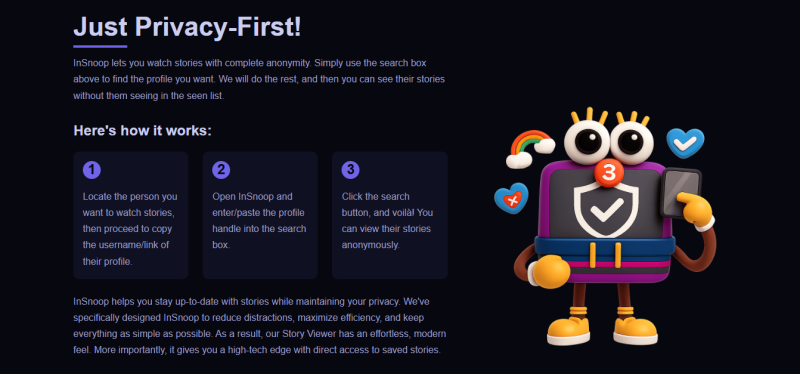
Now flip the observer. Being anonymous to InSnoop would mean the site itself cannot tell that the visitor was you. That is a much higher bar, and the tool does not clear it.
Like most websites, it receives technical information the moment you load the page. Its own privacy policy describes collecting your IP address, the pages you open, visit times, how long you stay, your operating system, and data gathered through cookies, pixels, and similar technologies. It also names Google Analytics for Firebase as a third-party service, and Google documents what that layer can gather in its Firebase privacy overview.
There is even a wrinkle worth flagging. The homepage suggests the site does not track behaviour or download history, while the formal policy describes IP collection, activity data, and analytics. Those statements are hard to reconcile, so lean on the detailed policy rather than the friendlier summary. Either way, the conclusion holds: anonymous to the story owner, not anonymous to the site.
The policy also puts numbers on how long that data can stick around. Those windows are worth reading before you decide the visit was truly fleeting.
| Data category | Stated retention period |
|---|---|
| Information you provide | Duration of use, plus up to 12 months |
| Automatically collected data | Up to 24 months |
| Aggregated or anonymized data | Potentially indefinite |
| Legally required records | As long as the law requires |
Retention windows as stated in InSnoop's own privacy policy. These are the provider's published terms and have not been independently audited.
You are not powerless here, though. The policy says you can request access to, correction of, or deletion of your personal data, and California residents get extra rights around access and opting out of certain sharing. It also states the service is not intended for anyone under 16. Those are real controls, yet they sit with the site, so using them means trusting it to honour its own terms.
The key differences, side by side
Reading the two relationships against each other makes the gap obvious. Notice that the observer changes in every row, and so does the honest answer.
| The question | Anonymous to Instagram | Anonymous to InSnoop |
|---|---|---|
| Who is the observer | Instagram and Meta's own systems | The third-party site you loaded |
| What it would protect | Your personal account staying out of the viewing | The site being unable to tell the visit was you |
| Your Instagram username | Not attached, since you never log in | Not needed, so not stored as a username |
| Your IP and device data | Not documented, and not publicly verified either way | Collected, per the site's own policy |
| Data retention | Story insights stay available to creators for a defined window | Automatically collected data kept up to 24 months, per its policy |
| Your control and rights | Account settings and platform tools you already own | Reliance on the site's stated access and deletion process |
| Independent verification | Meta documents its own metrics and platform rules | Self-reported, with no public technical audit found |
| Terms and legal layer | Automated access sits against Instagram's terms | The same gray zone, which the site cannot remove for you |
| Realistic answer | A practical likelihood, not a proven guarantee | No, the visit can be recorded |
| How to treat it | Reasonable for casual, low-stakes viewing | Assume the site logs that you were there |
Anonymous to Instagram compared with anonymous to InSnoop, one relationship per column.
Seven differences that actually matter
The table sets the two relationships next to each other. These seven points explain why the gap between them is wider than it first looks.
1. The observer changes. Instagram is the platform hosting the content. InSnoop is a middleman you chose to route through. Different party, different motives, different logs.
2. What identifies you is different. Instagram would tie a view to your account. InSnoop has no account to tie anything to, so it leans on your IP, device, and browser instead.
3. One is documented, the other is self-reported. Meta publishes how its metrics and rules work. InSnoop describes its own practices in a policy that no public technical audit has tested.
4. The data lives for different lengths of time. Instagram keeps story insights for creators across a set window. InSnoop states its own periods, some running up to two years, some potentially indefinite.
5. Your leverage is different. On Instagram you hold account controls and platform settings. With InSnoop you depend on its stated request process to reach or delete your data.
6. The promise is reliable to different degrees. Staying off the viewer list is structural and dependable. "Instagram sees nothing" is untested. "InSnoop sees nothing" is contradicted by its own policy.
7. The terms exposure attaches to different parties. Automated access runs against Instagram's rules, but that pressure falls mainly on the retrieval service, not usually on a casual viewer. InSnoop cannot lift that layer for you.
That last point is worth grounding in the source. Meta treats automated collection without permission as a terms violation and says it works to restrict it, which it lays out in its own explainer on how it combats scraping. The rule targets the party doing the automated retrieval, which is a helpful distinction to keep in mind.
How the difference plays out
Abstract layers get real fast once you picture a specific situation. The same tool can feel safe in one case and leaky in another, and the reason is always which watcher you should have been thinking about.
Scenario 1: The casual peek. You check one public story out of curiosity. The only watcher you cared about was the owner, and there you are covered. The other layers barely register.
Scenario 2: The repeat competitor check. You view a rival's stories every week. Now the site's logging and your network's visibility start to matter, because a pattern builds up over time.
Scenario 3: The work network. You browse from an office connection. Your administrator may see the domain even if the owner never learns your name. Anonymous to the owner is not the same as private at work.
Why the difference matters
For a one-off curious look at a public account, the distinction is mostly academic. You mainly cared about the story owner, and on that front the tool does its job.
It matters a lot more the moment stakes rise. If you are checking a competitor's account regularly, researching from a work network, or simply uncomfortable with an unknown operator holding your browsing data, "anonymous to the story owner" is not the reassurance you were looking for. Knowing which layer you actually need protection from changes which tool, or which precaution, makes sense.
One more layer: your network
There is a fourth watcher people forget. Your internet provider or a network administrator can often see which sites you connect to, even when the page content is encrypted. Encryption protects the contents of the traffic, not always the fact that you reached a given domain, as explained in this primer on what HTTPS does and does not hide.
A VPN can swap your visible IP address for the VPN server's address, which raises the floor. It still does not stop cookies, browser identifiers, or the analytics running inside the site itself. Privacy here is a stack, and no single switch flips all of it on.
Five alternatives worth knowing
If you decide a browser-based viewer suits your need, InSnoop is not the only one. These five sit in the same category. Each is explained briefly, and each carries the same public-only limitation.
1. StoriesIG (broad public viewer). A no-login browser tool for public stories, highlights, posts, and reels. Its wider content coverage suits quick public research when you want more than stories alone.
2. AnonyIG (viewer and downloader). Handles public stories, highlights, reels, and posts, with a download option. It states in its own materials that it does not keep searches or IP data, a claim that has not been independently audited.
3. Imginn (profile browser). An index-style way to scroll a public profile's stories, posts, and highlights in one place and save content. Freshness and availability can vary from day to day.
4. Instanavigation (simple story viewer). A clean, no-registration viewer for public stories and highlights, with downloads. Easy for a fast one-off check, and unable to reach private accounts or Close Friends stories.
5. StoriesDown (lightweight viewer). A minimal viewer and downloader for public stories and highlights, with no account needed. Good for speed, with the same public-only ceiling as the rest.
The pattern is the same across all five. None can open private accounts or Close Friends content, all sit in a terms-of-service gray zone, and none can promise absolute anonymity once you count the site and the network as watchers.
How to stay more private
You cannot make these tools perfectly anonymous, but you can raise the floor. Keep your browser updated, use a VPN to mask your IP, review cookie and tracking settings before accepting them, and never enter Instagram credentials or a verification code on a third-party site.
Above all, be skeptical of any viewer that claims it can reveal private profiles or deleted stories. That capability does not exist in a legitimate public tool, and the promise is usually the setup for something worse.
The bottom line
Anonymous to Instagram and anonymous to InSnoop are two different promises, and only one of them is what the tool truly delivers. Your personal account stays out of the story owner's view, which is the part most people care about. The site itself still sees your visit, and your network might too.
Decide which watcher you actually want to hide from, then choose your tool and your precautions around that. For casual, low-stakes viewing of public accounts, a browser viewer is a practical option. For anything beyond that, name the layer first, and let it set your expectations.
This article is for general information and is not legal advice. Respect other people's privacy and any applicable platform terms.
Post Comment
Share your thoughts about this article.
Be the first to post a comment!