Table of Content
- What Is InSnoop?
- How Does Anonymous Viewing Actually Work?
- InSnoop at a Glance: Key Facts
- Does InSnoop Actually Work Anonymously? The Honest Answer
- What Independent Reviews and Blogs Actually Say
- InSnoop vs. Alternatives: Side-by-Side Comparison
- Performance Score Comparison: InSnoop vs. Alternatives
- Safety, Privacy, and Risk: What You Actually Need to Know
- Security Checklist Before Using InSnoop
- When InSnoop Makes Sense and When It Does Not
- Content Ownership and Responsible Use
- Final Verdict: Does InSnoop Work for Anonymous Instagram Story Viewing?
Every so often, someone wants to quietly check a public Instagram story without leaving a trace. Maybe it is a competitor's account, an ex's profile, or just general curiosity about someone whose story ring keeps lighting up. Whatever the reason, the demand for anonymous Instagram story viewers has grown steadily alongside Instagram's own expansion, and a whole category of browser-based tools has appeared to fill that gap.
InSnoop is one of the better-known names in this space. A quick search for 'InSnoop anonymous Instagram story viewer' brings up dozens of guides, forum threads, and how-to posts. But most of them are thin on details. They tell you to go to the site, enter a username, and watch. They rarely explain how it works behind the scenes, whether the anonymity actually holds up, or what you are risking by using it.
This article covers all of that. It looks at what InSnoop is, how the anonymous viewing mechanism works in plain terms, what real reviews say, how it compares to alternatives, and whether the tool is actually safe to use. By the end, you should have a clear picture of when InSnoop is a practical solution and when it is better to look elsewhere.
What Is InSnoop?
InSnoop is a free, browser-based Instagram story viewer that allows users to watch public Instagram Stories and Highlights without being logged into an Instagram account. There is no app to download, no account to create, and no login required on your end. You go to the InSnoop website, type in the Instagram username of the person whose stories you want to see, and the tool retrieves and displays the available content.

The platform operates entirely through a web browser, which means it works across desktop computers, laptops, tablets, and mobile devices without any installation. It was built for casual use rather than professional social media monitoring, and it does not offer analytics, follower tracking, engagement data, or the kind of reporting features you would find in dedicated social media intelligence tools.
One limitation that cannot be overstated: InSnoop only works with public Instagram accounts. If the account you are searching for has been set to private, InSnoop cannot retrieve any content from it. The same applies to Close Friends stories, which Instagram restricts to a select list of followers chosen by the account owner. InSnoop has no mechanism to bypass those restrictions, and any site claiming it can is almost certainly misleading you.
This screenshot would show the InSnoop homepage interface, including the username search bar, the tool's branding, and an example of how the story results are displayed after entering a public account name.
How Does Anonymous Viewing Actually Work?
Instagram normally associates a Story view with the account that opened it. When a signed-in user watches a Story through Instagram, the account owner can usually see that username in the viewer information.
InSnoop removes the visitor’s personal Instagram account from the process. It does not ask the visitor to sign in to Instagram, connect an account or authorize access. Instead, the user enters a public profile link or username and InSnoop attempts to display the available content through its own website.
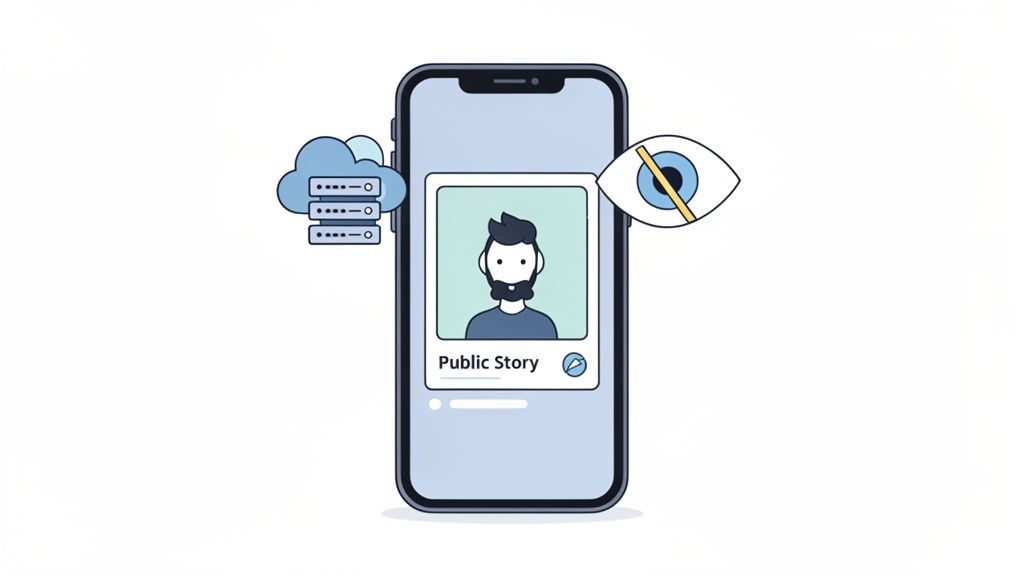
This explains why a visitor’s Instagram username should not be passed to the Story owner. There is no personal Instagram session attached to the search.
The exact retrieval method is less clear. InSnoop does not publish technical documentation explaining whether it uses cached content, automated browser sessions, unofficial endpoints, third-party providers or another retrieval system. It is therefore reasonable to describe the service as an intermediary, but not to claim that a specific API or server process has been verified.
Anonymous viewing also does not mean that no data exists anywhere. The Instagram account owner may not receive the visitor’s username, but InSnoop can still process technical information about the browser and device used to access its website.
What Instagram Officially Records About Story Engagement
There is another useful distinction between an individual viewer list and aggregate Story analytics.
Instagram provides creators with information about how their content performs. For professional business and creator accounts, Instagram Insights can include metrics such as Views, Accounts Reached, Interactions and Accounts Engaged for Stories and other content. Instagram defines Accounts Reached as the number of unique accounts that saw content at least once, while Views can include multiple displays or plays.
That means anonymous viewing should not automatically be interpreted as meaning that a Story produces no measurable activity whatsoever. The more specific claim is that the visitor's personal Instagram account should not appear as the viewing account when that personal account was never connected to the third-party service.
Whether a third-party retrieval request influences aggregate metrics is a separate technical question. InSnoop has not published enough technical information to establish exactly how Instagram categorizes every request generated through its service.
The 24-Hour Window Matters
Instagram officially states that photos and videos shared to Stories normally disappear from the profile, Feed and messages after 24 hours unless they are added to Highlights.
This creates a practical limitation for every third-party Story viewer. If a Story has already expired and was not preserved as a Highlight, failure to find it does not necessarily indicate that the viewer is malfunctioning.
Highlights operate differently. Instagram says Stories added to Highlights can remain visible on a profile even after the original Story has disappeared, until the account owner removes them.
This helps explain why InSnoop may sometimes display Highlights from an account even when that account currently has no active Story.
Anonymous to Whom?
The term “anonymous viewer” can refer to several different privacy relationships. Understanding the difference prevents users from assuming that the service offers more protection than it actually does.
Anonymous to the Instagram Story Owner
Because users are not required to connect their personal Instagram account, their Instagram username should not be attached directly to the viewing request.
This is the main type of anonymity that InSnoop advertises.
Anonymous to Instagram
This cannot be confidently guaranteed from publicly available information.
InSnoop does not publish sufficiently detailed technical documentation showing exactly how every Story is retrieved, what accounts or systems perform the retrieval, whether content is cached or how Instagram records those requests.
It is therefore safer to say that a visitor’s personal Instagram account is not directly involved rather than claiming that Instagram receives no information about the viewing activity.
Anonymous to InSnoop
No.
Like most websites, InSnoop can receive technical information when someone visits it. Its Privacy Policy says the service may collect information including:
- IP address
- Pages visited
- Visit date and time
- Time spent on pages
- Operating-system information
- Cookies, pixels, SDKs and similar technologies
- Usage information processed through third-party services
The policy also identifies Google Analytics for Firebase as a third-party service.
Anonymous to Your Internet Provider or Network Administrator
Not necessarily.
HTTPS can protect the contents of web traffic while it travels between a browser and a website, but network providers may still be able to identify the domain being accessed.
A VPN can replace the user’s visible public IP address with the VPN server’s IP address, but it does not prevent cookies, browser identifiers, analytics or activity inside the website from being processed.
InSnoop at a Glance: Key Facts
Before getting into the question of whether it actually works, here is a quick reference table covering the essential facts about InSnoop.
| Feature | Status / Detail |
| Works on public accounts | Yes |
| Works on private accounts | No |
| Can access Close Friends stories | No |
| Instagram login required | No |
| Account creation required | No |
| Browser based | Yes |
| Mobile app available | No |
| Story downloads supported | Yes, on some content types |
| Highlights viewing supported | Yes |
| Analytics or monitoring features | No |
| Price | Free |
Does InSnoop Actually Work Anonymously? The Honest Answer
InSnoop’s design provides a practical level of Instagram-facing anonymity because it does not require the visitor to sign in. The searched account is not opened through the visitor’s personal Instagram session, and no Instagram username is supplied to InSnoop.
That makes it different from third-party applications that ask users to connect an account or enter Instagram credentials. Avoiding those credentials removes the most immediate account-security risk.
However, the phrase “100 percent anonymous” needs qualification. There are two separate questions:
| Privacy question | Realistic answer |
|---|---|
| Will the Story owner see my Instagram username? | The visitor’s account is not connected, so the username should not be submitted as the viewer. |
| Does InSnoop know that I visited its website? | Its Privacy Policy says it may collect IP addresses, browser details, device identifiers and usage activity. |
| Can the result be guaranteed every time? | No. The Terms provide the service on an “as is” and “as available” basis. |
| Can InSnoop view private accounts? | No. It limits access to public information. |
| Is its technical system independently audited? | No public audit or technical documentation was found. |
The most defensible conclusion is that InSnoop can hide a visitor’s personal Instagram identity from the Story-viewing process, but it should not be described as creating complete online anonymity.
Reliability is also separate from anonymity. A failed search does not necessarily mean the profile is private or the username is wrong. Instagram can change how public content is delivered, Stories may have expired, or InSnoop’s retrieval system may be temporarily unavailable.
What Independent Reviews and Blogs Actually Say
Reading through the landscape of InSnoop coverage, a few consistent themes emerge across different sites and review formats.
The Positive Side
A significant share of reviews highlight InSnoop's simplicity as its biggest strength. There is no registration, no paywall, and no app to install. You arrive at the site, type a name, and you either get results or you do not. For non-technical users who just want a quick, no-fuss way to check public stories, that frictionless experience is genuinely appreciated. Several guides point out that InSnoop does not ask for your Instagram credentials at any point, which removes the most obvious risk associated with sketchy third-party tools.
Reviews aimed at educators, researchers, and social media marketers who need to monitor public content without alerting account owners tend to describe InSnoop as a useful starting point, even if they acknowledge its limitations for professional purposes.
The Concerns
On the other side, a recurring theme in more investigative reviews is the legal and ethical gray zone that all third-party Instagram viewers occupy. Instagram's terms of service prohibit the use of automated tools to access its platform without explicit permission. InSnoop, like its competitors, operates in tension with those terms. No widespread enforcement action against individual users of these tools has been publicly documented, but the theoretical risk exists.
Reviewers with a technical background often note that the reliability window for tools like InSnoop is unpredictable. When Instagram updates its backend or tightens access controls on public endpoints, third-party viewers can break without notice and without any guarantee of being fixed. Some reviews from late 2024 and early 2025 describe periods where InSnoop returned empty results or error pages for accounts that should have been publicly accessible.
Ethical concerns also come up. Watching someone's stories without their knowledge is not illegal in most contexts, especially for public accounts, but it is the kind of behavior that some reviewers flag as worth reflecting on before doing routinely.
How Much Weight Should You Give User Reviews?
User reports are useful for understanding whether a service loads quickly, produces results and remains usable after Instagram changes. They are much less useful for proving what happens technically behind the scenes.
For example, public discussions in 2026 include users reporting that they use InSnoop without providing an Instagram login. Those reports support the observation that the service is being used in the way it advertises, but they do not independently prove its anonymity architecture, data-retention practices or relationship with Instagram.
For this reason, reviews should be treated as evidence of user experience, rather than evidence of technical guarantees.
A stronger evidence hierarchy for evaluating an Instagram Story viewer is:
- Official Instagram or Meta documentation for Instagram behavior and platform rules.
- The viewer provider's current Terms and Privacy Policy for its own stated practices.
- Independent technical testing where methodology is disclosed.
- Reputable third-party reviews.
- Forum posts and individual anecdotes.
This distinction is especially important for claims such as “100% anonymous,” “cannot be detected” or “never stores data,” because those statements cannot normally be verified by simply watching a Story and checking whether a username appears.
InSnoop vs. Alternatives: Side-by-Side Comparison
| Category | InSnoop | StoriesIG | AnonyIG | PeekViewer |
|---|---|---|---|---|
| Public Story viewing | Yes | Yes | Yes | Yes |
| Instagram login | Not required | Not required | Not required | Not required |
| Registration | Not required | Not required | Not required | Required for paid monitoring |
| Highlights | Yes | Yes | Yes | Advertised |
| Reels and posts | Limited or not clearly promoted | Yes | Yes | Advertised |
| Downloads | Yes | Yes | Yes | Advertised |
| Price | Free | Free | Free | Paid subscription |
| Private-profile access | No | No | No | Claimed by the provider but not independently verified |
| Privacy transparency | Broad policy with inconsistencies | Check current policy before use | Provider claims it does not retain searches or IP addresses | Requires more account and billing interaction |
| Best use | Simple Story and Highlight checks | Wider public-content coverage | Public viewing and downloads | Paid profile monitoring claims |
StoriesIG and AnonyIG cover a wider range of public Instagram content, including Reels and regular posts. InSnoop is more focused on Stories, Highlights and straightforward downloading.
PeekViewer belongs in a different category because it asks users to choose a paid subscription and makes claims about monitoring private accounts. Such claims should be treated cautiously. A legitimate public viewer cannot simply override Instagram’s private-account permissions, and users should not enter Instagram credentials or install unknown software to unlock supposedly hidden content.
Performance Score Comparison: InSnoop vs. Alternatives
The table below scores InSnoop against two alternatives across four dimensions that matter most to users. Scores are based on the general sentiment across available reviews and should be read as directional rather than precise. All scores are out of 10.
| Metric | InSnoop | StoriesIG | PeekViewer | What It Measures |
| Ease of Use | 9 | 8 | 7 | How quickly a new user can get results |
| Anonymity Confidence | 6 | 6 | 6 | Likelihood your identity stays hidden |
| Reliability | 6 | 6 | 6 | Consistency of story loading across sessions |
| Feature Depth | 4 | 5 | 7 | Range of tools beyond basic story viewing |
| Risk Level (lower = better) | 5 | 5 | 5 | Exposure to ToS, legal, or privacy risk |
This bar chart would display the anonymity confidence scores for InSnoop, StoriesIG, and PeekViewer side by side. All three tools score around 6 out of 10, illustrating that none of them offer a truly robust anonymity guarantee. InSnoop's bar would stand alongside comparable bars for its two main competitors, making it easy to see at a glance that the entire category shares similar confidence limitations rather than one tool being definitively safer than the others.
Safety, Privacy, and Risk: What You Actually Need to Know
The safety question has two distinct dimensions. One is account safety, meaning whether using InSnoop can put your Instagram account at risk. The other is personal data safety, meaning what information InSnoop itself collects about you while you use it.
Account Safety
Because InSnoop does not require your Instagram login at any point, your account is not directly exposed to any risk through the viewing process. You are not handing over your username and password to a third-party site, which is the most dangerous thing someone can do with an Instagram account. The stories you view through InSnoop are not connected to your Instagram identity, which means there is no mechanism by which Instagram could trace a view back to you as an individual user.
That said, no confirmed wave of bans linked specifically to InSnoop use has been publicly documented. People who use it as an occasional viewer of public content appear to face minimal direct account consequences. The risk is not zero because Instagram's terms technically prohibit third-party tool usage, but in practice, the enforcement focus tends to be on bots, scrapers, and automation tools rather than casual one-off viewers.
Personal Data and Privacy
InSnoop now publishes a formal Privacy Policy that became effective on July 14, 2026.
According to that policy, the service may automatically collect:
- A visitor’s IP address
- Pages opened within the service
- The date and time of visits
- Time spent using the service
- The device’s operating system
- Information collected through cookies, SDKs, pixels and related technologies
The policy states that automatically collected data may be retained for up to 24 months. User-provided data may be retained for the duration of use plus 12 months, while aggregated and anonymized information may be retained indefinitely.
The policy also says that users may request access to, correction of or deletion of personal data. California residents are given additional rights concerning access, deletion and opting out of certain forms of sharing. The service says it is not intended for children younger than 16.
An Important Policy Inconsistency
InSnoop’s homepage FAQ says that the website does not track user behaviour or download history. Its formal Privacy Policy, however, describes IP-address collection, activity information, cookies and analytics technologies.
These statements are difficult to reconcile without additional clarification from the provider.
The difference may relate to what InSnoop considers “tracking.” For example, it may mean that the company does not build a permanent history of every profile viewed while still collecting general analytics and device information.
However, the site does not currently explain that distinction clearly.
Users should therefore rely on the more detailed Privacy Policy rather than interpreting the shorter homepage statement as a guarantee that no technical information is collected.
Current Data-Retention Summary
| Information category | Stated retention period |
| User-provided information | Duration of use plus up to 12 months |
| Automatically collected information | Up to 24 months |
| Aggregated or anonymized information | Potentially indefinite |
| Legally required records | As long as required by law |
These are the provider’s published terms and have not been independently audited.
Legal and Terms of Service Considerations
Instagram's terms of service prohibit accessing the platform through third-party tools that have not been formally authorized. Using InSnoop technically places users in breach of those terms, as does using most other viewer tools in this category. Whether that matters in practice depends on a few things. Instagram's enforcement against individual casual viewers is rare and not publicly documented. However, in some jurisdictions, accessing data in ways that contradict a platform's terms could carry additional considerations depending on local law. For the vast majority of users doing casual, low-frequency story viewing of public accounts, this is a theoretical rather than practical concern. For anyone using InSnoop in a professional or commercial context, the calculus is worth thinking through more carefully.
Bottom line on safety: InSnoop carries a lower direct risk than tools that require your Instagram credentials. But no third-party tool in this category is entirely risk-free, and the gap in transparent privacy disclosure is a real limitation.
What Instagram's Terms Actually Say About Automation
Instagram's current Terms of Use state that users cannot access or collect information in automated ways without Instagram's express permission. Meta separately defines data scraping as automated access and collection and says Instagram accounts may be restricted when activity associated with unauthorized scraping is detected.
Meta also publishes Automated Data Collection Terms stating that automated collection from Meta products requires express written permission unless another authorization applies. Those terms explicitly describe automated collection mechanisms such as scrapers, bots, robots, spiders and crawlers.
There is an important distinction here, however. These rules clearly address the party performing unauthorized automated access or collection. They do not by themselves establish that every person who merely opens a third-party website is personally performing that automation.
Consequently, it is safer to distinguish between:
- the platform-compliance position of the third-party service retrieving Instagram content;
- the conduct of an individual using that service;
- any Instagram account connected to automated activity; and
- separate legal obligations that may apply depending on how collected material is subsequently used.
Whether a particular activity creates contractual or legal liability depends on the facts and applicable jurisdiction. Users conducting systematic monitoring, commercial data collection or large-scale archiving have more reason to investigate those issues than someone casually opening publicly accessible content.
Security Checklist Before Using InSnoop
The lack of an Instagram login removes one major risk, but it does not make every page, advertisement or download automatically safe.
Before using the service:
- Confirm that the browser address displays the expected domain.
- Never provide an Instagram password or two-factor authentication code.
- Do not install an unknown application or browser extension.
- Avoid advertisements that imitate the site’s real search or download buttons.
- Reject unexpected executable files such as
.exe,.apk,.dmgor.msifiles. - Use an updated browser with phishing and malicious-download protection enabled.
- Review the privacy and cookie settings before accepting non-essential tracking.
- Scan unexpected downloads before opening them.
- Leave the page if it redirects repeatedly or displays fake security alerts.
- Do not assume that a website is trustworthy merely because it uses HTTPS.
Stories and videos would normally be delivered as ordinary media files, such as JPEG images or MP4 videos. A Story viewer should not need to install system software to display public content.
Warning Signs of an Unsafe Instagram Viewer
Treat a service cautiously when it:
- Promises access to private profiles
- Requests Instagram credentials
- Asks for a two-factor authentication code
- Requires a “verification” application
- Demands payment after displaying fake search progress
- Opens repeated pop-ups or redirects
- Downloads files automatically
- Claims it can reveal deleted or Close Friends Stories
- Offers no privacy policy or contact information
- Uses misleading buttons designed to resemble legitimate downloads
A service claiming it can bypass a private profile is particularly concerning. InSnoop itself states that private accounts are not supported.
When InSnoop Makes Sense and When It Does Not
Good Use Cases
• Checking a public account's stories without the account owner knowing you viewed them, in a low-stakes, one-off situation.
• Monitoring a competitor's public Instagram content as part of casual competitive research, without creating or logging into an Instagram account.
• Browsing story archives or highlights from public accounts that post content you find useful, without wanting to follow them or generate a notification.
• Quickly checking whether an account has active stories before deciding to follow it, without registering a view from your own profile.
Situations Where InSnoop Falls Short
• Private accounts. InSnoop cannot access them, and any tool claiming otherwise should be treated with serious skepticism.
• High-stakes monitoring where you need guaranteed, consistent results. The reliability is too inconsistent for professional-grade use.
• Professional social media intelligence work that requires analytics, tracking over time, or engagement data. InSnoop does not offer any of those features.
• Anyone who is uncomfortable operating in a terms-of-service gray zone. The tool sits outside Instagram's official ecosystem, and that is a position that will not suit everyone.
• Close Friends stories or any content that is not publicly available. InSnoop simply cannot reach that content.
Content Ownership and Responsible Use
The ability to view or download a public Story does not transfer ownership of that content.
Photographs, illustrations, music and videos may remain protected by copyright even when they are posted on a public profile. Instagram advises users to obtain permission before posting another person’s protected work, and its policies prohibit content that infringes intellectual-property rights.
Downloading content and republishing it are separate actions.
Before reusing downloaded media, consider:
- Who created the original material?
- Has the creator granted permission?
- Is attribution required?
- Is the use personal, editorial, educational or commercial?
- Does the content include music, logos or other third-party rights?
- Could republication mislead people about the original creator?
- Does local copyright law provide an applicable exception?
The fact that content can be accessed publicly does not automatically place it in the public domain.
Responsible Uses
Reasonable uses may include:
- Reviewing your own Stories
- Conducting limited research into public marketing campaigns
- Studying publicly available content formats
- Checking public event announcements
- Preserving authorized material for personal reference
- Reviewing content when the creator has given permission
Uses to Avoid
InSnoop should not be used for:
- Harassment or intimidation
- Persistent surveillance of an individual
- Attempts to bypass private-profile restrictions
- Collecting sensitive personal information
- Republishing copyrighted content without permission
- Impersonating creators
- Building an unauthorized commercial media archive
- Monitoring children or vulnerable people
- Circumventing blocks in order to continue unwanted contact
Privacy tools should not be used to disregard another person’s boundaries.
Final Verdict: Does InSnoop Work for Anonymous Instagram Story Viewing?
Yes, InSnoop works for what it is designed to do, with real limitations that are worth understanding before you rely on it.
For casual, occasional viewing of public Instagram stories where you want to avoid leaving your name in the viewer list, InSnoop is a functional free tool that delivers on its core promise more often than not. The no-login, no-installation experience is genuinely easy to use, and the fact that it does not ask for your Instagram credentials removes the biggest risk category associated with third-party tools in this space.
Where InSnoop falls short is in the consistency and robustness of that experience. Stories sometimes fail to load. Anonymity is not guaranteed in an absolute sense, it is more of a practical likelihood based on how the tool works. And the lack of a clear privacy policy means users are making a reasonable but unverified assumption about how their browsing data is handled.
The InSnoop anonymous Instagram story viewer sits in the same gray zone as all tools of its type. It is not a professional-grade solution, it is not appropriate for private accounts, and it is not a replacement for legitimate social media monitoring tools. But for the user who simply wants to quietly watch a public story without announcing themselves, it is a practical, free, and low-friction option that gets the job done most of the time.
Use it for casual, low-stakes purposes on public accounts. Approach anything beyond that with appropriate caution.
Post Comment
Share your thoughts about this article.
Recent Comments
Nikki
Jul 20, 2026So i used this to view someone's story then checked from my main account like an hour later and guess what my username was right there in their viewers list. so either the site doesnt work or instagram figured it out somehow either way dont use this if you actually need to be hidden. also the ads are sketchy as hell had one try to download something automatically. closed the tab immediately and ran a virus scan"
Login to reply