Replacing a face in a video once required careful tracking, masking, keyframes, and compositing. Today, AI Video FaceSwap can automate much of that process, making it possible to transform an existing video while preserving its original movement, expressions, and overall scene.
However, getting a convincing result is not simply a matter of uploading two files and clicking generate. The quality of the source face, target footage, lighting, camera angle, facial movement, and frame-to-frame consistency can all affect the final video.
This guide explains how AI Video FaceSwap works, what makes a result look natural, and how to approach the process more effectively.
_1789388159.jpg)
What Is AI Video FaceSwap?
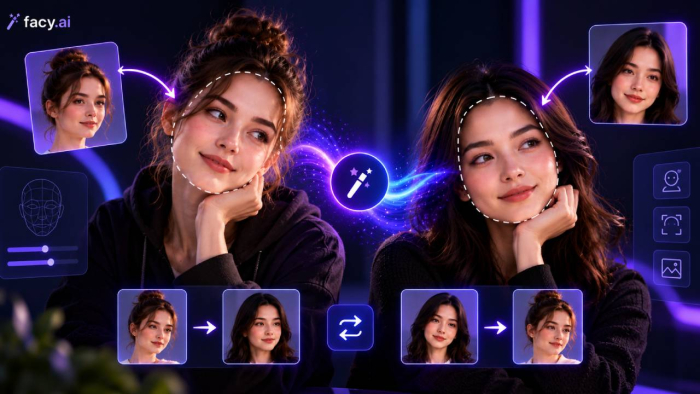
AI Video FaceSwap is a technology that replaces a person’s face in existing video footage with another face using AI-based face detection, tracking, alignment, and image synthesis.
Typically, the process involves two main elements: a source face, which provides the identity to be used, and a target video, where the replacement takes place. The AI analyzes facial features and movement in the footage before generating a replacement that follows the original subject.
Unlike traditional video editing, where artists may need to manually track facial movements and adjust masks frame by frame, AI-based tools automate much of this work.
AI Video FaceSwap vs. Photo Face Swap
The basic idea is similar, but video introduces another layer of complexity.
A photo only needs to produce one convincing image. A video must maintain a consistent appearance across many consecutive frames while the subject moves, changes expression, or turns their head.
That means a face swap can look convincing in one frame but still appear unnatural when the entire video is played.
Common Applications of AI Video FaceSwap
AI face swapping is often used for creative rather than purely technical purposes. For example, creators can transform characters in short videos, produce personalized social content, experiment with cosplay concepts, create memes, or adapt existing footage into new storytelling ideas.
One of its main advantages is that the original video already contains movement, camera work, timing, and scene composition. Instead of generating an entire video from scratch, creators can modify the identity of a character while retaining much of the original performance.
How Does AI Video FaceSwap Work?
Although different platforms use different models and processing methods, the general workflow involves several stages.
Detecting and Tracking the Face
First, the AI identifies the face in the target footage. It then tracks the face as it moves through the video.
Tracking is important because the subject may change position, turn their head, or move closer to or farther from the camera. The system needs to continuously locate the relevant facial region rather than treating every frame as an independent image.
Mapping the Source Face
The system analyzes the source face and maps its features onto the target subject.
This involves considering facial structure, proportions, orientation, and other visual characteristics. The better the source face matches the conditions of the target footage, the easier it is for the generated result to appear natural.
Blending the Face Into the Video
After mapping, the AI generates the replacement face and integrates it with the surrounding image.
This stage may involve adjustments to facial boundaries, color, lighting, texture, and other visual elements. The goal is to make the replacement appear as though it belongs naturally within the original scene rather than looking like a separate image placed on top.
Maintaining Consistency Across Frames
Video requires temporal consistency. The replacement face should not suddenly change shape, position, texture, or identity from one frame to the next.
AI systems therefore need to account for information across consecutive frames. Maintaining this consistency is one of the major differences between a convincing video face swap and a result that looks unstable or artificial.
Vimi: An AI Video FaceSwap Tool for Creative Video Effects

Vimi is an AI platform for creating and transforming visual content, with a dedicated AI Video FaceSwap effect for face-swapping video content.
How to Face Swap a Video With Vimi
Using Vimi for AI Video FaceSwap involves three main steps:
1. Prepare and Upload Your Materials
Choose a clear source face and a target video with visible facial features. Upload the required materials to Vimi's AI Video FaceSwap tool according to the platform's current requirements.
2. Generate the FaceSwap Video
Start the generation process. Vimi analyzes the facial features and movement in the footage and applies the selected face to the target video.
3. Review and Refine the Result
Watch the complete video and check the face alignment, expressions, and consistency during movement. If the result is not satisfactory, try using a clearer source face or better-matched target footage before generating again.
How to Create More Realistic AI Video FaceSwap Results
The AI tool matters, but the material you provide matters just as much. A few practical choices can significantly improve the result.
Start With a Clear Source Face
Use a source face with sufficient resolution and clearly visible facial features. Images with heavy blur, extreme filters, poor lighting, or significant obstruction may provide less useful information for the AI.
A relatively neutral and clearly visible face is often a good starting point.
Choose Suitable Target Video Footage
Not every video is equally suitable for face swapping. Footage with a clearly visible subject and relatively stable facial movement is generally easier to process.
Extremely fast movement, strong camera motion, frequent cuts, or very small faces can make the task more difficult.
Pay Attention to Lighting and Viewing Angle
A major difference between the source image and target video can affect visual consistency.
For example, placing a brightly lit frontal source face into a scene where the subject is shown in a dark side profile creates a more difficult matching problem. Whenever possible, choose source material with a facial angle and lighting direction that are reasonably compatible with the target footage.
Consider Facial Expressions and Movement
The source face does not simply need to look similar. The target video may include smiling, speaking, blinking, or other expressions.
Complex expressions and rapid movements can increase the difficulty of maintaining natural facial details. Reviewing the final video rather than judging a single frame is therefore essential.
Watch for Occlusion and Complex Scenes
Hands, hair, glasses, objects, or other people can partially cover the face during a video.
These occlusions can make tracking and replacement more challenging. Scenes with frequent obstruction or overlapping subjects may require additional editing or may simply be poor candidates for automated face swapping.
Check Frame-to-Frame Consistency
After generation, watch the entire video carefully.
Look for sudden changes around the eyes, mouth, jawline, skin texture, or facial boundaries. Also check whether the replacement remains aligned when the subject turns or moves.
A still frame can look excellent while motion reveals inconsistencies that are not obvious when viewing individual images.
Frequently Asked Questions About AI Video FaceSwap
Can AI Video FaceSwap Work With Different Facial Angles and Head Positions?
It can, but performance may vary depending on the degree of movement and the quality of the available facial information. Frontal or moderately angled faces are generally easier to process than extreme profiles or rapidly changing orientations.
Why Does an AI FaceSwap Sometimes Look Fine in a Still Frame but Unnatural in Motion?
A still image only shows one moment. Video requires the replacement to remain aligned and visually consistent across consecutive frames. Small tracking or generation errors can therefore become much more noticeable once the video is played.
Can AI Video FaceSwap Be Used for Multiple People in the Same Scene?
Some AI face-swapping systems support multiple faces, but results depend on the specific tool and the complexity of the footage. Scenes with overlapping people, frequent movement, or partial facial obstruction can be more challenging than single-subject footage.
What Are the Main Rights and Consent Issues With AI FaceSwap Videos?
Creators should have appropriate permission to use other people's faces and source footage, particularly when publishing or commercializing the result. Face-swapped content can also create risks related to impersonation, privacy, publicity rights, copyright, and misleading content. Responsible use means considering both the rights of the people depicted and the context in which the video will be shared.
Final Thoughts
AI Video FaceSwap makes it easier to transform existing video footage without rebuilding the entire scene from scratch. Its effectiveness, however, depends on more than the AI model itself.
Three principles are especially useful: start with suitable source and target footage, understand how movement and lighting affect the result, and evaluate the complete video rather than a single frame.
For creators who want to experiment with face-swapped videos as part of a broader visual workflow, tools such as Vimi can simplify the generation stage while leaving room for further editing and creative customization.
Post Comment
Share your thoughts about this article.
Be the first to post a comment!