Both TurboScribe and Rev turn audio and video into text, but they solve the problem from opposite ends. TurboScribe is an AI-only tool built for high volume at a flat price, powered by OpenAI's Whisper model. Rev is a hybrid service that pairs fast AI transcription with professional human transcribers, charging by the minute and aiming squarely at accuracy-critical work.
This comparison breaks down accuracy, pricing, features, and ideal users so the right choice becomes obvious for your situation. Visual charts and color-coded tables make the trade-offs easy to scan.
Two tools, two philosophies: flat-rate AI volume versus pay-per-minute AI and human accuracy.
Quick verdict Choose TurboScribe for high-volume, clean-audio transcription at a flat monthly price. Choose Rev when accuracy cannot slip, especially on messy audio, legal, or compliance work where human transcription earns its premium. |
At a Glance
Here is the fast overview before the detail. Figures reflect rates reported in 2026 and should be confirmed on each provider's site.
| Feature | TurboScribe | Rev |
|---|---|---|
| Model type | AI only (Whisper) | AI plus human option |
| AI accuracy (clean audio) | ~97-98% | ~95-96% |
| Human accuracy option | No | Yes, 99%+ guaranteed |
| Pricing model | Flat subscription | Per minute or subscription |
| Entry price | Free; ~$10/mo annual | $0.25/min AI; free 45 min/mo |
| Human transcription | Not offered | ~$1.50-$1.99/min |
| Best for | High-volume creators | Accuracy-critical teams |
Two Different Philosophies
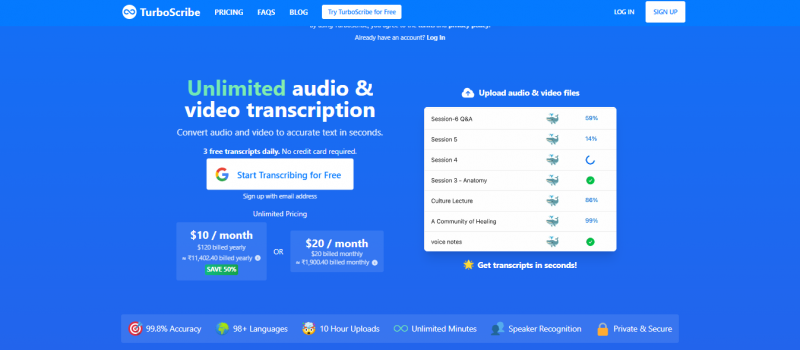
TurboScribe is a lean, focused product built by a former Meta AI engineer. It does one thing, batch AI transcription, and does it cheaply. On a paid plan you get unlimited transcriptions, files up to 10 hours or 5GB, up to 50 simultaneous uploads, translation into 134 plus languages, speaker recognition, timestamps, and ChatGPT-powered summaries. The whole pitch is volume without a per-minute meter running.
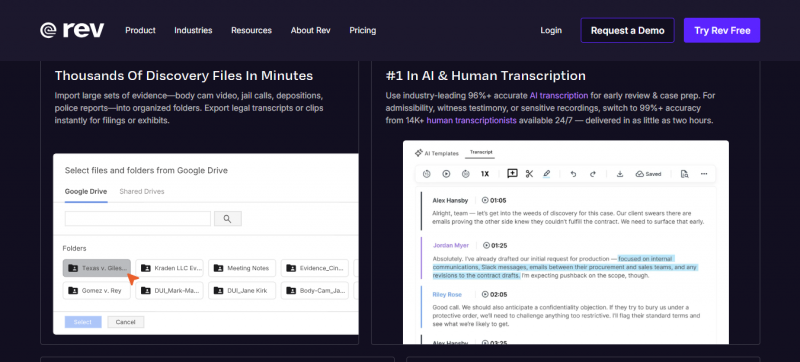
Rev is the established U.S. transcription service, and the only mainstream platform that offers both AI and human transcription in one interface. Its AI tier is fast and affordable per minute, while its human tier uses vetted professionals to guarantee 99 percent accuracy regardless of accents, noise, or jargon. A 2025 acquisition also made Rev the most legally specialized option, with deposition and exhibit workflows.
At a Glance
Here is the fast overview before the detail. Figures reflect rates reported in 2026 and should be confirmed on each provider’s site.
| Feature | TurboScribe | Rev |
|---|---|---|
| Model type | AI only (OpenAI Whisper, large-v3) | AI (Reverb engine) plus human option |
| AI accuracy, clean audio | ~97–98% | ~95–96% |
| Human accuracy option | No | Yes, ~99% guaranteed |
| Pricing model | Flat subscription | Per minute or subscription |
| Entry price | Free; ~$10/mo billed annually | Free 45 AI min/mo; $0.25/min AI |
| Human transcription | Not offered | ~$1.99/min |
| Developer API | Limited | Yes (Rev.ai / Reverb) |
| Best for | High-volume creators | Accuracy-critical teams |
Accuracy: Clean vs Messy Audio
This is where the two tools genuinely diverge. On clean, single-speaker recordings, both do well, and TurboScribe's Whisper engine often edges ahead on studio-quality podcasts. The gap opens on difficult audio.
• TurboScribe: excellent on clear audio, but it struggles with overlapping speakers, heavy background noise, and strong accents. There is no human fallback and no live transcription.
• Rev AI: solid on clean audio, with the option to escalate hard files to human transcribers who hold accuracy near 99 percent even on poor recordings.
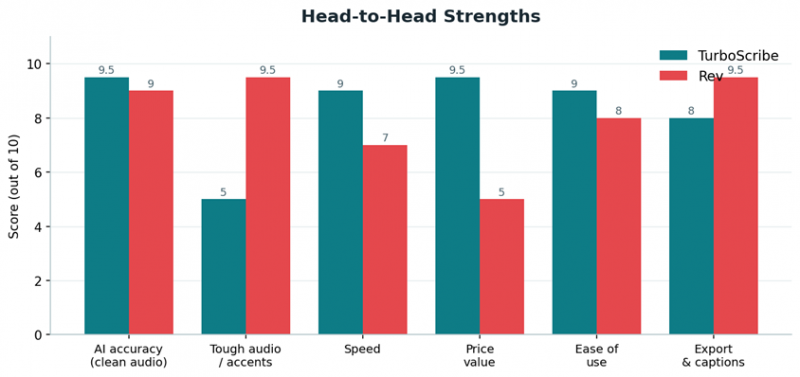
Figure 1. Where each tool leads: TurboScribe on price and clean-audio speed, Rev on tough audio and captions.
Audio tip Accuracy depends as much on your recording as the tool. A directional mic placed close to the speaker improves results more than any in-app setting, and it narrows the gap between AI-only and human transcription. |
Pricing: Flat Rate vs Per Minute
The cost question hinges on how many hours you transcribe each month. TurboScribe charges a flat subscription, so cost stays the same whether you transcribe one hour or one hundred. Rev's AI tier charges per minute, which is cheap for occasional use but scales up quickly with volume.
| Plan | TurboScribe | Rev |
|---|---|---|
| Free tier | 3 transcripts/day, 30-min cap | 45 AI minutes per month |
| AI pricing | ~$10/mo annual ($20 monthly) | $0.25/min (~$15/hour) |
| Human option | Not available | ~$1.50-$1.99/min |
| 10 hours of AI/month | ~$10 flat | ~$150 |
| Subscriptions | Unlimited plan | From ~$25/seat/mo (Essentials) |
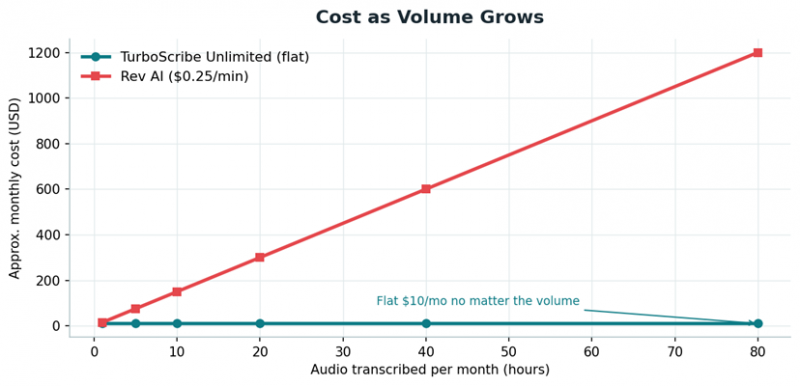
Figure 2. TurboScribe's flat fee stays level as volume climbs, while Rev's per-minute AI cost rises with every hour.
Watch the billing toggle TurboScribe's headline ~$10 rate requires annual billing; month-to-month is about $20. Rev's per-minute model also has fine print, including no refunds for unused human orders and a short cancellation window. |
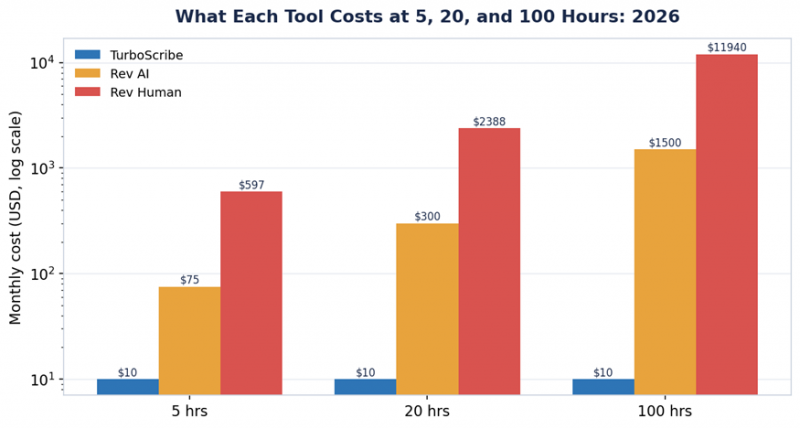
Figure 3. The same three tools at 5, 20, and 100 hours per month (log scale). The flat plan barely moves; the human tier climbs into the thousands.
Rev’s developer and add-on pricing
Rev’s consumer per-minute rate is not the whole story. Through its Rev.ai developer platform, the Reverb automatic-speech-recognition engine is priced far lower per minute than the $0.25 consumer rate, with a separate, higher rate for foreign-language audio. That matters for teams building transcription into software rather than uploading files by hand. Several cost mechanics are easy to miss:
• 15-second minimum: Even a very short clip is billed at a 15-second minimum, which can inflate costs when processing many tiny files.
• Stacked add-ons: Features such as sentiment analysis, topic extraction, summarization, and translation are billed per minute on top of the base rate and can multiply a feature-rich job’s cost.
• Translation premium: Human-translated subtitles are billed per source minute and rise sharply for some target languages, well above the English caption rate.
• No API free tier: The API has no free trial credit, so metered billing starts from the first minute, unlike some competitors that offer starter credit.
Watch the billing fine print TurboScribe’s headline ~$10 rate requires annual billing; month-to-month is about $20. Rev’s model stacks pay-as-you-go AI, pay-as-you-go human, several subscription tiers, and a legacy plan no longer sold to new customers, and subscriber discounts mainly apply to human orders. Read the checkout total, including any sales tax, before committing. |
Features Side by Side
Beyond accuracy and price, the everyday feature set shapes the experience. Both export to common formats and label speakers; they differ most on human services, captions, and integrations.
| Feature | TurboScribe | Rev |
|---|---|---|
| Supported languages | 98+ (134+ for translation) | 30+ AI; 17+ subtitle languages |
| Speaker labels | Yes | Yes |
| Timestamps | Yes | Yes |
| Export formats | DOCX, PDF, SRT, TXT | TXT, DOCX, PDF, SRT, VTT, JSON |
| AI summaries | Yes (ChatGPT-powered) | Available via VoiceHub |
| Human captions/subtitles | No | Yes, broadcast-quality |
| Transcription modes | Cheetah (fast), Whale (accurate) | Reverb AI; human tier |
| Import sources | YouTube, Dropbox, Drive, Vimeo | File upload; mobile recording app |
| Large files | Up to 10 hrs / 5 GB | Supported, per-minute billed |
| Live transcription | No | No (focus on uploads) |
| Developer API | Limited | Yes (Rev.ai) |
| Legal/deposition workflow | No | Yes (SmartDepo, 2025) |
Data, Privacy, and Compliance
For many professional buyers the deciding factor is not features but how each service handles sensitive recordings. This is an area where the two tools are documented differently, and where you should verify the current terms yourself before transcribing confidential material.
• TurboScribe: As a focused U.S. AI service, TurboScribe publishes comparatively limited compliance documentation. That can matter for medical users bound by HIPAA-style rules, or European users subject to GDPR data-residency expectations. If you handle regulated data, confirm exactly where files are processed and stored before uploading.
• Rev: Rev’s enterprise and legal positioning means more formal handling of sensitive material, reinforced by the SmartDepo acquisition aimed at legal testimony. Legal and compliance teams are a core market, so deposition and exhibit workflows are first-class rather than afterthoughts.
A general point worth keeping in mind: any cloud transcription service uploads your audio to a remote server. Where privacy is paramount and audio cannot leave your control, an on-device or self-hosted option may suit better than either tool here. Neither TurboScribe nor Rev is an offline product.
Developers and Integrations
The two tools serve developers very differently. TurboScribe is built around its own web app and offers only limited programmatic access, so it suits people who upload and download files manually. Rev exposes a full developer API through Rev.ai and its Reverb engine, which makes it the natural choice when transcription needs to run automatically inside another product, a captioning pipeline, a call-analytics system, or a media workflow. If you are choosing on behalf of an engineering team rather than for personal use, this distinction often decides the matter on its own.
Which Should You Choose?
Pick TurboScribe If
• You transcribe high volumes of clean audio, like podcasts, lectures, or interviews.
• You want predictable, flat monthly pricing instead of a per-minute meter.
• You batch large archives and value unlimited uploads and storage.
• Roughly 95 to 98 percent accuracy with light cleanup is acceptable for your work.
Pick Rev If
• Accuracy is non-negotiable: legal, medical, journalism, or compliance content.
• Your audio is messy, with accents, crosstalk, or background noise.
• You need broadcast-quality captions or human-translated subtitles.
• You only transcribe occasionally and prefer to pay per minute.
Match by situation
| Your situation | Better fit |
|---|---|
| High-volume podcast or lecture transcription | TurboScribe |
| Legal depositions or compliance records | Rev (human) |
| Tight, predictable monthly budget | TurboScribe |
| Occasional, accuracy-critical one-offs | Rev |
| Noisy or multi-speaker recordings | Rev (human) |
| Large multilingual archive on a flat fee | TurboScribe |
| Automated transcription inside an app | Rev (API) |
| Broadcast captions or translated subtitles | Rev |
Limitations to keep in mind
• TurboScribe: Lacks a human tier and live transcription, struggles with chaotic meetings, throttles very heavy batch uploads in practice despite the “unlimited” label, and as a U.S. service has limited published compliance documentation.
• Rev: Gets expensive at volume, stacks several pricing models that confuse first-time buyers, charges extra for add-ons such as translation and summarization, and its excellent human tier is slower than instant AI output.
Final Takeaway
TurboScribe and Rev are not really rivals so much as tools for different jobs. If you produce a steady stream of clean recordings and want unlimited transcription at a flat, low price, TurboScribe is the clear value pick. If your work cannot tolerate errors, or your audio is noisy and high-stakes, Rev's human-backed accuracy and caption quality justify the higher per-minute cost. Match the tool to your audio quality, volume, and accuracy needs, and either can be the right answer.
Post Comment
Share your thoughts about this article.
Be the first to post a comment!