Grok ranks third in the United States and close to invisible worldwide, depending entirely on which measurement you use. It also costs more than the market leader while being smaller than it. This document sets out what the 2026 data shows and where each product is the better choice.
Quick Note
ChatGPT is the better assistant for almost everything. Grok is the better instrument when the answer is less than an hour old.
ChatGPT wins on capability benchmarks, ecosystem, enterprise readiness and price. Grok wins on one capability that no other mainstream assistant replicates natively, which is direct access to live public posts on X.
That single advantage is genuinely valuable to a specific group of people, and close to worthless to everyone else. The purchasing question is therefore not which product is better in general, but whether real-time social data is worth 10 dollars a month more to you.
| ATTRIBUTE | GROK | CHATGPT |
|---|---|---|
| Core advantage | Live public posts on X | Breadth and measured accuracy |
| Standard paid tier | SuperGrok, 30 dollars per month | Plus, 20 dollars per month |
| United States share | 17.8 percent, third place | 52.9 percent, first place |
| Worldwide web visits | 2.4 percent | 53.9 percent |
| Coding index | 40 | 59 |
| Best suited to | Traders, journalists, social teams | General work, coding, business use |
Three findings drive the rest of this document. Grok's market position depends entirely on which measurement you cite. Its engagement per visit is roughly twice ChatGPT's. And it is the rare challenger that charges more than the incumbent.
Market Share Measurement
United States and Worldwide Estimates
This is the most misread statistic in the category. Grok is described both as the number three assistant and as holding about 2 percent of the market. Both descriptions are accurate. They measure different things.
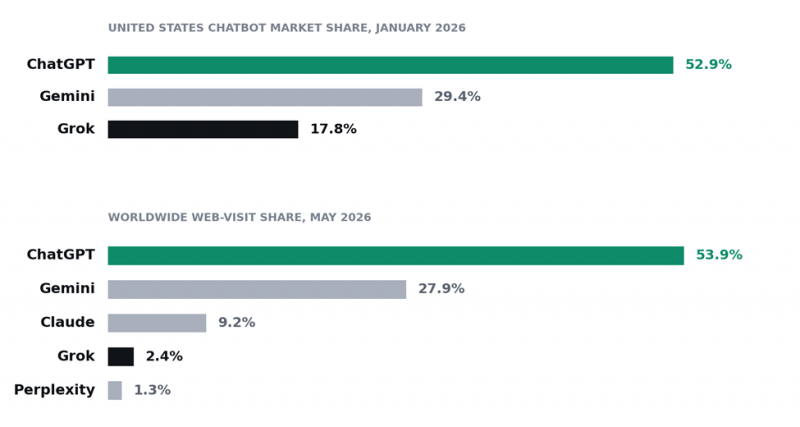
Figure 1. Grok shown in black in both panels. Sources: Reuters citing Apptopia, January 2026 (United States app usage); Similarweb via Momentic, July 2026 report covering May 2026 data (worldwide web visits).
HOW TO READ THIS
Grok is strongest where it is bundled. Its distribution runs through X, an American-skewed platform, and much of its usage happens inside the X app rather than on the open web. App-based United States measurement flatters it. Worldwide web-visit measurement penalises it. Neither figure is wrong, and quoting only one of them is how this comparison usually goes astray.
For scale on the other side, ChatGPT reports between 800 and 900 million weekly active users and adoption across roughly 92 percent of the Fortune 500. Grok reported 117 million monthly active users in March 2026, according to a SpaceX quarterly filing. Those are different units, which is itself part of the difficulty in comparing the two.
Growth Trajectory
The growth rate is the part nobody disputes.
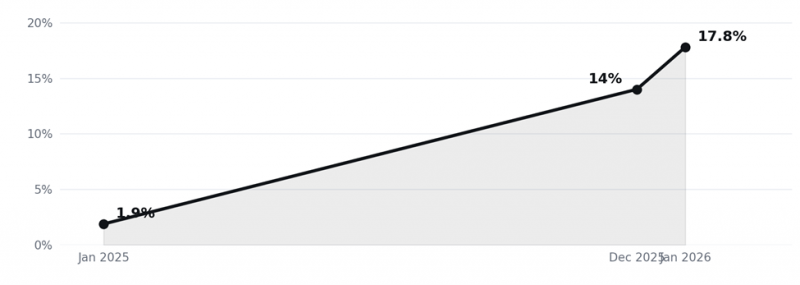
Figure 2. Grok United States chatbot market share. Source: Reuters citing Apptopia, reported January 2026.
Grok moved from under 2 percent to nearly 18 percent of the United States market in twelve months. That is a genuine and fast rise. It is also concentrated in one country, one platform and one use case, so it is better read as evidence of a strong niche than as an imminent change at the top of the market.
User Engagement
This is the most interesting number in Grok's favour, and it is rarely quoted. Average time per visit puts Grok well ahead of both larger rivals.
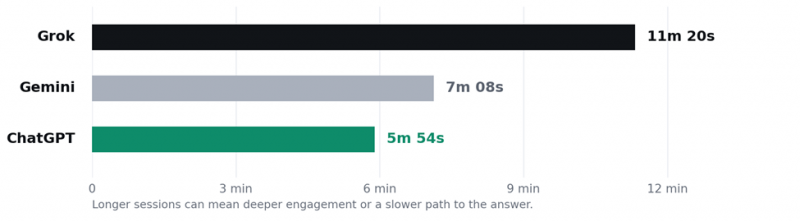
Figure 3. Average time per visit. Source: doit.software analysis, 2026.
The plausible explanation is that Grok is used for browsing and exploration rather than lookup. People arrive to see what is happening, follow threads of live discussion, and generate images. That is a different activity from asking ChatGPT to fix a function, and it should be read as a difference in behaviour rather than a measure of quality.
Capability Benchmarks
Both laboratories shipped flagship models within a day of each other. Grok 4.5 arrived on 8 July 2026, built on a new foundation architecture and described by Elon Musk as comparable to Claude Opus 4.7 but faster, more token-efficient and cheaper to run. GPT-5.6 followed on 9 July 2026.
On published evaluations, ChatGPT holds the advantage.
| MEASURE | RESULT | READING |
|---|---|---|
| Artificial Analysis Coding Index | GPT-5.5 leads 59 to 40 | A wide margin rather than a close call |
| Benchmark categories won | ChatGPT, 5 of 8 | MMLU, GPQA, SWE-Bench, hallucination rate, multimodal breadth |
| Context window | Grok, up to 2M tokens | The largest among major models |
| Flagship API input price | Grok 4.5 at $2 per 1M | Cheaper per token than the OpenAI flagship tier |
| Hallucination rate | Contested | Both vendors claim the lead, so treat both claims sceptically |
One structural change is worth knowing about. xAI has merged with SpaceX and now operates as SpaceXAI, and it acquired the AI code editor Cursor. Grok has also expanded well beyond chat, with a coding model called Grok Build, a Google Workspace add-on, and a Microsoft Outlook add-in shipped in July 2026. The product is no longer simply the chatbot on X.
Platform Strengths
Grok
Try Grok - https://grok.com
• Live information. Native access to public posts on X. No other mainstream assistant replicates this, and for breaking events it is a real advantage rather than a marketing line.
• Sentiment and reaction. Questions of the form what are people saying about this have no good answer from an indexed model.
• Image and video generation. Fast, stylistically broad, with native video output. Strong for social and creative work.
• Fewer guardrails. Grok will engage with edgier prompts that other assistants decline. Whether that counts as a feature depends entirely on your use case.
• API economics. Competitive token pricing, a very large context window, and unusually generous free developer credits.
ChatGPT
Try ChatGPT - https://chatgpt.com
• Coding. A wide and consistent benchmark lead, plus the Codex agent and a mature developer story.
• Structured reasoning. Wins most published evaluation categories, including hallucination rate on independent measures.
• Ecosystem. More than 500 third-party integrations, a plugin marketplace, team workspaces and admin controls.
• Enterprise readiness. Adoption across roughly 92 percent of the Fortune 500 brings procurement, compliance and support maturity that Grok is still building.
• Price at the tier most people buy. Plus costs 20 dollars per month against SuperGrok at 30.
Task Comparison
| TASK | BETTER TOOL | REASON |
|---|---|---|
| Breaking news in the last hour | Grok | Live X firehose rather than an index |
| Public sentiment on a topic | Grok | Reads what people are posting now |
| Social and creative imagery | Grok | Speed and stylistic range |
| Very long document analysis | Grok | Larger context window |
| Writing or debugging code | ChatGPT | 59 to 40 on the coding index |
| Research you will act on | ChatGPT | Lower measured hallucination rate |
| Work inside a company | ChatGPT | Integrations, admin controls, compliance |
| Production-grade image control | ChatGPT | Consistency across revisions |
| Everyday general assistance | ChatGPT | Broader capability at a lower price |
| Anything legally sensitive | Neither alone | Verify against a primary source |
The pattern is clear: Grok owns the present tense, and ChatGPT owns everything else.
Pricing Comparison
Consumer Subscription Tiers
The challenger costs more than the leader, which is unusual and matters. SuperGrok is 30 dollars per month against ChatGPT Plus at 20. Grok also sells access through two parallel ladders, one standalone and one bundled into X, which makes the lineup harder to read than it should be.
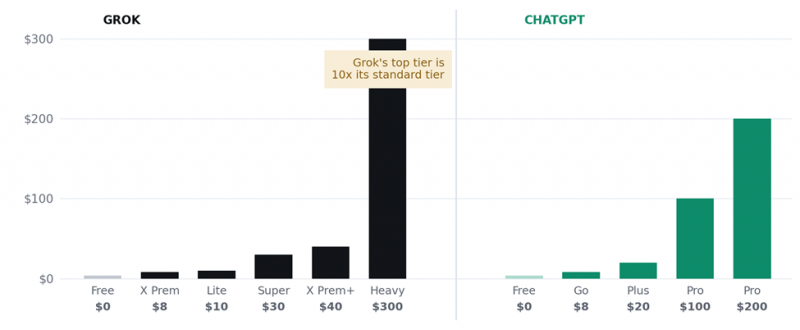
Figure 4. Consumer subscription tiers, monthly price. Sources: xAI published plans as reported by FelloAI, AI Tool Analysis and Costbench, July 2026; OpenAI plan pricing.
| TIER LEVEL | GROK | CHATGPT |
|---|---|---|
| Free | Free tier, 0 dollars | Free, 0 dollars, with ads in the US |
| Entry paid | X Premium 8, SuperGrok Lite 10 | Go, 8 dollars per month |
| Standard | SuperGrok, 30 dollars per month | Plus, 20 dollars per month |
| Bundled | X Premium Plus, 40 dollars per month | Not applicable |
| Top | SuperGrok Heavy, 300 dollars per month | Pro, 100 or 200 dollars per month |
Annual billing brings SuperGrok to roughly 25 dollars per month. Business and enterprise tiers are excluded.
Tier and Model Assignment
BEFORE YOU SUBSCRIBE TO GROK
Tier names do not map cleanly to model versions. New flagship models roll out in stages, so a paid tier may serve you an older variant during the rollout window, and the only consumer tier with confirmed full flagship access has been the 300 dollar Heavy plan. X Premium Plus at 40 dollars also carries tighter usage caps than standalone SuperGrok at 30, despite costing more, because the bundle is priced for X platform perks rather than AI headroom. Check which model your tier actually receives before paying.
The practical advice is to buy the standalone SuperGrok plan if artificial intelligence is your goal, and to buy X Premium Plus only if you actually want the X platform benefits that come with it.
API Pricing
Developers get a considerably better deal than consumers. Grok 4.5 is priced at 2 dollars per million input tokens and 6 dollars per million output tokens, with a 75 percent discount on cached input. The previous flagship remains available more cheaply with a 1 million token context. xAI also offers up to 175 dollars per month in free API credits through its data-sharing programme, which is among the most generous free tiers of any major provider.
If you are building rather than chatting, the economics look far more favourable than the subscription page suggests.
Limitations and Failure Modes
Grok. Live data from a social platform is live data from a social platform. Rumour, coordinated posting and simple error arrive with the same confidence as fact, and the model is summarising a crowd rather than verifying a claim. Fewer guardrails cut both ways. Tier and model opacity makes it hard to know what you bought, and regional availability of new flagship models has lagged.
ChatGPT. Slower on anything breaking, because an index is not a firehose. The free tier is now capped tightly and carries advertising in the United States. Its scale creates a problem of its own: heavy usage of a default tool tends to produce homogenised output, and the routing between models on paid tiers is not always visible to you.
Shared failure mode: both will state something false in a confident, well-formed sentence. Grok is likelier to be repeating a crowd. ChatGPT is likelier to be filling a gap. Verify anything consequential.
Verdict
Category Scorecard
| CATEGORY | WINNER | MARGIN |
|---|---|---|
| Real-time information | Grok | Uncontested |
| Live sentiment and reaction | Grok | Uncontested |
| Image and video generation speed | Grok | Clear |
| Context window size | Grok | Clear |
| API price and performance | Grok | Clear |
| Session depth | Grok | Clear |
| Coding | ChatGPT | Decisive, 59 to 40 |
| General reasoning benchmarks | ChatGPT | Clear, 5 of 8 categories |
| Multimodal breadth | ChatGPT | Clear |
| Ecosystem and integrations | ChatGPT | Decisive |
| Enterprise readiness | ChatGPT | Decisive |
| Consumer price | ChatGPT | Clear, 20 against 30 dollars |
| Scale and reliability | ChatGPT | Uncontested |
| Hallucination rate | Contested | Both vendors claim the lead |
Final tally: Grok 6, ChatGPT 7, one contested. A category count is not a score. Grok's six wins cluster tightly around a single job, which is knowing what is happening right now. ChatGPT's seven spread across the work most people do most days.
If You Can Only Pick One
• Most people: ChatGPT. It is cheaper, wins more benchmark categories, and covers a far wider range of tasks. The default is the default for defensible reasons.
• Traders, journalists, analysts and social teams: Grok. If your work depends on knowing what changed in the last hour, nothing else does this natively, and that alone can justify the higher price.
• Developers building products: Look at the API rather than the subscription. Grok's token pricing, context window and free credits change the calculation entirely.
• Anyone already paying for X Premium Plus: You have Grok already. Check your usage caps before adding SuperGrok on top of it.
Post Comment
Share your thoughts about this article.
Be the first to post a comment!