Cursor is an AI code editor. ChatGPT is a general-purpose assistant. They overlap only on one task, and the comparison is narrower than the question suggests. This document sets out what the 2026 benchmarks, adoption data and pricing actually show.
Summary
Cursor is the better coding tool. ChatGPT is the better tool for a developer.
These two products sit in different categories, and the overlap between them is narrower than the question implies. Cursor is a place you work. ChatGPT is a thing you ask.
Use Cursor when the code already exists: refactors that span files, matching conventions you did not write, understanding a repository you have just inherited. Use ChatGPT when the code does not exist yet: design work, learning, isolated debugging, and every non-code task in your week.
| ATTRIBUTE | CURSOR | CHATGPT |
|---|---|---|
| What it is | An AI-first code editor (a VS Code fork) | A general-purpose AI assistant |
| Where it runs | Your machine, inside your project | Browser, app or terminal |
| What it sees | Your indexed codebase | Whatever you paste in |
| Edits files directly | Yes, across many at once | Only through the Codex agent, in a sandbox |
| Non-code work | Barely | That is the whole point |
| Built for | Software engineers | Everyone |
Three findings drive the rest of this document. Model quality has converged on multi-file coding. One large capability gap survives, on terminal work. And the two pricing models differ in a way that matters far more than the identical headline prices.
Try Cursor - https://cursor.com
Try ChatGPT - https://chatgpt.com
Why the Comparison Is Misleading
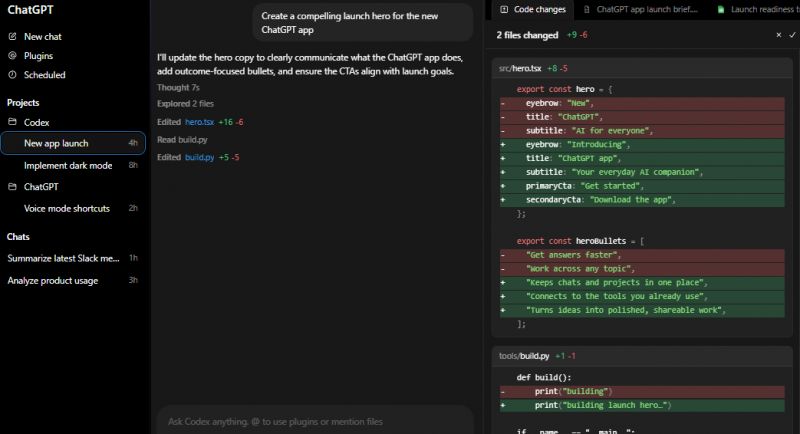
Cursor ships a model picker that includes GPT-5.5 alongside Claude and Gemini models and its own in-house Composer. Select GPT-5.5 inside Cursor and you are, in a real sense, using both products at the same time.
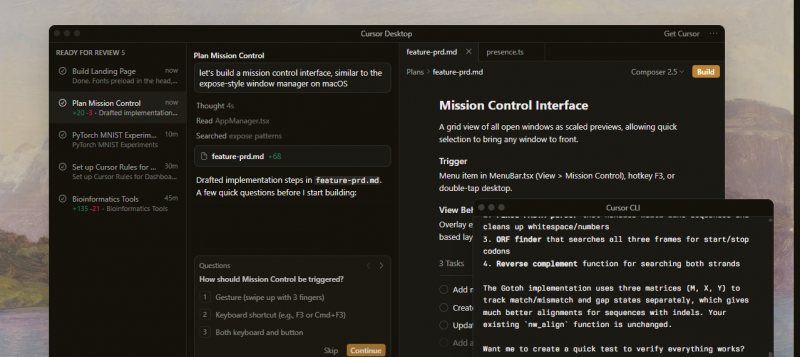
So the contest is not between two intelligences. It is between two interfaces to overlapping model families. Cursor's advantage was never a smarter model. It is knowing what sits in your repository.
ChatGPT knows what you paste. Cursor knows your repository. For a single question about a single function, that difference is nothing. For a refactor spanning more than two files, it is the difference between minutes and an afternoon. This is the reason developers pay for Cursor: not model quality, but context.
Capability Benchmarks
Cursor's in-house Composer 2.5 model, released in May 2026, scores about 79.8 percent on SWE-Bench Multilingual. That lands within a point or two of frontier models from OpenAI and Anthropic on multi-file coding work. On the task most developers perform most often, the tool you choose no longer determines the quality of the answer.
One gap survives, and it is a large one.
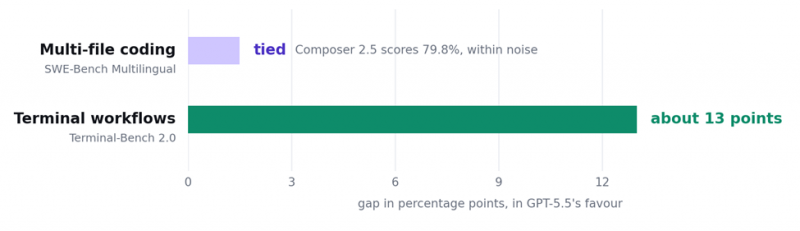
Figure 1. Capability gap in percentage points, in GPT-5.5's favour. Sources: Cursor published benchmark data via Memeburn (May 2026); Developers Digest Composer 2.5 guide (June 2026).
GPT-5.5 leads Composer 2.5 by roughly 13 points on Terminal-Bench 2.0, which measures shell workflows, builds and system administration.
Practical translation. If your day is builds, shells and system administration rather than file edits, that gap is the single strongest argument for staying in ChatGPT. If your day is editing code, raw capability no longer decides the question. Context does.
Composer benchmark figures are published by Cursor and have not been independently verified. Treat them as vendor claims rather than neutral measurement.
Adoption Data
Cursor's scale is real. It has passed a million developers and roughly 360,000 paying customers, sits inside a majority of the Fortune 500, and reportedly reached around 2 billion dollars in annualised revenue in early 2026. This is no longer an early-adopter tool.
Raw usage across the whole developer population still tilts heavily toward chatbots.
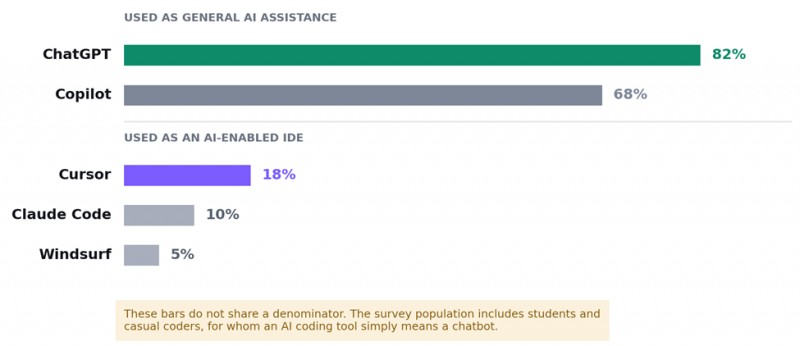
Figure 2. Developer tool usage. Source: Stack Overflow Developer Survey (49,000+ respondents), as analysed by Uvik Software, 2026.
The two groups in that chart answer different survey questions and do not share a denominator. The first measures general AI assistance, where a chatbot counts; the second measures AI-enabled IDEs specifically. Comparing a bar from one group against a bar from the other is not meaningful.
A separate signal points the other way. Among senior engineers surveyed by The Pragmatic Engineer in February 2026, OpenAI's Codex agent had already reached roughly 60 percent of Cursor's usage, after not appearing in the previous survey at all. The professional end of this market moves fast enough that any snapshot ages within months.
Platform Strengths
Cursor
• Multi-file refactors. Rename across the project, extract a shared utility, update every import, run the tests. In ChatGPT this becomes copy-and-paste archaeology.
• Tab completion. The strongest predictive autocomplete in any editor, with no ChatGPT equivalent, because it is not a chat feature at all. This is what users miss most when they leave.
• Staying in flow. No window switching, no re-explaining your project, no applying diffs by hand. Small per instance, large per day.
• Reviewable edits. Every agent change arrives as a diff you approve or reject. That safety rail is why people trust it with large changes.
ChatGPT
• Learning and explaining. Cursor is built to modify code, not to teach you what it does.
• Planning before code exists. With no repository to index, Cursor's core advantage simply is not present.
• Everything that is not code. Specs, standups, incident write-ups, postmortems, the RFC nobody wants to draft. A real share of any developer's week.
• Thinking out loud. Pasting a stack trace and reasoning through it often beats turning an agent loose before you know what is actually wrong.
Task Comparison Matrix
| TASK | BETTER TOOL | REASON |
|---|---|---|
| Refactor across 20 files | Cursor | It already knows the call sites |
| Autocomplete while typing | Cursor | No ChatGPT equivalent exists |
| Apply a fix to your real repo | Cursor | Direct file edits, reviewed as diffs |
| Match existing conventions | Cursor | It read your code first |
| Understand an unfamiliar codebase | Cursor | Whole-project indexing |
| Shell, builds and sysadmin | ChatGPT | 13-point Terminal-Bench lead |
| Learn a new concept | ChatGPT | Built to explain, not to edit |
| Design before writing code | ChatGPT | No repository to index yet |
| Documentation, specs, email | ChatGPT | Cursor does none of it |
| Compare libraries | ChatGPT | Research rather than editing |
The split is clean: Cursor owns everything inside the repository, ChatGPT owns everything outside it.
Pricing Comparison
At the headline tier these cost the same. The billing models underneath are not the same, and that is where budgets break.
Subscription Tiers
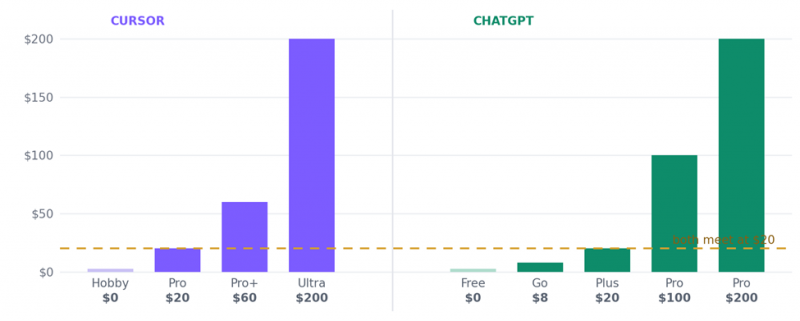
Figure 3. Monthly price per individual tier. Sources: Cursor pricing pages as reported by ComparEdge (16 July 2026), CloudZero and NoCode MBA; OpenAI plan pricing.
| TIER LEVEL | CURSOR | CHATGPT |
|---|---|---|
| Free | Hobby, 0 dollars | Free, 0 dollars |
| Entry paid | None | Go, 8 dollars per month |
| Standard | Pro, 20 dollars per month | Plus, 20 dollars per month |
| Higher | Pro+, 60 dollars per month | Pro, 100 dollars per month |
| Top | Ultra, 200 dollars per month | Pro, 200 dollars per month |
| Teams | 40 dollars per seat, Premium seats 120 | Business, about 20 to 25 dollars per seat |
Annual billing takes roughly 20 percent off every Cursor tier. Published tiers vary between price trackers, so confirm at checkout before subscribing.
How Cursor Credits Work
Every paid Cursor tier is a credit wallet sized to its price. A 20 dollar Pro plan includes 20 dollars of premium model usage. Which model you select decides whether you spend it.
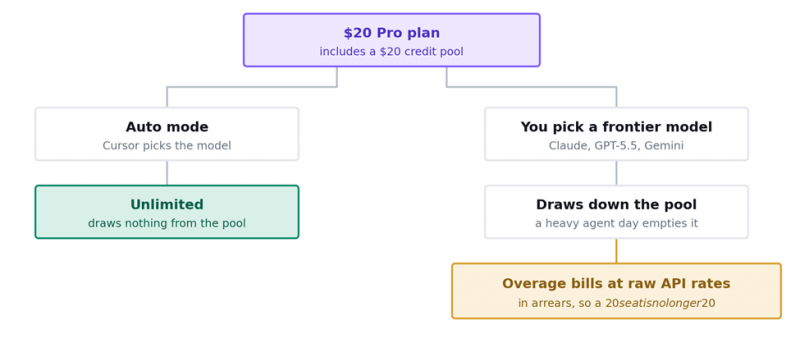
Figure 4. Sources: Cursor pricing documentation as reported by CloudZero (May 2026) and ComparEdge (July 2026).
BEFORE YOU SUBSCRIBE
Cursor has changed its pricing structure three times since 2025, issued refunds after users hit unexpected charges, and restructured its Teams tiers again in June 2026. Reports of allowances draining faster than expected are common. Start on Pro, run Auto mode by default, and watch two full billing cycles before upgrading. If credits vanish, the fix is usually routing, meaning stop sending routine edits to the most expensive model, rather than buying a bigger plan.
ChatGPT is not immune either. Its Codex agent moved to token-based billing in April 2026, so its cost varies with use as well. Neither product is genuinely flat-rate once you work seriously.
Most working developers run both, for about 40 dollars a month combined. That is the honest budget line.
Limitations and Failure Modes
Cursor. An agent that edits 30 files is considerably more dangerous than one that suggests a snippet, and the review-every-diff discipline is the first thing to go when you are moving fast. Pricing is genuinely hard to predict. And because it is a VS Code fork, you are trusting a smaller company with your primary editor.
ChatGPT. It invents APIs that do not exist, forgets constraints you set earlier in the thread, and writes code that is correct in isolation but wrong for your project, because it never saw your project. The paste-and-apply loop is slow and error-prone.
Both share one failure mode: plausible code that does not work. Neither removes the need to read what you ship.
Verdict
Category Scorecard
| CATEGORY | WINNER | MARGIN |
|---|---|---|
| Codebase-wide context | Cursor | Decisive |
| Multi-file refactoring | Cursor | Decisive |
| Autocomplete | Cursor | Uncontested |
| Editing your real files | Cursor | Decisive |
| Staying in flow | Cursor | Clear |
| Terminal and shell work | ChatGPT | Clear, about 13 points |
| Teaching and explaining | ChatGPT | Decisive |
| Planning before code exists | ChatGPT | Decisive |
| Non-code work | ChatGPT | Uncontested |
| Predictable billing | ChatGPT | Clear |
| Raw coding capability | Tied | Within 1 to 2 points |
Final tally: Cursor 5, ChatGPT 5, one tie. A category count is not a score. Weight these by how you actually spend your week. Someone refactoring a large codebase daily should read this table as a decisive Cursor win. Someone shipping small scripts and writing a lot of prose should read the same table the opposite way.
If You Can Only Pick One
• You code professionally: Cursor, with ChatGPT's free tier alongside it. The tab completion alone justifies 20 dollars for most professionals.
• You code occasionally, or you are learning: ChatGPT. Cursor's agents will happily produce working code you do not understand, which is a poor way to learn.
• Your work is terminal-heavy: ChatGPT. That 13-point gap is the clearest capability argument in this document.
• You are evaluating the whole field: Neither, yet. Claude Code, GitHub Copilot, Windsurf and Codex all occupy this space, and the two-way framing is already dated.
Overall Summary
Verdict: Cursor to build, ChatGPT to think. Cursor wins the narrow contest and loses the broad one.
Cursor is better at the specific thing it does, and that thing is valuable enough to justify its price for anyone who writes code most days. But it covers a small slice of a developer's week. ChatGPT covers a much larger slice less deeply.
The question of which has the better AI has stopped being useful. Both run comparable frontier models, frequently the same ones, and on multi-file coding the measured difference is within noise. What you are choosing between is a workshop and an encyclopedia, and the right answer depends entirely on whether you are building something today.
For most working developers the correct answer is not a choice at all. Run Cursor as your editor, keep ChatGPT open for everything else, and budget about 40 dollars a month.
Post Comment
Share your thoughts about this article.
Be the first to post a comment!