Gauthmath, said out loud, becomes goth math Say it aloud and the mystery dissolves. Gauthmath is a homework app that spread through short video, where names are spoken rather than typed. Millions of students searched for what they heard, and the spelling they invented took on a life of its own. |

Search the phrase and you will find three unrelated answers sharing one name
THE PROBLEM WITH THE PHRASE
One term, three claimants
Most confusing search terms are confusing because nobody has defined them. This one is confusing for the opposite reason. Three separate things have a legitimate claim to it, they have nothing to do with each other, and the search results mix all three together on the same page.
Sorting them out takes about two minutes and is worth doing before you install anything, because two of the three involve a subscription.
CLAIMANT ONE The aesthetic reading Black notebooks, candlelit libraries and equations in white ink, which is what the phrase sounds like it should mean, borrowed from a real visual culture | CLAIMANT TWO The misheard app Gauthmath, a homework solver launched in 2020 and rebranded in 2024, where nearly all the search volume comes from and almost nobody spells it correctly | CLAIMANT THREE The namesakes Several unrelated apps now published under the Goth name, from different companies, some having changed their own titles more than once |
CLAIMANT ONE
The aesthetic reading is not wrong, just smaller
There is a genuine visual culture behind the assumption. Dark academia emerged on social platforms in the late 2010s and became one of the most popular aesthetics on Tumblr by 2021, built around neo gothic architecture, classical literature, candlelight and the romance of study itself. Its lighter counterpart, light academia, was coined in 2019 as a deliberate answer to it, described by one trend analyst as keeping the love of learning while trading gothic darkness for open air and daylight.

The imagery the phrase evokes is real and well documented, and it is about mood rather than method
That culture is real, it is commercially active, and a search for study planners in this style returns dozens of paid templates built around exactly the imagery people imagine when they hear the phrase.
What it is not is a way of doing mathematics. There is no goth method, no alternative notation, no school of thought. There is a mood attached to studying, and mood does affect whether you sit down at the desk, which is not nothing. But if you arrived expecting a distinct mathematical practice, that is the part that does not exist.
Where the aesthetic genuinely does something The mechanism is unglamorous and real. A study environment you actively want to return to lowers the friction of starting, and starting is the step most people fail at. That is a habit effect rather than a comprehension effect. A black notebook will get you to the desk. It will not get you through a proof. |
CLAIMANT TWO
The app that people were actually hearing
Gauthmath launched in 2020 as a photo based math solver. It is built by ByteDance, the company behind TikTok, and operates through a Singapore entity. In 2024 it dropped the math from its name and became Gauth AI, reflecting an expansion into physics, chemistry, biology and beyond, though longtime users still call it by the old name.

The whole category works the same way, by photographing a question and reading back the steps
The mechanics are the same across this entire category. Photograph a question, the app reads it, a model solves what it read, and you get steps back. The current listing claims a 95 percent solve rate on school and early college level questions, coverage of more than 30 subjects and more than 50 languages, with an optional tier that escalates to human tutors when the model cannot manage.
None of that explains the spelling. The spelling comes from the distribution. The app grew through short video, where a name is heard rather than read, and the platform’s own search pages now carry entries for the misheard version alongside hashtags where users have invented several different spellings of their own.
The two ratings that tell the real story
Here is the detail worth carrying away from this section. The app holds two public scores that point in opposite directions, and both are accurate.
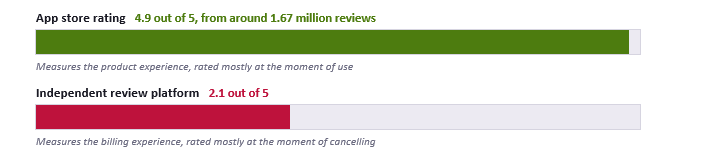
The gap is not a contradiction, and reading it correctly is a transferable skill. People rate an app in the store while they are using it and it is solving their homework. They rate a company on a review platform when something has gone wrong with money. A high store score with a low external score is the signature of a product that works and a subscription that is hard to leave.
Reviewers who have tested it consistently reach the same split verdict: the solving is genuinely good, the trial to paid transition is where the complaints cluster. Ownership adds a second question. The privacy concern here is inherited from the parent company rather than specific to this app, with no documented breach attached to it, but anyone uncomfortable with that exposure should know the nearest large competitor was acquired by a different technology company in 2022.
CLAIMANT THREE
The namesakes, and why this is the part that costs money
Once a misspelling accumulates that much search volume, it becomes an asset. Apps now exist under the Goth name that have no connection to the app people were originally looking for, and no connection to each other.
Checking public listings turns up at least three separate products using the name, published by different companies with different identifiers. One is credited to a Hong Kong registered developer. Another is credited to a Singapore registered company better known for a document scanning product. A third sits under a different identifier again, and the same listing has appeared under more than one title, including a name with no reference to Goth at all.
None of that is illegal, and none of it means any individual app is bad. Broad app titles get reused constantly. But it does mean the name is not an identifier. If a friend recommends this app, or a video does, the name alone does not tell you which product they meant.
| What you are checking | The original app | The namesake apps |
|---|---|---|
| Name on the store | Rebranded in 2024, so the old name persists only in conversation | Several products share the name, and at least one has changed its own title |
| Publisher | A single Singapore entity under a large parent company | Different companies with no relationship to each other |
| Review volume | Around 1.67 million store reviews | Far smaller, in the low thousands or fewer |
| Human tutor option | Offered on a higher tier | Not offered, these are model only |
| Pricing transparency | Published, though it varies by region | Listings can show several tiers whose differences are not explained |
| What the name tells you | Very little, since the app no longer uses it | Nothing at all, since several products answer to it |
The pricing pattern worth recognising One listing in this family displays a weekly plan, two different monthly plans at very different prices, a six month plan and an annual plan, with no public explanation of what separates the two monthly options. That may be an older product still attached to the listing, or two different entitlements, or a promotional route. The public information does not say. Treat an unexplained price ladder as a reason to read the checkout screen slowly rather than as evidence of anything worse. The specific risk in this category is not overcharging, it is a weekly plan bought by someone who assumed it was monthly. |
The overlap between these products is close enough that the differences only show up in use, which is why a closer look at one of the namesake apps is more informative than any amount of comparing store descriptions. The listings tend to describe an identical set of capabilities in an identical order, because they are describing the same underlying idea.
How to tell which one you have installed
Four checks, in order of how much they tell you. The first two settle it in most cases.

The developer line and the review count identify an app, while the title on its own does not
| Check | What it tells you |
|---|---|
| Read the developer line, not the app name | Every store listing names the company that published it, and that line is the real identifier, so two apps sharing a title under different publishers are different products with different privacy policies and different billing |
| Look at the review count rather than the score | A score out of five is easy to reach on a few hundred ratings, so the number underneath tells you how much weight it carries, since millions of reviews and a few hundred are not the same evidence at the same score |
| Check whether a human tutor option exists | This is the cleanest functional divider in the category, because escalation to a live expert requires an operation behind it, so its presence separates the large established product from the smaller model only ones |
| Open the subscription screen before the free trial | Read the billing period rather than the price, since weekly and monthly plans sit next to each other at similar looking numbers and differ roughly fourfold across a year |
THE ACTUAL MATHS
What any of these tools can and cannot settle
Whichever product you end up with, the failure modes are shared, because every one of them runs the same two stage process. The app has to read your question correctly, and then it has to solve the question it read. Those stages fail independently, and a clean photograph does not guarantee the first while a strong model cannot repair the second.
That matters more in mathematics than in most subjects, because a single misread character changes the problem entirely rather than slightly. A minus sign read as a plus produces a confident, well formatted, completely wrong solution, and nothing in the output signals that anything went wrong.
Four checks that catch most of it
• Substitute the answer back into the original equation. If it does not satisfy the equation you started with, the tool solved a different problem. This single check catches most misreadings.
• Ask whether the size of the answer is plausible before checking the working, because a wildly wrong magnitude is easier to notice than a wrong step.
• Read whether each step follows from the one above it. A longer explanation is not a more correct one, and skipped reasoning is common even when the final number is right.
• Type the problem manually when the answer looks strange. If the typed version gives a different result, the failure was in reading the photograph rather than in the mathematics.
There is also the school specific problem. A correct answer reached by a method your class has not covered is not usable, and a solver has no idea what your syllabus is. That gap is invisible in the output and only shows up when marked.
THE TAKEAWAY
So what is Goth Math It is a phrase that arrived by accident and then attracted things to itself. The aesthetic reading is real but modest, a way of making study feel worth showing up for rather than a way of doing mathematics. The search volume belongs to a misheard app name. And the name has since been adopted by unrelated products that benefit from the confusion, whether or not they set out to. The one thing worth remembering is the smallest. A name is not an identifier in an app store. Read the publisher line and the review count, and the three claimants separate immediately. Everything else in this article follows from that one habit. And the maths itself is unchanged by any of it. A tool that reads your question and shows its steps is a good second opinion and a poor first attempt, in a black notebook or any other colour. |
Post Comment
Share your thoughts about this article.
Be the first to post a comment!