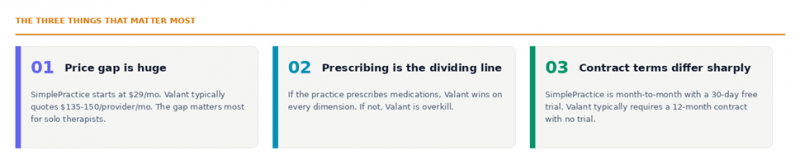
THE 30-SECOND ANSWER SimplePractice wins for most therapists. Valant wins for prescribers. The split is that clean. Solo and small therapy practices should default to SimplePractice. Practices with psychiatrists, psychiatric nurse practitioners, or 10-plus clinicians should default to Valant. The rest of this article explains why and shows when the rule of thumb breaks. |
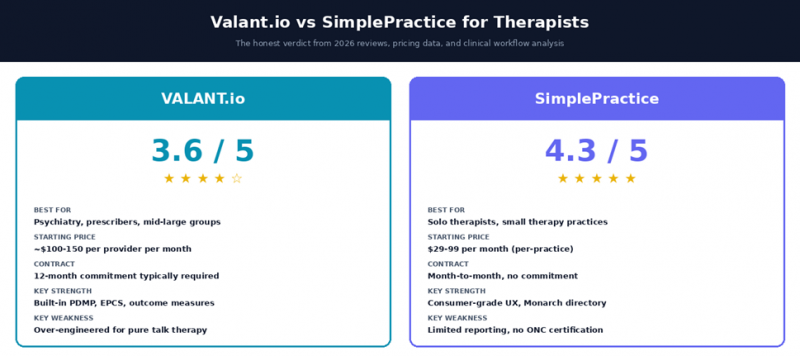
Aggregate scores across 2026 reviews from G2, Capterra, Software Advice, EHR Source, and Cortexa.
Decision Flowchart by Practice Type
One question separates the two platforms more than any other: does the practice prescribe medications? If yes, Valant.io is the answer. If no, SimplePractice is the answer. The flowchart below covers roughly 80 percent of practice scenarios in a single decision.
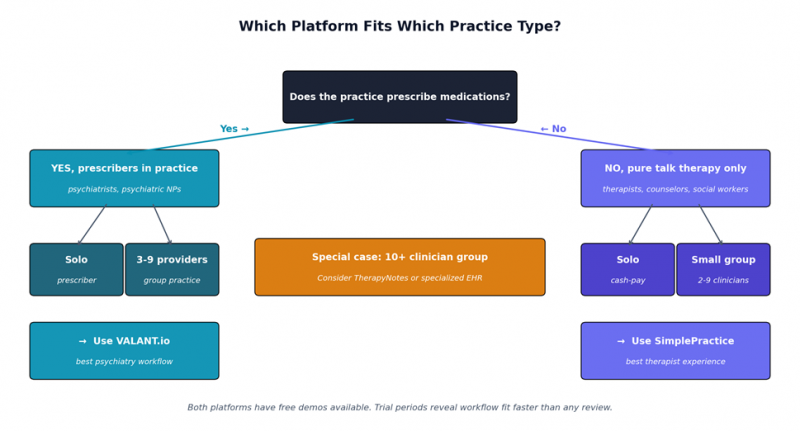
The decision flowchart covers most scenarios. Special cases (10+ clinician groups, MIPS reporting) are addressed in later sections.
→ The single rule of thumb Practices with prescribers pick Valant. Practices without prescribers pick SimplePractice. Everything else is detail. |
Platform Profiles and Quick Specs
Both platforms market themselves as behavioral health EHRs, but they target different buyers. Valant was built for psychiatry-led practices. SimplePractice was built for therapists running their own businesses. That difference shapes every part of each product.
| At a glance | Valant.io | SimplePractice |
|---|---|---|
| Founded | 2005 (Seattle) | 2012 (Santa Monica) |
| Built for | Psychiatry-led practices | Solo and small therapy practices |
| User base | Smaller, specialized | 225,000+ practitioners |
| Starting price | ~$135-150 per provider/mo | $29 per month |
| Contract | 12-month commitment | Month-to-month |
| Free trial | No (demo only) | 30-day free trial |
| ONC certified | Yes | No |
| Best capability | Prescribing, outcome tracking | UX, mobile app, growth tools |
Valant in one paragraph
Cloud-based EHR designed for behavioral health practices with prescribers as the primary user. Strengths include integrated PDMP lookups, EPCS for controlled substances, 100-plus clinical templates (CBT, DBT, MFT, TMS), 80-plus built-in outcome measures, ONC certification, and recently-added AI Notes Assist. Weaknesses include a dated UI, 12-month contract requirement, opaque pricing, and over-engineering for pure talk therapy.
SimplePractice in one paragraph
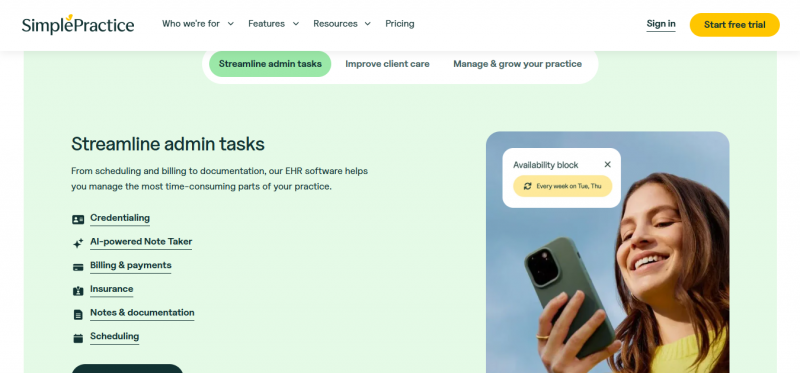
Cloud-based practice management and EHR purpose-built for solo and small-group therapists. Serves 225,000-plus practitioners. Strengths include consumer-grade UI, the best mobile app in the category, transparent month-to-month pricing starting at $29 per month, included Monarch therapist directory for referrals, and a 30-day free trial. Weaknesses include no ONC certification (so no MIPS Promoting Interoperability participation), e-prescribing as a paid add-on, and reporting that stays shallow for high-volume insurance practices.
Four Battles: Price, UX, Docs, Rx
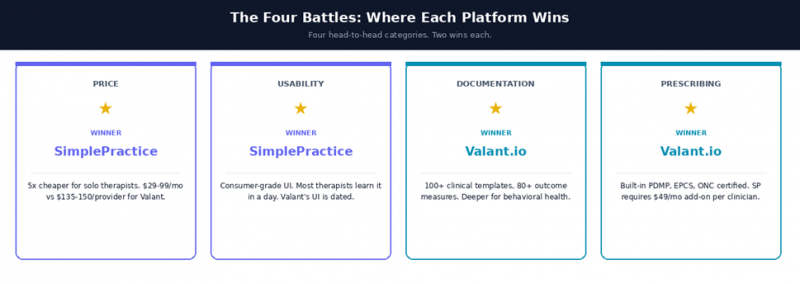
Most platform comparisons drown the reader in feature checklists. The honest comparison is simpler: four battles, two wins each. Each battle below names a winner and explains why.
Battle 1: Price
SimplePractice wins on price by a wide margin for solo and small therapy practices. The Starter plan at $29 per month covers basic scheduling, documentation, telehealth, and client portal. The Essential plan at $59 per month adds insurance billing, custom forms, and the Monarch therapist directory. The Plus plan at $99 per month adds custom branding and multi-location support.
Valant does not publish pricing. Based on aggregated 2026 user reports, smaller practices typically pay $135 to $150 per provider per month, with larger practices paying $200 to $300 per provider per month. The lack of published pricing is itself friction for buyers comparing options.
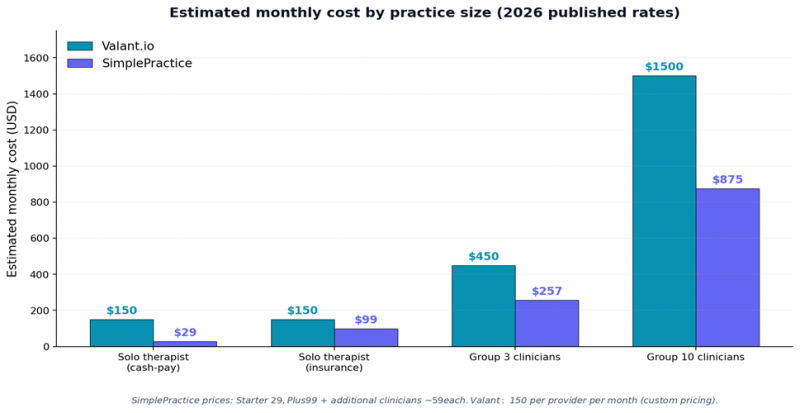
Estimated monthly cost by practice size. The gap is dramatic for solo and small practices.
$ Real-world price examples A solo cash-pay therapist pays $29/mo on SimplePractice or ~$135/mo on Valant. Over 12 months, the gap is $1,272. |
Battle 2: Usability
SimplePractice wins on usability decisively. The interface was designed with the same UX sensibility as a modern fintech or productivity app, not traditional health IT software. Most therapists report being operational within a day of signup without formal training. The mobile apps are widely considered the best in the behavioral health EHR category.
Valant's interface is functional but dated. Multiple reviewers on Capterra and Software Advice consistently note slower performance, complex navigation, and an aesthetic that has not kept pace with consumer software. Onboarding typically involves a configuration consultant and a multi-week setup period.
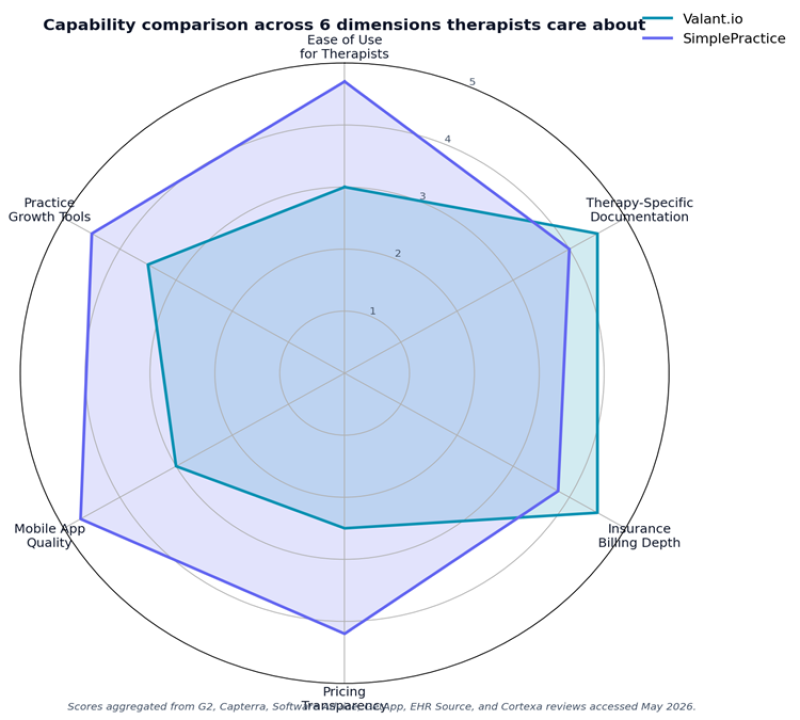
Capability radar across six therapist priorities. SimplePractice leads on usability, mobile, and growth tools.
Battle 3: Documentation Depth
Valant wins on clinical documentation depth. The platform includes 100-plus templates for evidence-based therapies including CBT, DBT, MFT, and TMS, built in collaboration with clinical advisors. 80-plus outcome measures (PHQ-9, GAD-7, and others) auto-score and graph longitudinally. The AI Notes Assist feature, added in 2025-2026, generates narrative notes during patient encounters.
SimplePractice supports DAP, SOAP, and customizable note templates plus treatment plans and diagnosis coding. The structure is competent for most therapists but lacks the specialty depth Valant offers. AI documentation is available through the AI Note Taker add-on at $35 per month per clinician.
✓ What this means for therapists If documentation includes measurement-based care with PHQ-9 and GAD-7 tracking, Valant saves substantial manual work. For straightforward talk therapy notes, SimplePractice handles the workflow well. |
Battle 4: Prescribing
Valant wins on prescribing. The platform was built with prescribers as the primary user persona. Integrated PDMP lookups eliminate the friction of separate state portal logins. EPCS for controlled substances is built in. Medication management, dosing history, and refill workflows are first-class features.
SimplePractice offers e-prescribing as an add-on at $49 per month per clinician plus an $89 one-time setup fee. The functionality is competent but does not match Valant's integrated workflow. For practices with multiple prescribers, the add-on math adds up quickly.
Scorecards by Practice Scenario
The four battles above are theoretical. What matters is how the scoring plays out for a specific practice type. The scorecards below show the verdict for six common practice scenarios.
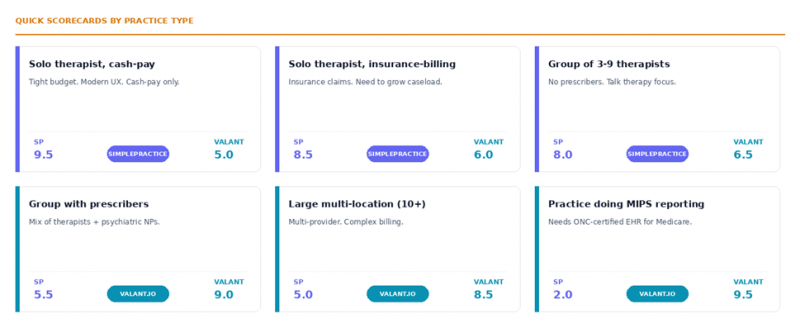
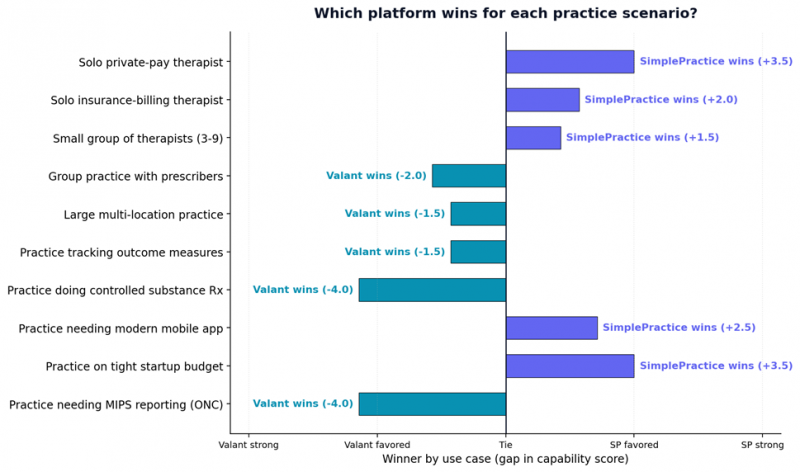
Scenario-by-scenario winner across ten common practice configurations. SimplePractice wins six; Valant wins four; none are ties.
Real Reviews from G2 and Capterra
Aggregated review scores tell part of the story. The verbatim feedback from real users tells the rest. The four reviews below are pulled from independent platforms (G2, Capterra, Software Advice) and represent the patterns most commonly observed across hundreds of reviews.
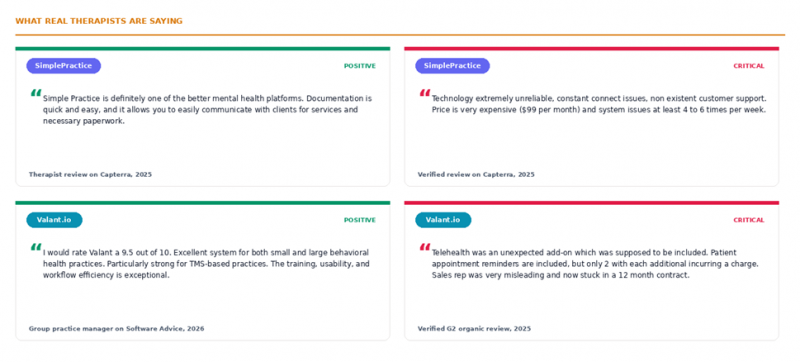
! Pattern worth noting Both platforms have devoted defenders and frustrated critics. The deciding factor in nearly every critical review is the fit between the platform and the practice. Valant frustrates therapists who do not prescribe. SimplePractice frustrates large groups and prescriber-heavy practices. |
Final Pick by Practice Type
After every battle, scorecard, and reviewer quote, the verdict comes down to two paths. The cards below summarize the decision in the simplest possible form.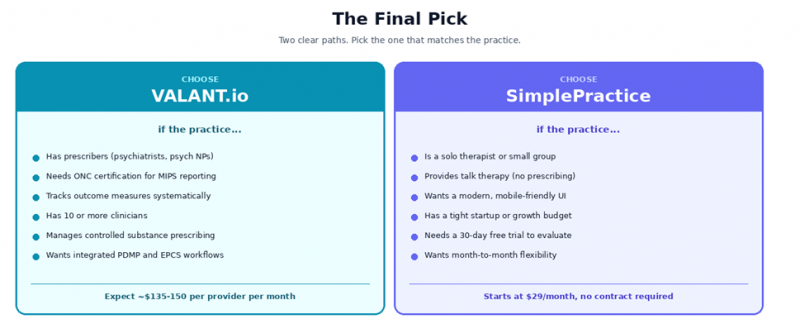
The shortest version: therapists pick SimplePractice. Prescribers pick Valant. Mixed practices pick Valant. Large groups pick Valant. Everyone else picks SimplePractice.
Post Comment
Share your thoughts about this article.
Be the first to post a comment!