Table of Content
- Quick Verdict and the Four Picks
- Why DreamPress AI Falls Short for Long Fiction
- Tool 1: Sudowrite (Best Prose Quality)
- Tool 2: NovelCrafter (Best for World-Builders)
- Tool 3: NovelAI (Best for Genre and Mature Fiction)
- Tool 4: Squibler (Best for Structured Plotters)
- Feature Comparison Table
- Pricing Breakdown
- Context Window: How Much Story Each Tool Remembers
- Decision Guide: Which Tool Fits Which Writer
- Final Recommendation and Sources
Quick Verdict and the Four Picks
Short version: DreamPress AI works well as a casual story-prompt tool for short, genre-flavored fiction, but novelists working on 50,000-word and longer manuscripts will hit its limits quickly. The four alternatives below address that gap from different angles. Sudowrite leads on prose quality. NovelCrafter leads on multi-book world-building. NovelAI leads on genre freedom and minimal content filters. Squibler leads on visual outlining for structured plotters.
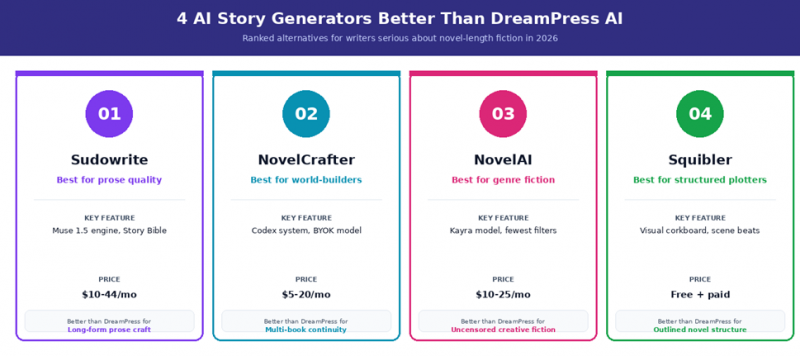
Four ranked alternatives. Each one beats DreamPress AI on a specific long-fiction capability.
Across hundreds of indie authors surveyed in 2024, those who combined a specialized fiction tool with a general-purpose chatbot completed manuscripts roughly 40 percent faster than those using a single tool.
The 2025 Authors Guild membership survey reported that 45 percent of published fiction writers now use AI tools at some stage of the creative process, most often for brainstorming, prose expansion, and overcoming writer's block.
Why DreamPress AI Falls Short for Long Fiction
DreamPress AI is a competent platform for what it was built for: short, genre-flavored stories generated from a prompt, with an emphasis on romance, fantasy, and adult content. The platform reportedly serves 400,000 to 600,000 users globally and runs on a hybrid stack combining Claude-2, GPT-4, and custom narrative models.
Part of the platform’s appeal is how little setup it requires. Most users simply enter a prompt, choose a tone or genre, and let the system build scenes conversationally, which is also why searches around how to use DreamPress AI have grown steadily among new users exploring AI storytelling tools.
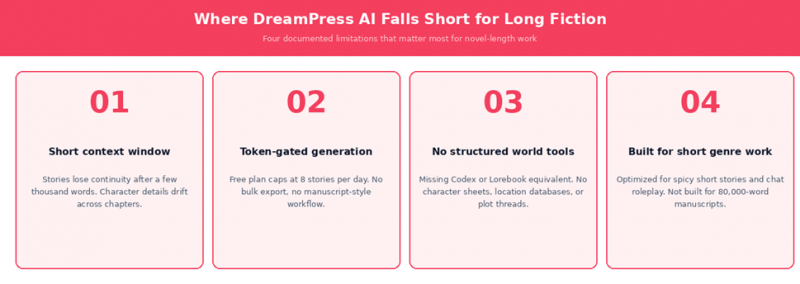
The problem appears the moment a writer tries to extend a single story past about 10,000 words. Independent reviews from late 2025 and early 2026 surface four recurring complaints from long-fiction writers.
Traffic data from AIPure reports DreamPress AI received approximately 282,000 monthly visits as of early 2026, down 11.1 percent year over year. The Trustpilot score sits at 4.5 out of 5, but the sample is only 51 reviews, which is too small for a confident verdict. (AIPure traffic analysis 2026; Trustpilot rating, accessed 2026)
The four alternatives covered below address each of these gaps directly. None of them are perfect. Each has its own trade-offs. The honest framing is that DreamPress AI is a casual tool, while these four are workhorses for novelists who plan to finish a manuscript.
Tool 1: Sudowrite (Best Prose Quality)
Overview
Sudowrite is the most established fiction-specific AI writing tool on the market in 2026. The platform's proprietary engine, Muse 1.5, is fine-tuned on a curated literature dataset and produces prose with a noticeably more polished texture than general-purpose chatbots. Sudowrite has been the go-to choice for serious novelists since 2022, and its feature set has matured steadily.
What it does well
• Muse 1.5 engine produces sensory-rich descriptions and dialogue tuned for fiction, not generic text.
• Story Bible holds character profiles, world rules, and plot threads. The system injects relevant context into every generation.
• Describe function expands flat prose with sensory detail across sight, sound, smell, taste, and touch.
• Guided Write turns plot beats into full scenes with appropriate pacing and tone.
• Canvas mind-mapping helps novelists visualize plot relationships across long arcs.
Where it falls short
• Pricing climbs quickly for high-volume writers. Heavy users routinely hit credit limits on the Hobby plan.
• Content filters are stricter than NovelAI or NovelCrafter. Dark horror and explicit romance can hit refusals.
• Less flexible than NovelCrafter for writers who want to swap AI models on the fly.
Pricing
Three tiers based on credit allowance: Hobby and Student at $10 per month for 225,000 credits, Professional at $22 per month for 450,000 credits, and Max at $44 per month for 2,000,000 credits. Annual billing offers a discount.
Sudowrite is the cleanest sentence-level prose-craft tool on the market. Writers who care most about how a paragraph reads will find no better option in 2026. - Inkfluence AI Novel Writer Comparison, April 2026 |
Tool 2: NovelCrafter (Best for World-Builders)
Overview
NovelCrafter takes a different approach: instead of bundling a fixed AI model, it provides the writing environment and lets writers bring their own AI keys. The platform connects to over 300 models through OpenRouter, plus direct integrations with OpenAI, Anthropic, and Google. The standout feature is the Codex, a structured database for characters, locations, factions, and world rules that gets automatically injected into the AI's prompt during generation.
What it does well
• Codex system is the most structured world-building tool of any 2026 platform. Far more capable than NovelAI's Lorebook for complex projects.
• Bring-Your-Own-Key model means access to any new AI model (Claude 4, GPT-5, Gemini) the day it ships.
• Multi-book series support through linked Codex entries that persist across projects.
• Customizable prompts let writers build their own shortcuts for recurring scene types.
• Affordable entry price relative to feature depth.
Where it falls short
• Steepest learning curve of the four tools. The Codex setup alone takes hours for a complex novel.
• BYOK model means writers also pay for API usage separately. Heavy writing sessions can run $5 to $10 in extra API cost.
• Prose quality depends entirely on which external model is connected. No baseline literary fine-tuning.
Pricing
Essential plan at $5 per month covers basic features. Standard at $14 per month adds unlimited Codex entries and team features. Premium at $20 per month adds advanced AI features and priority support. API costs from connected models are separate.
Tool 3: NovelAI (Best for Genre and Mature Fiction)
Overview
NovelAI is the platform of choice for fiction writers who want minimal content filters and a model trained specifically on narrative literature rather than web text. The proprietary Kayra model produces atmospheric prose particularly suited to fantasy, horror, and dark fiction. NovelAI is also one of the few platforms that encrypts all stored stories end-to-end, which matters for writers working on unpublished manuscripts.

What it does well
• Lowest content filtering of any major fiction platform. Dark horror, explicit romance, and morally complex scenarios generate without refusal.
• Kayra model is trained on a literature-focused dataset, not web scrape. Output reads more like fiction and less like a chatbot.
• Lorebook system functions as a digital brain that injects character and world details when keywords appear in the text.
• End-to-end encryption on stored stories. Privacy is a genuine feature here, not just marketing.
• Text Adventure mode for interactive narrative experiments and Storyteller mode for directed generation.
Where it falls short
• Context window on lower tiers is small (8,000 tokens), which limits long-form continuity without active Lorebook management.
• Less polished UI than Sudowrite or Squibler. The platform shows its hobbyist origins.
• Lorebook is more freeform and less structured than NovelCrafter's Codex.
Pricing
Three tiers: Tablet at $10 per month, Scroll at $15 per month, and Opus at $25 per month. Higher tiers expand context window, increase generation quality, and unlock image generation features. A free trial is available with strict generation limits.
Important note on content freedom NovelAI's lighter content filtering is intentional, but it does not exempt writers from copyright law, platform terms of service, or marketplace publication rules. Writers planning to publish on Amazon Kindle Direct Publishing or Apple Books should review each marketplace's content policies before relying on any AI tool for prose generation. |
Tool 4: Squibler (Best for Structured Plotters)
Overview
Squibler takes the opposite approach to NovelAI. Instead of dropping writers into a blank page, it walks them through building a structural framework first: characters, plot points, themes, and chapter structure. AI generation then happens within that framework, which keeps the output more coherent over long projects because the AI is working from the writer's structure rather than improvising.
What it does well
• Visual corkboard for plotting chapters and scenes. Especially useful for novelists who outline before drafting.
• Elements board tracks characters, settings, and plot threads with visual relationships.
• Genre-tuned generation modes for romance, mystery, thriller, sci-fi, and fantasy.
• Free tier offers 6,000 AI words per month and editing for 15 files. Enough to evaluate the platform on a real project.
• Simpler learning curve than NovelCrafter while still supporting full novel structure.
Where it falls short
• Raw AI output quality is a step behind Sudowrite's Muse and NovelAI's Kayra. Heavier editing required.
• Structured workflow feels constraining for discovery writers who prefer to find the story while drafting.
• Smaller community and fewer third-party tutorials than Sudowrite or NovelAI.
Pricing
Free tier (limited), Individual at $16 per month, and Unlimited at $20 per month. Both paid tiers remove the word and file limits of the free version.
Feature Comparison Table
Below is the side-by-side feature comparison across all five tools, with capability indicators on the dimensions that matter most for long-fiction work.
| Feature | Sudowrite | NovelCrafter | NovelAI | Squibler | DreamPress |
|---|---|---|---|---|---|
| Fiction-tuned model | Yes (Muse 1.5) | Via BYOK | Yes (Kayra) | Genre modes | Hybrid stack |
| Structured world-building | Story Bible | Codex (best) | Lorebook | Elements board | No |
| 80,000-word manuscript | Yes | Yes | Yes (with setup) | Yes | Difficult |
| Multi-book series support | Limited | Strong | Limited | Moderate | No |
| Content filter strictness | Medium | Depends on model | Low (most freedom) | Medium | Low |
| Free tier | Trial only | Trial only | Trial only | Yes (6K words) | 8 stories per day |
| Entry paid plan | $10 per month | $5 per month | $10 per month | $16 per month | $14.39 per month |
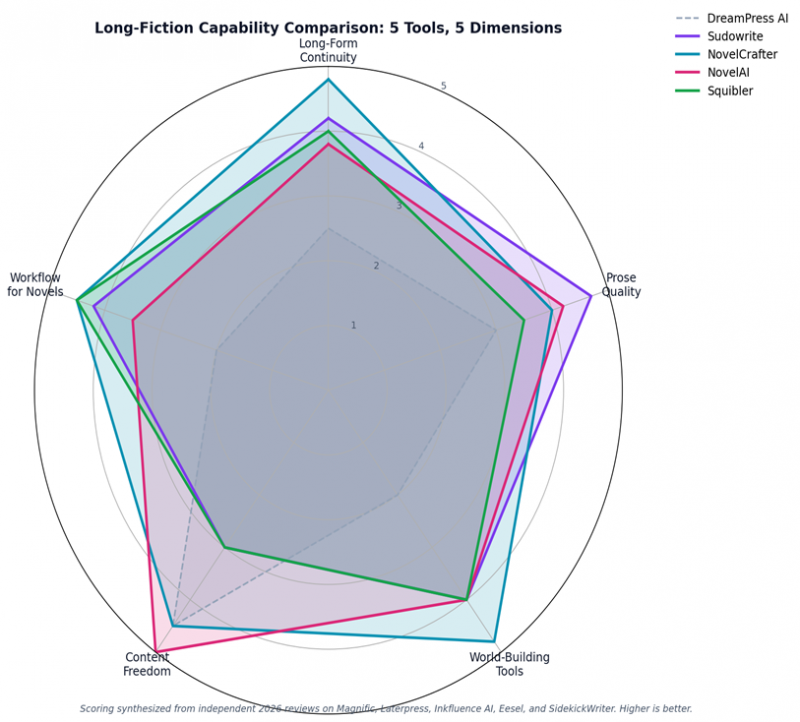
Capability radar across five long-fiction dimensions. NovelCrafter leads on continuity and world-building, Sudowrite on prose quality, NovelAI on content freedom.
Pricing Breakdown
Pricing comparisons across these tools require care, since the plans bundle different things. Sudowrite uses a credit system. NovelCrafter charges a subscription but passes through external API costs. NovelAI bundles model access and image generation in tiers. Squibler uses traditional flat-rate subscriptions. The chart below normalizes entry-tier pricing to allow a direct comparison.
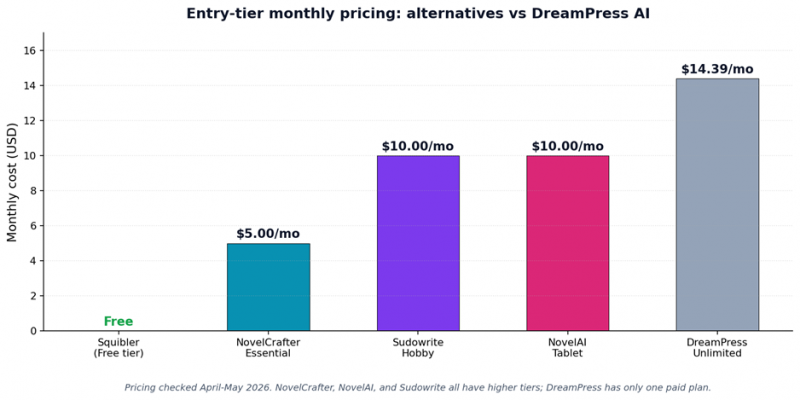
The cheapest entry-tier option is Squibler's free plan, useful for evaluating the platform on a real project before paying. Among paid plans, NovelCrafter at $5 per month is the lowest priced, though writers should budget separately for API costs from the connected model. Sudowrite and NovelAI both start at $10 per month, with feature depth that justifies the price difference over DreamPress AI's $14.39 per month unlimited plan.
Context Window: How Much Story Each Tool Remembers
One of the most under-discussed features in AI fiction tools is the effective context window: how much of a manuscript the AI can hold in working memory at once. This single number determines whether a tool can maintain continuity across a long novel without active prompt management.
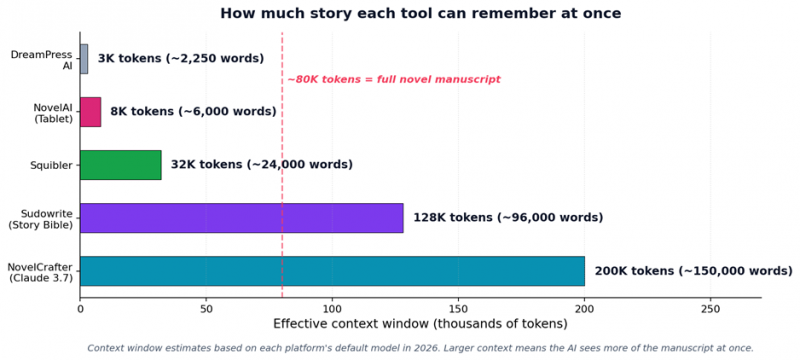
Effective context window per tool. Larger windows mean the AI sees more of the manuscript at once and is less likely to forget details.
A typical 80,000-word manuscript translates to roughly 100,000 to 110,000 tokens. Only NovelCrafter (paired with Claude 3.7 or similar) can hold an entire manuscript in working memory at once. Sudowrite's Story Bible approach simulates a larger window through intelligent retrieval, which works well in practice. NovelAI's 8,000-token base context is the tightest and requires careful Lorebook management for longer projects.
Without active memory systems like NovelAI's Lorebook or NovelCrafter's Codex, AI fiction tools typically lose track of character details after roughly 3,000 to 5,000 words, leading to inconsistencies in appearance, personality, and backstory. (Magnific AI Story Generator review, February 2026)
Decision Guide: Which Tool Fits Which Writer
Each of the four alternatives targets a different writer profile. The flowchart below maps the most common writing priorities to the tool that best serves them.
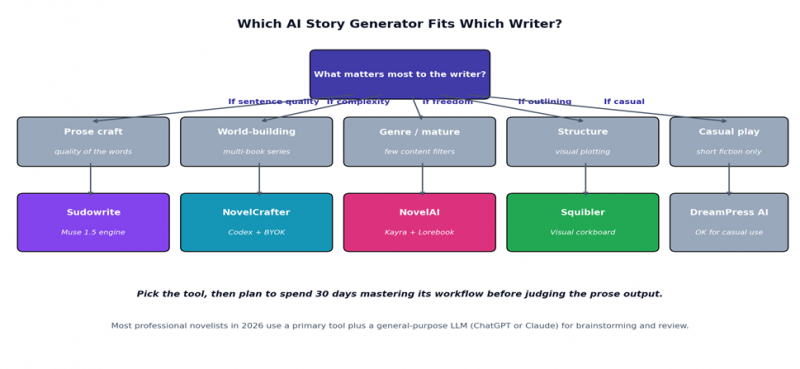
| Writer profile | Best fit |
|---|---|
| Literary novelist focused on prose craft | Sudowrite |
| Fantasy or sci-fi writer with complex worldbuilding | NovelCrafter |
| Multi-book series author | NovelCrafter |
| Horror, dark fiction, or unrestricted creative work | NovelAI |
| Romance or genre fiction with mature themes | NovelAI |
| Plotter who outlines every chapter before drafting | Squibler |
| First-time AI fiction user wanting a free trial | Squibler (free tier) |
| Tech-savvy author wanting model flexibility | NovelCrafter (BYOK) |
| Casual story-generation, short fiction only | DreamPress AI is acceptable |
Most productive authors in 2026 use two or three tools together: a specialized fiction platform for drafting, a general-purpose chatbot for brainstorming, and a manuscript editor for final polish. - ools review, March 2026 |
Final Recommendation and Sources
DreamPress AI is not a bad product. It is a niche product, built for casual storytelling with adult-genre flavoring. Writers who plan to finish a novel, publish a manuscript, or build a multi-book series will outgrow the platform quickly. The four alternatives above each address that gap from a different angle.
The most defensible recommendation by writer type: literary novelists choose Sudowrite, world-builders choose NovelCrafter, genre and unrestricted writers choose NovelAI, structured plotters choose Squibler.
The smartest workflow in 2026 is rarely one tool. Most professional novelists pair a specialized drafting tool with a general-purpose chatbot like ChatGPT or Claude for brainstorming and structural feedback, then move the manuscript into Scrivener or Atticus for final formatting and publishing.
Post Comment
Share your thoughts about this article.
Be the first to post a comment!