Table of Content
- Four questions, in this order
- Question 01
- Question 02
- Question 03
- Question 04
- The six tools in detail
- Every tier, priced
- The comparison in one table
- How much of the book will you actually own?
- What copyright protects
- What the largest store requires
- Why a distinctive voice is worth more than it was
- What none of them do
- Final Verdict
Six tools genuinely matter. Four questions eliminate all but one of them. This guide is built to end with a single answer rather than a ranked list you still have to interpret.
Read this first Ranked lists fail here because the tools are not competing for the same job. One holds a world together, one writes scenes, one ignores content filters, one is free and better at thinking than any of them. Ranking them against each other produces a winner that is wrong for most readers. So the structure below eliminates instead. Answer four questions in order and you will have stopped before the end, holding one tool. A later section covers what none of the vendors will tell you, which is how much of the resulting book you legally own. |
Four questions, in this order
Order matters. Each question removes options for a structural reason rather than a preference, so answering them out of sequence produces the wrong result. Question one is first because continuity is the constraint that cannot be solved later.
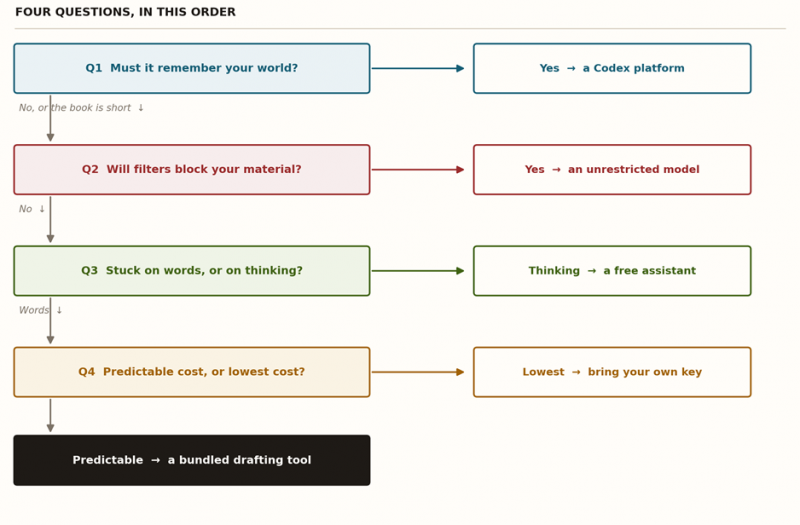
The order is deliberate, because continuity is the one constraint that cannot be solved after the fact
If you stop at question one, nothing further applies to you. If you reach the bottom, the answer is a bundled drafting tool. Everything between here and the reference section is the reasoning behind each cut.
Question 01Must it remember your world? |
This goes first because it is the only requirement that gets worse over time and cannot be patched at the end. A conversation has no memory of chapter four when you are writing chapter thirty one. Eye colours drift, a minor character quietly changes name, a rule established in the first act is broken in the third.
General assistants cannot fix this. Neither can a drafting tool with a light story bible, once the material passes a certain size. What solves it is a structured knowledge base that injects the relevant entries into each request automatically, so you are not pasting context every session.
IF YES, STOP HERE Novelcrafter, for the Codex  The Codex is a wiki of characters, locations, factions and lore that feeds the relevant entries in when a scene involves them. Define a magic system once and the model stops contradicting it. For epic fantasy, a series, or anything heavily built, this is the most valuable single feature in the category and no competitor matches it. |
The cost structure is unusual and worth understanding, because the subscription is only part of the bill. Novelcrafter uses a bring your own key model: the subscription buys the workspace, and model access is billed separately by whichever provider you connect, typically routed through an aggregator that exposes several hundred models. Four tiers are published, and only three of them include any model integration at all.
Scribe at 4 dollars a month, or 40 a year, is the organisation layer with no AI features, which makes it a story bible and writing environment rather than an assistant. Hobbyist at 8 dollars a month, or 80 a year, adds the external model integrations. Artisan at 14 dollars a month, or 140 a year, unlocks the full chat features and advanced customisation, and is the tier most solo novelists land on. Specialist at 20 dollars a month, or 200 a year, exists for collaboration and team management, and offers a solo writer nothing beyond Artisan.
Model spend sits on top of all of it. Writers report roughly 3 to 8 dollars a month on cheaper models for light use, rising toward 30 dollars a month for heavy generation on premium models. The trial is 21 days with full access and no card required, and the company states it runs no sales or seasonal discounts.
That flexibility is also the drawback. You manage keys, absorb variable costs, and occasionally troubleshoot. Collaborators who need edit access each require their own subscription, with no team discount documented, so a co writing pair starts at two subscriptions rather than one. Writers who want to press a button and receive a chapter find the setup genuinely irritating, which is a fair description rather than a criticism.
ELIMINATED AT THIS STEP Nothing yet. If your project is short, or continuity is not what is breaking, continue to question two. |
Question 02Will content filters block your material? |
Second, because it is binary. Either the tool will write your book or it will refuse partway through, and no amount of prose quality compensates for a refusal in the middle of the scene that the novel turns on.
Writers working in horror, dark fiction, explicit romance or morally difficult territory hit this regularly with mainstream assistants, which may decline or quietly soften material the story requires.

Filters interrupt at the sentence level, which is why this question comes before quality
IF YES, STOP HERE  Runs its own models with far fewer content restrictions, and encrypts work client side so the provider cannot read your manuscript. It also includes a Lorebook, which covers much of what the Codex does, so writers who answered yes to both questions one and two are still served here. |
Three paid tiers exist and text generation is unlimited on all of them, which is unusual in a category built on credits. Tablet at 10 dollars a month gives unlimited text on the Kayra 13b model with roughly 16,384 characters of memory. Scroll at 15 dollars a month doubles memory to about 32,768 characters, adds the larger Llama 3 Erato 70b model, and unlocks text to speech. Opus at 25 dollars a month carries the largest context window at around 28,672 tokens, plus experimental models and early feature access.
There is no annual discount at any tier. The free Paper tier is a limited trial rather than a permanent plan, giving a small number of text generations and a modest memory allowance, enough to judge the model but not to write with. A separate credit currency called Anlas applies only to image generation, so it is irrelevant to a text only workflow, and it persists after cancellation.
The trade you are accepting Prose quality is genuinely debated and generally rated below the category leaders, and there is no public API for integrating it elsewhere. The sensible workflow is to use it for the passages that trip restrictions on other platforms and a stronger tool for the rest, rather than treating it as a single solution. |
ELIMINATED AT THIS STEP Mainstream assistants and bundled drafting tools, for this material specifically. If filters are not your obstacle, continue. |
Question 03Are you stuck on words, or on thinking? |
Third, because it decides whether you need to spend anything at all. Most writers who go shopping for a drafting tool are not actually blocked on prose. They are blocked on structure, on a premise that will not hold, on an antagonist without a motive. That problem is free to solve.
General assistants are better at this than fiction specific platforms, because argument and conversation are what they are built for. You can interrogate a premise, generate five versions of a character and reject four, and pressure test a structure before committing months to it.
IF THINKING, STOP HERE AND SPEND NOTHING A general assistant, on the free tier Both major assistants have usable free tiers, with paid plans at 20 dollars a month if you need more volume. Reviewers testing them for fiction tend to rate one stronger on prose quality and voice consistency, the other broader on research and breadth. At this stage the difference barely matters, because you are producing options rather than final text. |
The structural limitation is worth naming. Neither retains your manuscript between sessions, so everything you established last week has to be reintroduced. That is exactly why question one comes first, and why these tools are the right answer for thinking and the wrong answer for a long book.
Two instructions that change the output more than the tool choice does Ask it to argue against your premise. Most writers unknowingly prompt for agreement, which returns enthusiasm and nothing usable. Asking what is predictable about the plot, which character has no reason to exist, or what a reader will guess by chapter three produces the developmental read that is otherwise expensive. And when you want feedback on pages, say you did not write them. Assistants lean toward encouragement when they believe they are addressing the author, and framing it as an assessment of someone else’s submission returns markedly more direct notes. |
ELIMINATED AT THIS STEP Every paid tool, for this reader. If you are genuinely blocked on prose rather than plan, continue to the last question. |
Question 04Predictable cost, or lowest cost? |
Last, because it is the only question here that is purely about money. Both remaining answers draft well. They differ in how the bill behaves.
IF PREDICTABLE, THIS IS YOUR ANSWER Sudowrite Built for novelists rather than marketers, with a Story Bible, a chapter generator, a proprietary model tuned for narrative prose, and scene level tools that expand a thin passage, add sensory detail, or rewrite the same paragraph in several registers. A series folder tracks elements across related books. It is the most complete drafting environment available and the easiest recommendation for someone whose goal is simply to finish. |
Three tiers run at 19, 29 and 59 dollars billed monthly, dropping to 10, 22 and 44 dollars on annual billing, a discount of roughly 24 to 47 percent depending on tier. Hobby and Student carries 225,000 credits a month, Professional 1,000,000, and Max 2,000,000.
Every tier unlocks the identical feature set, which is unusual and worth knowing: you are buying capacity, not capability. Only Max rolls unused credits forward, up to twelve months, while credits expire monthly on the lower two. Heavy drafters regularly report exhausting the entry allocation in days rather than weeks, so the tier decision should follow an estimate of your monthly output rather than precede it.
The trial is capped by credits rather than days, at 10,000 credits with full feature access and no card required, so it does not quietly expire while you are busy with something else.
Check the exports before committing This is a drafting environment rather than a publishing one. Reviewers note it does not produce finished ebook files, cover art or audiobook output, so a self publishing workflow needs at least one further tool downstream. That is a reasonable division of labour, but it is a cost that does not appear on the pricing page. |
If you answered lowest cost instead, you are back at the bring your own key model from question one, which has lower subscription fees and variable model spend on top. It suits light and moderate use. Heavy generators frequently spend more that way than they would on a bundled plan, so estimate your monthly output before choosing.
The six tools in detail
For checking your answer, or for readers who skipped the path. Each entry covers what the tool is, what it does that others do not, and where it stops.
Sudowrite
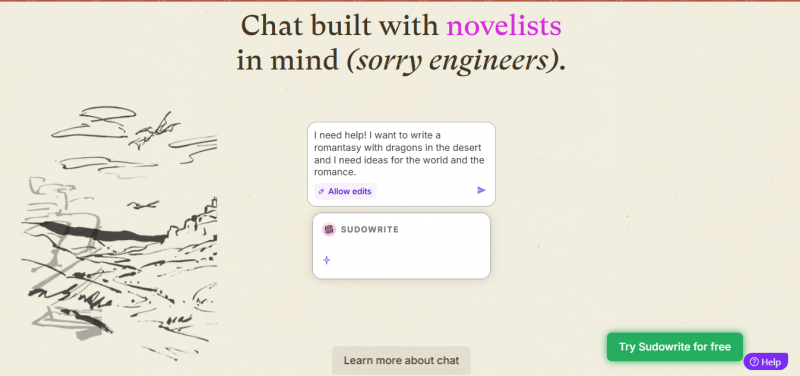
A browser based writing environment built specifically for fiction, and the most complete drafting tool in the category. The Story Bible holds characters, outline, style and worldbuilding, and feeds them into generation so scenes stay consistent with the plan. A proprietary model tuned for narrative handles the prose, and a chapter generator can take an outline beat to a full draft scene. The scene level tools are its real strength: expanding a thin passage, describing a setting across several senses, or rewriting a paragraph in several registers so you can choose rather than accept. A series folder tracks shared elements across related books.
Where it stops. It is a drafting environment, not a publishing one. Reviewers note it does not export finished ebook files, and offers no cover design or audiobook production, so a self publishing workflow needs at least one further tool. Credits are the other constraint, since generation volume rather than features is what you are buying.
Novelcrafter
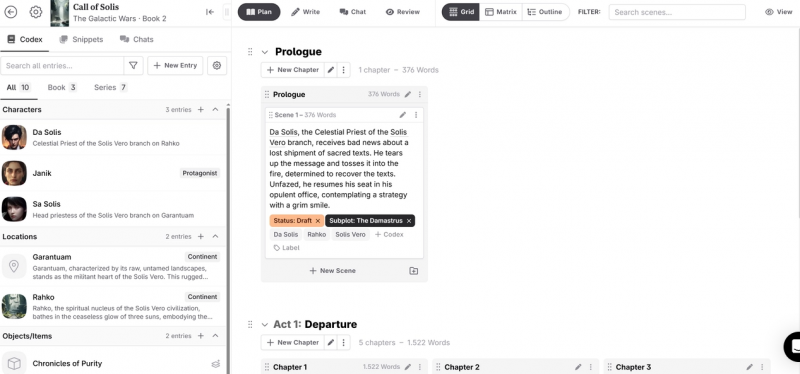
A long form writing platform organised around the Codex, an intelligent story bible that stores characters, locations, factions and lore and injects the relevant entries into each request automatically. Define a magic system once and generation stops contradicting it. It is the strongest answer in the category for series work and heavily built worlds. Rather than a single built in model, it connects to your own provider account, which in practice means access to several hundred models and the ability to route different tasks to different ones. Point of view and tense settings are held per manuscript so both you and the model stay consistent.
Where it stops. The bring your own key model means two bills rather than one, and the second is variable. Setup requires creating provider accounts and managing keys. The lowest tier includes no AI features at all, and the highest tier adds only collaboration, so most solo writers belong in the middle.
NovelAI
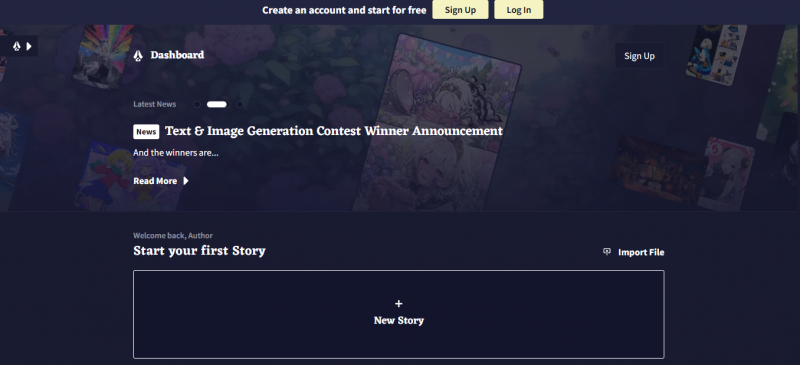
A storytelling platform running its own models rather than licensing someone else’s, which is the source of both its advantages. Content restrictions are minimal, so horror, dark fiction and explicit material do not trigger refusals partway through a scene. Work is encrypted client side, meaning the company cannot read your manuscript even in principle. A Lorebook covers much of what a Codex does, with entries activating by keyword. Text generation is unlimited on every paid tier, which is rare here. Higher tiers add larger memory, stronger models and text to speech.
Where it stops. Prose quality is genuinely debated and generally rated below the leaders. There is no public API, no annual discount, and no permanent free tier, only a limited trial. The image generation half of the product is irrelevant to most novelists but is still part of what you pay for.
General assistants
The two major conversational assistants are the best tools available for the thinking stage and the cheapest, since both have working free tiers. They are built for argument and exploration, which is what a premise needs before it becomes a manuscript. They also give the most useful developmental feedback of anything here, provided you ask specific structural questions rather than requesting general comment.
Where it stops. No memory of your manuscript between sessions, no story bible, and no continuity mechanism. Everything established last week must be reintroduced. For a long book this is the wall that sends people to the purpose built platforms.
Dedicated editing tools
Long form editing software rather than a generation tool, built to work across an entire manuscript and produce reports instead of opinions. Grammar, style, repetition, filter words, pacing and dialogue tags, across more than twenty five report types. Native integration with the main organisational writing software is a genuine differentiator for novelists, and something general purpose grammar tools do not offer.
Where it stops. It judges sentences, not story. It cannot tell you the middle sags or the antagonist has no motive. The author specific analyses, including manuscript reports and beta reader style feedback, run on a separate credit currency that is not included in any subscription tier.
Traditional writing software
No model features at all, and included here because it remains the organisational backbone for a large share of working novelists. Binder based structure handles multi viewpoint novels, series continuity and research better than anything in the AI category, and it is a one time purchase rather than a subscription, so the files and the licence stay yours.
Where it stops. It will not draft, brainstorm or edit. It pairs with the tools above rather than replacing them.
Every tier, priced
Published rates checked in July 2026 and given in US dollars. Where a tool discounts annual billing, both figures appear.
| Tool and tier | Monthly | Annual | What the tier buys |
|---|---|---|---|
| Sudowrite Hobby and Student | $19 | $10 per month | 225,000 credits a month, expiring monthly |
| Sudowrite Professional | $29 | $22 per month | 1,000,000 credits a month, expiring monthly |
| Sudowrite Max | $59 | $44 per month | 2,000,000 credits with rollover up to 12 months |
| Novelcrafter Scribe | $4 | $40 per year | Organisation and story bible with no AI features |
| Novelcrafter Hobbyist | $8 | $80 per year | Adds external model integration |
| Novelcrafter Artisan | $14 | $140 per year | Full chat features and advanced customisation |
| Novelcrafter Specialist | $20 | $200 per year | Adds collaboration and team management |
| NovelAI Tablet | $10 | No annual rate | Unlimited text, smaller model, about 16,384 characters of memory |
| NovelAI Scroll | $15 | No annual rate | Larger model, about 32,768 characters of memory, text to speech |
| NovelAI Opus | $25 | No annual rate | Largest context, experimental models, early access |
| General assistants | $20 | Varies by provider | Higher usage limits, with capable free tiers below |
| Editing tool Premium | $30 | $120 per year | Unlimited word count and the full report set |
| Editing tool Premium Pro | $36 | $144 per year | Adds the AI assisted features and higher daily limits |
| Editing tool lifetime | One time | $399 or $699 | Premium or Premium Pro features with no renewal |
| Traditional software | One time | $59.99 per platform | Full licence, with a lower mobile price and cross platform discounts |
Four costs that are not on the pricing pages Model spend on bring your own key platforms. The subscription is the smaller number. Writers report roughly 3 to 8 dollars a month on cheaper models for light use, rising toward 30 dollars a month for heavy generation on premium ones, which can exceed a bundled plan outright. Author reports sold separately. On the editing side, manuscript analysis and beta reader style feedback run on a credit currency that no subscription tier includes, though paid tiers buy those credits at a discount. If those features are why you are subscribing, budget a second line. The publishing tail. Drafting tools that do not export finished ebook files mean a formatting tool downstream, and cover work on top of that. Second seats. Collaboration is priced per person on the platforms that support it, with no team discount documented, so a co writing pair pays twice. |
One recent change worth knowing The leading editing tool restructured its pricing in 2026. The annual plan rose from 79 to 120 dollars, monthly from 20 to 30, and the lifetime licence from 299 to 399, alongside a new higher tier. Older articles quoting the previous figures are describing a plan that is no longer sold, which is a good reason to check any price here against the vendor before you buy. |
Figures are as published in July 2026 and several vendors revise them without notice. Regional pricing and currency differences apply.
The comparison in one table
| Tool | The job it owns | Continuity system | Content limits | Free access | Entry price |
|---|---|---|---|---|---|
| Sudowrite | Drafting scenes | Story Bible | Standard | 10,000 credit trial, no card | $10 per month annually |
| Novelcrafter | Continuity and lore | Codex | Depends on the model you connect | 21 day trial, no card | $4 per month |
| NovelAI | Unrestricted drafting | Lorebook | Minimal | Limited trial only | $10 per month |
| General assistants | Ideas and feedback | None | Standard | Ongoing free tiers | Free, or $20 per month |
| Dedicated editing tools | Line editing | Not applicable | Not applicable | Free tier capped at 500 words | $10 per month annually |
| Traditional software | Organising the manuscript | Binder and outline | Not applicable | Free trial | $59.99 once |
Entry price shows the cheapest route to a working setup, which is not always the cheapest tier.
How much of the book will you actually own?

No pricing page raises the ownership question, and it outlasts every subscription
No pricing page mentions this, and it carries more consequence than the subscription. Two separate systems, copyright registration and store disclosure, both turn on one distinction: did the machine produce the text, or did it help you produce it.
What copyright protects
The position of the United States Copyright Office is settled enough to plan around. Human authorship remains a requirement, so material generated entirely by a machine is not copyrightable. Where a work mixes human and machine written material, only the human contribution is protected. Critically, prompting is not authorship, however detailed the prompt and however many times you iterate. A federal appeals court affirmed the human authorship requirement in 2025.
Registration carries a disclosure duty as well. More than a trivial amount of machine generated material must be disclosed on the application, with a description of what the human author contributed. This is not a rejection mechanism. By April 2026 the Office had reportedly registered several thousand works combining human and machine authorship.
What this means for how you work Heavy editing, restructuring, rewriting and creative arrangement of machine drafted material are precisely the contributions that create protectable authorship. A writer who drafts with a tool and then genuinely rewrites is in a strong position. A writer who accepts generated chapters largely unchanged owns far less than they assume, and may own nothing in those passages. |
What the largest store requires
Self publishing disclosure turns on the same line, and it is narrower than most writers expect.
| What you did | Category | Disclosure required |
|---|---|---|
| Brainstormed ideas and plot with a model | Assisted | No |
| Outlined the book with a model | Assisted | No |
| Ran a grammar and style pass on your own prose | Assisted | No |
| Asked a model to refine sentences you wrote | Assisted | No |
| Generated scenes or chapters, then edited them | Generated | Yes |
| Generated the cover art | Generated | Yes |
| Translated the book with a model | Generated | Yes |
Three details that surprise people Disclosure is internal to the store and is not shown to readers, and the store has stated it does not affect royalties or ranking. Editing generated text afterwards does not move it into the assisted category. And accounts are capped at roughly three new titles per day, a limit introduced to slow mass publishing, which applies regardless of how legitimate your series is. Because disclosure is invisible and penalty free, there is no upside to concealing it and real downside if you do, including removal of the title and, for repeated cases, loss of the account. |
General information rather than legal advice, and rules differ by country and platform. Verify current requirements before publishing.
Why a distinctive voice is worth more than it was
There is a tendency to discuss the flood of machine written fiction as a prediction. It is not. One science fiction magazine published its own moderation data, and the shape of it is the clearest picture available of what changed and how quickly.
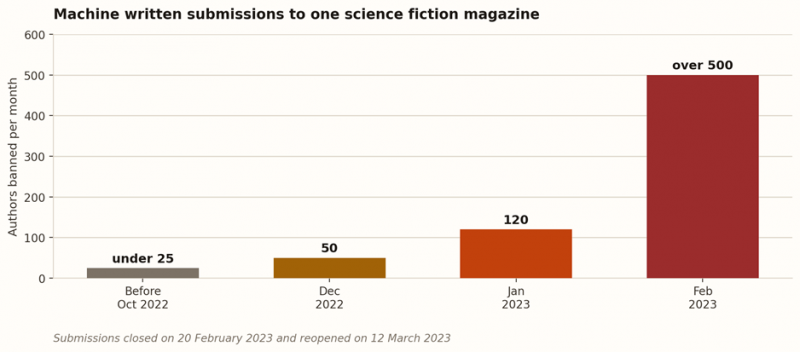
Monthly bans for plagiarised or machine generated submissions, from the magazine published figures
Before late 2022 the magazine banned fewer than twenty five authors a month for plagiarised or machine generated submissions. That rose to about fifty in December 2022, roughly doubled again in January 2023, and passed five hundred in February 2023. Submissions closed on 20 February and reopened on 12 March, after the magazine rebuilt its filtering. In context, it received around eleven and a half thousand submissions across the whole of 2022.
The editor’s own account of the problem is the useful part. The difficulty was never that machine written stories were winning. It was that reading through them consumed the attention that would otherwise go to new writers, which is a volume problem rather than a quality one.
What this implies for your manuscript Two things follow, and they point the same way. Undisclosed machine drafted work now meets more scrutiny than it did, at magazines and at the largest self publishing store alike. And in an environment where competent prose has become abundant, the scarce thing is prose that does not read like everything else. |
What none of them do
Competent prose is now abundant, which makes the improbable sentence the scarce thing
Every tool here produces competent prose. Competent is the ceiling, and the reason is structural rather than a matter of the models improving.
These systems generate the most probable next passage given everything before it. That instinct is exactly right for grammar and exactly wrong for voice, because a distinctive voice is by definition the improbable choice. The odd image, the sentence that breaks its own rhythm, the joke that should not work. Prose that never surprises has been averaged, and readers register it as flat well before they can explain why.
The consequence is a division of labour rather than an argument against the tools. Use them where the probable answer is the right answer, which covers a great deal of any manuscript: continuity, structural notes, line level cleanup, getting through a scene you already understand. Keep the improbable choices for yourself. They are the reason someone reads you rather than someone else.
Final Verdict
Where the path ends for most people If you skipped to here, the short answer is Sudowrite, because drafting is where most novels stall and it is the most complete environment for that job. But the more accurate answer is that most readers should stop earlier. Novelcrafter for a series or a heavily built world, NovelAI when filters rather than quality are the obstacle, and a free assistant for anyone whose real problem is the plan rather than the prose, which is a larger group than the marketing in this category admits. Whatever you land on, the distinction that matters most is not between two products. It is between generated and assisted, because that single line decides how much of the book you legally own and what you must declare when you publish it. Draft with whatever helps, then rewrite enough that the result is genuinely yours. That is both the stronger legal position and, not coincidentally, the better book. Start free, add a tool only when you hit an actual wall, and let the manuscript tell you what it needs. |
Post Comment
Share your thoughts about this article.
Be the first to post a comment!