WHAT YOU ARE ACTUALLY SIGNING UP FOR
|
THE SHORT VERSION
|
What it is
What Pink Video Chat actually is

Pink Video Chat is a live, random video chat service that connects you one-on-one with strangers around the world. You open it, turn on your camera, and start talking almost immediately, then skip to the next person when you want. There is no feed to scroll and no long profile to build first. Speed is the whole point, which puts it in the same family as older stranger-chat apps and cam-to-cam platforms, best understood as a video chat app with a social or dating angle rather than a traditional social network.
It shows up as a website and as several Android apps, some with more than a million downloads between them. That matters for one practical reason: the name is doing a lot of work.
SAFETY FLAG / NAME CONFUSION The word “pink” is catchy and gets clicks, and more than one app and site uses some version of it. Some of those may be low-quality clones or copycats. It is also easy to confuse with the unrelated “Pink WhatsApp,” a known malware scam that disguises itself as a colorful WhatsApp and has been flagged for stealing data. Download only from official app stores, and check the developer name before you install anything. |
How it works
The experience, start to finish
The flow is deliberately frictionless. You allow camera and microphone access, the app matches you with a random person, and the conversation starts on the spot. If it is not going anywhere, you skip and get matched again. Some versions add discovery cards, public group rooms, and virtual gifts on top of the basic one-on-one matching.
One useful pattern to know: public or themed rooms tend to be safer than fully random one-on-one calls, because they are easier to moderate and there is a crowd. The random one-on-one match is where the most unpredictable behavior shows up.
What it costs
Free to download, paid to actually use
Downloading Pink Video Chat is free, and basic random matching is usually free too. The catch is that a lot of the features people actually want, such as gender or region filters and private calls, sit behind coins or diamonds you buy in the app. Reviewers repeatedly note that these paywalls are not obvious until after you install, that prices vary by region and version, and that refunds are hard to get with slow or unresponsive support.
| What you touch | Typical cost | Worth knowing |
|---|---|---|
| Download | Free | Offered on Android app stores and on the web |
| Basic random matching | Usually free | The core meet-a-stranger experience |
| Gender or region filters | Paid | Often gated behind coins and not shown until after install |
| Private or premium calls | Paid | Charged in coins or diamonds, per action or per minute |
| Gifts and coin bundles | Paid | Sold in packs, with prices that shift by region |
| Refunds | Rarely simple | Users report slow support and low success rates |
If you decide to try it, a simple rule protects you: spend nothing until you fully understand what a coin buys and what it costs. Treat the free tier as the whole product until proven otherwise.
The real risks
Where random stranger video goes wrong
None of this is meant to scare you off a novelty app. It is meant to name the things that actually come up so you recognize them fast.
Fake profiles and bots. This is one of the most common complaints across reviews: scripted messages and calls that feel automated rather than human. Because the process behind any verified badge is unclear, treat those badges with healthy skepticism.
Explicit and unwanted content. Random stranger video can surface nudity, harassment, or disturbing behavior with little warning. Moderation is a mix of automated detection and human review, and human review queues can run from minutes to hours, so nothing catches everything in real time.
Coin-gift scams. A recurring pattern is being nudged to send coin gifts in exchange for something on camera, and then getting blocked once the gift lands. Be skeptical of anyone who steers the conversation toward spending.
Off-platform pressure. Another common move is a quick push to continue on a different app or through a link. Slow down whenever that happens, and do not follow unknown links.
Device and data concerns. The apps request broad permissions, and some builds have drawn reports of crashes and odd behavior. Combined with limited transparency about who runs the platform and how data is handled, that is worth factoring in before you install.
READ THIS IF A MINOR MIGHT USE IT These apps are built for adults Random video chat with strangers exposes minors to explicit content and to adults who should not be contacting them, and the age checks on apps like this are weak, often just a tap to confirm you are old enough. If you are under 18, do not use it. If you are a parent or guardian, treat any random video chat app as adult software: talk with your child, use the parental controls built into their phone, and understand that a report button does not make these spaces safe for kids. Omegle, the app that defined this category, shut down in 2023 under the weight of exactly these safety and legal problems. |
Privacy and permissions
What it can see, and what to assume
Expect the app to ask for your camera, microphone, and notifications, plus optional location for region-based matching. Some listings show a long list of permissions beyond those basics, which is worth reading before you accept.
You will also see reassuring claims, such as encryption, privacy controls, and promises that raw video is not stored. Take those as the platform's own claims rather than verified facts, since they are hard to check independently, and the fine print may still allow sharing some data with partners.
Assume the person on the other end can screenshot or record you, no matter what any in-app warning says. Do not show or say anything you would not want saved.
Is it legit
Real app, thin trust
To be fair, Pink Video Chat is not an outright scam. The app works, and plenty of people use it without incident. The problem is trust rather than function. Independent, trustworthy coverage of it is limited, a large share of app-store reviews look generic or possibly fake, complaint ratios are high, and there is very little public information about who operates it. Star ratings for apps in this niche are easy to inflate, so treat glowing averages and fast-growth marketing figures as unverified until something independent backs them up.
How to protect yourself
If you do try it, these habits carry most of the weight. None of them are complicated, and together they remove the majority of the everyday risk.
- Download only from official app stores, check the developer name, and avoid pink installers offered on random websites.
- Use a nickname. Never share your real name, phone number, address, workplace, or school.
- Turn on any blur or mask option for the opening moments of a call if the app offers one.
- Keep the block and report controls within reach, and use them early rather than waiting.
- Never send money, coins, or gifts to someone who pressures you, and do not move to another app or link on request.
- Limit permissions where you can, especially location, and read the privacy policy before accepting.
- Assume you can be recorded, and keep your camera framing and behavior in line with that.
If you are under 18, do not use it. If you are a parent, turn on parental controls and talk about it openly.
Other options, and how they differ
If you want random video chat with clearer pricing or stronger moderation, these are the names that come up most often. None are risk-free, availability changes, and the same safety habits apply to all of them, so it is worth skimming recent app-store reviews before you commit. Here is a quick comparison, followed by the detail on each.
| Platform | Launched | Scale | Cost | Signup |
|---|---|---|---|---|
| Azar | 2014 | 540M+ downloads | Freemium, gems | Account needed |
| Camsurf | mid-2010s | 19M+ users | Free, optional premium | No signup needed |
| OmeTV | 2015 | Millions worldwide | Free, ad supported | Optional on mobile |
| Chatroulette | 2009 | 4M+ monthly at peak | Freemium | No signup needed |
| Monkey | 2016 | 30M+ users | Free | Phone verification |
Azar
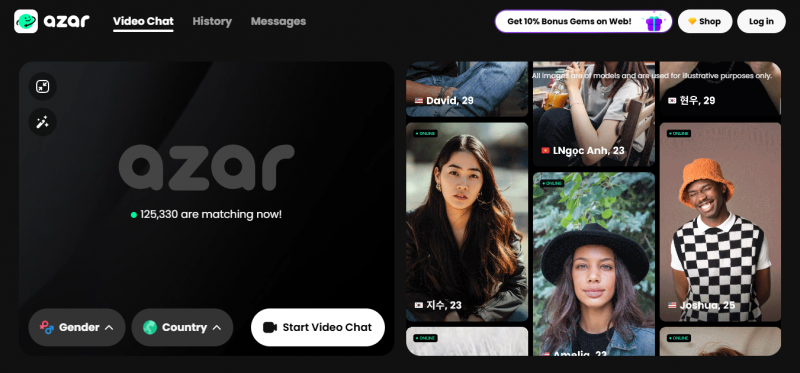
Developed by Hyperconnect in Seoul and launched in 2014, Azar is the giant of the category. By the time Match Group, the company behind Tinder, bought Hyperconnect for 1.725 billion dollars in 2021, its biggest acquisition ever at the time, Azar had passed 540 million cumulative downloads and ranked as the highest-grossing one-on-one video chat app in the world, and the ninth highest-grossing non-gaming app on Google Play in 2020. Its standout feature is real-time translation that turns speech and text into subtitles across many languages, alongside beauty and AR filters, a Pick and Match browse mode, and an Azar Badge for verified users. Core matching is free, but the features people want most, gender and region filters, run on its gem currency at roughly 22 gems per swipe, with gem packs ranging from about 4 dollars for 500 gems to about 182 dollars for the largest bundle, and premium tiers near 13 and 115 dollars a month. It carries a Google Play rating around 3.7, and reviews consistently praise the translation and reach while criticizing the cost, the number of bot-like or paid profiles, and a ban system that can lock up gems you already bought.
Camsurf

A lighter, safety-first option that has been running since the mid-2010s and now shows more than 19 million registered users. It works in the browser or as an iOS and Android app, connects you in under a second across more than 200 countries, and needs no account. Its whole pitch is moderation: a mix of AI and community review runs on every session rather than relying only on user reports, which makes it one of the more family-friendly choices. Unusually, its country, gender, and language filters are free, where most rivals charge for them, though some versions add an optional premium tier of roughly 5 to 20 dollars a month that removes ads and unlocks unlimited filtering. The trade-offs are a smaller user pool than Azar or OmeTV, no interest-based matching, and fairly aggressive device fingerprinting used to power that moderation.
OmeTV

Launched in 2015 as an unfunded project based in Portugal, OmeTV has grown into one of the largest mobile players in random video chat, especially across eastern and central Europe. It is free, with built-in translation across dozens of languages and country filters, and it runs on Android, iOS, and the web. You can start on the desktop site without an account, though the mobile app generally asks you to register, and the free experience is ad-supported. Its moderation is responsive but inconsistent, so the quality of any given session varies with traffic and region.
Chatroulette
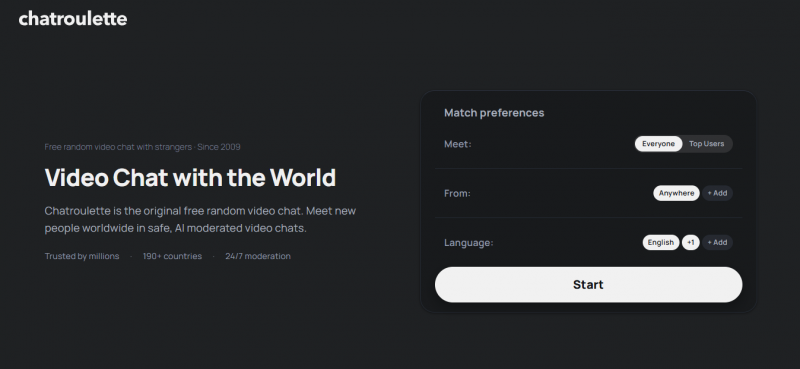
The platform that invented random video chat, launched in 2009 by Andrey Ternovskiy, then a 17-year-old in Moscow. At its 2010 peak it drew around 4 million monthly visitors and set off a wave of clones. After years of reputation problems it has leaned into face detection and automated nudity screening, so the modern version feels far more managed than its chaotic early days while keeping the fast-skip energy. It runs in the browser with no signup and uses a freemium model. The caveats are a user pool that has been shrinking, a dated interface with no video effects or interest matching, and a gender filter that is basic or paid.
Monkey

A mobile-first app launched in November 2016 by two US teenagers, Ben Pasternak and Isaiah Turner, built around a distinctive 15-second timed video chat that you can extend by mutual interest, plus mini-games, interest hashtags, and age and gender shown before you connect. It grew fast, hitting about 50,000 users and half a million calls within weeks and nearly 3 million downloads by mid-2017, then was acquired by the app Holla in early 2018, and it has since reported more than 30 million registered users. It requires phone verification. It also comes with the clearest safety caution on this list: reviewers repeatedly flag weak moderation and privacy weaknesses, and it was removed from major app stores in 2024 following safety concerns. If you are considering it, treat that history as a reason for extra care, and remember that a younger user base raises the stakes on moderation.
The VerdictFun novelty, only with your guard up Pink Video Chat delivers exactly what its category promises: fast, unpredictable, face-to-face conversation with strangers and no setup. That single sentence is both the appeal and the risk. For a curious adult who treats it carefully, guards personal details, spends nothing until the coin system is clear, and leans on block and report, it can be a harmless way to pass time. For anyone hoping for verified, genuine connections, or for minors, it is the wrong place. The honest takeaway is not avoid it or trust it, but know what you are turning your camera on for. Do that, and you will make a better decision than most first-time users. Bottom line: a low-stakes novelty for careful adults, and a poor fit for anyone expecting safety, authenticity, or a place for kids. |
Post Comment
Share your thoughts about this article.
Be the first to post a comment!