Five conditions have to be true before a model cites you. They are sequential, and failing any one produces zero citations no matter how well you do the other four. This document sets out each gate, the evidence behind it, and the one statistic in this field that points in two directions at once.
| PEER-REVIEWED LIFT | PLATFORM OVERLAP | CONVERSION GAP |
|---|---|---|
| Up to 40% | 11% | 15.9% |
| visibility improvement from the tested tactics | of domains cited by both ChatGPT and Perplexity | conversion from ChatGPT against 1.76 percent from organic |
How Citation Actually Works
You are not optimising for a ranking. There is no position one.
Want more users for your site? - webmasters
A model does not paste your query into a search box and read the results in order. It breaks the question into sub-queries, retrieves separately for each, and synthesises one answer from whatever came back. That single mechanical difference invalidates most of what ranking-based SEO teaches.
Two consequences follow. First, your content has to match the sub-queries the model generates, not the question the user typed. Ask an AI for the best VPN for streaming in Europe and it may search separately for the best VPNs of 2026, VPN streaming performance, and European server coverage. You need to be findable on all three.
Second, models are non-deterministic. Ask the same question five times and you get five different answers. There is no fixed position to hold, so the metric is a mention rate across many prompts rather than a rank on one.
| ROUTE | HOW YOU GET IN | HOW FAST IT MOVES |
|---|---|---|
| Parametric | Being present in training data, which means being written about widely before the cutoff | Very slow. Measured in model generations. |
| Retrieved | Being crawlable, indexed, and the best match for a live sub-query | Fast. Days to weeks. |
Everything actionable sits in the second route. The five gates below are the sequence a page passes through before it appears as a citation.
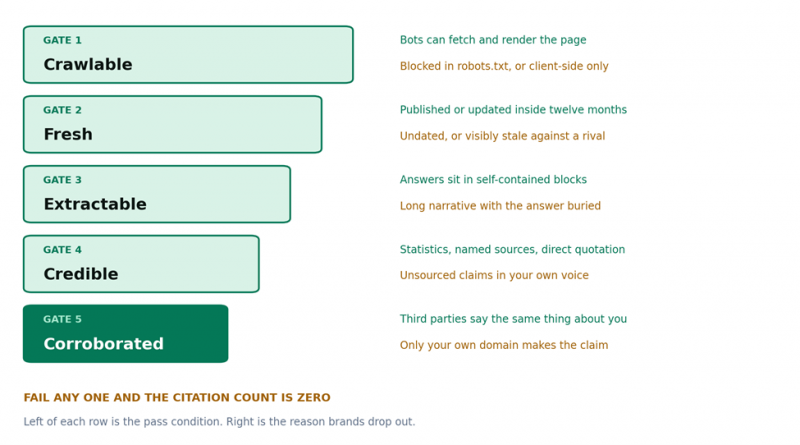
Figure 1. The five gates. Sequence compiled from the Princeton GEO framework (Aggarwal et al., KDD 2024) and 2026 citation studies from Yext, Semrush, BrightEdge and Digital Bloom. The ordering is this guide's framing.
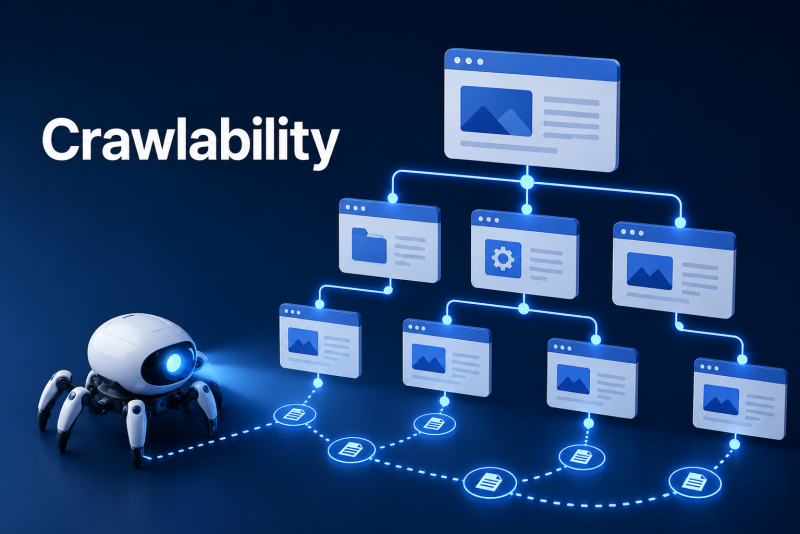
Gate 1: Crawlability
Before anything else can matter, a machine has to be able to fetch your page and read it. A surprising share of brands fail here and never find out, because nothing in their analytics reports an absence.
The specific thing most teams miss: ChatGPT Search retrieves largely through Bing's index. Published analysis puts roughly 87 percent of ChatGPT-cited pages among Bing's top results. If your sitemap has never been submitted to Bing Webmaster Tools, you are close to invisible to the largest AI search surface in the world, regardless of how you rank in Google.
• Submit your sitemap to Bing, today. This is a ten minute job with a larger effect than most content work, and it is the single most commonly skipped step in the whole discipline.
• Check robots.txt for the AI crawlers by name. GPTBot, OAI-SearchBot, ChatGPT-User, ClaudeBot, PerplexityBot and Google-Extended. Blocking some and allowing others is a legitimate policy choice, but doing it by accident is common.
• Render server-side. If the answer only exists after JavaScript runs, assume a retrieval crawler will not see it. Content that matters belongs in the initial HTML.
• Read your access logs. Crawler hits are the only exact signal in this whole field. Everything else is sampled.
PASS CONDITION Named AI crawlers are permitted, the sitemap is in Bing Webmaster Tools, and the answer is present in server-rendered HTML. | DROP OUT IF You blocked a crawler by accident, never submitted to Bing, or your content only assembles in the browser. |
Gate 2: Freshness
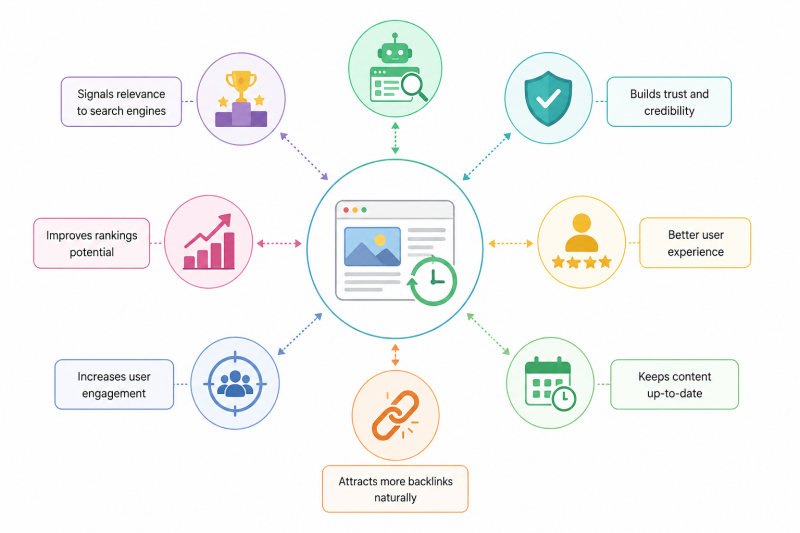
Recency is weighted far more heavily by retrieval systems than by classic ranking. Published 2026 analysis finds that around 65 percent of AI bot traffic targets content published or updated within the past year, and that a 2024 article without updates consistently loses to a 2026 article on the same topic.
This makes a quarterly refresh cycle with a visible last-updated date one of the highest-return activities in the discipline, because it requires no new writing.
PASS CONDITION Your cornerstone pages carry a visible and accurate last-updated date, refreshed on a schedule rather than when someone remembers. | DROP OUT IF Your best page is undated, or dated 2024, and a competitor republished the same ground this year. |
Gate 3: Extractability
Retrieval systems do not read your article. They pull passages. A page that reads beautifully end to end can be useless if no single block of it answers a question on its own.
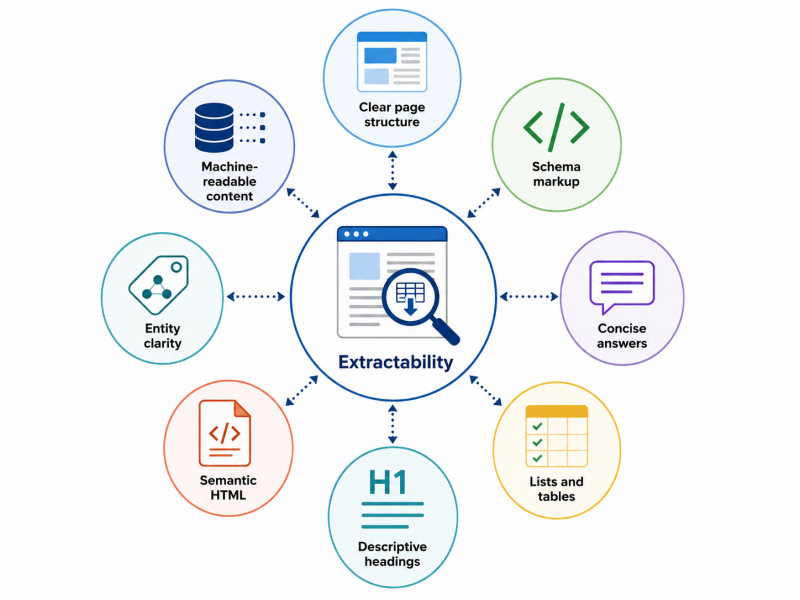
The practical format that emerges consistently from 2026 testing:
| ELEMENT | TARGET | WHY |
|---|---|---|
| Direct answer under each heading | 40 to 60 words | Long enough to stand alone, short enough to lift whole |
| Paragraph length | 2 to 3 lines | Engines pull self-contained blocks, not flowing narrative |
| Headings | Phrased as real questions | They need to match the sub-queries, not your content plan |
| Comparison tables | Use them | Among the most citable formats available |
| Answer position | First, then context | Lead with the conclusion and expand afterwards |
This is the inverse of how most brand content is written, which builds context first and reaches the point in paragraph six. That structure is optimised for a reader who has already decided to read. Retrieval has made no such commitment.
PASS CONDITION Any single section of your page, read in isolation, answers one real question completely. | DROP OUT IF Your answer only makes sense to someone who read the three paragraphs above it. |
Gate 4: Credibility

Most advice in this field is assertion. This gate is not. The founding study, by researchers at Princeton, Georgia Tech, the Allen Institute for AI and IIT Delhi, was presented at ACM SIGKDD 2024 and tested nine tactics across a benchmark of 10,000 queries spanning nine domains.
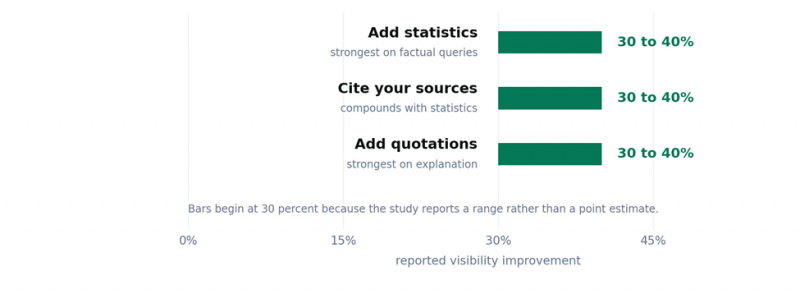
Figure 2. What the Princeton study found. Source: Aggarwal et al., GEO: Generative Engine Optimization, ACM SIGKDD 2024. Benchmark of 10,000 queries across nine domains. Subject-level effects reported by DerivateX, April 2026.
The counterintuitive finding is the middle one. Citing other people's research makes a model more likely to cite you. It reads as thoroughness rather than as sending readers elsewhere, and it is the tactic brands resist most.
The practical translation is a rewrite rule. Replace every internal claim with an attributed external one. Instead of writing that AI search is growing quickly, write the number, name the source, and give the year. A specific figure with a named origin is the shape that gets lifted into an answer.
PASS CONDITION Your key claims carry a number, a named source and a date, and you quote recognised experts directly. | DROP OUT IF Your page asserts things in your own voice with nothing behind them, however true they are. |
Gate 5: Corroboration
Classic SEO is a first-party game. You optimise a site you own. This gate is mostly third-party, and it is the hardest shift for in-house teams because the work happens on properties you do not control.
Two findings anchor it. Sites cited across four or more AI platforms are reported to be 2.8 times more likely to appear in ChatGPT responses. And the engines diverge sharply in what they trust, which means a single-platform strategy fails by construction.
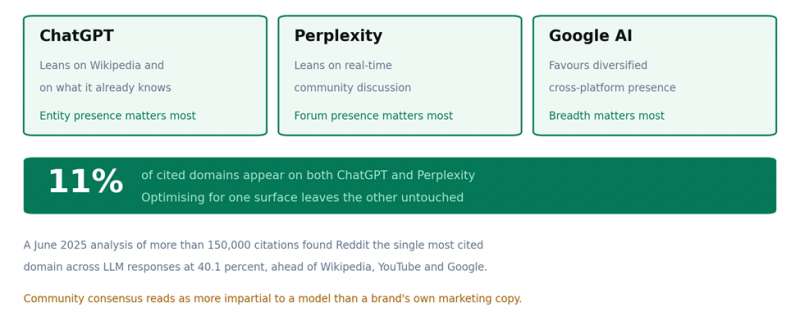
Figure 3. Platform divergence. Sources: Digital Bloom AI Visibility Report, May 2026; Semrush AI search study; citation analysis reported by Visual Capitalist, June 2025.
• Get the entity right first. Wikidata, and Wikipedia if you genuinely meet the notability bar. Do not manufacture a page you do not qualify for, because that fails and damages you.
• Be present where the discussion happens. Reddit, industry forums, review sites, podcasts, analyst write-ups. Participate honestly. Models are good at detecting and deprioritising promotional posting, and a ban removes all visibility at once.
• Earn third-party comparison coverage. The listicle that names you alongside competitors is worth more than the page on your own site that says you are the best.
• Keep your facts consistent everywhere. If your pricing, founding date or positioning differ between your site and third-party listings, you have given the model a reason to trust neither.
PASS CONDITION Four or more independent properties describe your brand, consistently, without you having written the words. | DROP OUT IF Every claim about you traces back to your own domain, or your details conflict across the web. |
Contradictory Evidence on Citation Sources
Gate 5 rests on a claim that two large studies flatly contradict. Anyone selling you a strategy built on either number is quoting the half that suits them.
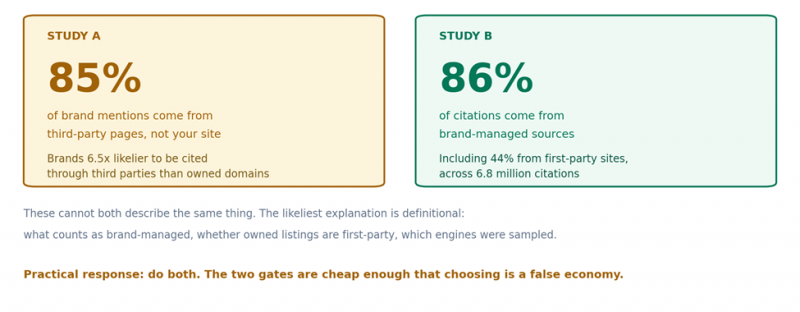
Figure 4. Two 2026 studies, opposite conclusions. Study A reported by WRITER, 2026. Study B is a Yext analysis of 6.8 million AI citations, reported 2026. Neither publishes a methodology detailed enough to reconcile the gap.
This is worth sitting with, because it is the clearest signal available about the maturity of this discipline. The single most repeated strategic claim in LLM SEO, that third-party coverage beats owned content, has a well-sourced counterpart saying the reverse. Treat any confident allocation of budget between the two as an opinion wearing a number.
What Does Not Work
• Adding schema markup specifically for AI answers. Google published its first dedicated guide to generative AI search on 15 May 2026 and stated plainly that structured data is not required for AI Overviews or AI Mode, and that there is no special markup to add. Schema still has value for classic rich results. It is not an AI lever.
• Writing an llms.txt file and expecting retrieval. Adoption by the major engines remains unconfirmed. It costs nothing to publish, so publish it if you like, but do not count it as work done.
• Keyword stuffing, in any modern form. Models detect and deprioritise it. The failure mode here is worse than wasted effort, because thin promotional content actively signals low quality.
• Chasing a rank position. There is not one. Frequency across many prompts is the measurable outcome, and reported monthly citation drift of 40 to 60 percent means a single check tells you almost nothing.
THE UNCOMFORTABLE CONSENSUS
Practitioners converge on a figure that undercuts most of the products in this category: roughly 80 percent of generative engine optimisation is ordinary, competent SEO. Crawlability, site quality, topical authority and genuine expertise. The genuinely new work is the extractable formatting in Gate 3, the citation discipline in Gate 4, and the third-party presence in Gate 5. If your fundamentals are weak, none of the new tactics will compensate.
The Business Case
AI referral volume is still modest for most sites. What makes it interesting is who arrives. Visitors coming from an AI answer have already done their research and arrived with a shortlist, which shows up starkly in conversion data.
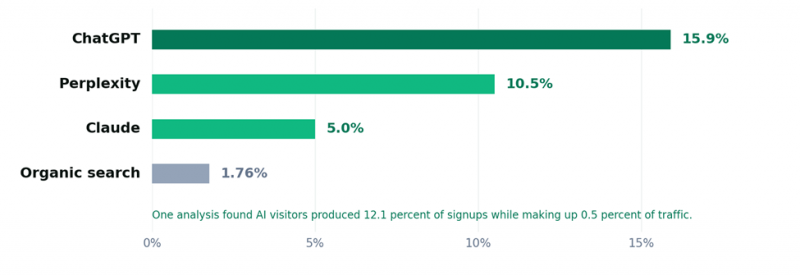
Figure 5. Conversion rate by traffic source. Source: Seer Interactive LLM conversion analysis, June 2025, and Ahrefs signup attribution data. Conversion rates vary widely by sector and these figures come from a limited sample of properties.
One further finding removes the usual objection that this cannibalises classic search. AI Overview citations have been reported to lift adjacent organic click-through by around 35 percent, which suggests the two surfaces reinforce rather than compete.
Verdict
| ACTION | EVIDENCE QUALITY | EFFORT |
|---|---|---|
| Submit your sitemap to Bing Webmaster Tools | Strong | Ten minutes, once |
| Audit robots.txt for named AI crawlers | Strong | Under an hour |
| Add statistics with named sources and dates | Peer reviewed | Ongoing discipline |
| Quote named experts directly | Peer reviewed | Ongoing discipline |
| Restructure pages into 40 to 60 word answers | Practitioner consensus | High, one pass per page |
| Quarterly refresh with visible dates | Strong | Low, recurring |
| Build presence on four or more platforms | Contested allocation | High and continuous |
| Add schema markup for AI specifically | Contradicted by Google | Skip it |
| Publish llms.txt | Unconfirmed | Free, so optional |
Verdict: the two gates with real evidence behind them, crawlability and citation discipline, are also the cheapest. Do those first, restructure for extraction second, and treat everything about third-party allocation as an unsettled bet.
• You are starting from zero: Gate 1 and Gate 2 in a single afternoon. Sitemap to Bing, crawler audit, dates on cornerstone pages. These are the only steps here with a clear mechanism and near-zero cost.
• If your fundamentals are already strong: Go to Gate 4. The rewrite rule of replacing internal claims with attributed external ones is the highest-evidence content change available.
• You have budget and patience: Gate 5, knowing the allocation evidence is contested. Start with entity consistency and comparison coverage, which help under either study.
• If someone quotes you a single citation percentage: Ask which study, which engines, and what counted as brand-managed. The two headline figures in this field disagree by a wide margin.
Post Comment
Share your thoughts about this article.
Be the first to post a comment!