Table of Content
Most AI products spent 2026 moving features behind paywalls. Anthropic went the other way on several of them. Here is exactly what $0 buys on Claude right now, verified against the official pricing page rather than secondhand summaries, and where the free plan genuinely stops.
THE DIRECT ANSWER
Yes. Claude has a permanently free plan at claude.ai. No credit card, no trial clock, no expiry. It includes web search, memory across conversations, file creation with code execution, connectors via remote MCP, desktop extensions, and extended thinking. What you do not get is the top-tier Opus and Fable models, Claude Code, Research, and the higher usage ceiling. The cap is metered by compute in rolling five-hour sessions, not by a published message count.
Plan details and prices verified against claude.com/pricing and Anthropic help centre, 24 July 2026
DISCLOSURE
This article was drafted by Claude, Anthropic AI assistant, about Anthropic own pricing. Every figure below is sourced from Anthropic published pricing page and help centre so you can check it independently, and the comparison section reports where rival free tiers beat Claude. Verify current pricing before acting on it, since Anthropic states plans are subject to change.
What the free plan actually includes
This list is taken from Anthropic own pricing page rather than from third-party summaries, several of which are out of date on this exact point.
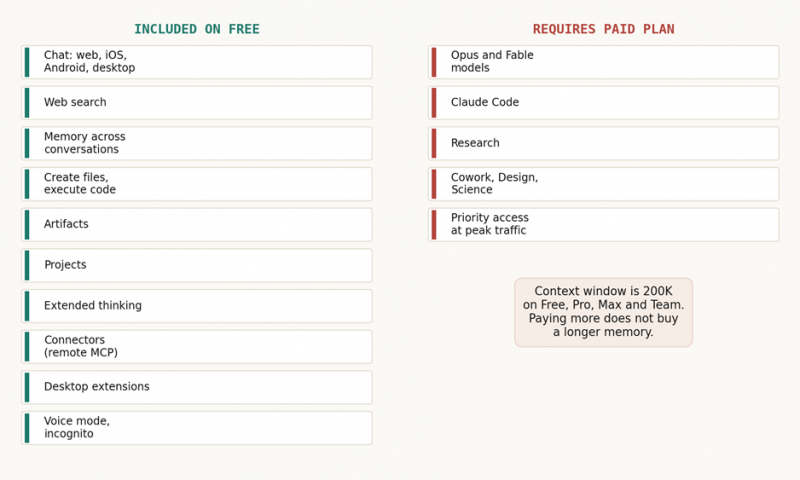
Figure 1. Free plan capabilities against paid-only features, from claude.com/pricing.
| CAPABILITY | FREE | DETAIL |
|---|---|---|
| Chat on web, iOS, Android, desktop | Included | All four clients, same account |
| Web search | Included | Live retrieval inside chat |
| Memory across conversations | Included | Carries context between chats |
| Create files, execute code | Included | Real file output, not just snippets |
| Artifacts | Included | Rendered documents, code, visualisations |
| Projects | Included | Caching here reduces quota burn |
| Extended thinking | Included | Deeper reasoning on hard prompts |
| Connectors, remote MCP | Included | Slack, Google Workspace, custom tools |
| Desktop extensions | Included | Local tool access |
| Voice mode, incognito chats | Included | Both on the free tier |
| Context window | 200K | Same as Pro and Max |
| Opus and Fable models | Paid only | Sonnet and Haiku on free |
| Claude Code | Paid only | All paid plans include it |
| Research | Paid only | Multi-source deep investigation |
| Claude Cowork, Design, Science | Paid only | Pro and above |
| Priority at peak traffic | Max only | Free deprioritised under load |
THE DETAIL MOST GUIDES GET WRONG
The 200K context window is identical on Free, Pro, Max, and Team. Paying more does not buy a longer memory inside a single conversation. Only Enterprise moves to 500K on the default model.
That matters because context window is the thing people most often assume they are buying. They are not. What paid plans buy is more usage, better models, and Claude Code, in roughly that order of practical impact.
How the limits actually work
Anthropic does not publish a message count, and the reason is structural rather than evasive. Usage is metered by compute consumed, so a one-line question and a 40-page PDF analysis draw very differently from the same pool.
Per the help centre, the factors that move your consumption are message length, file attachment size, current conversation length, tool usage such as Research and web search, model choice, effort level, and Artifact creation. Two people on identical plans sending identical message counts can hit the ceiling hours apart.
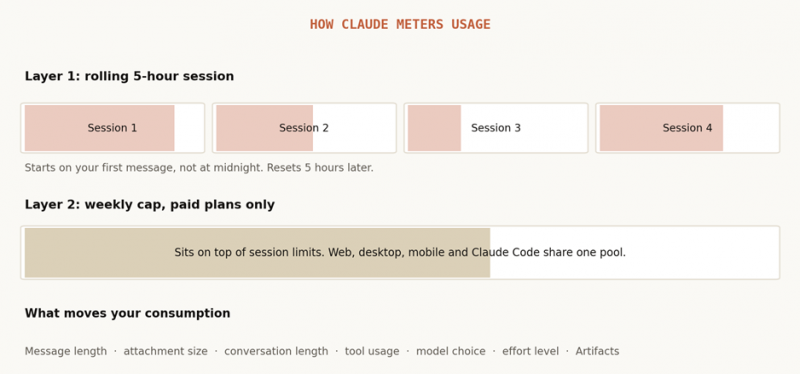
Figure 2. The two-layer metering system, from Anthropic usage limit documentation.
The two-layer system
| LAYER | APPLIES TO | BEHAVIOUR |
|---|---|---|
| 5-hour session | All plans | Rolling window, starts on your first message, not at midnight |
| Weekly cap | Paid plans | Sits on top of the session limit |
| Shared pool | Paid plans | Web, desktop, mobile and Claude Code all draw from one pool |
| Usage credits | Paid plans | Continue past the cap at standard API rates |
Widely cited figures put free usage at roughly 15 to 40 messages per five-hour window, or about 30 to 100 messages a day. Treat those as estimates from user reporting, not published policy. They shift with model choice, attachment size, and current demand.
FREE-TIER SPECIFIC CONSTRAINT
Priority access at high traffic times is a Max feature. On the free plan you are first to feel congestion when demand spikes, which in practice means the effective ceiling is lower during busy hours than the same quota would suggest at quiet times.
Three mechanics that stretch the free quota
These come from Anthropic own usage guidance, and the first one is the highest-leverage item in this document for a free user.
| MECHANIC | EFFECT | WHY IT WORKS |
|---|---|---|
| Put documents in a Project | Large | Project content is cached and does not count again when reused |
| Batch related questions | Moderate | One message with five questions costs less than five messages |
| Reference earlier context | Small | Claude remembers within a chat, so re-pasting is wasted quota |
The Projects mechanic is the one worth acting on. Upload your reference material once, then ask as many questions against it as you like. Only the new portions of each exchange draw against your limit. For anyone doing repeated work over the same documents, this is the difference between hitting the cap daily and rarely seeing it.
Free versus paid, by the official numbers
Every figure here is from claude.com/pricing as of 24 July 2026. Annual pricing differs from monthly, which is a distinction most comparison articles omit.
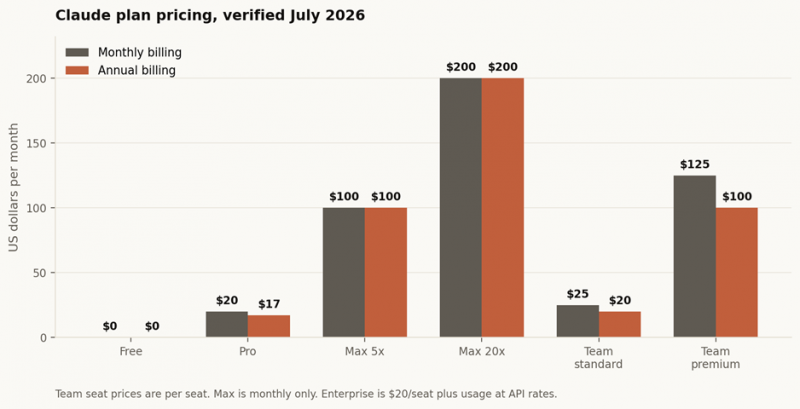
Figure 3. Monthly against annual pricing across all Claude plans, July 2026.
| PLAN | MONTHLY | ANNUAL | USAGE VS PREVIOUS TIER |
|---|---|---|---|
| Free | $0 | $0 | Baseline |
| Pro | $20 | $17/mo, $200 up front | At least 5x Free per session |
| Max 5x | $100 | Monthly only | 5x Pro |
| Max 20x | $200 | Monthly only | 20x Pro |
| Team standard | $25/seat | $20/seat | More than Pro |
| Team premium | $125/seat | $100/seat | 5x standard seat |
| Enterprise | $20/seat | Plus usage at API rates | Scales with consumption |
Two things stand out. Pro at annual billing is $17 per month, not $20, a 15% saving that only appears if you pay $200 up front. And Team standard at $20 per seat annually costs the same as Pro monthly while adding SSO, central billing, and no model training by default.
What each paid step actually unlocks
| UNLOCK | FREE | PRO | MAX | TEAM |
|---|---|---|---|---|
| Sonnet, Haiku | Yes | Yes | Yes | Yes |
| Opus | No | Yes | Yes | Yes |
| Fable | No | Usage credits | 50% weekly | Yes |
| Claude Code | No | Yes | Yes | Yes |
| Research | No | Yes | Yes | Yes |
| Cowork, Design, Science | No | Yes | Yes | Yes |
| Priority at peak traffic | No | No | Yes | No |
| SSO, central billing | No | No | No | Yes |
| Model training | Opt-out | Opt-out | Opt-out | None |
| Context window | 200K | 200K | 200K | 200K |
THE PRIVACY DIFFERENCE WORTH KNOWING
On Free, Pro, and Max, model training is opt-out, meaning it happens unless you turn it off in settings. On Team and Enterprise there is no model training on your content by default. If that distinction matters to you, it is a settings toggle on individual plans rather than something you need to pay to fix.
How Claude free tier compares
Free tiers across the three major assistants, as of July 2026. Each vendor limits a different thing, which is what makes direct comparison misleading unless you name the axis.
| DIMENSION | CLAUDE FREE | CHATGPT FREE | GEMINI FREE |
|---|---|---|---|
| Cost | $0 | $0 | $0 |
| Credit card | Not required | Not required | Not required |
| Top model included | No | No | Metered access |
| Ads | None | Yes, US | None |
| Limit style | Compute per 5 hours | Messages per 5 hours | Daily caps |
| Behaviour at cap | Wait for reset | Silent downgrade | Wait for reset |
| Relative generosity | Middle | Most restrictive | Most generous |
| Standard paid tier | $20, $17 annual | $20 | $19.99 |
| Cheapest paid entry | $17 annual | $8 Go, with ads | $4.99 |
The honest reading: Gemini free tier is the most generous on raw volume, ChatGPT is the most restrictive and the only one that shows ads, and Claude sits between them while being the only one of the three with no advertising at any tier.
THE BEHAVIOUR DIFFERENCE THAT MATTERS MOST
When you hit the cap on Claude, you wait. When you hit it on ChatGPT, the system falls back to a lighter model without announcing it, which several outlets note you can only detect by noticing answers got shallower. A hard stop is more honest than a silent downgrade, though it is also more inconvenient. Which you prefer depends on whether you would rather be blocked or quietly served something weaker.
When the free plan stops being enough
Concrete thresholds rather than general advice. Each row is a specific trigger, not a vague suggestion to upgrade.
| TRIGGER | MOVE TO | REASONING |
|---|---|---|
| Hitting the cap twice or more daily | Pro, $17 annual | At least 5x the session allowance |
| You write code in a terminal | Pro | Claude Code is paid-only, included at Pro |
| You need multi-source research | Pro | Research is paid-only |
| You work in Claude most of the day | Max 5x, $100 | Adds priority access at peak times |
| You run agents or long sessions | Max 20x, $200 | Higher output limits, 20x Pro usage |
| Two or more people, shared billing | Team, $20/seat | Same as Pro monthly, adds SSO |
| You need Opus occasionally | Stay free | Sonnet handles most work |
THE UPGRADE ADVICE THAT ACTUALLY HOLDS
Do not upgrade preemptively. The free tier now covers web search, memory, file creation, Projects, connectors, and extended thinking, which is more than most people will exhaust. Use it until the friction is real and repeated, then pay. The two clearest signals are hitting the cap daily and needing Claude Code, and both are unambiguous when they happen.
THE VERDICT
Still free, genuinely useful, and metered by compute rather than message count.
Claude free plan is not a trial and does not expire. Through early 2026 several features moved down into it rather than up out of it, including web search, memory, Projects, and file creation with code execution. The plan you get for $0 today is materially better than the one people remember from 2024.
The three real ceilings are model access, Claude Code, and usage. Opus and Fable sit behind Pro. Claude Code is paid-only. And the five-hour compute window will interrupt anyone doing sustained daily work. None of those are hidden, and none of them degrade the free experience in ways that make it feel deliberately crippled.
CASUAL OR OCCASIONAL USE
- Stay free. Under roughly ten messages a day, you will rarely meet the ceiling. Web search, memory and Projects are all included.
STUDENTS AND RESEARCHERS
- Stay free, use Projects. Upload source material once and query it repeatedly. Cached project content does not redraw against your limit.
DAILY PROFESSIONAL USE
- Pro at $17 annual. The $200 up-front payment saves 15% against monthly. Adds Opus, Claude Code, Research, and at least 5x session usage.
DEVELOPERS
- Pro minimum. Claude Code is not available free at any usage level, and it shares the same pool as chat.
ALL-DAY HEAVY USE
- Max 5x at $100. The only tier that adds priority access when traffic is high, which matters more than raw quota during peak hours.
TWO OR MORE PEOPLE
- Team at $20/seat annual. Same cost as Pro monthly, adds SSO, central billing, and no model training on your content by default.
The question in the title has a short answer and a useful one. Yes, Claude is still free. The more actionable question is whether the five-hour compute window interrupts your actual work, and the only way to learn that is to use the free plan until it stops you.
Post Comment
Share your thoughts about this article.
Be the first to post a comment!