There’s a moment common to almost every new Yodayo user: the first image appears, glowing in soft anime lighting, with linework so clean it feels hand-drawn. It’s the kind of result people used to spend days coaxing out of traditional AI models, and yet here it arrives instantly, as if summoned from a studio of tireless illustrators.
That moment is why Yodayo exploded.
But the longer someone stays on the platform, the more that initial amazement begins to collide with a quieter, more complicated truth — one that doesn’t appear in the promotional blurbs or the cheerful splash page showcasing thousands of character portraits.
Yodayo is a platform with two personalities. One of them is brilliant. The other is unstable. And the tension between the two defines everything that happens on it.
Chapter One: The Part of Yodayo That Rarely Disappoints

If you were to walk into a physical version of Yodayo’s art generator, it would feel like a dedicated anime workshop rather than a Silicon Valley lab. Everything inside it speaks the same visual language: the sharpness of shōnen character designs, the painterly softness of gacha games, the expressive exaggeration of modern digital anime art.
General-purpose AI tools often flatten stylistic differences. Yodayo, built on anime-tuned diffusion models, does the opposite. It exaggerates those differences in a way that feels intentional. That focus delivers an unusual kind of reliability: not realism, not photorealistic rendering — but fidelity to anime’s internal rules.
There is a reason creators describe the art tool as a “shortcut past the frustration curve.”
The platform doesn’t ask beginners to wrestle with samplers, CFG scales, or complex negative prompt structures. Someone else has already done the wrestling.
When people say Yodayo “understands anime,” this is what they mean: the thing it tries to do, it does well.
But that’s only half the platform.
The Model Hub Is a Bigger Part of Yodayo Than It First Appears
One reason Yodayo can produce such a wide range of visual styles is that users are not restricted to one proprietary image model.
The current Model Hub allows creators to upload checkpoints and several types of model add-ons, including LoRAs, textual inversions, and LyCORIS files. Yodayo's current documentation says uploaded model files use the .safetensors format.
Creators can also train LoRAs directly through the platform. Yodayo's training guide currently recommends roughly 20–30 training images for character LoRAs and 30–50 for concept LoRAs, while allowing up to 100 images in a training dataset.
That makes the community itself part of the image-generation infrastructure. A creator is not simply choosing between Yodayo-made styles; they can build, upload, share, and reuse models created by other members.
It also explains why two users can have very different impressions of “Yodayo image quality.” The result depends not only on Yodayo itself but also on the selected checkpoint, LoRA or Spell, prompt, sampler, generation settings, and model version.
Chapter Two: The Tavern — A World Built on Sand
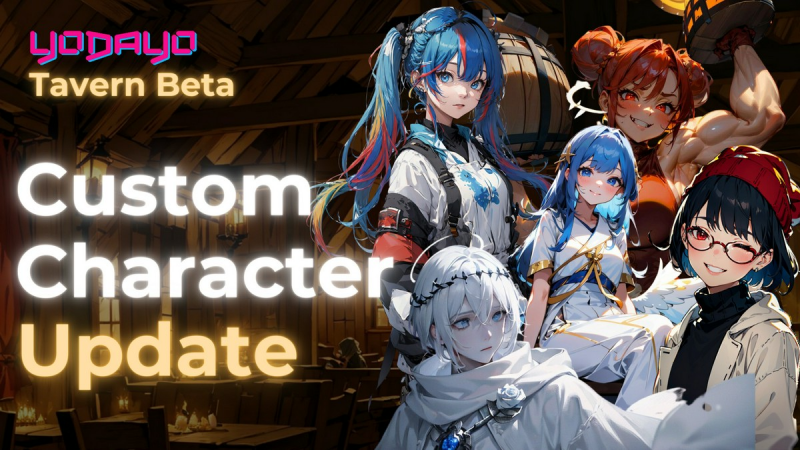
Then there’s The Tavern.
It’s marketed as a place where characters become more than drawings. A space for conversations, worldbuilding, emotional arcs, roleplay, improvisation, and story experimentation. And for many people, it begins that way.
But if the generator feels like a studio, the Tavern feels more like a stage built without a foundation.
The problem is subtle at first. A character forgets a detail. A name. A promise. A piece of lore that mattered ten messages ago. Then it happens again. And again. Eventually the user realizes the AI isn’t malfunctioning — it simply doesn’t remember.
There is no functional long-term memory holding the conversation together. Every chat is a sandcastle built too close to the tide.
Where the art generator encourages users to think bigger, the chat system punishes anyone who tries.
Yodayo never explicitly hides this limitation, but it also never foregrounds the emotional impact it can have on people who approach AI companions with expectations shaped by other platforms. Users don’t discover the limitation until the moment something breaks — and by then, they’re already invested.
The criticism above reflects the Tavern experience evaluated when this article was published. Yodayo's current product positioning has since changed in an important way.
Yodayo now explicitly advertises Tavern with “Memory” and “Reasoning” as features. It also offers Memory Box and Lorebook tools designed to improve narrative continuity.
That does not necessarily mean Tavern now possesses unlimited autonomous long-term memory.
The distinction matters.
The Memory Box is a user-controlled feature where important information can be manually written down for the character to remember. Yodayo's documentation currently says this feature is available on the web version.
Lorebooks provide a more structured retrieval system. Creators can store character information, relationships, locations, rules, events, and other worldbuilding details. Entries are activated using keywords found in the conversation.
Yodayo's documentation says a Lorebook can contain unlimited entries, but only retrieved information is placed into the active AI context. The documentation currently describes retrieval of up to roughly 4,096 characters, or approximately 1,025 tokens, at a time. Users can also adjust “scan depth,” which determines how many previous messages are searched for relevant Lorebook keywords.
So the situation is more nuanced than simply saying Tavern either “has memory” or “does not have memory.”
It now has tools specifically designed to reinforce continuity, but manual memory fields and keyword-triggered Lorebooks are technically different from an AI companion automatically remembering every meaningful event across months of conversation.
That distinction should remain important when evaluating Yodayo for long-form roleplay.
Chapter Three: The Other Elephant in the Room — Instability That Lives Behind the Curtain
Every fast-growing startup has growing pains. Yodayo’s issue isn’t that it changes; it’s how it changes.
Across 2024 and 2025, creators documented a pattern that has become part of the platform’s identity:
● Art models quietly shifting in behavior
● Credit systems being rearranged
● Chat features being restructured without framing
● Output quality fluctuating between updates
● NSFW rules tightening, loosening, then tightening again
● “Better memory” labels appearing even when memory remained unchanged
For a casual user, these shifts are minor.
For a creator using Yodayo to illustrate a game, develop a character series, or build a consistent art style, they can be catastrophic. A model update doesn’t just change an image — it can break months of visual continuity.
The lack of communication turns technical evolution into uncertainty.
Yodayo often feels like an early-access game where the developers are sprinting to the next feature faster than they can document the last one.
Yodayo's Own Terms Explicitly Warn Against Depending on Platform Stability
There is an unusually relevant detail in Yodayo's Terms of Service.
The company states that its services are continuously evolving and may change in areas including the art style of generated assets, generation algorithms, and available features. It also says it makes no guarantees concerning service quality, stability, uptime, or reliability.
More importantly for professional creators, the Terms explicitly tell users not to create dependencies on particular attributes of the service or its generated assets.
That language does not prove that Yodayo is unusually unreliable compared with competitors; AI platforms routinely reserve broad rights to change their products.
But it does reinforce a practical point raised throughout this review.
If a creator is producing a commercial game, comic, visual novel, character library, or long-running visual series, saving prompts and finished files is not enough. They should also document the exact checkpoint, model version, LoRAs, generation parameters, seeds, and any other settings needed to recreate the workflow elsewhere.
Yodayo's own Terms acknowledge that the platform itself may change.
Chapter Four: The Community That Became Yodayo’s Real Operating System
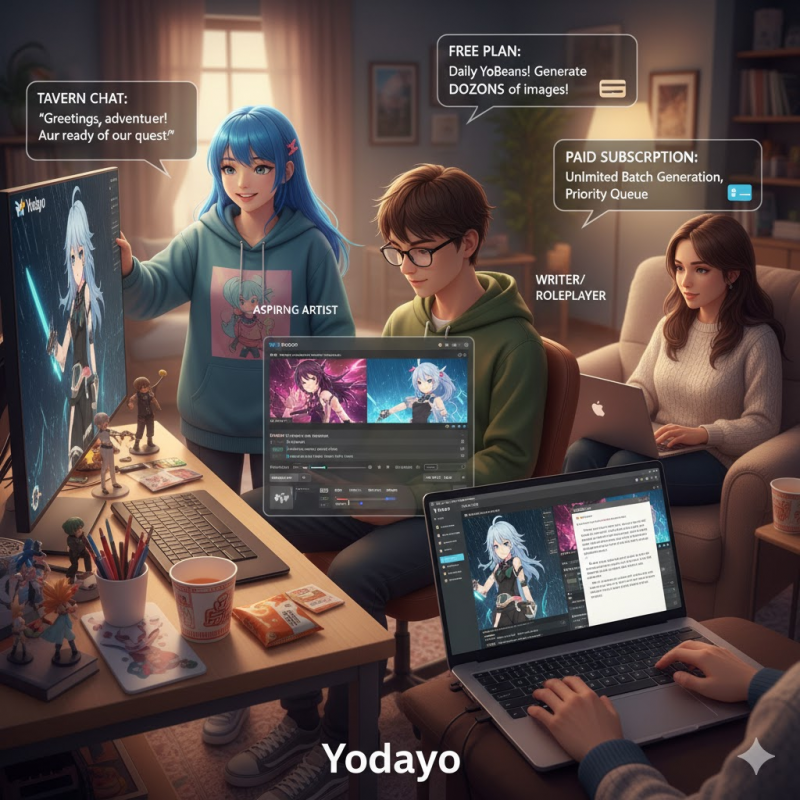
Yet here is the paradox: despite the instability, Yodayo’s community remains one of the most creative, generous, and resilient groups in the AI art space.
Every artwork includes its own blueprint:
● prompts
● negatives
● model versions
● resolution settings
● LoRA attachments
This transparency creates an ecosystem where learning is communal and talent compounds. Users don’t hoard knowledge — they publish it.
The result is a strange phenomenon: the platform feels more stable because the community is. Users teach each other what the documentation doesn’t explain. They build tutorials Yodayo never wrote. They turn every post into a lesson.
In many ways, the community runs the platform while the platform runs behind the community trying to catch up.
It’s the closest thing AI art has to an apprenticeship culture, and it’s arguably Yodayo’s greatest long-term asset.
The Community Is Now Part of the Toolset, Not Just the Social Layer
The community's role has become even more structural.
Yodayo currently advertises a Discord community of more than 40,000 members and a Model Hub containing more than 105,000 models and Spells. Again, both figures are company-reported rather than independently audited.
Lorebooks have also become shareable community assets. Yodayo's Lorebook Hub allows users to publish Lorebooks publicly, let others add them to characters or chats, or keep them private.
This means users can now share not only finished art and prompts, but also reusable pieces of narrative infrastructure: character histories, fictional universes, behavioral rules, relationships, locations, and other structured information used by Tavern.
That reinforces one of the central arguments of this review: Yodayo's community is not merely consuming the platform. In many cases, users are building pieces of the experience that other users then depend on.
Chapter Five: The Question No One Likes Asking — What Happens If You Depend on Yodayo?
| What Users Come For | Does Yodayo Deliver? | Why It Matters |
| Predictable art workflows | ✔️ Yes | The anime generator is stable, consistent, and well-tuned. |
| Collaborative prompt evolution | ✔️ Yes | The community shares full prompts, making iteration easy. |
| Anime-specific creative tools | ✔️ Yes | Yodayo shines when users want anime and only anime. |
| Emotional continuity in chat | ✖️ No | The Tavern has no true long-term memory. Storylines collapse over time. |
| Evolving personalities or relationships | ✖️ No | Characters revert to defaults once the context window fills up. |
| Long, immersive roleplay arcs | ✖️ No | Chat resets break narrative flow, especially for multi-session RPs. |
| Companions that remember past interactions | ✖️ No | The system lacks retrieval-based memory, making long-term bonding impossible. |
What Yodayo's Content Rules Currently Say
Because Yodayo's moderation rules changed repeatedly during its earlier history, it is useful to distinguish historical community complaints from the policy currently published by the platform.
As of this update, Yodayo's Content Policy uses three visible content classifications: PG, PG-13, and R.
The policy says R-rated material can include revealing clothing, violence, and gore, and users can choose to view sensitive material. However, sexually explicit material is currently prohibited for generation and publication.
Yodayo says moderation combines automated AI classification with human review. Content flagged by the automated system can be reviewed by staff, and users are given an appeal process for moderation decisions.
The platform also specifically prohibits suggestive depictions of minors, explicit content involving minors, certain non-consensual sexual material, celebrity deepfakes, and several other categories of prohibited material.
Yodayo Is Currently an 18+ Platform
Yodayo's current Terms state that users must be over 18, and its account onboarding screen requires users to confirm that they are at least 18 years old before continuing.
That requirement is worth making explicit because anime-focused AI platforms can naturally attract younger fandom communities.
Regardless of whether the content being generated is PG, PG-13, or R-rated, Yodayo's present platform-access rule is 18+.
Final Chapter: So What Is Yodayo, Really?
Yodayo is ultimately a tool that performs beautifully in the moments when creativity is visual, immediate, and experimental. Its strengths appear in short bursts of inspiration, in iterative idea testing, and in the kind of artistic play that thrives on visual feedback rather than long-term structure. Where it consistently struggles is in the parts of creativity that depend on continuity, emotional persistence, or narrative stability. The platform handles single moments well, but it cannot reliably carry those moments into a coherent story over time.
Its best qualities come from its focus. Yodayo’s anime art engine succeeds because it chooses a narrow lane and commits to it fully. Its weakest qualities come from ambition. The Tavern attempts to build interactive worlds, evolving characters, and emotional bonds on top of technical foundations that simply are not developed enough to support them. This is not a failure of concept, only a limitation of the system as it currently exists.
Many platforms collapse because they aim too small or innovate too slowly. Yodayo faces a different risk. It tries to deliver multiple complex experiences at once, and in doing so, some parts of the platform outpace the technology that is meant to sustain them. The result is a tool that impresses immediately but cannot always uphold its deeper promises.
The honest conclusion is clear. Yodayo stands among the most capable anime art platforms available today, and for visual creativity it offers remarkable value. But it is not yet a dependable system for worldbuilding, and it is not a platform suited for users who expect emotional consistency or long-term character memory from an AI companion. It shines when used as a creative instrument, not as a narrative foundation.
Use it to explore ideas. Use it to learn new techniques. Use it to experiment without friction. Just do not rely on it to remember the stories you want it to help you tell.
Post Comment
Share your thoughts about this article.
Be the first to post a comment!