If you are prepping for exams in 2026, you have probably run into both Gizmo AI and StudyFetch. Both promise the same thing at a glance: feed them your notes, slides, or lecture videos, and get back study material that helps you remember the content. Both are popular, both are well rated, and both want your subscription. So which one earns it when there is a real exam on the line?
I went through both in detail. I compared their features, their pricing, the cognitive science they lean on, and what thousands of students are saying on the App Store, Google Play, and Trustpilot. The short version is that these two are built around different ideas of what a study app is for. One is a memory machine wrapped in a game. The other is an all in one tutor that turns your course into a full study toolkit. The right pick depends on how you study and what kind of exam you are facing.
Here is the full, section by section breakdown, with the numbers where they matter, where each app wins, where it falls short, and my own pick at the end. No hype, just a clear look at both.
The 30 second version
Here is the quick side by side before we get into the detail.
| What we are comparing | Gizmo AI | StudyFetch |
|---|---|---|
| Core idea | AI flashcards and quizzes with spaced repetition | All in one study suite built around an AI tutor |
| Best known for | Fast flashcards and gamified daily review | Spark.E, a tutor grounded in your own materials |
| Founded and scale | Around 2021 by Cambridge alumni, about 13M users | 2023 by Ryan Trattner and Esan Durrani, 6 to 7M users |
| Source formats | PDFs, YouTube, notes, audio, photos, Quizlet, Anki | PDFs, slides, Word, video, audio, photos, Canvas |
| AI tutor | Yes, explains answers and concepts | Yes, voice and chat, answers from your files |
| Flashcards | Core strength, auto generated | Yes, plus auto generated notes |
| Quizzes and tests | Gamified quizzes | Quizzes plus exam style practice tests |
| Spaced repetition | Built in and central | Included in the flashcard system |
| Live lecture capture | Record and transcribe lectures | Yes, real time notes during class |
| Standout extras | Streaks, leaderboards, study games | Audio recaps, video explainers, image analysis, essay grader |
| Gamification | Heavy, a core hook | Lighter, mainly Arcade mode |
| Languages | Mainly English | 20+ languages |
| Platforms | Web, iOS, Android | Web, iOS, Android (Android can be buggier) |
| Free tier | Daily lives and limited quizzes | Very limited, a few uploads and chats |
| Entry price | About $9 / month or roughly $50 / year | About $5 to $8 / month on annual billing |
| App store ratings | 4.8 App Store, about 4.7 Google Play | 4.8 App Store, 4.5 Google Play |
| Best for | Memorizing and building a daily habit | Understanding a course and exam practice |
Prices and features in this space change often, so treat these as a snapshot and confirm the current details on each site.
What each tool is built for
It helps to understand the core idea behind each app, because that shapes everything else.
Gizmo AI
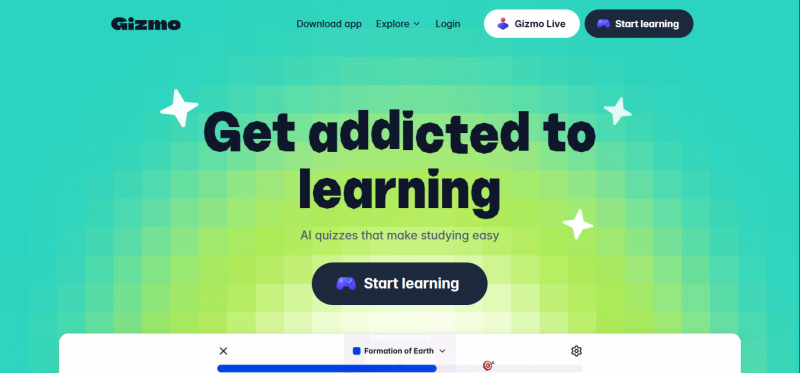
Gizmo AI is, at heart, an AI flashcard and quiz app built on memory science. You feed it a PDF, a YouTube link, a photo of your notes, or an existing Quizlet or Anki deck, and it turns that into flashcards and quizzes in seconds. Then it uses spaced repetition and active recall to drip those questions back to you at the moments you are most likely to forget them. The twist is heavy gamification: lives, streaks, leaderboards, and study games that make daily practice feel less like a chore. Founded around 2021 by a group of Cambridge University alumni, it has grown to roughly 13 million users and raised north of 20 million dollars, and it is squarely aimed at students who need to memorize a lot and keep showing up.
StudyFetch
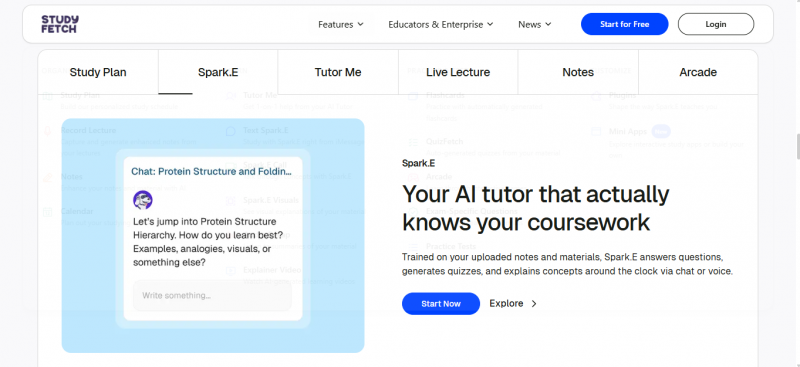
StudyFetch is an all-in-one study platform built around an AI tutor named Spark.E, shown as a friendly white dog. You upload your course materials, and StudyFetch turns them into notes, flashcards, quizzes, and full practice tests, while Spark.E answers questions about that specific content rather than the open internet. Many StudyFetch Review looks at how it folds in live lecture recording, audio recaps, video explainers, an image analyzer for diagrams, and an essay grader. Founded in 2023 by Ryan Trattner and Esan Durrani, it reports six to seven million students and raised an 11.5 million dollar Series A led by Owl Ventures, with the College Board taking part. It is aimed at students who want one place to understand a course and prepare for the test.
Turning your material into study sets
The first job either app has to nail is taking your messy source material and giving you something useful back.
Gizmo AI is fast and flexible here. It handles PDFs, YouTube videos, typed and handwritten notes, audio recordings, and imports from Quizlet and Anki, and it can scan a photo of your notes and produce a deck in seconds. There is also a library of more than a million public decks, so for common subjects half the work may already be done. The main friction shows up with very long inputs, where 50 page PDFs or long lecture transcripts can take longer or occasionally stall, so breaking big files into chunks helps.
StudyFetch accepts a similarly wide range, including PDFs, PowerPoint, Word docs, YouTube links, audio, photos of handwriting, and Canvas imports, and it processes lecture videos up to about an hour. StudyFetch says it builds a full study set in around 48 seconds on average. The difference is less about formats and more about what comes out, since StudyFetch aims to generate a whole toolkit, including structured notes and practice tests, not just flashcards. So both ingest almost anything you throw at them, with Gizmo leaning toward quick flashcards and StudyFetch toward a broader set of study materials from one upload.
The AI tutor and understanding
When you are stuck on a concept, the tutor is where these apps either help or frustrate.
StudyFetch's Spark.E is the headline feature, and it is the stronger tutor of the two. Because it is grounded in your uploaded materials, it answers questions based on what your professor taught rather than generic internet knowledge, and it works over chat or voice, around the clock, in more than 20 languages. StudyFetch reports that explanations are the most common use of Spark.E by far, which fits a tool designed for understanding rather than shortcuts.
Gizmo AI also has an AI tutor, and it is useful for the moment you get a question wrong and want to know why. It explains concepts and can help with homework, and for medium difficulty topics in subjects like biology or social studies it usually does the job. For very advanced or nuanced material, the explanations can oversimplify. So if a deep, conversational tutor that knows your course is the priority, StudyFetch has the clear edge, while Gizmo's tutor is a helpful sidekick to its flashcards rather than the main event.
Practice, quizzes, and exam readiness
Since the whole question here is about exams, how each app helps you practice under pressure matters a lot.
StudyFetch is built more directly for test prep. Alongside quizzes, it generates exam style practice tests drawn from your material, lets you choose question types and counts, and gives immediate feedback so you can see what you still miss. Reviewers who tested it call the practice tests one of its most practical features for real exam preparation. Add the study plan and calendar, which break your material into milestones around your deadlines, and it starts to feel like a guided run up to test day.
Gizmo AI focuses on quizzing through its flashcard and lives system. The quizzes feel like mini exams and give quick feedback on weak spots, which is great for drilling recall, but it leans lighter on full, timed mock tests. So for structured, exam style practice, StudyFetch is the more complete option, while Gizmo is excellent for the rapid fire recall drilling that underpins it.
Memory and long term retention
Passing an exam is really about what you can recall under pressure, which is where memory technique comes in.
Gizmo AI puts spaced repetition and active recall at the center of the product. It schedules each card based on how well you know it, showing tricky cards more often and easy ones less, which mirrors how memory works and is built for long term retention over weeks and months. It is not perfect, and some power users feel the intervals can be too aggressive, occasionally pushing a card a month out after a few correct answers, which is less finely tuned than a tool like Anki. Even so, for daily, science backed review, it is a strong fit.
StudyFetch also includes spaced repetition in its flashcards and adjusts review timing based on your performance, but retention technique is one feature among many rather than the beating heart of the app. So if long term memorization is your single biggest need, Gizmo is built around it more tightly, while StudyFetch treats it as part of a wider toolkit.
Staying motivated
The best study app is the one you will open in the first place, so motivation design counts.
This is Gizmo AI's signature move. Streaks, a lives system, leaderboards, friend challenges, and study games turn revision into something closer to a mobile game, and a lot of students say that loop is what gets them to start a session when they are tired. The flip side is that the lives system can interrupt you at the worst moment, locking you out for about ten minutes when you run out on the free plan, and heavy gamification is not for everyone.
StudyFetch leans on engagement too, mainly through Arcade mode, which turns notes and flashcards into interactive games, but its motivation mechanics are lighter and not the core pitch. So if you struggle to stay consistent and a game like push helps, Gizmo is built for you, while StudyFetch assumes you are already driven by the goal of understanding the material.
Accuracy and trust
This is the part that matters most for exams and gets the least attention: can you trust what the AI gives you?
Both apps share the same limitation. AI generated study material is excellent for clean, text heavy subjects, but it gets less reliable with technical notation and visual content. StudyFetch reviewers report errors in math equations, chemistry notation, and medical terminology, and weaker reading of complex diagrams like anatomy or circuit schematics, so its image analysis is best double checked. Gizmo's cards can likewise lack clinical or contextual depth, and medical students in particular often edit cards before relying on them.
The takeaway is the same for both. Treat the AI output as a strong first draft, not gospel, and review what it generates before you study from it, because a confidently wrong flashcard is worse than none at all. For text based courses, both are reliable. For proof based math, organic chemistry, or anatomy, plan to verify.
Pricing and value
Both are freemium, and in both cases the free tier is more of a demo than a daily driver.
Gizmo AI's free plan gives you a set of daily lives, around fifteen, plus a limited number of AI quizzes per day, with lives refilling every ten minutes. Premium removes those limits for roughly 9 dollars a month or about 50 dollars a year, and there are student discounts that can cut the price meaningfully, though some plans are billed weekly at a higher effective rate. If you study daily during an exam season, the yearly plan is good value, while for occasional use the weekly option adds up fast.
StudyFetch's free tier is tighter, with only a couple of uploads and a handful of tutor chats, which is barely enough to evaluate it. Its Base plan runs about 5 dollars a month on an annual plan, and Premium about 8 dollars a month annually, with higher month to month pricing and a short free trial. For a full semester across several courses, that is reasonable for an all in one tool. The shared caution, and the single most common complaint about StudyFetch across review sites, is billing: auto renewal and cancellation trip people up, so set a reminder if you start a trial.
Platforms and access
Where you can study matters when revision happens on the bus as much as at a desk. Both apps offer web, iOS, and Android, so you can move between phone and laptop. The practical difference is polish on Android. StudyFetch's Android app draws more complaints than its iOS version, with reports of study sets not saving and occasional sync issues, while Gizmo's mobile apps are widely used and generally smooth, though some users hit loading or login glitches after updates. Neither has a strong offline mode, so a shaky connection on exam morning can be a problem for both. Access is broadly even, with a slight edge to Gizmo for consistent mobile performance.
What real users say
Feature lists matter less than whether students keep using these apps, so here is what the numbers say.
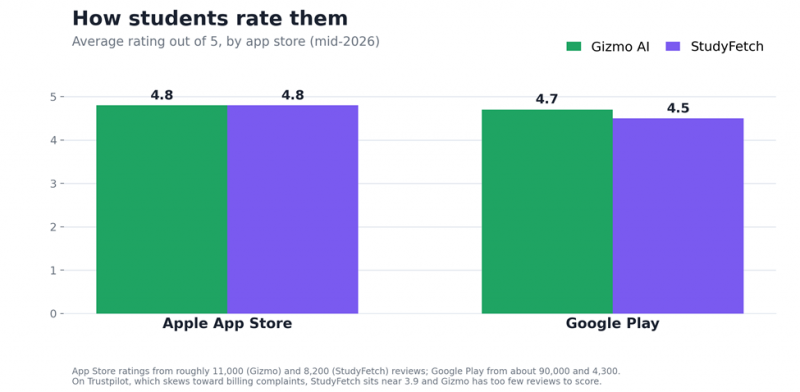
App store ratings for both, with review counts and Trustpilot context noted below the bars.
On the app stores, both are loved. Gizmo AI holds about 4.8 on the Apple App Store from roughly 11,000 ratings and around 4.7 on Google Play from a much larger base of about 90,000 ratings, which also tells you it has a big, active mobile following. StudyFetch matches it at 4.8 on the App Store from about 8,200 ratings and sits at 4.5 on Google Play from roughly 4,300. The praise is similar for both: large time savings, quick conversion of material into study tools, and, for StudyFetch, the context aware tutor.
Trustpilot tells a more critical story, as it tends to for subscription apps. StudyFetch sits around 3.9 there across a few hundred reviews, with most of the negative ones pointing at billing and cancellation rather than the studying itself. Gizmo has too few Trustpilot reviews to carry a meaningful score, but its app store reviews include the same billing gripe, with some users frustrated about unsubscribing. The pattern is familiar: students like using both, and the friction, when it appears, is about money and cancellation, not learning.
Where each one pulls ahead
To pull it together, here is the quick tale of the tape.
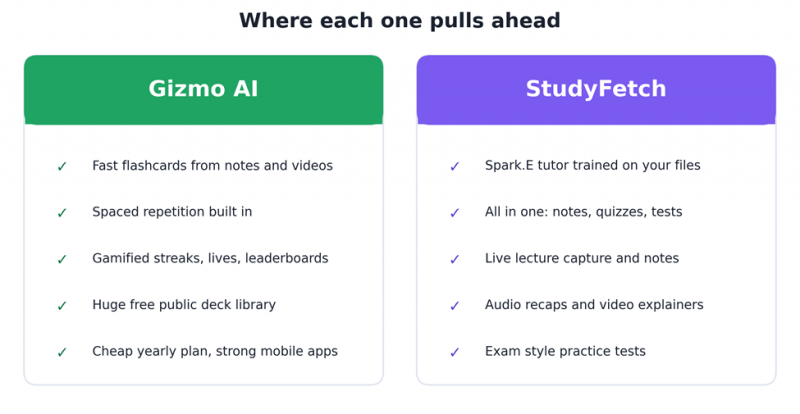
A quick look at where each tool leads.
Gizmo AI pulls ahead on fast flashcard generation, spaced repetition built into the core, gamification that keeps you studying daily, a giant library of free public decks, and a cheap yearly plan with strong mobile apps. StudyFetch pulls ahead on its Spark.E tutor grounded in your own materials, an all in one toolkit that includes notes and exam style practice tests, live lecture capture, multiple learning formats like audio recaps and video explainers, and broader language support.
Where each tool falls short
No app is all upside, so here is the other side of the ledger.
Gizmo AI comes up short on:
• A free tier whose lives system locks you out at the worst moments.
• A lighter AI tutor and fewer full, exam style practice tests.
• AI cards that can lack depth in technical or clinical subjects.
• Weekly billing that gets expensive if you are not on the yearly plan.
StudyFetch has its own rough edges:
• A very restrictive free tier that is hard to evaluate properly.
• Accuracy that slips on math, chemistry, and complex diagrams.
• An Android app that is buggier than the iOS version.
• Billing and cancellation complaints that show up across review sites.
Which one should you choose?
Strip it back and the choice comes down to how you study and what you are sitting.
Go with Gizmo AI if your exam is mostly about memorization, if you respond well to gamified daily habits and streaks, if you want flashcards and recall drilling above all, and if you want a low yearly price and a polished phone app.
Go with StudyFetch if you want help understanding a course as well as memorizing it, if you value a tutor that knows your materials, if exam style practice tests and live lecture notes matter, and if you want one platform to handle everything from notes to test prep.
My final verdict
So which one would I reach for before an exam? Here is where I land.
Neither app is a magic shortcut, and the data backs that up. Students rate both around 4.5 to 4.8 on the app stores, and the loudest complaints about each are about billing, not learning. The real answer is that they are not the same tool, so the better question is which one matches the way you study.
If I were cramming facts, vocabulary, dates, formulas, definitions, anything that lives or dies on recall, I would reach for Gizmo AI. Its spaced repetition is the tighter, more focused engine, and the gamified loop is the thing that would get me to study every day, which is usually the real battle. For a memory heavy exam, that combination is hard to beat at the price.
But if I were trying to understand a dense course and walk in ready for the exam, not just memorize it, I would lean toward StudyFetch. Spark.E answering questions from my own lecture slides, plus exam style practice tests and lecture capture, adds up to a more complete prep system. It does more, and for conceptual subjects that depth matters.
My one line take: pick Gizmo AI to memorize and stay consistent, and pick StudyFetch to understand a course and practice for the test. Whatever you choose, do two things. Start on the free tier to see if the workflow fits, and always double check the AI generated cards and answers before you trust them on exam day, because the tool that helps you most is the one whose output you can rely on. That is the test that matters more than any rating.
Post Comment
Share your thoughts about this article.
Be the first to post a comment!