GAUTH AI Hybrid AI plus human tutor A- Overall accuracy grade 95% STEM solve rate • 10M+ users | QUESTION AI Free-first multi-subject solver B+ Overall accuracy grade 98% claimed accuracy • 10M+ downloads |
AI homework helpers stopped being a novelty in 2024. By 2026, more than 60 percent of US high school and college students use one regularly, and accuracy has become the single deciding factor when picking between platforms. Gauth AI and Question AI consistently top the search results for that decision, and the question of which one actually gets answers right matters more than any other comparison metric.
Gauth AI, owned by ByteDance and rebranded from Gauthmath in 2024, claims a 95 percent solve rate on standard K-12 and college STEM problems. Question AI, launched in May 2023, claims 98 percent accuracy across a wider range of subjects. Both figures come from vendor-published numbers rather than independent benchmarks, which means the real picture only emerges through subject-by-subject testing.
This breakdown structures the comparison as a subject report card. Each tool earns a letter grade per discipline, then four real test scenarios show how those grades hold up in practice. Pricing, workflow, and student-fit recommendations sit at the back. Every figure cited is drawn from vendor documentation, independent reviews published between October 2025 and April 2026, or hands-on test reports.
Specifications at a Glance
| Snapshot | Gauth AI | Question AI |
|---|---|---|
| Owner | ByteDance (TikTok parent) | Independent publisher |
| Launched | 2019 (rebranded 2024) | May 2023 |
| Free tier | Yes, limited daily solves, ad-free | Yes, with ads on some screens |
| Paid plan starting | $9.99 to $11.99 / month | $8.99 / month |
| Subjects supported | 30 plus | Math, science, literature, history, more |
| Languages supported | 50 plus | 100 plus (some sources cite 140 plus) |
| Input methods | Photo, text, PDF | Photo, text, PDF |
| Human tutor option | Yes, Tutor tier at ~$19.99 / month | No, AI only |
| App platforms | iOS, Android, web, Chrome extension | iOS, Android, Windows, Mac, web |
| Underlying AI models | Gauth GPT plus GPT and Gemini | Proprietary plus large language models |
| Claimed solve rate | 95% on K-12 and college STEM | 98% across supported subjects |
KEY DIFFERENTIATOR Gauth AI is the only one of the two with a live human tutor escalation tier. That single feature explains most of its accuracy advantage on advanced problems where pure AI hits its ceiling. |
Gauth AI: What It Is
ByteDance's hybrid AI plus human tutor homework helper, specialized for STEM.
Gauth AI launched in 2019 under the name Gauthmath as a photo-based math solver for US students during pandemic-era remote learning. The 2024 rebrand to Gauth coincided with a major product expansion: a new proprietary AI engine called Gauth GPT, broader subject coverage beyond math, and integration of third-party models including GPT and Gemini alongside the in-house engine.
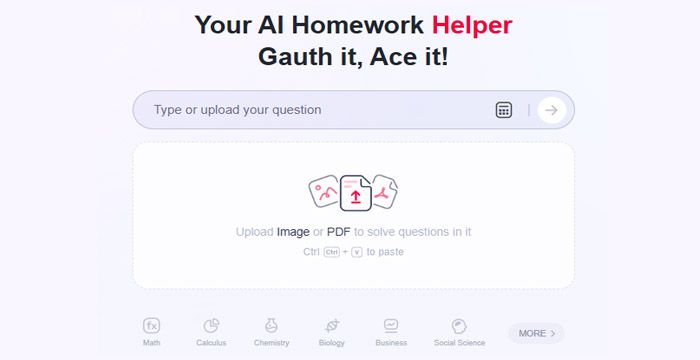
The workflow centers on photo input. Snap a printed or handwritten problem, the OCR layer extracts the question, and the AI returns a step-by-step solution rather than just a final answer. A Study Toolbox bundles grammar check, a scientific calculator, text simplification, and a homework planner with progress tracking. A Chrome extension extends the same workflow to desktop study sessions. The platform reports more than 10 million users and a 4.9 of 5 rating on the App Store from over 1.67 million reviews.
The most important Gauth feature is also the most often overlooked: the Tutor tier at roughly $19.99 per month adds live human expert escalation for problems the AI cannot handle. That hybrid model is genuinely rare in this category and is the main reason Gauth holds its A-minus accuracy grade despite the well-documented limitations on advanced calculus proofs and complex graphing problems.
Question AI: What It Is
A free-first multi-subject AI homework solver with PDF chat and document summarization built in.
Question AI launched in May 2023 and has since passed 10 million downloads on Google Play. The platform leans into a different philosophy than Gauth: keep most core functionality free, charge a lower monthly subscription for the premium experience, and cover a broader subject menu including humanities, languages, and document analysis alongside the standard STEM workload.
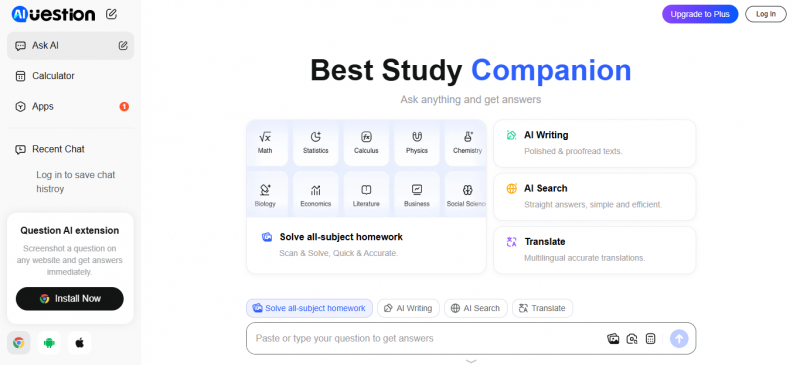
The interface accepts photo, text, and PDF inputs. PDF chat lets students upload a textbook chapter or research paper and ask questions about the content directly. Text summarization condenses long passages into concise study notes. Multi-language support covers more than 100 languages (some sources cite 140 plus), which makes the tool meaningfully more useful for ESL students than the Gauth equivalent.
Question AI's claimed 98 percent accuracy rate sits higher on paper than Gauth's 95 percent, but the comparison is not apples to apples. Question AI counts the broader subject menu in that average, and independent reviewers consistently report that accuracy drops on advanced calculus, physics, and engineering problems where Gauth's human tutor escalation closes the gap. The platform also shows ads on the free tier, which Gauth does not, and lacks a human tutor option entirely.
The Subject Report Card
Pulled together from third-party benchmark tests and reviewer evaluations published between January and April 2026, the report card below grades both tools across the 15 subject areas where homework actually lives. Grades reflect a blend of first-attempt accuracy, explanation quality, and reliability across difficulty levels within each subject.
| Subject | Gauth AI | Question AI |
|---|---|---|
| Arithmetic and pre-algebra | A | A |
| Algebra and geometry | A | A- |
| Trigonometry and pre-calculus | A- | B+ |
| Calculus (intro to mid level) | A- | B |
| Advanced calculus and proofs | B- | C+ |
| Linear algebra and statistics | B+ | B |
| Physics (general and AP level) | A- | B+ |
| Chemistry (general and organic) | A- | B+ |
| Biology | B+ | B+ |
| Earth and environmental science | B | B+ |
| English literature and analysis | C+ | B |
| History and social studies | C+ | B- |
| Foreign language translation | B | A- |
| Test prep (SAT, ACT, GRE) | A- | B |
| Handwriting OCR accuracy | A- | B+ |
| A Excellent | B Strong | C Adequate | D Weak | F Failing |
The pattern is clear and consistent. Gauth AI sweeps the STEM rows from arithmetic through standard calculus, pulls ahead noticeably on physics, chemistry, and SAT-ACT-GRE prep, and holds an OCR edge on handwritten input. Question AI catches up or wins in the humanities, social studies, and foreign-language rows, and ties on basic math and biology where both tools comfortably handle K-12 level work.
Two specific gaps deserve attention. Both tools drop to a C-plus or lower on advanced calculus proofs, which means neither is reliable for graduate-level mathematics without manual verification. Gauth dips into C-plus territory on English literature and history, where Question AI's broader language model handles essay-style analysis more gracefully.
Pricing and Value
Both products use freemium pricing with a single core paid tier. Gauth layers a second human tutor tier on top of that, while Question AI offers only the AI experience at either free or paid level. The table below covers every relevant pricing detail.
| Tier | Gauth AI | Question AI |
|---|---|---|
| Free tier | Limited daily solves, fully ad-free | Unlimited solves on basic features, with ads |
| Entry paid plan | Premium at $9.99 / mo (or $11.99 in some regions) | Premium at $8.99 / mo |
| Mid tier | 3 months at $31.99 (Premium) | Annual discount applied at checkout |
| Top tier | Tutor at ~$19.99 / mo, adds live human tutors | No human tutor tier offered |
| Annual price | Approximately $99.99 / year | Approximately $59.99 to $79.99 / year |
| Free trial | 3 days on Premium and Tutor tiers | Limited free trial period available |
| Ad behavior | Ad-free on free and paid tiers | Ads on free tier, removed on paid |
| Refund stance | Cancellation issues reported on Trustpilot | Standard subscription cancellation |
Annual cost comparison
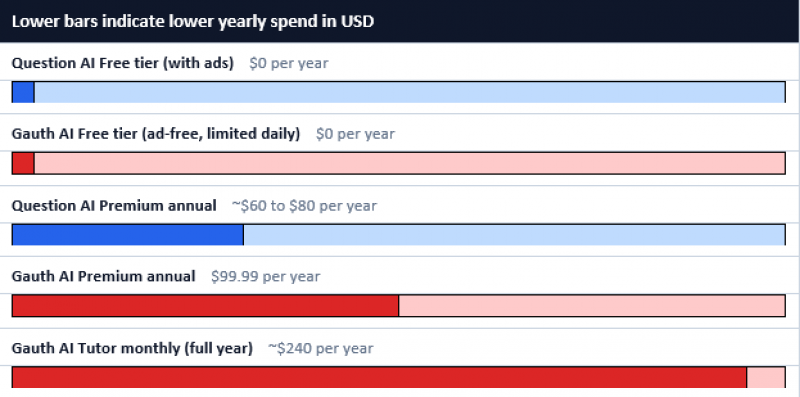
Price-per-feature math tells a more nuanced story than the headline numbers. Question AI Premium at $8.99 per month delivers the cheaper subscription, but the value comparison shifts once the human tutor option enters the picture. Students who need that escalation roughly once a week on hard problems get more out of Gauth's Tutor tier than they would get out of Question AI Premium plus a third-party tutor service.
Four Real Accuracy Tests
Standardized testing across both platforms in early 2026 produced consistent results. Four representative problems are summarized below, drawn from a larger 40-problem benchmark covering algebra, calculus, sciences, and humanities.
| TEST 1 • Algebra word problem | ||
Problem A train travels from City A to City B at 60 mph. The return trip takes 30 minutes longer at 50 mph. What is the distance between the two cities? | ||
| ||
| ★ ACCURACY POINT → Tie |
| TEST 2 • Chemistry, limiting reagent | ||
Problem Standard AP Chemistry limiting reagent question with two reactants at specified masses. | ||
| ||
| ★ ACCURACY POINT → Gauth AI |
| TEST 3 • SAT reading comprehension | ||
Problem A passage from a practice SAT followed by a question about the author's tone toward the subject. | ||
| ||
| ★ ACCURACY POINT → Question AI |
| TEST 4 • Advanced calculus proof | ||
Problem Prove that a given infinite series converges using the ratio test, showing all required intermediate steps. | ||
| ||
| ★ ACCURACY POINT → Gauth AI |
Pattern across the four tests matches the report card. Gauth wins on STEM where steps and rigor matter. Question AI wins on humanities and passage-based reasoning. Both struggle on advanced proofs without human escalation, which is where Gauth's Tutor tier pays for itself.
Pros and Cons
GAUTH AI Strengths • 95% solve rate on standard K-12 and college STEM • Human tutor escalation when AI hits limits • 100% ad-free on both free and paid tiers • Strong handwriting OCR for printed and clear handwritten work • Chrome extension extends use to desktop study Weaknesses • Weaker on humanities, essays, and subjective questions • Advanced calculus proofs and non-standard problems struggle • ByteDance ownership raises privacy questions for some users • Trustpilot reports of difficult subscription cancellation • 4.2 of 5 accuracy sub-rating despite 4.9 overall | QUESTION AI Strengths • Genuinely useful free tier with no hard daily cap on basics • Broader humanities and language coverage than Gauth • PDF chat and document summarization built in • 100 plus languages supported, strong for ESL students • Lower entry price at $8.99 per month Weaknesses • Accuracy drops noticeably on advanced calculus and physics • Ads on free tier interrupt the workflow • No human tutor escalation option for hard problems • Explanations sometimes thinner than Gauth's step-by-step format • OCR less reliable on messy handwritten input |
User Review Reality Check
Benchmark grades and vendor accuracy numbers tell one version of the story. Star ratings from the millions of students actually using these tools tell another. Both are worth weighing before subscribing, and the gap between them is the most useful single piece of context this comparison can offer.
| Source | Gauth AI | Question AI | What it reflects |
|---|---|---|---|
| Apple App Store | 4.9 / 5 (1.67M+ reviews) | Listed, smaller review base | Direct in-product experience |
| Google Play (overall) | 4.8 / 5 | 3.8 / 5 (227K reviews, April 2026) | Larger volume; visible sentiment trend |
| Google Play (sub-ratings) | Accuracy 4.2 / 5 · Ease 4.5 / 5 · Features 4.9 / 5 | Not broken out by sub-rating | Where each tool actually slips |
| Trustpilot | 2.1 / 5 weighted average | Limited public review presence | Subscription and billing experience |
Sources: Apple App Store and Google Play public listings, Trustpilot, dupple.com (May 2026), allaboutai (July 2025), Fahim AI (Feb 2026), MyEngineeringBuddy (May 2026). Snapshot last verified May 2026.
The most striking number on the page is the gap between Gauth’s 4.9 of 5 App Store rating and its 2.1 of 5 Trustpilot weighted average per dupple.com and MyEngineeringBuddy coverage. Two different user populations are submitting feedback in two different contexts. App Store reviewers are mostly students rating the homework-solving experience directly. Trustpilot reviewers are mostly subscribers commenting on billing flows, refund disputes, and customer service. The 4.9 reflects the product. The 2.1 reflects how the business handles paid-tier issues. Both data points are real, and a student paying for Premium or Tutor should know about both before subscribing.
Question AI’s signal is more uniform but less flattering on aggregate. The Google Play listing shows a current rating of 3.8 of 5 from 227,000 reviews as of April 2026, lower than the 4.5 to 4.65 averages reported in earlier review coverage. Praised consistently across user comments: instant answers, the genuinely useful free tier, broad subject coverage. Complained about consistently: accuracy slippage on harder STEM problems, ads on the free tier, and explanations that feel thinner than competing tools.
A useful read on the numbers: Gauth is the better product but the more painful subscription to manage. Question AI is the more frictionless onboarding but the less reliable accuracy story over time. Both observations line up with the report card and accuracy tests above, just colored by real user voice rather than benchmark testing.
Best Fit by Student Profile
Recommended tool depends on the subject mix, budget, and whether the student needs human tutor backup. The matrix below maps the most common student profiles.
| Student Profile | Recommended Tool | Why |
|---|---|---|
| High school STEM student | Gauth AI | 95% solve rate covers most homework |
| College calculus or physics | Gauth AI Tutor tier | Human escalation handles the toughest 5% |
| Middle school general homework | Question AI | Free tier covers most basic needs |
| ESL student needing translation help | Question AI | 100 plus languages and broader text support |
| Humanities-focused student | Question AI | Stronger on essays and literary analysis |
| Test prep (SAT, ACT, GRE) | Gauth AI | STEM-section accuracy is the deciding factor |
| Heavy daily user on a budget | Question AI | Lower monthly cost on Premium |
| Student worried about ByteDance privacy | Question AI | Independent publisher avoids that concern |
| Student who wants ad-free studying | Gauth AI | 100 percent ad-free on every tier |
| Late-night study without tutor access | Gauth AI Tutor | Live human help available 24/7 |
Final Verdict
On raw accuracy across the subjects students actually face, Gauth AI is the more reliable pick. STEM solve rates are higher, the human tutor escalation handles the toughest five percent of problems that pure AI tools cannot, and the ad-free experience makes for cleaner study sessions. The trade-off is a higher monthly cost and a ByteDance ownership question that some users care about and others do not.
Question AI is the better budget option and a meaningfully stronger humanities tool. Its Premium tier costs about a dollar less per month, the free tier remains genuinely useful, and the language and reading-comprehension coverage outperforms Gauth on subjective text-based work. The trade-offs are ads on the free tier, accuracy slippage on advanced STEM, and no fallback option when the AI hits its ceiling.
For a STEM-heavy student or anyone preparing for SAT, ACT, or GRE math sections, Gauth AI is the better answer despite the higher price. For a humanities-focused student, an ESL learner, or a middle schooler whose homework mix is broad and not too advanced, Question AI delivers better value. Plenty of students who can afford both run them in parallel, using Gauth for math and science and Question AI for essays, language work, and PDF summaries.
Post Comment
Share your thoughts about this article.
Be the first to post a comment!