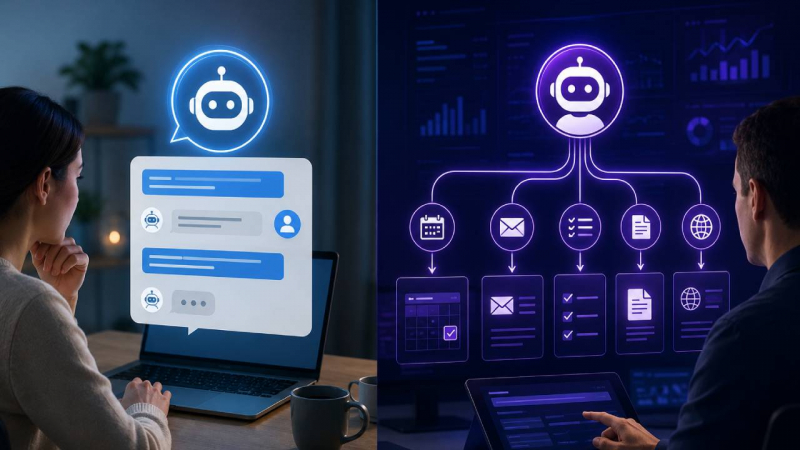
Previously, when people talked about conversational software, they used the term "AI chatbots." To start a dialogue, you simply had to type a question and receive a response.
Today, the terminology has changed somewhat. We increasingly hear the term "AI agents." However, this is not a rebranding of a previous product, as there is a structural difference between the two terms.
Therefore, you need to understand it in more detail. This is especially relevant for those developing products or trying to automate work processes. Our material will also be useful for anyone trying to understand what areas and directions to invest in next.
The Essence of AI Chatbots And What Valuable Things They They Do for Ordinary Users
At their core, AI chatbots are reactive systems. You ask, they answer. You give them a prompt, they generate text based on that prompt. That's basically the whole loop.
Most AI chatbots operate within a single conversational turn or a short back-and-forth. Among the best examples are early customer support bots, FAQ assistants, or even general-purpose tools people use for writing help. They don't plan. They don't execute multi-step tasks on their own. They respond.
This doesn't mean chatbots are useless, far from it. A well-built chatbot can handle a huge chunk of customer service tickets and answer product questions at 3 AM. It can even draft an email in seconds. However, there's a ceiling to what a chatbot can do. And that ceiling is set by its lack of autonomy. It waits for you. Always.
Welcome AI Agents as Your Reliable Business Helper: An Entirely Different Product
AI agents flip that model on its head. Instead of just responding, a machine can act. It can break a goal down into steps, decide which tools to use, execute those steps, check the results. At the end, adjust if something doesn't go as planned.
Say you tell a program: "Find the three cheapest flights to Lisbon next month and book the best one under $400." A chatbot would probably just explain how you might do that yourself. An AI agent, on the other hand, could actually search, compare, and complete the booking. The work involved using numerous tools and data sources, with little or no assistance required.
So, we explored the differences of both in each feature:
● Interaction style. AI Chatbots are reactive, single-turn. AI Agents (Smart automation tools) are goal-driven and multi-step.
● Autonomy. AI Chatbots are almost not autonomous, where smart automation tools have medium and high levels.
● Tool use. AI Chatbots - rare or none. Smart automation tools - frequent (APIs, browsers, databases).
● Memory across tasks. AI Chatbots show limited memory. Smart automation tools are often persistent.
● Best for. AI Chatbots are good for Q&A, support, and drafting. Smart automation tools are the best option for automation, research, and execution.
This is really the heart of the differences between AI chatbots and AI agents. One is a conversational interface. The other is closer to a digital coworker that has some capacity for independent judgment.
How Your Business Workflows Automation May Change Even More
You may wonder how AI automates business workflows? It isn't a theoretical question because companies are already doing this at scale.
Take lead qualification. Instead of manually checking a CRM, cross-reference company data, and draft a first outreach email, a machine can do all three. Then it flags only the leads worth a human's time. Or take inventory management. An agent can monitor stock levels, cross-check supplier prices, and trigger reorders automatically, without someone babysitting a spreadsheet.
What makes this product valuable here isn't intelligence for intelligence's sake. It's the chaining. A single AI agent might call five or six different tools in sequence to finish one task. Something no chatbot architecture was ever designed to do.
That's why many teams are now viewing such AI systems as infrastructure, not just a feature. They're beginning to be embedded into entire departments, seamlessly performing repetitive tasks.
Where AI Tools Fit In Business Productivity
There's no shortage of AI tools for business productivity right now. These include writing assistants, meeting summary software, planning bots, and more. But most of these still fall into the chatbot category. They help you do a task faster; they don't do the task for you end to end.
AI optimization is starting to eat into that gap. A few examples worth mentioning:
● Research tools that gather, summarize, and structure information from dozens of sources in minutes.
● Coding options that write, test, and debug code with minimal supervision
● Ops programs that monitor systems and resolve routine incidents on their own.
● Marketing tools that draft, schedule, and even A/B test campaign variants.
None of this replaces human judgment entirely. Honestly, it shouldn't. But it does shift where humans spend their time. Less grunt work, more decision-making. That's the actual promise behind AI automation. Also, it's why the category grows so fast.
Infrastructure Matters to Collect Reliable Public Web Data With AI
Here's something people don't talk about enough. AI agents are often data-hungry by design. To research a market, compare competitor prices, or monitor public listings, they need to pull information from the open web. Repeatedly, at scale, and without getting flagged.
This is where collecting public web data with AI runs into a very practical wall. Sites throttle requests, flag repeated access from the same IP, or serve different content depending on location. A machine that can't reliably reach the data it needs is, frankly, not much of an agent at all. It's just a chatbot with extra steps.
It's essential to use a dedicated proxy for teams that build or run these systems. It is often part of the underlying infrastructure. It keeps agent-based data collection stable and consistent. It's not the flashy part of the stack. However, it's the part that keeps everything else from breaking under real-world traffic conditions.
Artificial Intelligence Solutions for Enterprises
Once you scale past a single use case, you really talk about enterprise artificial intelligence solutions. And that's a different conversation altogether. It's not just "does the agent work." It's "does it work securely, does it integrate with existing systems, and can it be audited when something goes wrong."
Large organizations adopting AI have to rethink governance almost from scratch. Who approves what a system is allowed to do? What happens if it makes a wrong call on a financial transaction or a customer communication? These aren't hypothetical concerns. They are actively being worked out by legal and compliance teams.
Still, the direction is pretty clear. Enterprises aren't slowing down on this. If anything, the pressure to adopt AI automation flows increases, mostly because competitors already are.
Thoughts About the Future: What Comes Next after Intelligent Automation
So where does this actually go? Intelligent automation for modern businesses is likely to keep moving toward systems where multiple AI agents collaborate. One gathers data, another analyzes it, another executes the resulting action, with a human reviewing the outputs that matter most.
It's worth being honest, though: not every task needs an AI helper. Plenty of workflows are still better served by a simple chatbot, or by no AI at all. In the future, the real challenge won't be simply the widespread use of AI agents. You'll need to understand where a chatbot is sufficient, and where another tool truly justifies its complexity.
Conclusions
The use of two terms, AI chatbots and AI agents, isn't just a play on words. It's a significant distinction between two separate products. The structural difference lies in several areas:
● autonomy,
● tool use cases,
● the ability to operate without your intervention.
Chatbots provide answers to specific questions, while autonomous AI systems act independently. Both are good options, but they serve different purposes.
Post Comment
Share your thoughts about this article.
Be the first to post a comment!