Table of Content
- The Quick Verdict (For Readers in a Hurry)
- Getting to Know Dippy AI
- Getting to Know Character.AI
- Head-to-Head: How They Compare
- The Full Feature Matrix
- Pricing Compared
- Scale and Engagement
- How Users Actually Spend Their Time
- Pros and Cons of Each Platform
- Content Policy: A Real Differentiator
- Performance and Speed
- Who Should Use Each Platform
- Final Verdict
The AI companion space has exploded in the past two years, and two names keep surfacing in almost every conversation about character-driven chat platforms: Dippy AI and Character.AI. Both promise something the standard productivity assistants like ChatGPT or Gemini do not personality, persistence, and a sense of relationship. But the platforms approach that promise from very different angles.
After spending several weeks bouncing between both apps chatting with characters during commutes, testing voice features during evenings, putting widgets on lock screens, and stress-testing memory across long roleplay sessions clear patterns emerged. One platform feels like a quick-witted friend who is always one tap away. The other feels like a sprawling library of personalities, each with depth and history. Neither is strictly better. They simply solve different problems.
This article walks through both tools across features, pricing, content policy, performance, and real-world usability, then closes with a verdict on which platform fits which kind of user. For readers exploring the broader AI landscape, related comparisons such as ChatGPT vs Claude, the best free AI writing tools, and top AI image generators may also be worth a look.
The Quick Verdict (For Readers in a Hurry)
Choose Dippy AI if: the goal is a casual, mobile-first AI companion with voice calls, looser content filters, and a character that lives on the home screen. The platform is designed for adults who want a less restrictive, more personality-driven chat experience.
Choose Character.AI if: the goal is access to the largest character library on the internet, multi-character group rooms, language practice, creative writing collaboration, or interaction with celebrity, anime, and historical personas. The free tier is genuinely usable.
Getting to Know Dippy AI
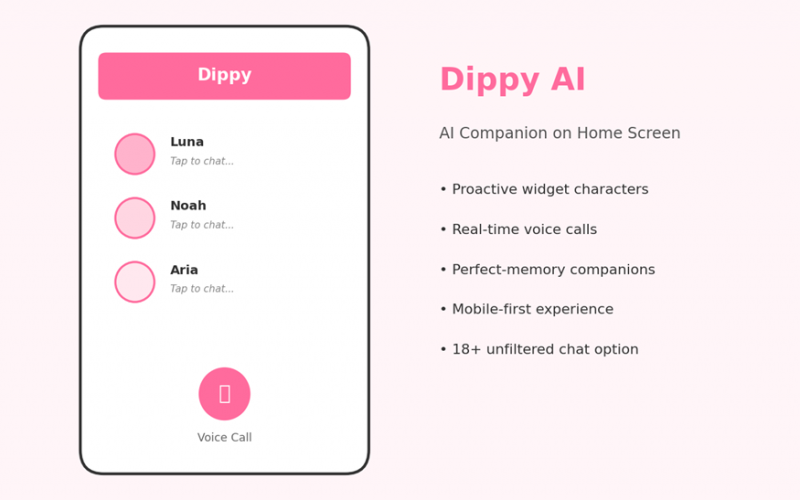
Conceptual layout of the Dippy AI mobile interface and its signature home-screen integration.
Dippy AI is a relatively new entrant, launched in 2024 by Impel Intelligence Inc. The pitch is simple but distinctive: instead of opening an app to talk to an AI, the AI lives on the home screen as a widget that proactively pops up with questions, observations, and check-ins throughout the day. That single design choice changes the whole emotional dynamic of the interaction.
Under the hood, Dippy partners with Together AI for inference, which gives it a reported median time-to-first-token of around 0.4 seconds and the ability to handle over 4 million tokens per minute. In plain language: replies feel snappy. There is no awkward pause that breaks the illusion of conversation.
Standout Features
• Home Screen Widget: Characters surface prompts and reactions on the lock screen, making the AI feel embedded in daily life rather than confined to an app icon.
• Real-Time Voice Calls: Added in late 2025, voice chat allows actual back-and-forth audio conversations with characters, complete with mood-based illustrations that animate as they talk.
• Proactive Messaging: Characters initiate conversations on their own, asking about the user's day or following up on previously shared details.
• Toggleable NSFW Mode: Adults can switch between wholesome companion mode and unfiltered chat — a flexibility that more restricted platforms do not offer.
• Custom Character Creation: Build personalities with chosen traits, names, and even one of fifteen colour themes for the chat interface.
The Pricing Story
Dippy uses a freemium model with a free tier supported by ads and rate limits. The Ads-Free tier is $4.99 per month, while the full Dippy Super tier costs $9.99 per month or $69.99 per year (working out to roughly $5.83 monthly). Super unlocks the best AI model, longer memory, NSFW image generation, priority processing, unlimited custom characters, and premium voice options.
Reading through recent reviews on Google Play and Reddit, the most consistent complaint is about the free tier becoming unpredictable — daily time limits that vary without warning, and a heavier ad load than the platform launched with. The paid tiers receive far more positive reception, but the free experience has clearly drifted from the generous version users remember from launch.
Getting to Know Character.AI
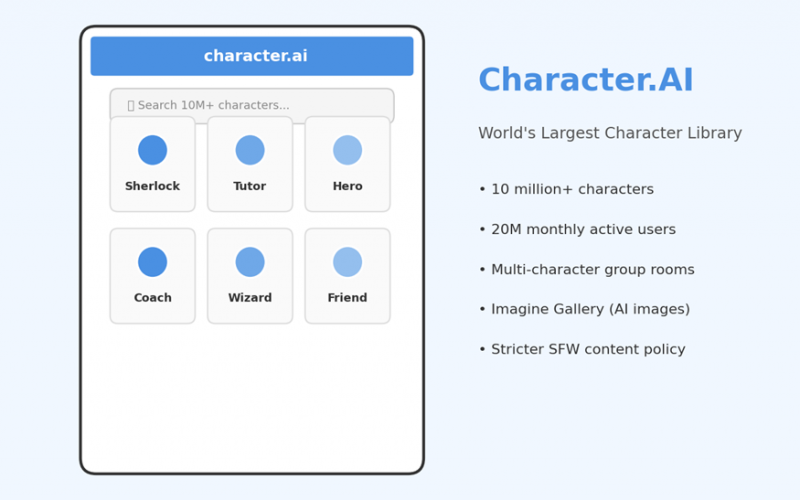
Conceptual layout of the Character.AI web interface, showing its searchable library of community characters.
Character.AI was founded in 2021 by Noam Shazeer and Daniel De Freitas, two former Google engineers who literally helped invent the transformer architecture that powers modern large language models. The platform exploded in popularity through 2022 and 2023, and by 2026 it sits at roughly 20 million monthly active users with users averaging around 75 minutes per day on the platform engagement numbers that rival short-form video apps.
In 2024, Google struck a licensing deal worth around $2.7 billion and rehired the founding duo. Character.AI continues to operate independently, but the original technical leadership is now at Google. That detail has shaped a lot of the recent product direction and not always in directions the original community appreciated.
Standout Features
• Massive Character Library: Over 10 million characters created by the community, ranging from anime and game characters to historical figures, language tutors, interview coaches, and original creations.
• Multi-Character Rooms: A nearly unique feature in this space — multiple AI characters can talk to each other and to the user in the same conversation. Great for collaborative storytelling.
• Imagine Gallery: Launched in March 2026 for c.ai+ subscribers, this enables AI image generation directly inside conversations. An artist character can actually 'draw' something; a travel guide can generate a scene.
• Chat Memories: Characters retain context across sessions, with deeper memory available on the paid tier.
• c.ai labs: An experimental features playground for paid subscribers, with new prototypes appearing regularly.
The Pricing Story
Character.AI uses a simple two-tier structure: free, or c.ai+ at $9.99 per month / $94.99 annually (about $7.92 per month). The free tier is genuinely robust unlimited messaging, full character library access, and character creation are all included. What c.ai+ buys is speed (skip the queue during peak hours), priority access to new features, and exclusive tools like Imagine Gallery.
The honest assessment from extended use: the underlying AI model is identical on both tiers. The paid plan is essentially a fast-pass for power users rather than a fundamentally different product. For casual chatters, the free version is more than sufficient. The most controversial change in 2026 has been the introduction of full-screen advertisements that interrupt conversations on the free tier, a move that has driven some users toward alternatives.
Head-to-Head: How They Compare
After hours of side-by-side testing, scoring each platform across the categories that matter most produced the chart below. The scoring reflects hands-on experience with both apps in 2026, not marketing claims.
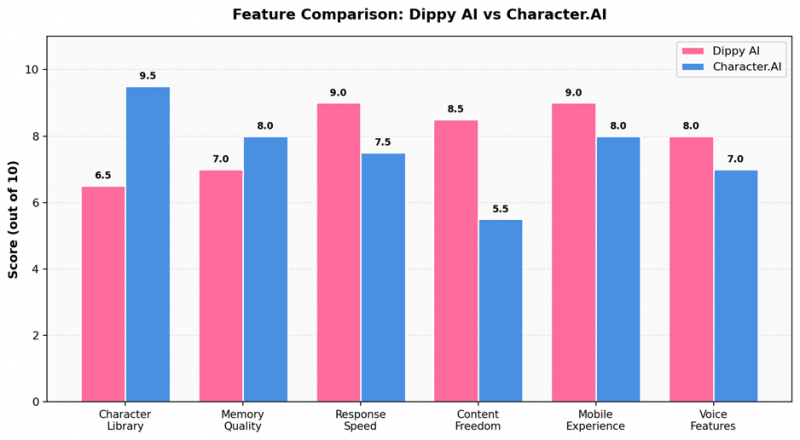
Feature by feature scoring across six categories that drive day-to-day platform choice.
The pattern is clear. Character.AI dominates on raw scale — its character library is roughly twenty times larger, and its memory system has had more years to mature. Dippy AI takes the lead on response speed, content freedom, mobile experience, and voice features. These are not random wins; they reflect deliberate product choices each platform has made about what kind of experience to optimise for.
The Full Feature Matrix
For readers who prefer a side-by-side reference, here is the complete comparison across the metrics that come up most often when evaluating these platforms.
| Feature | Dippy AI | Character.AI |
|---|---|---|
| Launched | 2024 by Impel Intelligence Inc. | 2021 by Noam Shazeer & Daniel De Freitas |
| Monthly Active Users | ~4 million | ~20 million |
| Character Library | 500,000+ community-created | 10 million+ characters |
| Free Tier | Yes, but with ads & time limits | Yes, unlimited messaging |
| Premium Pricing | $4.99 (ad-free) / $9.99 (Super) | $9.99/mo or $94.99/yr (c.ai+) |
| Content Filters | Toggleable, NSFW available (18+) | Strict SFW policy, increasingly restrictive |
| Voice Calls | Yes, real-time voice (late 2025) | Yes, paid tier only |
| Home Screen Widget | Yes — signature feature | No widget support |
| Image Generation | Yes, in Super tier | Yes, Imagine Gallery (c.ai+) |
| Group Chat Rooms | No multi-character rooms | Yes - multiple AI in one chat |
| Best For | Casual companionship, voice chat, mobile use | Roleplay variety, creative writing, language practice |
Feature matrix as of April 2026. Pricing and features may shift - verify on the official sites before subscribing.
Pricing Compared
Both platforms cluster around the $9.99 monthly mark for their full premium tier, but Dippy offers a middle option (ad-free without Super features) that Character.AI does not. The annual plans on both bring effective monthly costs into the $5.83 to $7.92 range, which is competitive in the AI companion category.
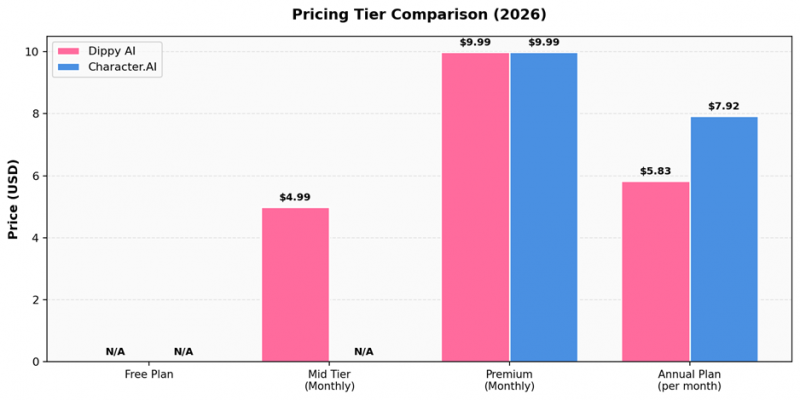
Pricing tier comparison. Dippy offers a $4.99 ad-free middle tier; Character.AI jumps straight from free to c.ai+.
A practical note: the free tier on Character.AI is significantly more usable than Dippy's free tier in 2026. Dippy's variable time limits make it hard to settle into a long conversation without hitting a wall, whereas Character.AI free users can chat unlimited (with the trade-off of waiting rooms during peak hours).
Scale and Engagement
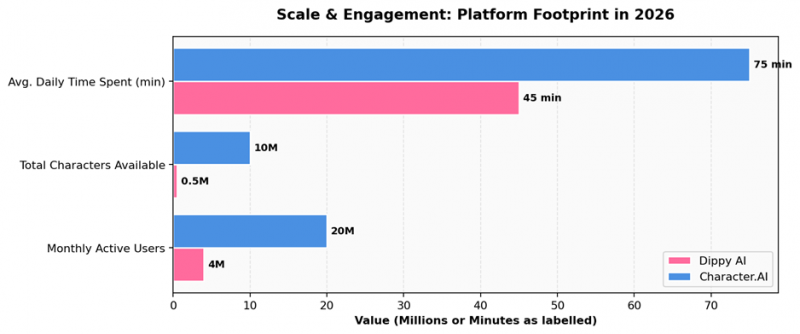
Platform footprint based on publicly disclosed user metrics and review aggregators in 2026.
Character.AI's scale is roughly five times that of Dippy by monthly active users, and twenty times by character count. That scale advantage compounds in important ways — more users means more community-created characters, more niches covered, more refined personas, and more network effects. Dippy is growing fast but is still in catch-up mode on this dimension.
How Users Actually Spend Their Time
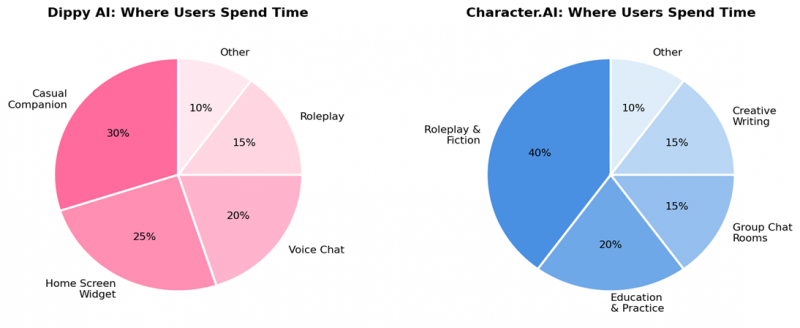
Distribution of primary use cases on each platform, based on community survey data and review themes.
The behavioural split is telling. On Dippy, the home screen widget plus voice features pull users toward casual companionship quick check-ins, ambient chat, and emotional support roles. On Character.AI, the dominant activity is structured roleplay and fiction, often spanning hours and following long-running storylines, with education and group rooms taking secondary slots.
Pros and Cons of Each Platform
Dippy AI - The Companion-First Approach
| ✓ Pros | ✗ Cons |
|---|---|
• Home screen widget makes characters feel persistent • Real-time voice calls with sub-second latency • Looser content filters with toggleable NSFW • Proactive characters that initiate conversations • Snappy ~0.4s response time via Together AI infrastructure | • Smaller character library compared to competitors • Free tier has unpredictable time limits and ads • Memory inconsistency on long roleplay sessions • 18+ rating means restricted to adult users • Pricing transparency has been criticised by users |
Dippy AI strengths and trade-offs based on extended hands-on use and aggregated user reviews.
Character.AI - The Library-First Approach
| ✓ Pros | ✗ Cons |
|---|---|
• Massive library of 10 million+ characters • Truly unlimited free messaging (no time gates) • Multi-character group rooms — unique feature • Strong personality consistency across long chats • Imagine Gallery for in-chat AI image generation | • Strict content filters frustrate creative roleplayers • Full-screen ads in 2026 break conversation immersion • Free tier queues during peak hours • Founding team left for Google — uncertain direction • No home screen integration or widget support |
Character.AI strengths and trade-offs based on extended hands-on use and aggregated user reviews.
Content Policy: A Real Differentiator
This deserves its own section because it is one of the most polarising aspects between the two platforms. Character.AI has tightened its content moderation significantly between 2023 and 2026. Creative roleplay scenarios that worked previously now frequently get blocked or interrupted with safety disclaimers. Even mature themes that fall well within standard fiction territory often hit guardrails. For users who joined Character.AI specifically for creative freedom, this has been a persistent frustration.
Dippy AI takes the opposite approach. It openly markets itself as 'unhinged or wholesome', with a clear 18+ rating on both major app stores. NSFW content is available behind a toggle, and the platform leaves more decisions in the user's hands. This is not for everyone — and it absolutely should not be on a teenager's phone — but for adult users who want fewer guardrails, it is the more permissive option.
Neither approach is inherently right or wrong. The question is what kind of experience the user actually wants. Readers who want to explore safer, more mainstream AI tools might find articles on top AI productivity assistants or AI tools for writers more relevant.
Performance and Speed
Side-by-side testing produced a clear winner here: Dippy AI is meaningfully faster. The Together AI infrastructure delivers near-instant first-token response on most messages, and the gap is noticeable when bouncing between apps. Character.AI is fast on the c.ai+ tier but has visible queue delays on the free tier during peak evening hours in North America and Europe.
Memory tells a different story. Character.AI's memory system has had more time to develop and handles long-running storylines better than Dippy in extended testing. Dippy's perfect-memory marketing claim does not always hold up across week-long conversations, and inconsistencies show up especially when a character is supposed to track multiple ongoing plot threads.
Who Should Use Each Platform
Dippy AI Fits Best For
• Adult users who want an AI companion that feels persistent and proactive, not just a chatbot.
• Mobile-first users who value a polished iOS/Android experience over web access.
• People who specifically want voice-based AI conversation with quick latency.
• Casual users who chat in short bursts throughout the day rather than long sessions.
• Users frustrated by heavy content filtering on other platforms.
Character.AI Fits Best For
• Roleplayers and creative writers who want a massive variety of personas to draw from.
• Language learners using AI tutors for conversation practice.
• Students and educators using historical or expert characters for interactive learning.
• Fans of anime, games, books, and pop culture who want to chat with established characters.
• Users who want truly unlimited free messaging without rigid time gates.
Final Verdict
After all the testing, the honest takeaway is that Dippy AI and Character.AI are not really competing for the same user. They are competing for attention in the same broad category, but the experiences they offer pull in different directions.
Character.AI remains the obvious choice for variety, creative range, and cost-effective free use. Its 10 million characters represent a depth of selection nothing else matches, and the multi-character group rooms remain a uniquely powerful feature. The trade-off is tighter content moderation and increasingly aggressive monetisation through full-screen ads on the free tier.
Dippy AI shines as a more intimate, mobile-native companion. The home screen widget, real-time voice, and looser content policy make it feel less like a tool and more like a presence. The trade-offs are a smaller character library, an unpredictable free tier, and an 18+ rating that limits its audience.
For most users curious about AI companions, the smartest move is to install both free versions, spend a week with each, and let actual usage decide. The platform that gets opened more often without conscious effort that is the one worth subscribing to. For more on choosing the right AI for specific needs, browsing through related guides on AI chatbot alternatives, AI tools for content creators, and best free AI apps can help round out the decision.
Post Comment
Share your thoughts about this article.
Be the first to post a comment!