Table of Content
- What Is CrossMarket AI Really About?
- CrossMarket AI Claimed Features
- Who Owns and Operates CrossMarket AI?
- What Users Say About CrossMarket AI
- Can You Withdraw Money From CrossMarket AI?
- Is CrossMarket AI Legit or a Scam?
- Pros and Cons of CrossMarket AI
- Comparison With Legitimate AI Trading Platforms
- Final Verdict: My Experience With CrossMarket AI
- FAQs About CrossMarket AI
Why I Investigated CrossMarket AI
Over the past few years, I’ve reviewed many platforms that market themselves as AI-powered trading solutions. A common pattern tends to appear in these services, heavy use of AI buzzwords, promises of steady or unusually high returns, and very little transparency about regulation or ownership.
When I first looked at CrossMarket AI, several of these signals appeared almost immediately. The platform promoted advanced AI trading capabilities but provided limited information about who runs it, how the technology actually works, or what regulatory oversight exists.
Because of these similarities to other questionable trading platforms, I decided it was worth examining the service more carefully instead of dismissing it outright. A deeper investigation helps determine whether it offers real value or simply follows a familiar pattern seen across many AI-branded investment tools.
What CrossMarket Appears to Offer
CrossMarket is commonly promoted as an AI-powered arbitrage system. Arbitrage means purchasing an asset in one market and selling it in another where the price is temporarily higher.
The underlying concept is real. Professional traders do look for price differences between exchanges, currencies, securities, and related financial instruments.
That does not validate a particular retail investment scheme.
Real arbitrage returns are affected by fees, spread, execution delays, liquidity, withdrawal limits, taxation, failed transfers, and competition from faster traders. A platform claiming that automated arbitrage can provide stable passive income still needs to show where trades occur, how funds are protected, and how results are independently verified.
CrossMarket’s public website currently provides no such evidence. It does not name the exchanges used, disclose API connections, show executed trade identifiers, publish a whitepaper, or explain how its supposed AI model makes decisions.
What Is CrossMarket AI Really About?
According to its promotional material, CrossMarket AI positions itself as an AI-powered trading system designed to analyze multiple financial markets at the same time. The platform claims it scans cryptocurrency markets, forex trading activity, stock movements, and broader macro-economic signals to identify opportunities that traditional traders might miss. The concept it promotes is called “cross-market intelligence,” where AI supposedly finds correlations between different markets to generate profitable trading insights.
However, when looking beyond the marketing language, the platform provides very little technical detail about how this system actually works. There is no publicly available whitepaper, no technical documentation explaining the algorithms, and no information about the models, datasets, or trading infrastructure used to generate signals.
In practice, most of what appears on the site is promotional messaging combined with a login or registration prompt. The absence of transparent documentation or verifiable system details creates a major credibility gap, because legitimate AI trading platforms typically provide at least some technical explanation of their methodology.
Do Not Confuse “Cross-Market AI” With CrossMarket.ai
There is an important terminology problem in this category.
Cross-market AI can be used generically to describe artificial-intelligence systems that analyze relationships across multiple markets, datasets, or asset classes.
CrossMarket.ai, on the other hand, is a specific online platform.
Those are not the same thing.
This matters because several capabilities listed earlier in this article—such as customer segmentation, marketing analytics, social-media analysis, commodities analysis, and broad predictive analytics—describe what a theoretical cross-market AI system could do.
They should not automatically be interpreted as verified CrossMarket.ai features.
As of August 12, 2026, the publicly indexed CrossMarket.ai website mainly exposes login, registration, and password-recovery pages. Its registration interface requests information including a user's name, country, mobile number, email address, password, and referral code.
I could not verify public technical documentation demonstrating that CrossMarket.ai itself performs every broad AI function listed above.
Therefore, readers should distinguish between:
| Statement | Evidence Level |
|---|---|
| “AI can analyze multiple markets” | General technical concept |
| “CrossMarket says it uses AI” | Platform claim |
| “CrossMarket actually performs a specific AI process” | Requires technical evidence |
| “CrossMarket's AI produces profitable trades” | Requires audited performance evidence |
This distinction makes the article much more accurate.
CrossMarket AI Claimed Features
1. Multi-Market Data Integration: Cross-Market AI pulls and processes data from multiple markets or platforms simultaneously such as stocks, crypto, commodities, social media sentiment, and customer behavior logs instead of focusing on a single silo.
2. Pattern Recognition Across Markets: Using machine learning, it identifies correlations and signals between markets that traditional tools might miss for example, linking commodity price movements with currency or stock shifts. These insights can help strategy planning and risk assessment.
3. Predictive Analytics & Trend Forecasting: The AI forecasts macro movements by analyzing vast datasets, helping users anticipate market changes and make more informed decisions (e.g., allocation of investment capital or marketing resources).
4. Real-Time Alerts & Signals: Many systems generate real-time trading or strategy signals based on cross-market behavior — accelerating decision cycles compared to manual analysis.
5. Automation & Efficiency: Tasks like data aggregation, analysis, pattern detection, and even strategy execution can be automated, saving time and reducing human error. This lets professionals focus on larger strategy instead of repetitive tasks.
6. Customer-Centric Insights (Beyond Financial Markets): In marketing and business use cases, Cross-Market AI can link customer behavior from social interactions to purchase history across channels, resulting in deeper segmentation and personalized campaign targeting.
7. Visual Dashboards & Decision Tools: Platforms often include intuitive dashboards that visualize complex relationships between markets, making it easier for traders or analysts to act on insights.
What Evidence Would Actually Verify an AI Trading Platform?
A polished dashboard does not verify an AI trading system.
Neither does seeing a balance increase on-screen.
For a trading platform claiming automated arbitrage or algorithmic execution, I would look for evidence in several layers.
1. Legal Entity
The platform should clearly identify the company responsible for:
- Holding customer funds
- Providing the investment service
- Handling withdrawals
- Resolving disputes
A brand name or web domain is not enough.
2. Regulatory Status
Users should be able to verify the company or investment intermediary with the regulator responsible for the activity in the relevant jurisdiction.
Investor.gov specifically warns that unregistered or unlicensed investment platforms frequently use AI-related claims and recommends independently verifying the registration of firms and investment professionals.
3. Trading Venues
If the business claims to perform arbitrage between markets, it should be possible to determine where those trades actually occur.
Useful evidence could include:
- Exchange names
- Broker relationships
- API integrations
- Settlement procedures
- Custody arrangements
4. Execution Records
Real trading generates records.
Depending on the market and infrastructure, meaningful verification could include:
- Execution timestamps
- Buy and sell prices
- Order identifiers
- Fees
- Settlement information
- Venue information
A number displayed inside a private dashboard is not equivalent to independent proof that the underlying trade occurred.
5. Performance Methodology
Performance claims should explain:
- Gross returns
- Trading fees
- Withdrawal or network fees
- Slippage
- Losses
- Failed trades
- Drawdowns
- Time period
- Whether results are simulated or live
6. Independent Verification
The strongest evidence would come from an auditor, regulator, broker, exchange, or another independent party capable of confirming trading activity.
Without these layers, users are largely being asked to trust the operator's own representation of its results.
What Can Be Verified
None of the above features are independently documented
- No third-party audits
- No backtesting data
- No API disclosures
- No broker integration proof
In legitimate AI trading platforms, at least some of this information is publicly verifiable. Here, it isn’t.
What Remains Unverified
No public evidence was found for:
- The AI model or software architecture.
- The market-data providers being used.
- Direct integration with recognised exchanges.
- Live or independently verified trade execution.
- Historical performance after all fees.
- Risk-management and loss-control rules.
- Segregation of customer funds.
- Insurance or investor-protection arrangements.
- Cybersecurity or financial audits.
- The legal entity responsible for customer balances.
The absence of documentation is especially significant because users cannot independently test the claimed system from the public website.
Who Owns and Operates CrossMarket AI?
When I ran the domain through ScamAdviser, I found it was a newly registered site with private, hidden ownership. ScamAdviser gave it a moderate score but warned that the anonymity, use of proxy services, and recent registration all lower trustworthiness.
Meanwhile, Scam Detector’s analysis was even harsher, giving the platform a trust score of just 8.4/100, calling it high-risk and potentially unsafe.
If ownership is hidden and the platform isn’t transparent about its team, I immediately wonder, why would they hide if it’s a genuine product? This led me to check user reviews to see if real traders had better experiences.
What Authorities Have Actually Said About the People Behind Related Schemes
This section should now rely more heavily on official and law-enforcement-linked evidence.
The Enforcement Directorate has separately investigated the QFX/YFX/BotBro network.
In February 2025, authorities said ₹170 crore across approximately 30 bank accounts had been frozen during an investigation into an alleged unregulated investment scheme involving QFX and related operations. The ED alleged that investors had been promised high returns and that other schemes connected with Lavish Choudhary included BotBro, TLC Coin, and Yorker FX.
Later ED reporting described QFX/YFX/BotBro operations as involving alleged AI- or bot-based forex-investment promises.
The April 2026 Goa case goes further for this article because the police allegation specifically included Crossmarkets among the entities attributed to Choudhary.
The careful conclusion is therefore:
There is credible law-enforcement evidence connecting Lavish Choudhary with alleged investment schemes, and a 2026 Goa Police complaint specifically names Crossmarkets among entities he allegedly represented as founder.
That is stronger and more defensible than relying on WHOIS anonymity alone.
A Better Evidence Scale for CrossMarket Claims
Instead of classifying every claim as simply true or false, I would now use four evidence levels.
| Level | Meaning |
| Verified | Supported by reliable independent evidence |
| Platform-claimed | CrossMarket or promoters say it is true |
| User-reported | Appears in reviews or community discussion |
| Unverified | I could not find adequate independent proof |
For example:
“CrossMarket.ai has a registration page.”
Verified.
“CrossMarket uses advanced artificial intelligence to identify profitable trades.”
Platform claim / unverified from publicly available technical evidence.
“Some users say they received payouts.”
User-reported. Trustpilot currently contains such claims.
“Some users say withdrawals stopped.”
Also user-reported, with additional allegations appearing in the April 2026 Goa Police case.
This framework is more useful than treating promotional claims, review comments, and regulator findings as equally reliable evidence.
How Does CrossMarket AI Claim to Work?
CrossMarket AI says it:
- Collects market data
- Processes it using AI
- Identifies opportunities
- Executes or recommends trades
This explanation is extremely generic. It mirrors hundreds of known scam platforms that reuse the same AI narrative without proof.
There is no demonstration of:
- Model training
- Risk management logic
- Market exposure limits
- Loss handling
Does CrossMarket AI Use Real AI, or Just Buzzwords?
The biggest issue is the lack of evidence that CrossMarket AI runs genuine AI models. There are no technical documents, code samples, or audits.
This aligns with what developers on Reddit often point out: many companies simply slap “AI” onto their name without real innovation. CrossMarket AI fits this description perfectly, lots of hype, but no tangible proof.
Since the company doesn’t show transparency, I looked at what actual users had to say.
What Users Say About CrossMarket AI
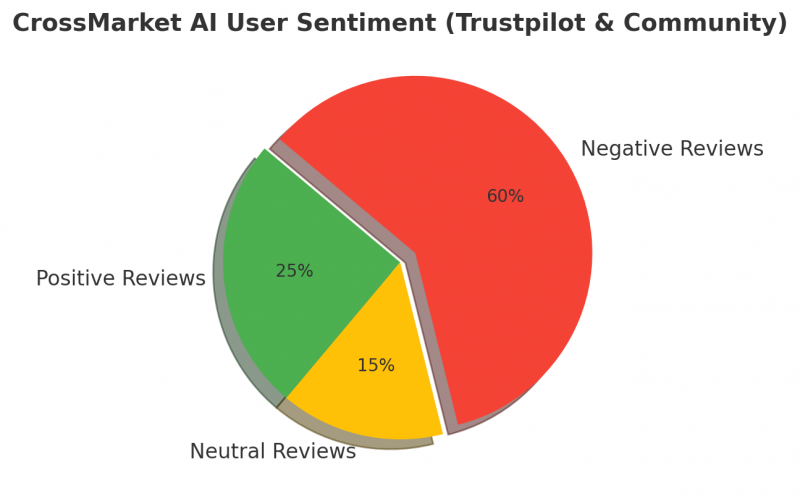
On Trustpilot, reviews are mixed and suspicious. A few glowing comments call it “the best trading tool,” but others outright label it a scam. The recurring complaint? Withdrawal problems, people could deposit money easily, but retrieving it was another story.
When reviews are polarized, either extremely positive or extremely negative, it’s often a sign of fake reviews mixed with genuine complaints. That pattern raised even more doubt for me.
This sentiment was echoed in trading communities, especially on Facebook.
Community Reactions: What Traders Discuss on Facebook
In trading forums and Facebook groups, many traders discuss whether CrossMarket AI is a scam. Several said they were lured by promises of guaranteed returns, but when they tried to withdraw, their accounts were locked or delayed indefinitely.
When communities start to doubt a platform and compare it to Ponzi-style schemes, it’s usually not a good sign. Which leads us to the question most people ask: Can you actually withdraw money from CrossMarket AI?
Can You Withdraw Money From CrossMarket AI?
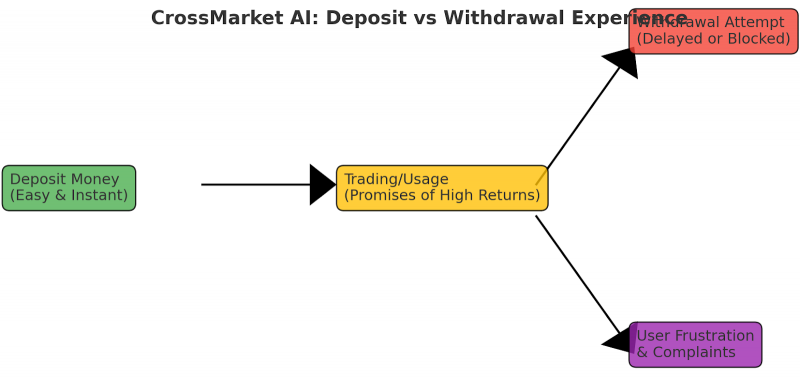
From the complaints I reviewed on Trustpilot and social media, the answer seems to be no—or at least not reliably. Many users reported deposits going through instantly, but withdrawals being delayed, rejected, or blocked.
This is one of the strongest indicators of a scam. A trading platform that restricts withdrawals is not protecting liquidity—it’s protecting itself at your expense.
This connects directly to another scam tactic: the promise of guaranteed high returns.
Why High-Return Promises Are Red Flags
The “too good to be true” pitch is central to platforms like CrossMarket AI. It promises easy wealth and AI-driven accuracy, but offers no proof.
Real-world examples confirm this danger. In one case reported by The Hindu, a man in Hyderabad lost ₹10 lakh after trusting an AI trading scheme that promised guaranteed returns.
Similarly, the California DFPI has warned that AI scams are on the rise, often preying on investors with promises of certainty in a market that is inherently uncertain.
That’s why I wasn’t just worried about money, I was also worried about security.
Security Risks: Malware and Phishing Concerns
It’s not only about losing deposits. Gridinsoft’s malware scan flagged CrossMarket AI as a potentially dangerous domain, raising risks of phishing, malware, or stolen personal data.
That means even visiting or logging in could put you at risk, not just financially, but also digitally.
With all these concerns piling up, I had to ask myself: is CrossMarket AI legit at all, or just another scam?
Is CrossMarket AI Legit or a Scam?
Based on the available warning signs, CrossMarket AI raises multiple serious credibility concerns. The platform shows hidden ownership, no visible regulatory status, no technical proof that its AI system actually exists, and repeated complaints about withdrawals and account access.
On top of that, community skepticism and basic security concerns make the overall risk profile hard to ignore. Even if not every user loses money, the combination of these signals is consistent with platforms that operate in a very high-risk or potentially scam-like pattern.
In practical terms, CrossMarket AI does not show the transparency or trust signals expected from a legitimate financial platform. For that reason, it should be treated with extreme caution rather than as a reliable AI trading service.
I prefer this response
Pros and Cons of CrossMarket AI
Pros
- Attractive AI-driven branding.
- Promises multi-market analysis.
- Some positive user reviews about ease of use.
Cons
- Hidden ownership, no regulation.
- Withdrawals are often blocked.
- Scam warnings from watchdogs.
- Security concerns
- Strong community skepticism on Facebook.
The cons clearly outweigh the pros. Which naturally raises another important question: how does it compare to real, regulated AI trading platforms?
Comparison With Legitimate AI Trading Platforms
| Feature | CrossMarket AI | Regulated Platforms |
|---|---|---|
| Regulation | None | Yes |
| Ownership Transparency | Hidden | Public |
| AI Documentation | None | Partial / Verified |
| Withdrawals | Reported issues | Reliable |
| Legal Accountability | None | Enforced |
Examples of legitimate platforms:
- eToro
- Interactive Brokers
- Coinbase
What Are the Red Flags to Spot in Platforms Like This?
From my investigation, these are the red flags I now always look for:
- Hidden ownership or anonymous domains.
- Guaranteed high returns.
- Difficulty withdrawing funds.
- Malware or phishing warnings.
- No regulatory license.
CrossMarket AI ticks every single one of these boxes.
Final Verdict: My Experience With CrossMarket AI
After weeks of digging through reviews, scam detection tools, and regulatory warnings, I can confidently say CrossMarket AI is not a platform I’d trust. It follows the classic playbook of AI-based scams, hidden ownership, unrealistic promises, and withdrawal issues.
My Rating of CrossMarket AI
Based on the investigation of transparency, technical credibility, user feedback, and overall risk indicators, my personal rating for CrossMarket AI is 2 out of 10.
The platform makes strong claims about AI-powered trading but provides almost no verifiable evidence to support those claims. Important trust signals such as regulatory disclosure, company identity, technical documentation, or audited performance data are missing.
Because of these gaps—combined with reported withdrawal issues and community skepticism, the platform carries a very high risk level. For most investors or traders, it would be far safer to avoid it and choose regulated, transparent trading platforms instead.
If you’re genuinely interested in AI trading, stick with regulated alternatives like eToro, Interactive Brokers, or Coinbase. They may not promise overnight wealth, but they won’t put your money, or your identity, at risk.
FAQs About CrossMarket AI
Where is CrossMarket AI based?
CrossMarket AI does not clearly disclose its headquarters or physical office, which makes its operations less transparent.
Does CrossMarket AI offer customer support?
The site claims to provide customer support, but users often report slow responses or no replies at all.
How does CrossMarket AI make money?
It likely profits from user deposits and trading fees, though the platform does not provide a clear revenue model.
Does CrossMarket AI have a demo account?
No official demo or trial account is available, making it hard to test the platform without depositing real money.
Can CrossMarket AI be trusted for long-term investing?
Given the lack of transparency, regulation, and negative reviews, it is not advisable for long-term investments.
Post Comment
Share your thoughts about this article.
Be the first to post a comment!