Most people open one of these every day. Almost nobody asks which one earns the tab.
One has been the default since 2022. The other went from a novelty bolted onto a social network to the fastest-growing assistant on the market. The choice usually gets made by accident and never revisited. This comparison sets both against four core jobs, because the winner changes depending on the job.
The contenders
Short profiles first. The detail that matters sits in the use-case sections below, where each tool is judged against a specific job rather than in the abstract.
ChatGPT
OPENAI · 4.6 / 5 · G2
The incumbent, running GPT-5.5 since April 2026. It reached 900 million weekly active users in February 2026, handling 2.5 billion prompts per day. GPT-5.5 takes the highest score across nine evaluation benchmarks, including 84.9% on GDPval, which measures performance across 44 professions.
STANDARD TIER $20/mo | CONTEXT 400K | FREE TIER Yes | BUILT FOR Breadth |
Grok
XAI · 4.3 G2 · 2.4 Trustpilot
The challenger, and no longer a novelty. xAI shipped Grok 4.5 on 8 July 2026, built around agentic tool calling and configurable reasoning. It scores 54 on the Artificial Analysis Intelligence Index at #4 overall, and takes the single top spot on agentic tool use.
STANDARD TIER $30/mo | CONTEXT 1M | FREE TIER Limited | BUILT FOR Speed |
The market positions are diverging in an interesting way. ChatGPT holds roughly 64.5% of the chatbot market, while Grok climbed from a 1.9% share to nearly 18% in under a year. Meanwhile ChatGPT's app market share fell from 69.1% in January 2025 to 45.3% in early 2026, with weekly users still climbing even as share drops. Being the default and being the best have started to come apart.
Grok won 46 to 34 across 28 hands-on tests in seven categories, outperforming ChatGPT on factual accuracy, real-time research, and trust and safety, while ChatGPT won on writing quality and user experience. That headline hides the useful detail, which is that the two tools win different categories. The sections below unpack which.
Four use cases
Each section takes a core job, names which tool handles it better, and shows the evidence behind the call. Roles listed are the people most likely to care about that job.
Writing and everyday professional work
BETTER FIT: CHATGPT
CONTENT WRITERS · MARKETERS · COMMS TEAMS · CONSULTANTS · SMALL BUSINESS OWNERS
This is the most consistent finding across every outlet that tested both. For business emails, long-form content, reports and documentation ChatGPT produces consistently usable output, and in head-to-head writing tests across multiple comparison outlets it typically wins on output quality and user experience. The result held even in the test suite Grok won overall, which makes it the rare finding both camps agree on.
Grok is not weak here, but its house style runs looser. Some users prefer the structured, safe tone of ChatGPT while others prefer Grok's casual, sometimes edgy style. For copy that ships to a client or a public channel, the structured option needs fewer passes.
The same logic extends to general-purpose use. ChatGPT's advantages are reliability, integrations, polished writing, production coding support, memory, multimodal depth and predictable workflows, making it the better default for everyday professional work. Price reinforces it: Grok is worth it mainly for people on X who want live, less-filtered answers; for coding, writing or value, $20 rivals give more.
EVIDENCE
| 28-test suite, writing category | ChatGPT |
| Cross-outlet writing consensus | ChatGPT |
| GDPval, 44 professions | 84.9% |
| Standard tier price | $20 vs $30 |
| G2 rating | 4.6 vs 4.3 |
The practical read: editing time is the real cost of a writing tool, not the subscription. Fewer revision passes per draft compounds faster than a $10 monthly difference, and $120 a year buys a lot elsewhere.
Real-time research and news monitoring
BETTER FIT: GROK
JOURNALISTS · PR AND SOCIAL TEAMS · ANALYSTS · TRADERS
The most decisive gap in the entire comparison, and it is not close. Grok has native integration with X, and in testing achieved 87% accuracy on trending queries from the past 24 hours compared to ChatGPT's 76%; ChatGPT has browsing through Bing but lacks direct social media data access.
Reviewers echo the benchmark. Across 15 verified G2 reviews Grok averages 4.3/5, and the recurring hero is real-time information: people lean on it to cut through social-media noise and surface what is trending right now. Nothing in ChatGPT's toolkit substitutes for a live feed, and this category also carried Grok's win in the 28-test suite.
EVIDENCE
| Last-24-hours query accuracy | 87% vs 76% |
| 28-test suite, real-time research | Grok |
| Native social data access | Grok only |
| 28-test suite, factual accuracy | Grok |
The practical read: this single capability justifies the higher price for anyone whose work is time-sensitive. For everyone else it is a feature that never gets opened.
Technical work: coding, mathematics and agents
BETTER FIT: SPLIT BY TASK
SOFTWARE ENGINEERS · DATA SCIENTISTS · QUANT ANALYSTS · OPS AND AUTOMATION TEAMS
Coding is where the sources disagree most sharply, and pretending otherwise would be dishonest. One hands-on suite scored technical skills 6-6, finding Grok the stronger coder and debugger while ChatGPT handled data analysis and structured output formatting better. Benchmark-led comparisons reach the opposite conclusion, putting ChatGPT ahead on SWE-Bench Verified with more mature API SDKs and a larger developer community. The split resolves along a predictable line: Grok favours speed and exploration, ChatGPT favours structure and mature tooling.
On mathematics the gap is measurable rather than contested. Grok posts stronger mathematical reasoning at 95% versus 86% on AIME 2025, and it also leads in finance-heavy tasks and performs strongly on GPQA and professional benchmarks spanning law, education and healthcare.
Agentic automation is Grok’s clearest technical win. On the Artificial Analysis Intelligence Index it takes the single top spot on agentic tool use, and for agentic workloads it is fast, cheap and hard to beat on value. It tops benchmarks in tool use, parallel calling and SaaS automation across Gmail, Sheets and Slack, and handles long-running agent loops. API economics point the same way: Grok 4.5 runs $2 / $6 per million tokens with $0.50 cached input, a 75% cache discount, while xAI gives every developer up to $175/month in free API credits, the most generous free tier among major AI providers.
One caveat belongs beside all of this. xAI published no general-reasoning, math, science or safety benchmarks for Grok 4.5 despite marketing it for knowledge work, and there is no Artificial Analysis entry or community SWE-bench replication as of 9 July. The math and agentic numbers are documented, but independent verification of the newest release remains thin.
EVIDENCE
| AIME 2025 | 95% vs 86% |
| Agentic tool use ranking | Grok #1 |
| SWE-Bench Verified | ChatGPT |
| Hands-on technical category | 6-6 tie |
| Free monthly API credits | Up to $175 |
| SDK maturity | ChatGPT |
The practical read: Grok wins mathematics, agentic automation and API economics outright. ChatGPT holds structured production coding and SDK maturity. The deciding question is whether the work is exploratory or production-bound.
Enterprise deployment and large-scale documents
BETTER FIT: CHATGPT
IT AND PROCUREMENT · LEGAL · HEALTHCARE · EDUCATION · RESEARCH TEAMS
Not a capability question but a risk question, and the gap is wide. ChatGPT is built to avoid disallowed content and unstable claims, making it predictable in classrooms, hospitals, corporate communications and public-facing brand content, though it sometimes refuses topics users want to explore.
Grok's record makes procurement harder to clear. In early March 2026 xAI reduced video generation rate limits across tiers without advance notice, drawing complaints from heavy users who had built workflows around the prior limits, and customer support is widely described as ineffective.
Grok does hold one genuine advantage in this territory. It offers a 2.5x larger context window at 1M versus 400K tokens, which helps when working with very large codebases. The wrinkle worth catching: that figure applies to the Grok 4.3 line, while Grok 4.5 ships with a 500K-token context window, and the prior Grok 4.3 remains available and cheaper at $1.25 / $2.50 per million tokens with the 1M context. The newest model is not automatically the right pick for long-document work.
EVIDENCE
| Paying business users | 9M+ |
| Integrations | 500+ |
| Trustpilot rating | Grok 2.4/5 |
| Undisclosed limit changes | Grok |
| Largest context window | Grok 1M |
The practical read: predictability is the product in regulated settings, and a tool that changes limits without notice is hard to defend to a review board. Teams buying purely for context should check which model version their tier actually serves.
CONTEXT THAT APPLIES ACROSS ALL FOUR USE CASES
Grok's review picture splits sharply by source, and the gap is too large to omit. Trustpilot sits at 2.4/5 as of January 2026, with recurring complaints centering on content moderation inconsistency and support that does not resolve subscription issues, against 4.3/5 on G2. There is also a documented safety incident: Grok's image generation tools were used to create malicious content in late 2025 and January 2026, leading to investigations in seven countries, after which xAI limited image generation to paid subscribers.
Pricing clarity is a further issue. Tier names do not map cleanly to model versions and tier-to-model assignment changes during staged rollouts, meaning two subscribers on the same plan can reach different models on identical prompts. None of this reduces the model's measured capability, but it belongs in any honest purchase decision.
Side by side
The four use cases condensed, with the commercial rows that apply across all of them. Standard paid tier, verified July 2026.
| USE CASE | CHATGPT | GROK | BETTER FIT |
|---|---|---|---|
| Writing and everyday work | Most polished | Looser, edgier | ChatGPT |
| Real-time research | 76% accuracy | 87% accuracy | Grok |
| Coding | SWE-Bench lead | Faster iteration | Contested |
| Mathematics | 86% AIME | 95% AIME | Grok |
| Agentic automation | Strong | #1 independently | Grok |
| API economics | Mature SDKs | $175 free credits | Grok |
| Enterprise readiness | Mature, predictable | Moderation questions | ChatGPT |
| Large documents | 400K context | 1M context | Grok |
| G2 rating | 4.6 / 5 | 4.3 / 5 | ChatGPT |
| Trustpilot | Not comparable | 2.4 / 5 | ChatGPT |
| Standard price | $20/mo | $30/mo | ChatGPT |
Broken to the sub-task level, Grok takes four rows, ChatGPT takes two, coding stays contested, and ChatGPT wins all three commercial rows. That split is the finding. The price asymmetry sharpens it further: SuperGrok at $30 against ChatGPT Plus at $20 means Grok must be meaningfully better at a specific job to justify $120 more per year.
WHERE THIS GOES Drop-in section for the ChatGPT vs Grok article. Place it after "Side by side" and before "The Verdict", so user evidence validates the comparison table before the recommendation lands. The chart was built for this section and carries no licensing restriction. Every review below is paraphrased rather than quoted. |
What real users say
Benchmarks measure capability. Reviews measure what happens when capability meets a billing page, a support ticket, and a Tuesday deadline. The two tell different stories, and the gap between them is the most useful thing in this section.
Something strange happens when you pull ratings for both tools across platforms. The scores do not just differ, they invert. ChatGPT holds a 4.7 out of 5 on G2 from over 2,000 reviews, with 83% awarding five stars. The same product sits at 1.6 out of 5 on Trustpilot from nearly 2,800 reviews, where 73% give it one star.
That is not a small discrepancy. It is close to a three-point spread on the same software in the same year.
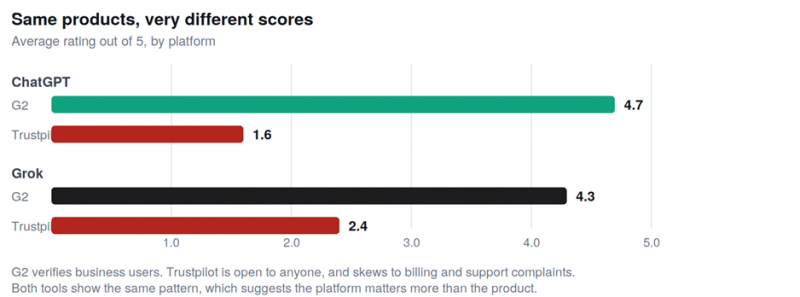
Both products score far higher on the business review platform than on the open consumer one.
Why the platforms disagree
The gap is not evidence that one set of reviewers is lying. It reflects who each platform collects from and what they were doing when they wrote.
G2 and Capterra target business software buyers evaluating a productivity tool, and they verify reviewers. Trustpilot is open to anyone with no purchase verification, and people rarely visit a review site to report that their subscription renewed smoothly. B2B platforms also solicit reviews actively, and one SaaS operator described a process where only users meeting internal success criteria were invited to post publicly, sometimes in exchange for gift cards.
HOW TO READ ANY AI TOOL'S RATINGS Treat the G2 score as a read on the product and the Trustpilot score as a read on the company's billing and support. Neither is the full picture. If you are choosing a tool for daily work, the first matters more. If you are handing over a card and expecting to cancel later, the second matters more. |
What ChatGPT users praise
The positive pattern is remarkably consistent across G2 and Capterra. People cite how little setup it needs, the clean interface, and its role as a daily companion for coding, emails, sales and marketing plans, and learning new material.
An R&D project manager in apparel praised how easy, fast and affordable image creation is on the lower subscription tier, called the web version basic but effective, and highlighted the way Projects organises topics and holds context. They rated the VS Code integration efficient with decent response times. G2 3.5 / 5 R&D Project Manager, apparel and fashion, July 2026 |
A teacher described using it to automate goal tracking and creation, saying it saved meaningful teaching time, and separately for drafting parent emails and optimising individual education plans. G2 Education sector reviewer |
Another reviewer summarised the appeal as time saving and problem solving, giving the example that a presentation which would normally take four or five hours can be done in around one. G2 Productivity use case |
G2's aggregated satisfaction scores back the sentiment up. Ease of use sits at 9.5 out of 10 across more than 1,600 responses, ease of setup at 9.6, and product direction at 9.3.
What ChatGPT users complain about
The criticism clusters just as tightly, and it splits by platform. On G2 the top negative tag is inaccuracy with 107 mentions, followed by unreliable information at 68. That is a quality complaint from people who otherwise like the product.
The same apparel project manager who praised the image tools rated its coding weaker than Claude, saying response accuracy fell below others in the same model range. G2 3.5 / 5 Same reviewer, on the downside |
On Trustpilot the complaints change character entirely. They cluster around billing disputes, support failures, and model quality regressions after updates. Those are company complaints rather than model complaints, which is precisely why the score is so different.
What Grok users praise
Across 15 verified G2 reviews Grok averages 4.3 out of 5, with 13 of 15 saying they would recommend it. The recurring hero is real-time information, matching what the benchmark section of this comparison already found. People use it to cut through social media noise and get a current snapshot rather than scrolling.
A designer said they reach for Grok to explore ideas before starting a website project, valuing that it explains concepts plainly, organises information without overcomplicating it, and handles follow-up questions well. They now use it for brainstorming, project planning and researching unfamiliar topics. G2 Design and web project workflow |
A reviewer working on lead generation said it helps identify the right leads and described the information it returns as accurate and dependable, adding that their only wish was for more connector options. G2 Sales and lead research |
Specific features that draw repeated mentions: the voice mode, customisable tone, fast inference, easy onboarding, moderate pricing, and the Google Drive and Gmail connectors. G2's own tag summary lists ease of use, versatility, response time and creativity enhancement as the top positives.
What Grok users complain about
G2's negative tags are blunt: technical issues, low accuracy, inaccurate responses, context understanding and hallucinations. Reviewers also report that interface and tool navigation feel harder than rival assistants, that image generation feels capped, and that responses can stall or time out.
One G2 reviewer noted that answers are generally helpful but said they still verify important details from original sources on technical or project-specific topics. G2 On trusting the output |
Another flagged that Grok leans heavily toward X-centric use cases and offers weaker guardrails than Gemini or Claude on sensitive topics. G2 On enterprise fit |
Trustpilot is where it gets sharper, and the complaints are specific enough to be checkable.
One reviewer described a promotion that failed to apply, a support agent who confirmed the error and initiated a $30 refund through Stripe, then reversed position hours later claiming no suitable payment was found. Three weeks on, they reported the money still had not returned and the subscription remained active and due to renew. Trustpilot 1 / 5 Refund dispute, April 2026 |
Another objected to the removal of the free unlimited tier in April 2026, arguing that pushing users into paid subscriptions for the image and video generators took away something the community valued, alongside a SuperGrok price increase. Trustpilot Pricing change, mid 2026 |
A long-form reviewer catalogued unfulfilled open-source commitments, noting that a public promise to release Grok 3 weights within roughly six months had passed its deadline by about five months as of July 2026, and argued xAI gained reputational credit for a commitment it had not honoured. Trustpilot Open source commitments, July 2026 |
Support structure explains some of this. xAI runs a help centre, FAQ, email ticketing and Discord, with no live chat or phone line. API documentation is described as reasonably thorough, but consumer billing support is weaker, and Trustpilot reviews repeatedly describe refund difficulty and confusion over which linked account, whether X, Apple or Google, a subscription is actually tied to.
THE SUBSCRIPTION TRAP WORTH KNOWING ABOUT Several complaints trace to a single ambiguity: users cannot tell which account their subscription is billed through, so cancellation attempts land in the wrong place. Before subscribing to either tool, note exactly where you paid, because that is where you must cancel. |
The complaints that map onto the use cases
Set the review themes against the four jobs in this comparison and they line up more neatly than aggregate scores suggest.
| Use case | What reviews confirm | What reviews add |
|---|---|---|
| Writing and everyday work | ChatGPT's ease of use scores 9.5 and setup 9.6, matching its win here | Inaccuracy is the top G2 complaint, so drafts still need checking |
| Real-time research | Grok reviewers name live information as the single best feature | Users still verify technical details against original sources |
| Technical work | The contested verdict shows up in reviews too, with one calling ChatGPT's coding weaker than Claude | Grok's hallucination and context tags suggest more supervision on long tasks |
| Enterprise deployment | Weaker guardrails and X-centric design are named directly by reviewers | Billing and refund friction is a procurement problem the benchmarks miss |
What the reviews change, and what they do not They do not overturn the capability findings. Grok's real-time advantage and ChatGPT's writing advantage both show up in user language as clearly as in the benchmarks, which is a good sign for both. What they add is the commercial risk that testing cannot capture. ChatGPT's low consumer score is driven by billing and support rather than the model, and Grok's is driven by refunds, sudden plan changes and unclear account linking. If you are buying for a team and someone else has to defend the invoice, that difference belongs in the decision alongside AIME scores. The practical read: judge the model on G2, judge the company on Trustpilot, and assume you will need to cancel one day so you know in advance where to do it. |
The Verdict
ChatGPT is the better default. Grok is the better specialist. The right question is which job comes first.
For anyone who wants one tool and no further deliberation, ChatGPT is the sounder choice. It writes better, costs $10 less each month, integrates with more existing software, and behaves predictably enough to place in front of a client or a compliance team. It is the pick for reliable writing, coding, research and enterprise workflows in one mature ecosystem.
That recommendation weakens as the work gets more specific. Grok won the most rigorous public head-to-head this year, holds the top independent ranking on agentic tool use, runs roughly a third faster, and is the only one of the two that can report what is happening online right now. The real difference is workflow fit: Grok is stronger for real-time social analysis, fast technical exploration and less filtered creative work, while ChatGPT is stronger for polished output, integrations, production coding and predictable business use.
Post Comment
Share your thoughts about this article.
Be the first to post a comment!