Table of Content
- Follow the money, not the feature list
- Paid by the minute, gender paired
- Free and advertising funded
- Flat subscription
- Free, community funded
- Freemium matching and paid events
- Five tools, described properly
- The five tools compared
- How to read reviews in this category
- What actually reduces risk
- Verdict
Sorted by how each app makes money, because the revenue model predicts who you will meet more reliably than any feature list does.
Start with what Mirami actually is Mirami is a random video chat platform that pairs men with women, markets its female side as real and verified, and runs on virtual coins with in app purchases. Its Google Play listing carries a Mature 17+ rating. Its own site describes it as comparable to Omegle, Chatroulette and Monkey. That means the product is metered conversation, not social networking. Understanding which part of it you liked determines whether the right alternative is another video roulette or something structurally different, and most articles on this query never make that distinction. |
Follow the money, not the feature list
Every app in this space claims the same things: real people, instant matching, safety tools, global reach. Those claims are unverifiable before you install, and they are identical across products that deliver very different experiences.
One thing is published, checkable and genuinely predictive: how the app gets paid. A service earning per minute has an interest in longer calls. A service earning from advertising has an interest in session volume. A service earning from renewals has an interest in you not having a bad time. These are not accusations, they are just incentives, and they show up in the product.
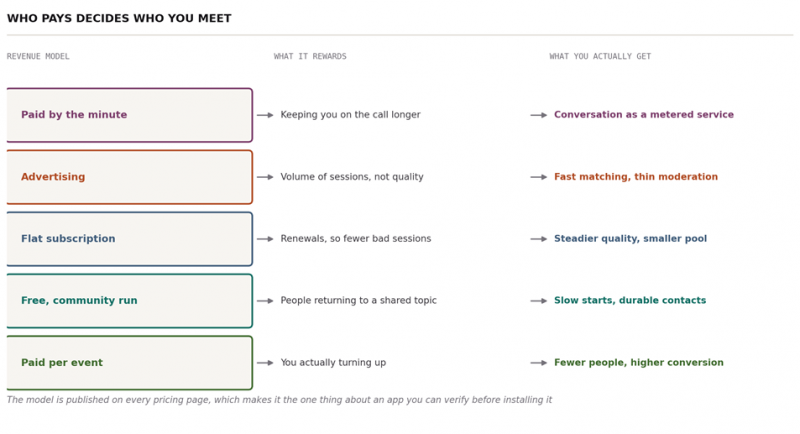
The one property of an app you can check before installing it, and the one that predicts the experience
So the five sections below are five business models rather than five apps. Find the one that matches what you actually want, then the named examples inside it.
Paid by the minute, gender paired
This is Mirami’s own category, so it is where you land if what you liked was the specific experience rather than the general idea.
COIN METERED HOST CHAT Mirami, and the products built the same way | |
You buy virtual currency, and time with a matched partner draws that balance down. Matching is gender paired rather than open, and the platform markets the availability and verification of women on the other side as its core differentiator. Common features include translation, gifts, favourites and chat history. Named alternatives in this same model include CooMeet, Camloo and similar coin based services, all of which pair on the same premise and monetise the same way. | |
SUITS YOU IF You want fast, low commitment attention on demand and you are comfortable paying for time rather than for access | WATCH FOR Perceived cost rises quickly past the free portion, and some user reviews report chats that felt inauthentic or pre recorded |
Be honest with yourself about the category When one side is compensated for being available and the other side pays per minute, the interaction is closer to paid companionship than to meeting someone. There is nothing wrong with buying entertainment, and plenty of adults do. But if your actual goal is a friendship or a relationship that continues off the platform, this model is structurally working against you, because a conversation that ends is a conversation that stops earning. |
Free and advertising funded
The closest thing to the classic random chat experience, and the model with the weakest economics for safety.
AD SUPPORTED ROULETTE Chatroulette, CamSurf, OmeTV, Emerald Chat | |
Free to use, open matching rather than gender paired, monetised through advertising and optional upgrades. Matching is instant and the pool is large, which is the appeal. Moderation is a pure cost centre in this model, which is the structural problem. Quality varies enormously by time of day and region, because the experience is entirely a function of who happens to be online. | |
SUITS YOU IF You want the original random chat experience at no cost and you are willing to skip through a lot to find a good conversation | WATCH FOR Thin moderation is inherent to the model, and one platform in this group drew a formal regulatory warning in 2025 |
The documented record for this category Omegle, the platform that defined this model, shut down permanently on 8 November 2023 after fourteen years. Its founder cited the financial and psychological cost of fighting misuse. The immediate trigger was a lawsuit alleging the platform facilitated child sexual exploitation, settled for a reported 22 million dollars, and the site had been referenced in a large number of cases against child abusers. In August 2025 Australia’s eSafety Commissioner issued a formal warning to OmeTV, citing insufficient safeguards to prevent adults contacting children. This is a category with a real and documented safety history, not a theoretical one, and every product in it is intended for adults. |
Flat subscription

A flat fee changes what the business needs from you, which is the whole argument for this model
SUBSCRIPTION RANDOM CHAT Paid access rather than paid time | |
A monthly fee for access, with no meter running during conversations. The incentive changes meaningfully here, because the business needs you to renew, which means it needs you not to have a bad month. That funds moderation in a way advertising does not and metering does not. The trade is a smaller pool, since a paywall filters out most casual users, and you are paying whether or not you use it in a given week. | |
SUITS YOU IF You use this kind of app regularly and would rather pay a predictable amount than watch a balance drain | WATCH FOR Smaller active pools mean longer waits at off peak hours, and cancellation terms vary widely across this group |
Free, community funded
A different product entirely, and the right answer for a large share of people who arrive at this search.
INTEREST FIRST COMMUNITIES Discord, Meetup | |
Neither is a stranger chat app, and that is the point. On Discord you join servers built around a topic, and conversation happens alongside people who return because of the shared interest. It is free, has no friend matching, and depends entirely on finding an active server that suits you. Meetup organises real world events around activities, has operated since 2002, and is free for members while organisers pay a monthly fee to run groups. It is built for walking into a room of people around a shared topic rather than for one to one conversation. | |
SUITS YOU IF You want people who will still be there next month, and you have a topic or activity to anchor the first conversation | WATCH FOR Slow starts. Neither offers instant matching, and Meetup requires turning up in person, which is the barrier for many people |
Why this model converts better Random matching produces a conversation with no reason to continue. Interest first platforms produce a reason to continue before you have even spoken, because the shared topic is doing the work that a random match asks small talk to do. That is why people who want durable contacts rather than passing ones usually end up here, even though it feels slower at the start. |
Freemium matching and paid events

Purpose built apps solve narrower problems than random chat, and solve them considerably better
PURPOSE BUILT CONNECTION APPS BFF, Peanut, Timeleft, HelloTalk, Tandem, Slowly | |
These solve narrower problems than random chat and solve them better. Bumble’s friendship product was folded into a redesigned app called BFF in 2025, focused on platonic connection. Peanut matches women by life stage. Timeleft seats you at dinner with a small group of strangers in your city on a fixed night and charges per event. For talking to people in other countries, which is a common reason people use random video chat, language exchange apps are the better fit. HelloTalk and Tandem pair you with native speakers who want to learn your language, which gives both sides a genuine reason to keep talking. Slowly takes the opposite approach entirely, delivering messages on a delay based on real distance, which suits people who found random chat too fast. | |
SUITS YOU IF You have a specific goal such as friendship, language practice or meeting people locally, rather than wanting conversation in general | WATCH FOR Paid event models cost more per contact but convert far better, and free matching apps have a well documented gap between matching and actually meeting |
Five tools, described properly
One named product from each model, covered in enough depth to decide without installing anything. They are ordered from closest to Mirami to furthest from it, which is also roughly the order from fastest gratification to most durable outcome.
TOOL 01 - Paid by the minute CooMeet  | ||
What it is The closest direct equivalent to Mirami, and the most developed product in that model. CooMeet is a one to one random video chat that matches men with women only, and it is built around the claim that the female side is genuinely verified rather than bots or recycled footage. How it works Men buy minutes that function as in app currency, and the meter runs while a conversation continues. Women use the platform free and can earn through the virtual gift system, which is the detail that most clearly defines the category. Verification of female accounts is reported to involve identity documents plus a camera based check, with moderators issuing gesture challenges during live sessions to confirm the person on screen matches the account. The platform states a zero tolerance policy on minors and says it may share data with authorities where violations are suspected. How it feels in use Entry is fast, with no lengthy profile setup, and the interface is more polished than most free competitors. Because one side is paying and the other can earn, the conversational dynamic differs noticeably from open random chat. Reviewers consistently describe it as guided and dating adjacent rather than chaotic. | ||
COST Minute packages reported from around 5 dollars for 10 minutes, with a subscription commonly promoted near 25 dollars monthly | PLATFORMS Web, iOS and Android | MATCHING Opposite sex only, no flexible gender filtering |
BOTTOM LINE The strongest execution of the model Mirami uses, and worth considering if verification is the specific thing you want. It is also the model least likely to produce a contact that continues off the platform, because the meter is the business. | ||
TOOL 02 - Free, advertising funded Chatroulette 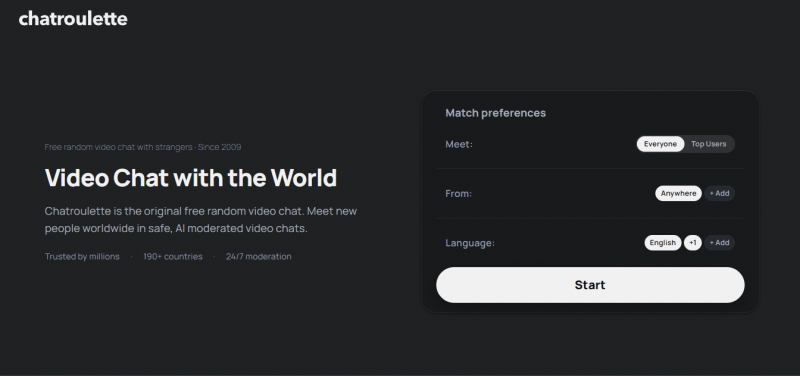 | ||
What it is The original random video chat platform, launched in 2009, and the product that created the entire category. It survived the collapse that took Omegle, which makes it the longest running option here by a wide margin. How it works Open the site, allow camera access, and you are paired with a random person. No account is required for basic use, matching is open rather than gender paired, and skipping to the next person is a single action. The company has invested in automated moderation, including image based detection intended to catch explicit content before a human has to see it, which was a direct response to the reputational problems that defined the platform in its early years. How it feels in use Deliberately barebones next to the paid products. Quality is entirely a function of who happens to be online, so the experience varies sharply by time of day and region. Expect to skip through a substantial number of matches before a conversation holds, which is the trade you accept for a free and unmetered product. | ||
COST Free, with optional paid upgrades | PLATFORMS Browser based, with mobile access | MATCHING Open and random, filters largely behind payment |
BOTTOM LINE The honest choice if you want the classic experience without a meter running. Set expectations for volume over quality, and treat the moderation as better than it once was rather than as comprehensive. | ||
TOOL 03 - Free with paid tier Emerald Chat 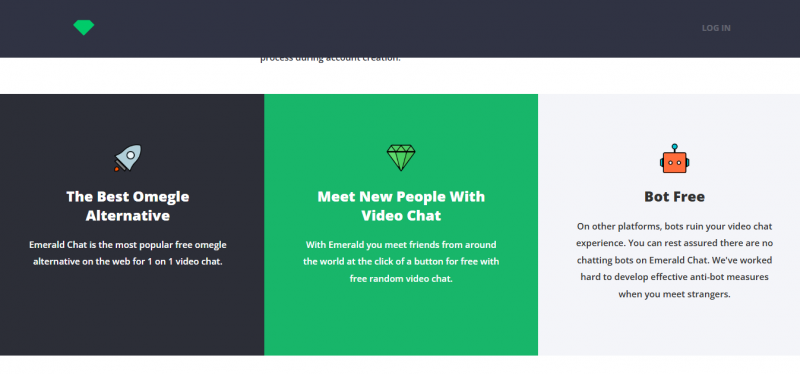 | ||
What it is A deliberate attempt to fix what made the first generation of random chat unpleasant, positioned between the free roulette apps and the paid ones. It keeps anonymity and random matching but adds structure intended to filter out bad actors and bots. How it works Alongside standard random video and text matching, it offers interest based pairing, so you can be matched with people who selected the same topics rather than purely at random. It also operates a reputation system in which behaviour affects your standing on the platform, which gives repeat offenders something to lose. Anti spam measures are a stated focus rather than an afterthought. How it feels in use The community is smaller than the large free platforms, which cuts both ways. Waits can be longer and the pool thinner, particularly outside peak hours, but reviewers consistently describe the conversations as more civil and the bot encounters as less frequent. Interest matching noticeably improves the odds that a conversation has somewhere to go. | ||
COST Free core product with an optional paid tier | PLATFORMS Browser based | MATCHING Random, or filtered by shared interests |
BOTTOM LINE The best compromise in the roulette category, and the one to try first if previous random chat put you off. Smaller pool, better behaviour, and interest matching that makes conversations easier to start. | ||
TOOL 04 - Free, community funded Discord  | ||
What it is Not a stranger chat app at all, which is precisely why it belongs here. Discord is a platform of independent communities called servers, each built around a topic, where conversation happens continuously among people who return because of a shared interest. How it works You join servers rather than matching with individuals. Each server contains text channels and voice channels, and voice channels in particular work as ambient spaces you can drop into rather than as scheduled calls. Video and screen sharing are supported. There is no friend matching algorithm, no swiping and no queue, so what you get depends entirely on finding a server that is active and suits you. How it feels in use Slow at first and durable afterwards, which is the opposite profile to random chat. Nobody will pair you with anyone, and the first week can feel like standing at the edge of a conversation. But the people are still there next month, which is the thing random matching almost never delivers, and familiarity accumulates without either party having to make it explicit. | ||
COST Free, with an optional cosmetic subscription | PLATFORMS Desktop, browser, iOS and Android | MATCHING None, you join communities by topic |
BOTTOM LINE The highest return option for anyone whose actual goal is people who stay. It demands more initiative than any other tool here and rewards it more, provided you have a genuine interest to anchor it. | ||
TOOL 05 -Freemium HelloTalk  | ||
What it is A language exchange platform, and the right answer for a common but rarely stated reason people use random video chat, which is wanting to talk to people in other countries. It pairs you with native speakers of your target language who want to learn yours. How it works You set a native language and a target language, then find partners by language, interests, city or distance. Conversation happens through text, voice notes, voice calls and video calls, with translation, transliteration and correction tools built directly into the chat window so you do not have to leave the app. Beyond one to one chat there are Moments, a feed where you post and receive written corrections, and Voicerooms for group spoken practice, both of which mean your practice does not depend on one partner being available. How it feels in use The reciprocity is what makes it work. Both sides are getting something concrete, so the conversation has a reason to continue that has nothing to do with novelty. Interest based matching on topics such as travel, cooking or gaming, rather than language level alone, produces noticeably better conversations. Many users report friendships that outlast the language practice. | ||
COST Free tier covers most core features, with daily caps on translation and correction. Paid VIP pricing varies significantly by region and promotion | PLATFORMS iOS and Android, mobile focused | MATCHING By language, interests, and location |
BOTTOM LINE The best option here for international contact specifically. Both people have a reason to keep talking, which is the structural advantage random video chat can never offer. | ||
The five tools compared
Read the row for the outcome you want rather than looking for a single winner, since these products are not competing for the same job.
| Tool | Model | Cost | Matching | Pool size | Best outcome it produces |
|---|---|---|---|---|---|
| CooMeet | Paid by the minute | Minute packages or subscription | Opposite sex only | Large | Verified partners, immediately |
| Chatroulette | Advertising funded | Free with upgrades | Open and random | Large and variable | Volume of short conversations |
| Emerald Chat | Free with paid tier | Free core product | Random or by interest | Moderate | Civil conversations with somewhere to go |
| Discord | Community funded | Free | By topic, not by person | Very large | Contacts that persist for months |
| HelloTalk | Freemium | Free tier with paid VIP | By language and interest | Large and international | International friendships with a purpose |
Pool size reflects reported scale rather than measured figures, since none of these platforms publish audited user numbers.
How to read reviews in this category

Most articles ranking apps in this category are published by companies that operate competing apps
This deserves its own section because it changes how much weight you should give to any article on this topic, including this one.
Search for alternatives to any random chat app and most of the top results are published by companies that operate competing random chat apps. The article recommends several products, then names its own as the best option, usually with a sign up link. The reviews are not independent, and the ranking is a sales page in the shape of a comparison.
Three checks take about thirty seconds each and filter most of it.
• Look for a product of their own. Check the site header and footer for an app the publisher operates. If the article recommends that app, the ranking is advertising.
• Check whether any drawbacks are specific. Genuine reviews name conditions where a product performs badly. Promotional ones list generic cons that apply to every product in the category.
• See whether the safety record is mentioned at all. An article about this category that never mentions the documented history is either uninformed or omitting something inconvenient.
Applying it here This article names no single winner, has no product to sell, and states plainly that the paid per minute model is structurally poor for anyone whose goal is a lasting connection. Judge it on whether the reasoning holds rather than on the recommendations, and verify current pricing and policies on each vendor’s own site before paying for anything. |
What actually reduces risk
Generic advice to be careful is not useful. These are the specific behaviours that matter in this category, and they apply regardless of which model you choose.
• Keep the conversation on the platform until trust is genuinely earned. Requests to move to a private channel early are the most common opening move in both scams and grooming.
• Assume anything on camera can be recorded. Screen recording is trivial and undetectable, and coerced intimate imagery is the basis of the most common extortion pattern in this space.
• Treat urgency as the warning sign. Emotional intensity within minutes, or any conversation that turns toward money, gift cards or crypto, is a script rather than a person.
• Withhold identifying details longer than feels natural. Employer, neighbourhood, school and daily routine are the pieces that turn an online contact into an offline risk.
• Use report and block rather than just skipping. Skipping protects you and leaves the account operating. Reporting is the only input moderation systems actually receive.
• Meet in public and tell someone, if you move offline. A public place, your own transport, and one person who knows where you are and when you expect to be back.
For parents, and for anyone under 18 Every product in the first three models is intended for adults, and Mirami’s own store listing carries a mature rating. The documented history in this category, including a platform shutting down over child exploitation litigation and a national regulator warning another over inadequate safeguards, is specifically about adults reaching minors through random matching. If you are under 18, the interest first and purpose built models are the appropriate places to meet people, and random video chat is not. If something has already gone wrong, most countries have a reporting route for online child exploitation and for image based abuse, and platforms are obliged to act on those reports. Reporting is worth doing even when it feels too late. |
Verdict
There is no single best app like Mirami, because the question hides two different goals that pull in opposite directions.
If what you want is immediate, low effort attention, Mirami already does that and the alternatives in its model do the same thing with different pricing. Switching will change the price and the interface and very little else, so the honest advice is to spend the smallest amount that answers your question and stop there.
If what you want is to actually meet people, then the entire first model is working against you, and so is most of the second. A service earning per minute needs the conversation to continue on the platform, which is the opposite of a contact that leaves with you. That is not a criticism of the companies, it is just what the incentive produces.
For that goal the answer is a different shape of product. Discord if you have an interest to anchor it, HelloTalk if the international element was the appeal, Meetup or a dinner app if you want people in your own city, and Emerald Chat if you want to stay in the random chat format but with better behaviour and interest matching. All of them feel slower at the start, and all of them produce more contacts that are still there in a month.
The one test worth applying to any app in this category Ask what the company needs you to do in order to get paid. If it needs you to stay on a call, it will be good at keeping you on calls. If it needs you to renew next month, it will be good at making this month pleasant. If it needs you to turn up to an event, it will be good at getting people into a room together. Every product here is genuinely good at the thing it is paid for, and unreliable at everything else. |
Whichever you choose, the safety practices above are not optional in this category. The documented record includes a major platform closed by litigation over child exploitation and a national regulator formally warning another about inadequate safeguards, both within the last three years.
Post Comment
Share your thoughts about this article.
Be the first to post a comment!