AI writing tools are now part of most content workflows. That makes one question routine for editors and team leads: was this draft written by a person, by an AI model, or by some mix of the two? AI detection tools try to answer that with a probability score.
No detector is perfect, and a score is a signal rather than a final ruling. Even so, the right tool helps you screen submissions, keep quality consistent, and protect a brand voice your readers recognize. Below are five of the strongest options in 2026, each explained in detail, followed by clear comparisons of how they differ.
Why detection matters for content teams
For content teams, detection is really about trust and risk. Publishers vet freelance submissions, agencies hold a consistent standard across many writers, and in-house teams protect a voice that readers have come to expect.
Search visibility is part of the picture too. Google does not ban AI content outright, but it rewards original, people-first work and treats pages made mainly to game rankings as spam, as Google's own guidance on AI-generated content spells out. A detector is one simple way to check that what you publish still reads as authentic and useful.
What to look for in a detector
When you compare tools, a few things matter more than a headline accuracy claim. Look at the false positive rate, which is how often real human writing gets flagged. Check whether the tool shows sentence-level highlights, how it handles edited or paraphrased text, and how well it fits your workflow through team seats, an API, or a browser extension.
| Tool | Best for | Standout feature | Free option | Starts around |
|---|---|---|---|---|
| Originality.ai | Content teams and publishers | AI, plagiarism, and fact-check in one scan | Trial credits | $14.95 / mo |
| GPTZero | Individual writers and editors | Generous free tier with sentence highlights | 10,000 words / mo | Paid tiers above free |
| Copyleaks | Enterprise and multilingual teams | Detection across 30 plus languages | Limited free checks | Custom plans |
| Winston AI | Agencies and small teams | Readability score plus image detection | Free trial | $12 / mo |
| Sapling | Support and product teams | Real-time checks inside your tools | Free web checker | $25 / mo |
Pricing changes often. Treat these figures as a starting point and confirm current numbers with each vendor.
01 - Originality.ai
Best for: Teams and publishers · Free: Trial credits · From: $14.95/mo · Languages: 30+ · Extras: Plagiarism, fact-check
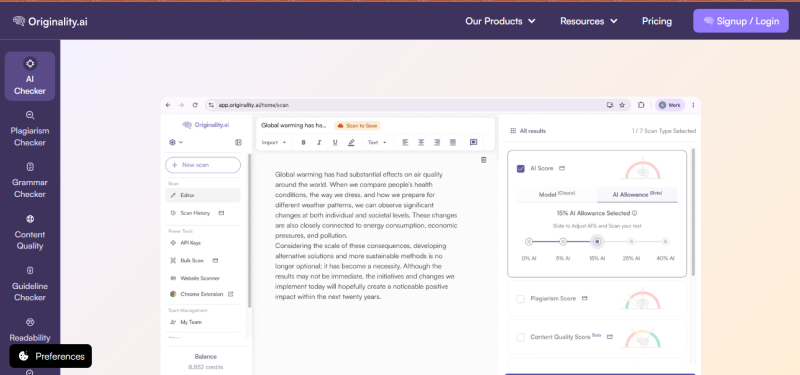
Originality.ai is built for people who review content at volume. A single scan returns an AI probability score, a plagiarism check, and readability and fact-checking signals, which removes the friction of running two or three separate tools on every article. For an agency handling twenty freelancers, that consolidation is the core value.
On accuracy, it is one of the stronger performers on paraphrased and adversarial text, an area where most detectors weaken. Independent adversarial benchmarks have placed it near the top of the field for content that has been run through a paraphrasing tool. Real-world accuracy on plain AI output tends to land in a wide band rather than the near-perfect figure on the marketing page, and it is weaker on the newest model families, so the fact-check and plagiarism layers often carry as much weight as the raw score.
The pricing model is credit-based. The Pro plan sits around $14.95 a month for a block of credits, where one credit covers roughly 100 words, with a pay-as-you-go option and an Enterprise tier that unlocks API access and larger volumes. Team dashboards, a Chrome extension, and content-management integrations round out the daily workflow.
The trade-offs are real. The credit system and dashboard feel heavier than a solo writer needs, the interface shows its age next to newer tools, and false positives still surface on genuine human writing. It rewards teams that build a repeatable review process around it.
Best fit: agencies and publishers screening many submissions each month who want detection, plagiarism, and fact-checking in one place.
02 - GPTZero
Best for: Writers and editors · Free: 10,000 words/mo · From: Paid tiers above free · Languages: English focus · Extras: Sentence highlights
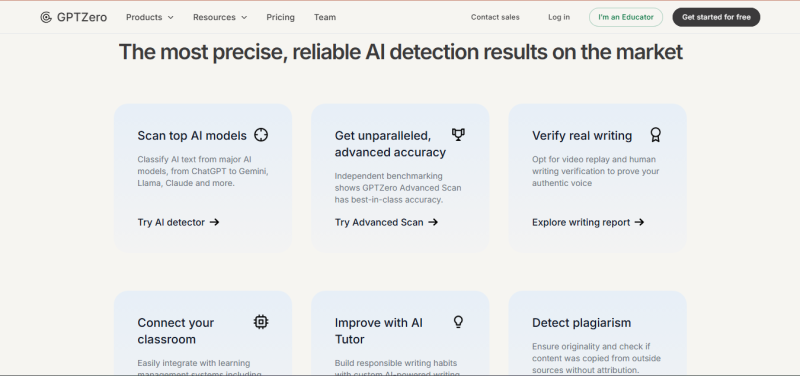
GPTZero grew out of a Princeton project and became one of the most recognized detectors, especially in education. Its defining choice is calibration: it leans conservative, tuning for a very low false positive rate so that real human writing is unlikely to be wrongly flagged. In the tool's own testing that rate is a fraction of a percent, among the lowest of the major detectors.
That caution has a cost. On broad benchmarks that reward catching every piece of AI text, GPTZero scores lower than aggressive tools, because it would rather miss some AI content than accuse an innocent writer. For a writer or editor, that is usually the right bargain. It also loses ground on heavily edited or humanized text, where its catch rate drops.
Writers value its sentence-level highlights, which point to the specific passages that raised the score, and its free tier of roughly 10,000 words a month, which renews and covers several drafts. It calibrates against bias toward non-native English writers, a common failure mode elsewhere, and paid tiers add deeper reporting and team history.
One note for buyers: GPTZero was acquired in 2026 by the company behind a major writing assistant, so it now sits inside a larger writing ecosystem. If you mainly want a careful second opinion on your own drafts, it remains an easy default.
Best fit: individual writers and editors who want a cautious, readable check with a strong free tier.
03 - Copyleaks
Best for: Enterprise, multilingual · Free: Limited checks · From: Custom plans · Languages: 30+ · Extras: Image and video, API
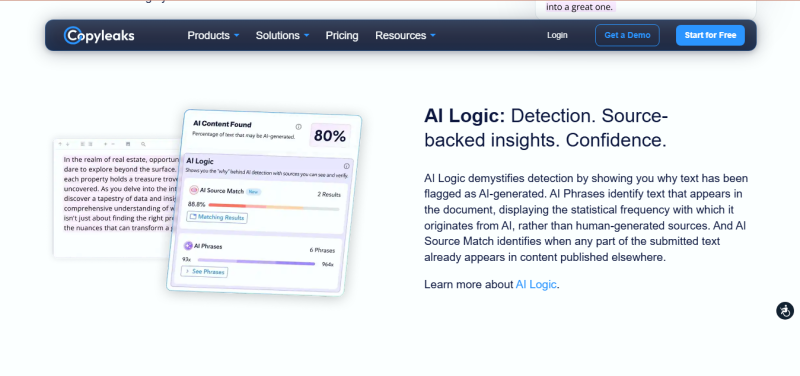
Copyleaks is the pick when scale, languages, and compliance matter. It detects AI writing across more than 30 languages, which is a hard requirement for global publishers and international institutions that the English-first tools cannot meet. It also combines AI detection with a full plagiarism engine in the same platform.
On accuracy, independent testing has shown it holding up better than some rivals on lightly edited AI text, which is where many detectors fall apart. Like every classifier it can still be defeated by heavy paraphrasing, so the score remains a screening aid rather than proof.
The enterprise features are the real differentiator. Copyleaks offers multiple sensitivity modes, a well-documented API with several software development kits, learning-management integrations for schools, and security controls such as SOC 2 and ISO 27001 alignment, including a no-storage option for sensitive content. It also reaches beyond text into image and video detection.
The cost per check can run higher than tools that only do AI detection, and pricing is oriented toward organizations rather than individuals, so it earns its place where the extra breadth and controls are truly needed.
Best fit: large or international teams that need multilingual coverage, API depth, and enterprise-grade data controls.
04 - Winston AI
Best for: Agencies and small teams · Free: Trial · From: $12/mo · Languages: Several · Extras: Readability, image detection
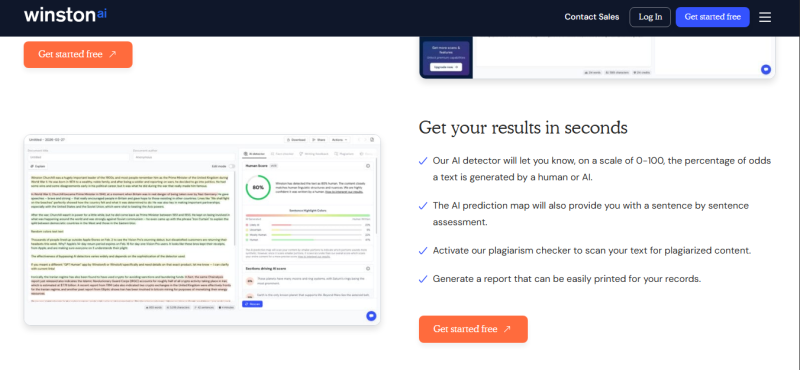
Winston AI frames detection as part of content quality rather than a simple pass or fail. Alongside an AI probability it returns a human score you can treat as an optimization target and a Flesch-Kincaid readability grade, which fits how editorial teams already think about polish and clarity.
It also reaches beyond text. Winston detects AI-generated images and deepfakes from popular generators, extracts metadata, and includes optical character recognition for scanned or handwritten input, alongside support for several languages and a built-in plagiarism check. Its subscription pricing is predictable and starts low, which suits smaller agencies.
The main caveat is evidence. Winston's headline accuracy numbers come largely from in-house testing rather than independent benchmarks, so treat the highest figures as a claim to verify on your own samples. Its API depth and academic standing are lighter than Copyleaks, and like all detectors it can misread edited text.
Best fit: agencies and small content teams that want detection tied to readability and a clear, low subscription price.
05 - Sapling
Best for: Support and product teams · Free: Web checker · From: $25/mo · Languages: English only · Extras: Real-time, low-cost API
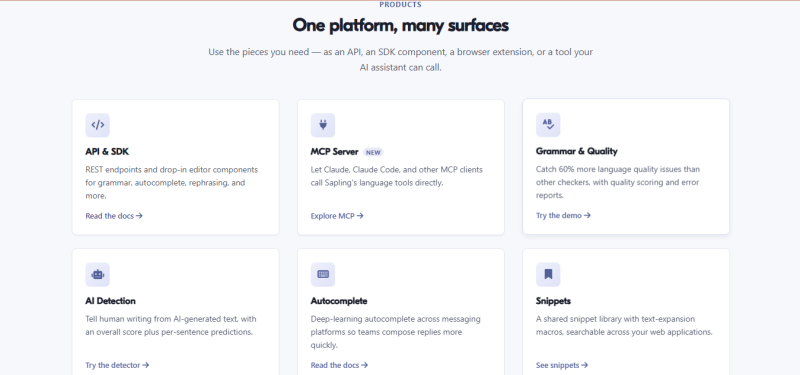
Sapling started as a writing assistant for customer-facing teams, and its detector reflects that origin. It runs in real time through a browser extension and an API, so checks happen inside the tools your team already uses, such as a help desk or a customer-relationship platform, rather than in a separate tab.
The web checker is free with no hard cap, sentence-level highlights point to suspect passages, and its API is priced very low, which makes it attractive for developers who need basic detection at high volume. It covers the major model families across GPT, Claude, Gemini, and others.
The honest limitation is accuracy calibration. In independent testing Sapling has posted one of the higher false positive rates in the field and weaker overall accuracy than the leaders, especially on short or edited text. That places it as a first-pass screen rather than a final authority. Paid tiers add team analytics, single sign-on, and self-hosted deployment for larger organizations.
Best fit: support and product teams, and developers, who want quick, in-workflow screening at the lowest cost and will pair it with human review.
The differences that decide it
On paper these tools look similar, since all five return an AI probability. The gaps appear once you look at how they are calibrated, what they charge for, which languages and media they cover, and where they live in your workflow. The sections below break down each of those axes.
Accuracy and false positives
The biggest split is calibration. GPTZero is tuned to protect innocent writers, so it holds a very low false positive rate but catches less raw AI text. Sapling sits at the opposite end of the reliability scale, with the highest false positive rate among the leaders in independent tests, which is why it works best as a first pass.
Originality.ai leads the pack on paraphrased and adversarially edited content, while Copyleaks holds up better than most on lightly edited text. Winston AI reports the highest accuracy of the group, but from in-house testing rather than third-party benchmarks, so its numbers deserve a personal check. The lesson is that a high catch rate and a low false positive rate pull against each other, and no single tool wins both.
Originality.ai CHOOSE IF You review other people's work at scale and want detection, plagiarism, and fact-checking in one scan, with the strongest handling of paraphrased text. | GPTZero CHOOSE IF You check your own drafts and fear a false accusation more than a missed one, and you want sentence highlights plus a large free tier. |
Free access and pricing models
The pricing structures differ from one another, so the cheapest tool depends on how you use it. GPTZero offers a renewable free tier of about 10,000 words a month, and Sapling gives a free web checker with no hard cap, which makes both easy entry points for individuals.
Originality.ai runs on credits, where one credit covers roughly 100 words, with a Pro plan near $14.95 a month and an Enterprise tier that unlocks the API. Winston AI uses a straightforward subscription from around $12 a month after a trial. Copyleaks is mostly custom and enterprise-priced. For high-volume automation, the number to compare is the per-word API cost, where Sapling and Originality.ai tend to be the most economical.
Languages and media types
Coverage beyond English is where the field separates sharply. Copyleaks and Originality.ai both handle 30 or more languages, but only Copyleaks and Winston AI extend detection to images and, for Copyleaks, video. GPTZero and Sapling are English-focused and text-only, which is fine for many teams but a dealbreaker for global or multimedia work.
| Tool | Languages | Beyond text | Built-in plagiarism | API |
|---|---|---|---|---|
| Originality.ai | 30 plus | Text only | Yes | Yes |
| GPTZero | English focus | Text only | Limited | Yes |
| Copyleaks | 30 plus | Images and video | Yes | Yes, with SDKs |
| Winston AI | Several | Images and deepfakes | Yes | Basic |
| Sapling | English only | Text only | No | Yes, low cost |
Coverage varies by plan. Confirm language and media support for the specific tier you intend to buy.
Workflow and integrations
Where a tool lives shapes whether your team uses it consistently. Originality.ai centers on a review dashboard with team seats, a browser extension, and content-management hooks. Copyleaks is the most integration-heavy, with software development kits and learning-management connections aimed at engineering and institutions.
Winston AI leans on an agency-friendly dashboard with shareable reports, GPTZero pairs its highlights with writing-history and classroom features, and Sapling is the only one that runs live inside support and sales tools through its extension and API. If checking has to happen without breaking flow, that placement is decisive.
Copyleaks CHOOSE IF You need breadth and control: many languages, image and video detection, deep API and SDKs, and enterprise security such as SOC 2 and ISO 27001. | Winston AI CHOOSE IF You are a small agency that wants detection tied to readability and a human score, with predictable low pricing, and can verify accuracy on your own samples. |
Where Sapling sits apart
Sapling is the outlier of the five. It trades top-tier accuracy for placement and price, living inside your existing tools in real time, staying English-only, and undercutting everyone on API cost. That makes it a strong triage layer for teams that check high volumes of short messages, provided a person makes the final call.
What these tools can and cannot do
Every tool on this list is a signal, not a verdict. Detectors read statistical patterns, so formal, tidy, or highly structured writing can look machine-made even when a person wrote it. Research from Stanford found that detectors flagged more than half of essays by non-native English writers as AI-generated, a fairness problem worth keeping in mind, and you can read the full study on that bias here.
Paraphrasing and light editing also pull detection scores down, so a clean pass does not prove human authorship. The safe approach is to combine any score with human judgment, edit history, and context before you act on it.
ONE QUICK HABIT Before you trust any detector, run a piece of writing you know is human through it first. If your real work comes back flagged as AI, that tool's false positive rate is too high for your needs. |
What to do when a draft gets flagged
A high AI score does not always mean you have to start over. Often the fix is sentence-level editing that adds your own voice, specific examples, and real detail, since vague, generic phrasing is what raises scores in the first place.
If AI is part of your drafting process and you want the finished piece to read naturally, it helps to understand how humanizing tools change text. Our breakdown of whether SafeWrite AI can make AI content sound human walks through what these tools do well and where they still fall short.
How to choose the right tool
Match the tool to your role. A solo writer wants a careful, low-false-positive check, which points to GPTZero. A content team or publisher screening volume wants detection and plagiarism in one place, which points to Originality.ai or Winston AI.
A large or multilingual organization leans toward Copyleaks, while a support or product team gains most from Sapling's in-workflow checks. Whatever you land on, verify it against writing you trust and keep a person in the loop.
Choose for your workflow, verify, then trust your team
AI detection tools have become a normal part of the content workflow, but their job is to inform decisions, not to make them. Originality.ai and Winston AI suit content teams, GPTZero suits individual writers, Copyleaks suits enterprise and multilingual work, and Sapling suits fast in-workflow checks.
Pick the one that matches how you work, test it against writing you already trust, and keep a human in the loop. Used that way, a detector protects your quality and your reputation without getting in the way.
Post Comment
Share your thoughts about this article.
Be the first to post a comment!