Every ranking you have read answers a question nobody asked. "Animation" means four different jobs, and the tool that wins one loses the others badly. Here is what the pricing pages and credit math actually say.
THE SHORT ANSWER
Runway wins cinematic and generative clips. Vyond wins character-driven 2D explainers. Synthesia wins presenter and training video at scale. Kling wins physics-heavy realism for the money. If you only remember one thing: pick your category first, your tool second. Picking tool-first is why most teams pay for two subscriptions and finish neither project. |
The four categories of animation AI
Ask "what is the best animator AI" and you get a list of fifteen tools with star ratings. That list is useless, because the tools on it are not competing with each other. Asking Runway to build a compliance training module is like asking a film camera to write a memo.
The market splits cleanly into four jobs. Almost every bad purchase happens when someone buys from the wrong column.
JOB 01 Generative clips Text or image goes in, a few seconds of cinematic footage comes out. B-roll, mood boards, music visuals. Runway, Kling, Luma, Pika, Sora. | JOB 02 2D character explainers Scripted stories with characters, props, and scenes you control frame by frame. Vyond, Animaker, Powtoon. |
JOB 03 Presenter and avatar video A digital human reads your script in 120+ languages. Training, onboarding, internal comms. Synthesia, HeyGen. | JOB 04 3D motion and rigging Motion capture, physics-aware keyframes, character rigs. Cascadeur, DeepMotion, Autodesk Maya. |
The ten tools, one at a time
Before any comparison makes sense, you need to know what each tool is for. These are grouped by job, in the order of the four categories above. Read the two or three in your category and skip the rest.
Runway
A New York AI research company building what it calls General World Models, systems designed to simulate physical environments and characters. In practice, Runway is the most complete production environment in generative video: you generate, edit, and direct in one place. It has also quietly become a marketplace, since one subscription now includes Google Veo 3 and 3.1, Kling 3.0 Pro, Seedance 2.0, BFL Flux.2 and Seedream 5.0 alongside Runway's own models. Terms of Use were last updated 11 February 2026.
STANDARD $12/mo annual, 625 credits | PRO $28/mo annual, 2,250 credits | MAX $76/mo annual, 9,500 credits | BURN RATE 25 credits/sec on Gen-4.5 |
STRENGTHS
● Max buys 791 seconds of Gen-4.5 or 1,900 seconds of Gen-4 Turbo per month
● Pro costs about $0.012 per credit annually, roughly 37% cheaper per credit than Standard
● Gen-4 Turbo at ~5 credits/sec stretches the same 625 credits from 25 to 125 seconds
● Commercial use permitted on all 5 tiers including free, per Runway’s Usage Rights page
● Upgrades prorate and refresh credits the same day, so a mid-month tier change is not wasted
LIMITATIONS
● Runway’s own help article confirms credit-usage miscalculation as a recognised, recurring problem, with users reporting internal errors that still drain balances
● Reviews from late 2024 through January 2026 show zero documented infrastructure improvements against 10 to 20 minute queues
● Minimum credit top-up is 1,000, so there is no small refill
● A 60-second 1080p Gen-4 video runs about 1,500 credits, which is 2.4 months of Standard
● Workflow automation nodes bill separately, and 100 monthly runs with one Claude node costs 300 to 400 credits
Best fit: Freelancers, YouTubers and small teams who need control over the shot and will iterate three times before keeping one.
Pika
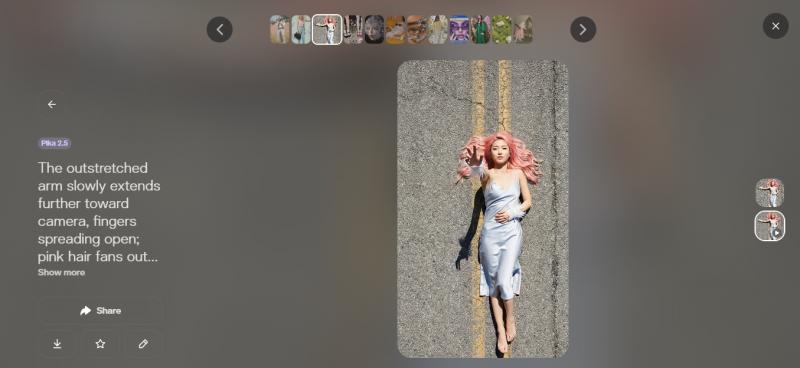
The cheapest credible entry into generative video. Pika trades length and camera control for speed and price, which turns out to be exactly the right trade for short-form social. Its pricing is also refreshingly simple in a category built on credit math: three flat tiers, no per-second arithmetic.
STANDARD $8/mo | UNLIMITED $28/mo | PRO UNLIMITED $58/mo | MAX CLIP About 4 seconds |
STRENGTHS
● Standard at $8 undercuts Runway Standard by $7 and Pika Unlimited at $28 matches Runway Pro’s price with no credit ceiling
● 3 flat tiers, so output never swings 5x on model choice the way Runway credits do
● Faster turnaround than Runway, which reports 10 to 20 minute queues across tiers
LIMITATIONS
● Maximum clip length is roughly 4 seconds against Runway’s 10
● Lower output resolution than Runway, which upscales to 4K from Standard upward
● No motion brush or director mode equivalent, so shots cannot be pre-planned
● 1 model only, against the 6+ Runway bundles into every paid tier
Best fit: Social-first creators posting daily, where four seconds is the format rather than a limitation.
Luma Dream Machine
Luma’s distinction is not raw quality, though that is strong. It is predictability. The platform is built around repeatable operations, extend, modify and reframe, which means you can plan a sequence rather than roll dice on each clip. The intended workflow is explicit: generate a three-second base clip, then extend it. It is also the strongest of the group on realistic physics and natural motion.
STANDARD $10/mo | PRO $30/mo | PREMIER $95/mo | MONETIZED WORK Plus or Unlimited tier |
STRENGTHS
● Physics and natural motion rated above Runway, which leads instead on stylistic control
● Extend, modify (video-to-video) and reframe are 3 repeatable operations, not one-off effects
● Licensing names the exact tier monetized work requires, against Runway where reviewers report cancellation and billing disputes
● The documented workflow is a 3-second base clip, then extend, so longer sequences are planned rather than re-rolled
LIMITATIONS
● Monetized content requires Plus or Unlimited, so the $10 tier will not cover commercial work
● Weaker stylistic control than Runway, which leads on motion brush and director mode
● 1 model only, so no Veo or Kling fallback under the same bill
Best fit: Anyone building sequences rather than single shots, particularly where physical realism carries the frame.
Kling
Kling made its name on physics. Fluid, hair and cloth, the things that betray AI video fastest, are where it concentrates, and the 3.0 generation is widely treated as the physics-realism benchmark. On pure cost per second for straightforward generations, Kling 3.0 can run 3 to 5 times cheaper than Runway. It is also bundled into every paid Runway tier, so many people already have it.
CURRENT MODEL Kling 3.0 Pro | COST PER SECOND 3 to 5x below Runway | INCLUDED WITH Every paid Runway tier | SPECIALISM Fluid, hair, cloth physics |
STRENGTHS
● Physics-based realism for fluid and hair is the reason it appears on nearly every 2026 shortlist
● 3 to 5 times cheaper per second than Runway on simple generations
● Available inside Runway Standard at $12/mo, so no second subscription is needed
LIMITATIONS
● No editing environment around the model, where Runway bundles Aleph and Act-Two at $12/mo
● No equivalent to Runway’s motion brush or director mode
● Bought standalone it is a second bill for a model already inside Runway Standard
Best fit: Hero shots where physical realism carries the frame, called from a platform you already pay for.
Vyond
The most capable manual animation builder on the market, and the one tool here a traditional animator would recognise as animation software. Its character-driven studio is built for hand-crafted explainer and training video, with AI layered on top rather than substituted for the craft. Text-to-video accepts a document, a script or a URL. Note that Vyond has renamed its tiers before, from Essential and Premium to the current lineup.
BUSINESS $58/mo annual ($699/yr) | PAID MONTHLY $99/mo, a 71% premium | PROFESSIONAL ~$100/mo per user ($1,199/yr) | ENTERPRISE / AGENCY ~$137 and ~$167/mo per seat |
STRENGTHS
● 10,000 credits per user per month, with no per-minute output ceiling
● 650+ high-quality text-to-speech voices
● 3 text-to-video entry points (doc, script, URL), plus screen and webcam recording
● 2.5D animation with depth effects, which most AI tools cannot produce
LIMITATIONS
● AI features draw down the same 10,000-credit pool that everything else uses
● Paying monthly costs $99 against $58 annual, a $492 yearly difference
● Business is single-user, so a second animator means $1,398/year rather than $699
● Agency seats at roughly $167/mo per user make small teams expensive fast
Best fit: Teams whose characters need to act, not merely appear, and who will revise output rather than ship the first pass.
Animaker
Closer to Canva than After Effects, which is a compliment in the right context. One prompt generates a full video across 2D, whiteboard and newer cinematic and realistic generative modes, and an advanced editor is there when the AI gets the timing wrong. Its voice library is the largest of any tool in this roundup by a wide margin.
TIERS ~$15, ~$25, ~$43/mo annual | VOICES 1,800+ in 180+ languages | STYLES 2D, whiteboard, cinematic | FREE TIER Yes, plus custom Enterprise |
STRENGTHS
● 1,800+ voices across 180+ languages, nearly triple Vyond’s 650
● Auto lip-sync maps mouth movement to narration across all 1,800+ voices
● AI subtitle generation built in across 180+ languages, no separate captioning pass
● A 30-second product demo is achievable in one session by a non-animator
● Entry tier at ~$15/mo is roughly a quarter of Vyond Business
LIMITATIONS
● Template ceiling caps custom character work, where Vyond offers frame-level control for $43 more
● HD export sits behind the paywall, the standard freemium pattern across 13 tested free video makers
● Drag-and-drop trades Vyond’s frame-level control for speed, closer to Canva than After Effects
Best fit: Solo marketers and beginners who need volume and speed, where characters need presence rather than performance.
Synthesia
The most widely used AI avatar platform, with 50,000+ teams and a 4.7 rating from over 2,000 G2 reviews. You paste a script, pick an avatar and a language, and it renders. Its real advantage is multilingual reach: one English script becomes a training video in 40 languages, which is why enterprise L&D adopted it first. Minutes are metered to the second, so a 59-second video leaves 9:01 on a Starter plan.
STARTER $18/mo annual, $29 monthly | CREATOR $64/mo annual, $89 monthly | UNIT COST $2.90 to $2.97 per minute | CAPS 10 and 30 min/mo, no rollover |
STRENGTHS
● Zoom reports 90% faster production and $1,000 to $1,500 saved monthly per employee, with one designer making 200+ micro videos in 6 months
● Teleperformance reports $5,000 saved per video across 40+ languages for 380,000 employees in 170 markets
● Spirit Airlines reports a 76% drop in HR phone enquiries and 600% higher content engagement
● AI Playground puts Veo 3.1 and Sora 2 inside the platform on every tier including free
● PowerPoint import keeps the original deck design and converts speaker notes into the script
LIMITATIONS
● Additional editors pay full price with no seat discount, so five Creator editors is $445/mo or $5,340/year
● Minutes never pool across seats, so one editor caps at 30 while another’s 30 expire unused
● Overages run roughly $2 to $5 per minute and are not documented in official pricing
● Capterra reviewers report near-identical videos approved once then flagged later, with support unable to override moderation
● Medical and healthcare content is blocked on stock avatars, requiring a custom avatar at a $1,000/year minimum that reviewers say is disclosed only after purchase
Best fit: L&D, HR and internal comms teams who need a human face delivering policy at multilingual scale.
DeepMotion
Point a camera at a person and get their motion on a 3D character. DeepMotion does markerless capture from ordinary video, with no suit and no hardware, and its team came out of Blizzard, Pixar, Disney, Roblox, Microsoft and Ubisoft. Billing is unusually legible for this category: one credit buys one second of animation or one 3D pose. It solves the capture half of 3D animation cheaply.
ENTRY PRICE From $9/mo | CREDIT RATE 1 credit = 1 second | FREE TIER 2 animation minutes/mo | MULTI-PERSON Up to 8 from one video |
STRENGTHS
● Captures up to 8 people from a single video input for group scenes
● Exports 3 formats (FBX, BVH, GLB) straight into game engines
● Rotoscope Pose Editor traces motion over the source video, with multi-joint select and auto-save every minute
● Face and hand tracking add 0.5 credits per second each, so the cost is predictable before you run a job
● Credits are earnable back by labelling or correcting your own jobs, which no other tool here offers
LIMITATIONS
● Falls behind on advanced rigging and keyframing, the 2 areas Cascadeur is built around
● Commercial licensing needs a paid plan, so the 2 free monthly minutes cannot ship
● Studio plan’s unlimited credits drop to low job priority after the first 7,200 each month
● Needs a performer on camera, so invented motion (creatures, impossible stunts) falls outside its range
Best fit: Game and VR teams with access to a performer, who need motion on characters quickly.
Cascadeur
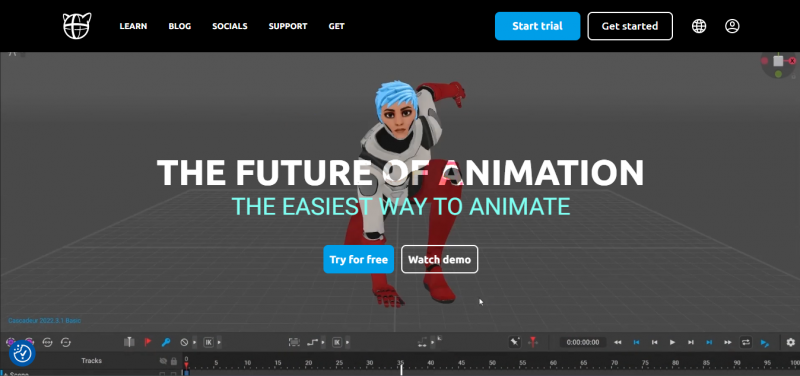
The opposite approach to DeepMotion. Built by Nekki, the studio behind Shadow Fight and Vector, Cascadeur emerged from their own animation needs and took $1.5m in internal funding in 2021 to generalise it. AutoPhysics analyses your animation and proposes a physically accurate version on a ghost character, which you accept or reject. The company is explicit that it cannot generate motion for you: you animate, it assists.
STRENGTHS
● AutoPhysics enforces weight, balance and momentum, where competing tools generate poses under no physical constraint
● The control rig avoids Euler angles, removing gimbal lock entirely rather than working around it
● Animation Unbaking converts baked mocap into editable keyframes, selecting keyframes and interpolation intervals for you
● Yearly Indie at €12/mo leaves a perpetual licence behind when it expires, unique among these 10
● Exports FBX, DAE and USD into Unreal, Unity, Blender, Maya, 3ds Max and Daz 3D
LIMITATIONS
● Indie blocks 3 tools: Animation Retargeting, Scene Linking, and Environment Interaction in AutoPhysics
● Indie commercial use is capped at $100k gross revenue per year
● Cascadeur states AutoPhysics results are not guaranteed on animation with poor timing and spacing, so it cannot rescue weak work
● No skinning or joint hierarchy tools, and models far from 180cm hit rigging problems
● No AAA studios or film projects are publicly documented, and the 1 detailed case study is a Spanish indie RPG
Best fit: Indie developers and small studios, typically 1 to 5 people, animating body mechanics without mocap access.
Autodesk Maya
The industry standard, now with AI folded into an expert pipeline rather than sold as a shortcut. Bifrost handles cloth, fluid and particle simulation, and MotionMaker generates natural character motion from a few keyframes or a guide path, cutting manual keyframing in previs and layout. This is where the other tools’ output eventually lands, which is why FBX and USD support matters everywhere else in this report.
PRICING Autodesk subscription | SIMULATION Bifrost framework | AI FEATURE MotionMaker | LEARNING CURVE 100+ hours |
STRENGTHS
● All 4 stages in one application: modeling, animation, VFX and rendering
● Bifrost simulates cloth, fluid and particles, which none of the other 9 tools attempt
● MotionMaker generates natural motion from a few keyframes or a guide path, cutting previs and layout keyframing
● The destination pipeline that Cascadeur (FBX, DAE, USD) and DeepMotion (FBX, BVH, GLB) both export into
LIMITATIONS
● Traditional animation software demands roughly 100+ hours against 5 to 10 for template tools
● AI assists an expert workflow, so the 100+ hour curve is the cost, not the licence
● Overkill for anything the 9 tools above already handle
Best fit: Studios with an existing 3D pipeline who want AI to compress previs, not to skip it.
Head to head
Now that each tool has been introduced on its own terms, the direct comparisons are worth something. These are the four decisions that come up most, each broken into the criteria that decide them. The marked side wins that row.
Runway Pro vs Pika
| Runway Pro | CRITERION | Pika |
|---|---|---|
| › $28/mo annual, 2,250 credits | PRICE | › $8/mo, cheapest real entry |
| › Up to 10 seconds | CLIP LENGTH | About 4 seconds |
| › Motion brush, director mode, precise control | CAMERA | Limited control |
| Slower, 10 to 20 min queues reported | SPEED | › Faster turnaround |
| › Veo, Kling, Seedance, Flux bundled in | MODELS | Pika only |
Verdict: Pika wins social-first content where speed and cost beat polish. Runway wins agency and client work where the longer clips and camera control are the whole point. At 3.5x the price, Runway has to earn it, and it only does if you need control.
Vyond Business vs Animaker
| Vyond Business | CRITERION | Animaker |
|---|---|---|
| $58/mo annual, $99/mo monthly | PRICE | › From ~$15/mo annual |
| › Frame-level control, custom character stories | CEILING | Template-driven, Canva-like |
| Steeper, built for hands-on animators | LEARNING | › Drag and drop, hours not weeks |
| 650+ voices | VOICE | › 1,800+ voices, 180+ languages |
| › Doc, script and URL to video | AUTOMATION | › Single-prompt full video generation |
Verdict: Animaker if you need volume and speed and your characters mainly need to be present. Vyond if your characters need to act. The gap is roughly $43 a month and about 90 hours of learning curve, so be honest about which constraint is real for you.
Synthesia Creator vs Vyond Business
| Synthesia Creator | CRITERION | Vyond Business |
|---|---|---|
| $64/mo annual, $89/mo monthly | PRICE | › $58/mo annual |
| Capped at ~30 min/mo, no rollover | OUTPUT CAP | › Credit pool, no minute ceiling |
| › 120+ languages from one script | LANGUAGES | 650+ voices, less turnkey |
| › Digital presenter talking to camera | FORMAT | › Characters, props, scenes |
| ~$2.97 per finished minute | UNIT COST | › No per-minute metering |
Verdict: These are not really competitors, which is exactly why teams buy the wrong one. Synthesia if a human face delivering the script is the point, and especially if you need it in 40 languages. Vyond if the concept needs illustrating rather than narrating.
Cascadeur vs DeepMotion
| Cascadeur | CRITERION | DeepMotion |
|---|---|---|
| €12/user/mo Indie, €49 Pro | PRICE | › From $9/mo |
| › AutoPhysics enforces weight and momentum on your keyframes | METHOD | › Markerless capture from ordinary video |
| › You accept or reject every ghost-character suggestion | CONTROL | Rotoscope editor fixes drift after the fact |
| › Quick Rigging, no gimbal lock | RIGGING | Trails competitors |
| Watermarked, feature-limited | FREE TIER | › 2 animation minutes monthly |
| $100k/year gross revenue cap on Indie | LICENCE | › Any paid plan grants commercial rights |
| You animate it, frame by frame | INPUT | › Point a camera at a person |
Verdict: DeepMotion when you have a performer and want their motion on a character fast, and its $9 entry and 2 free minutes make it the cheaper thing to try first. Cascadeur when there is no performer and the motion has to be invented, which is most of what games need. Studios run both, because they solve opposite halves of the same problem. Watch the Indie revenue cap: cross $100k and Cascadeur costs €49 rather than €12.
What these tools actually cost
Sticker prices are close to meaningless here. Two tools at $29 can differ by a factor of ten in finished output, because one bills by the seat and the other bills by the second.
| TOOL | ENTRY PRICE | WHAT YOU GET | THE CATCH |
|---|---|---|---|
Runway GENERATIVE | $12/mo annual / $15/mo monthly | 625 credits per month, watermark removed, plus Veo, Kling and Seedance in the same subscription | 625 credits is roughly 25 seconds of Gen-4.5. Credits do not roll over. |
Runway Pro GENERATIVE | $28/mo annual / $35/mo monthly | 2,250 credits, about 90 seconds of Gen-4.5 or 187 seconds of Gen-4 | Best cost per credit of any tier. Minimum top-up purchase is 1,000 credits. |
Pika GENERATIVE | $8/mo | Fast short-form generation, cheapest real entry point | Shorter maximum clips and less camera control than Runway. |
Luma Dream Machine GENERATIVE | $10/mo | Extend, modify and reframe operations built for sequences | Monetized work needs a higher tier. |
Kling 3.0 Pro GENERATIVE | Included in paid Runway tiers | Physics-based fluid, hair and cloth realism, 3 to 5x cheaper per second than Runway | No editing environment or camera controls wrapped around the model. |
Vyond Business 2D EXPLAINER | $58/mo annual / $99/mo monthly | 10,000 credits per user, 650+ voices, doc and script to video | Single seat. AI features draw from the same credit pool. |
Animaker 2D EXPLAINER | From ~$15/mo annual | 1,800+ voices across 180+ languages, auto lip-sync, 2D and whiteboard styles | Template-driven. Closer to Canva than After Effects in ceiling. |
Synthesia Starter PRESENTER | $18/mo annual / $29/mo monthly | About 10 video minutes a month, 125+ avatars, logo removed | Per editor seat. Minutes do not pool and do not roll over. |
Synthesia Creator PRESENTER | $64/mo annual / $89/mo monthly | About 30 minutes a month, 180+ avatars, up to 5 personal avatars | Roughly $2.97 per finished minute. A five-person team means five subscriptions. |
DeepMotion 3D MOTION | From $9/mo | Markerless capture from video, 1 credit = 1 second, up to 8 people per clip, FBX/BVH/GLB export | Trails on advanced rigging. Studio "unlimited" drops to low priority after 7,200 credits. |
Cascadeur 3D MOTION | €12/user/mo Indie / €49/user/mo Pro | AutoPhysics and AutoPosing, no gimbal lock, yearly Indie converts to a perpetual licence | Indie caps commercial use at $100k/year and locks retargeting and scene linking. |
Budget for waste. Failed generations still burn credits, and Runway’s own help documentation acknowledges credit miscalculation as a recurring issue. Plan for 10 to 15% credit loss from failures and iteration before you decide a tier is enough.
The credit trap, in one chart
RUNWAY STANDARD, 625 CREDITS
Same plan. Same money. The model you pick changes your monthly output by 5x. This single fact matters more than which platform you choose.
| Gen-4.5 | ██████ | 25 sec |
| Gen-4 | ████████████ | 52 sec |
| Gen-4 Turbo | █████████████████████████████ | 125 sec |
The workflow that follows is obvious once you see it: draft on Turbo, render the keeper on Gen-4.5. Teams that skip this step burn a month of credits on shots they throw away.
The numbers behind the shift
MARKET CONTEXT
78% of professional animators now use AI-assisted tools for at least part of their workflow | $15B projected size of the AI animation market by 2030 | 23% expected annual growth rate for AI video generation through 2030 | 5-10 hrs to basic proficiency on template tools, against 100+ hours for traditional software |
One number is worth reading twice. Consistent character faces used to be the benchmark everyone chased; in 2026 they are simply expected. The competition has moved to control: camera angles, lighting, and audio that syncs without a post-production pass.
Five things to check before you pay
BUYER'S CHECKLIST
- Count editors, not viewers. Synthesia and Vyond charge per seat with no discount. A five-person team on Synthesia Creator is roughly $445 a month, not $89.
- Check whether the free tier renews. Runway’s free 125 credits are a one-time deposit, not a monthly allowance. It is an evaluation tool, not a workflow.
- Read the overage rate before the sticker price. Synthesia overages run roughly $2 to $5 per extra minute, and unused minutes never roll over.
- Confirm API access is on your tier. Runway moved API access to Enterprise only in January 2026, stranding Pro users who had built integrations.
- Budget the audio separately. Most generation tools ship silent footage. Voice and sound effects are a second subscription and the fastest quality upgrade you can buy.
The verdict
FINAL RECOMMENDATION
The profiles above narrow on capability. This is the same answer stated plainly, for the six profiles that cover most people reading this. One pick each, no runner-up, because a runner-up is how you end up with two subscriptions.
THE YOUTUBER Runway Pro $28/mo annual 2,250 credits covers 10 to 15 finished clips a month, and it integrates cleanly into an existing edit. Draft on Turbo, finish on Gen-4.5. | THE TIKTOK CREATOR Pika $8/mo Four-second clips are the format anyway. You are paying for speed and volume, not camera control you will never use. |
THE L&D TEAM Synthesia Enterprise Custom, unlimited minutes Once three people are editing, per-seat Creator costs more than Enterprise and still lacks SSO and SCORM. Skip the middle tier. | THE SOLO MARKETER Animaker From ~$15/mo annual Explainers and social posts, fast, with lip-sync and subtitles built in. The template ceiling will not be your bottleneck. |
THE AGENCY Vyond Professional ~$100/mo per user annual Client work needs frame-level control and revisions. Per-seat pricing is fair when several people produce and the output is billable. | THE GAME OR VR STUDIO DeepMotion, plus Cascadeur $9/mo plus €12/user/mo Capture what a performer can do, hand-animate what they cannot. Roughly $22 a month covers both, and it is the one profile where two tools is the right answer. |
If none of these fit, default to the cheapest paid tier in your category and run one real project through it. Not a demo prompt, a real script with your real characters. Character drift and credit burn only appear on real work, and they are the two things that decide whether you renew.
Post Comment
Share your thoughts about this article.
Be the first to post a comment!