Table of Content
I opened both platforms with the same goal: pick a character, start a scene, and see how far I could get before something stopped me. One of them stopped me before I typed a single word. Here is the whole run, screenshot by screenshot, including the part where I had to log in twice to get a chat box that actually accepted text.
| FORMAT | METHOD | VERDICT |
|---|---|---|
| First-hand walkthrough | Free tier, no priming | At the bottom, unhedged |
At a glance
Scored from one session each, on the free tier, July 2026. Every row is backed by a screenshot from the actual run.
| Dopple AI | Round | CrushOn AI |
|---|---|---|
| Instant. Characters load the second you land | First load | Slower. Cards filled in as I scrolled |
| Name, tagline, one line of bio | Character info | Message count, tags, creator stats, comments |
| Message limit popup before my first word | Entry friction | Full story intro, then a login nudge |
| Required. Twice, in my case | Login wall | Required to send, but I read the scene first |
| In character, fourth wall intact, fast | Reply quality | Multi-character scene, formatted, fast |
| Two numbers. Done | Pricing clarity | Credits, tiers, add-on packages |
| $5.99 annual / $9.99 monthly | Entry price | $7.90/mo annual, up to $25 for Luxe |
WHY I RAN THIS
Two platforms, one honest question
Every roleplay platform sells the same promise. Thousands of characters. Deep memory. Conversations that feel alive. You only find out what is true when you sit down and try to use the thing.
So I did exactly that with Dopple AI and CrushOn AI, on the same day, on the same machine, both on the free tier, with no accounts warmed up in advance. I picked a well known character on each, tried to start a scene, and let the platform show me its real personality. Not the marketing copy. The actual product.
What follows is that run in order. Thirteen screenshots, all my own. My reaction under each one. Then pricing, then what real users are saying on Trustpilot and the app stores, then my verdict.
DOPPLE AI
A strong front door with a lock on it
The first thing Dopple shows you is a crowd
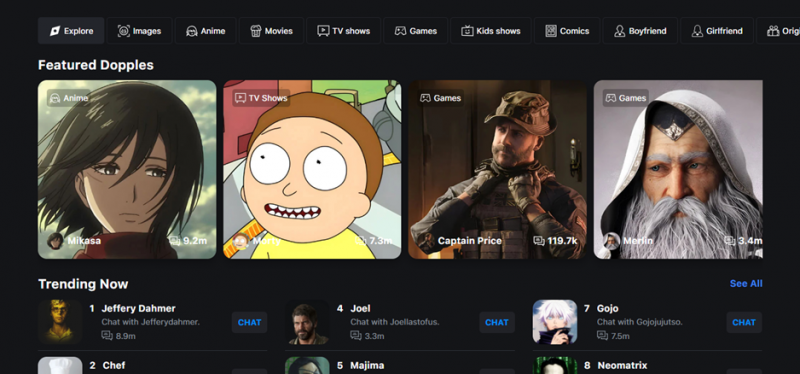
My screenshot: Dopple's explore page. Category tabs across the top, featured characters below, trending list with message counts.
There is no empty text box asking how it can help. You land on tabs for Anime, Movies, TV shows, Games, Comics, Boyfriend, Girlfriend, and a Featured row with Mikasa at 9.2m messages and Morty at 7.3m. Below that, a Trending Now list ranked one through eight.
WHAT I NOTICED Those message counts are doing real work. They are social proof stapled to every card, and they set the tone before you have clicked anything. The layout is clean and it loaded instantly, which matters more than it sounds like it should. My only friction was that the Trending list mixes a serial killer, a chef, and an anime protagonist in the same eight slots, so it tells you what is popular without telling you what is good. |
I scrolled down and picked Deadpool
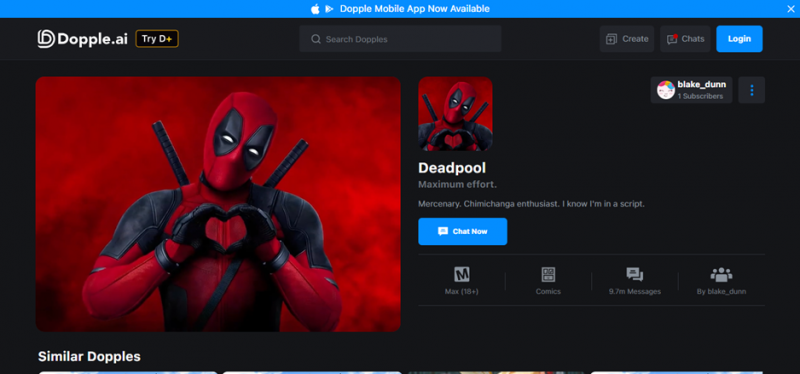
My screenshot: the Deadpool page. Tagline, one line of bio, Chat Now, and four stat chips underneath.
Big hero image, the tagline “Maximum effort,” and a bio that reads: mercenary, chimichanga enthusiast, I know I'm in a script. Underneath sit four chips: Max (18+), Comics, 9.7m Messages, By blake_dunn. The creator has one subscriber.
It is worth knowing what sits behind that anonymity. Building a Dopple takes a name, a short bio, an optional image, a category and a tone setting, and costs nothing, which is why the catalogue looks the way it does. The breakdown of Dopple's features and character categories walks through the full creation flow and reaches the same conclusion I did from the outside: quality control is the thing missing, and there is no report button to flag a broken character.
READING BETWEEN THE LINES Nine point seven million messages against a creator with a single subscriber is a telling combination. The character is enormously popular and the person who made it is essentially anonymous. That is the community model working exactly as designed, and it also means the quality of any given Dopple is a coin flip on whoever wrote the prompt. The page itself gives you almost nothing to judge that by. One line of bio, no sample dialogue, no comments. |
I hit Chat Now and got a countdown timer
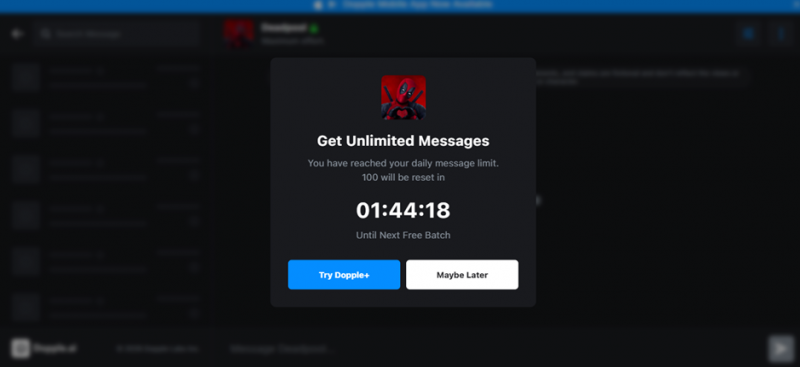
My screenshot: before typing anything, "You have reached your daily message limit." One hour, forty four minutes until the next free batch.
Not after a good scene. Not thirty messages in. This was the first thing between me and the chat window: a modal telling me I had hit a daily limit I had not spent, with a clock counting down and a Try Dopple+ button sitting where the conversation should be.
The timing is not unique to me. Many reviewers found the same nudge pattern in Dopple’s credit system, noting that users report being pushed to buy credits during longer sessions or when using popular characters. Deadpool at 9.7m messages is about as popular as that catalogue gets.
THE PART THAT STUNG A paywall after a great conversation is a fair trade. A paywall before the conversation is a pitch, and it lands completely differently. I had spent maybe ninety seconds on the platform. I had no attachment to anything yet, no scene in progress, nothing worth paying to protect. All the modal did was tell me the free tier was theatre. I clicked Maybe Later, because there was nothing to buy yet. |
I got through to the room and still could not type
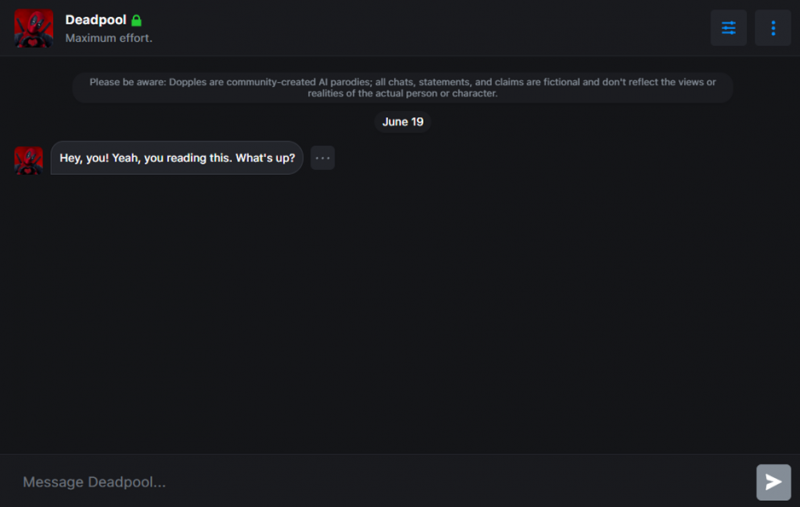
My screenshot: the room loaded, the opener was there, the input box was not accepting anything. Two attempts.
Deadpool had already spoken: "Hey, you! Yeah, you reading this. What’s up?" Good opener. Exactly right for the character. And then nothing, because the message box would not take input. I assumed my connection had dropped, tried again, and hit the same wall.
WHERE THE RUN NEARLY ENDED This is the worst possible moment for a product to fail, because it fails silently. There is no error, no explanation, no "log in to continue." The interface looks completely functional and simply ignores you. I only worked out it was a login gate by guessing. If I had been a casual visitor rather than someone testing on purpose, I would have closed the tab and blamed my wifi. Notice the date stamp too: June 19, on a session I was running in July. |
The fix was a login the interface never asked for
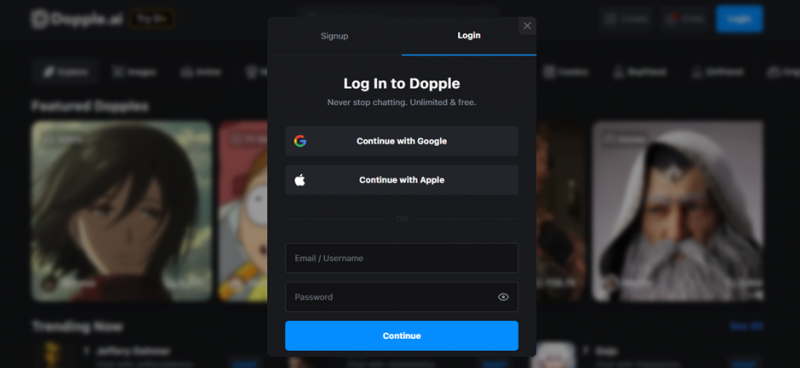
My screenshot: "Never stop chatting. Unlimited & free." Sitting above the wall that had just stopped me chatting.
Google, Apple, or email. I signed in and the input box started working immediately, which confirmed the diagnosis: the silent failure in step four was an unlabelled auth wall.
WORTH SAYING PLAINLY The tagline on this modal is "Never stop chatting. Unlimited & free," which is a bold thing to print directly above the thing that stopped me chatting. Requiring an account is completely reasonable. Every platform does it. Requiring one without saying so, and letting the chat box sit there looking usable, is a product decision that costs Dopple users who never find out what the problem was. |
Once it worked, it was good. Genuinely good
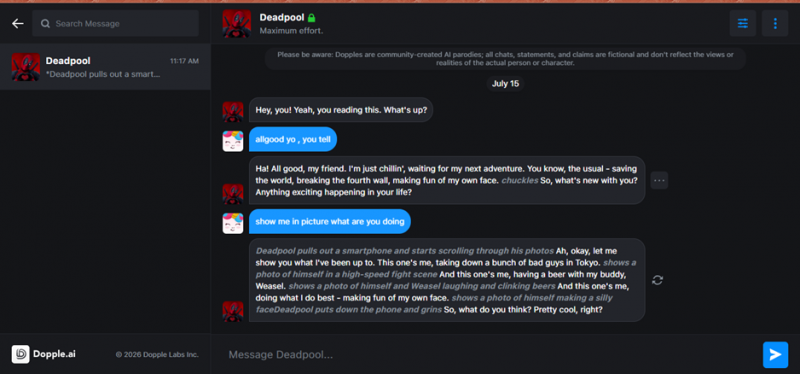
My screenshot: the same chat after logging in. In character, fast, and it improvised around a request it could not literally fulfil.
I sent "allgood yo, you tell" and got back a reply about chilling, waiting for the next adventure, saving the world, breaking the fourth wall, and making fun of his own face, with a chuckles emote in the middle. Then I asked for pictures. It could not send images, so instead it wrote a scene: Deadpool pulls out a smartphone, scrolls his photos, narrates three of them, puts the phone down and grins.
CREDIT WHERE IT IS DUE That improvisation is the most impressive thing Dopple did all session. A weaker model refuses the request or apologises about being an AI. This one stayed inside the fiction and turned a limitation into a bit of character work, and it did it fast. Voice, pacing, and the fourth wall gag all landed. The frustrating part is that six screenshots of friction stand between the front page and this moment, and most people will not push through all of them to find out the writing is this solid. |
The pricing page is the cleanest screen on the platform
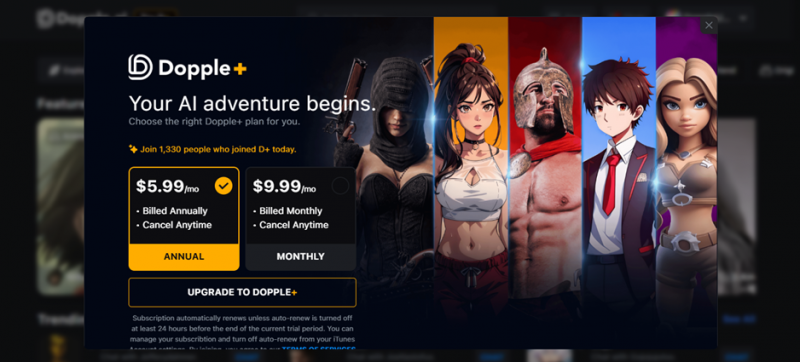
My screenshot: two options, one decision. $5.99/mo annual or $9.99/mo monthly, cancel anytime on both.
Two cards. Annual at $5.99 a month, monthly at $9.99. Both say cancel anytime. There is a "join 1,330 people who joined D+ today" counter and a wall of character art down the right side.
One caveat I only found later, and it matters. This modal is not the whole cost. Dopple also runs a separate credit system for image-based chats and premium characters, sold in packs through an in-app store, and many reviews notes that there is no public pricing table for it, with prices shown only inside your account when you try to unlock something. So the cleanest pricing screen in the category is clean partly because it leaves things out.
THE ONE THING DOPPLE NAILS No credits on this screen. No tokens. No per-model surcharge. Two numbers, pick one, done. After the mess of the previous six steps this was almost a relief, and the annual saving is real at forty percent. My reservation is not the price, it is what I know about the free tier now: the limit modal fires before you have any evidence the product is worth $71.88 up front. |
CRUSHON AI
Slower to load, faster to trust
Same idea, denser execution, slower start
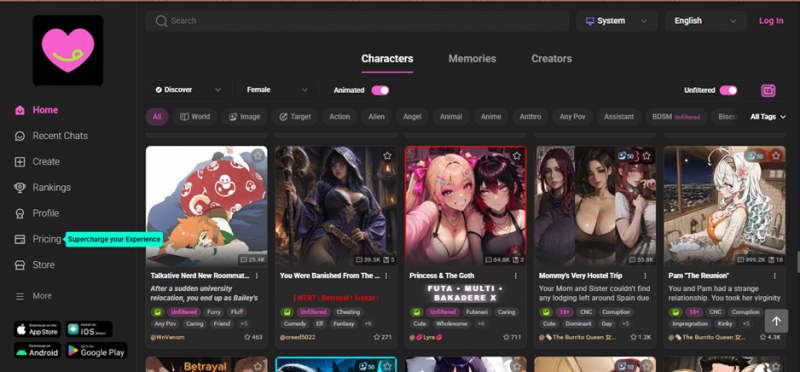
My screenshot: CrushOn's grid. Every card carries a scenario line, tags, message count and creator handle.
Sidebar navigation, filters for Discover, gender, Animated, Unfiltered, and a tag row running across. The cards show more than a name: a two line scenario, a tag stack, a message count, a creator handle and a favourite count. It also took a beat to populate as I scrolled.
FIRST IMPRESSION The lazy loading is real and it is the first thing you notice. Cards arrived a moment behind my scroll, which never happened on Dopple. What you get for that wait is a card that actually tells you something. "You Were Banished From The Kingdom" with cheating and isekai tags, 39.5K messages, 271 favourites. I could triage this grid without opening anything. On Dopple I had to click a card to learn what it was. |
I picked Princess & The Goth and got a dossier
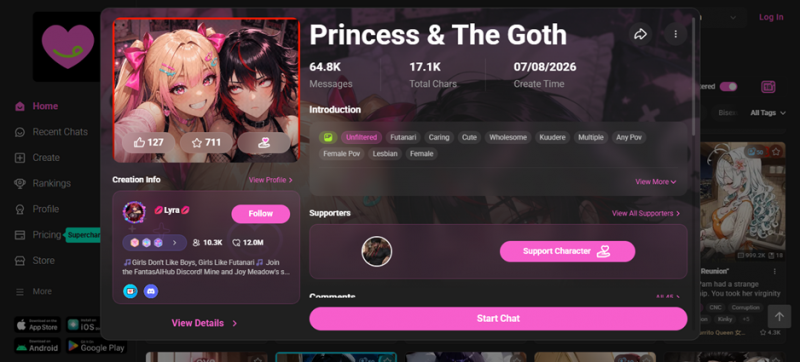
My screenshot: 64.8K messages, 17.1K total chars, created 07/08/2026. Creator Lyra has 10.3K followers and 12M messages.
Message count, character length, creation date, full tag list, a creator card with follower and message totals, a Follow button, a supporters panel, and comments. Then Start Chat.
The 17.1K figure is the part I would watch. That is the character definition itself, and CrushOn’s builder lets creators go that deep with detailed traits and background settings, which reviewer's feature and access breakdown covers alongside the public and private bot split. Lyra published this one publicly. Plenty of the best ones never leave their creator’s account.
WHY THIS SCREEN MATTERS Compare this to the Deadpool page. There I got one line of bio and a creator with one subscriber. Here I can see the character was built a week ago, runs 17.1K characters of definition, and comes from someone with a 10.3K following and 12 million messages behind them. That is enough to make an informed choice before spending a minute of my time. In a catalogue where anyone can publish anything, the metadata is the quality filter, and CrushOn hands it over without being asked. |
It opened with a story, not a greeting
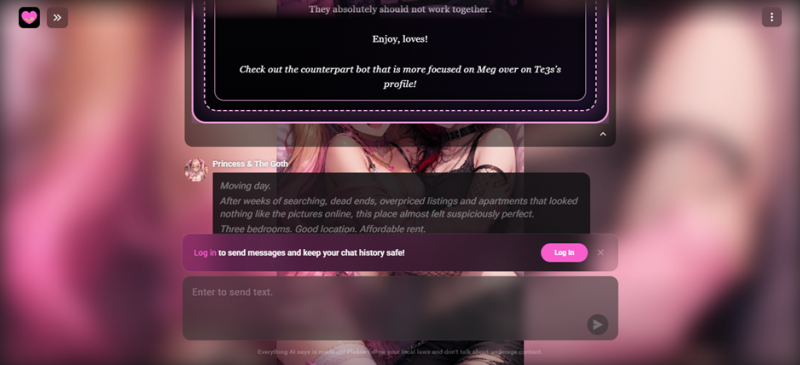
My screenshot: a creator note, then the scene. "Moving day." A login banner sits at the bottom rather than over the top.
First a formatted note from the creator with setup and a pointer to a companion bot, then the scene itself. Moving day. Weeks of searching, dead ends, overpriced listings, apartments that looked nothing like the photos, and a place that almost felt suspiciously perfect. Three bedrooms, good location, affordable rent.
THE CONTRAST THAT DECIDED THIS Dopple opened with "Hey, you! What’s up?" and a paywall. CrushOn opened with prose that has a hook in it, and let me read all of it before mentioning login. By the time the banner appeared at the bottom of the screen, I already wanted to know why the rent was that cheap. That is the entire difference between the two platforms in one screen. One asks you to invest before it gives you anything. The other gives you something first. |
Same login requirement, completely different timing
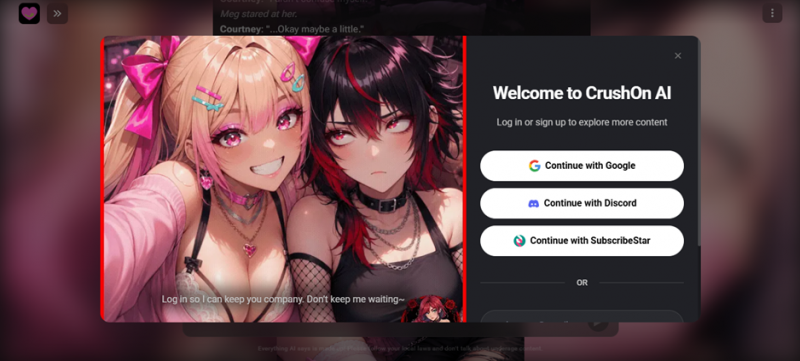
My screenshot: Google, Discord, or SubscribeStar. The in-character line reads "Log in so I can keep you company."
To send a message I had to sign in, exactly like Dopple. Behind the modal you can see the scene had already moved on. Meg stared at her. "Okay maybe a little."
SAME WALL, BETTER PLACEMENT I want to be fair here, because this is not a free pass. It is the same requirement. The difference is that CrushOn asked for it after I had read a scene I was invested in, and told me clearly what it wanted, in one modal, with the reason attached. Dopple asked for it by silently breaking the input box. One of those is a gate. The other is a bug that happens to be a gate. Discord as a login option is also a small signal about who this platform expects to show up. |
The conversation ran two characters at once, smoothly
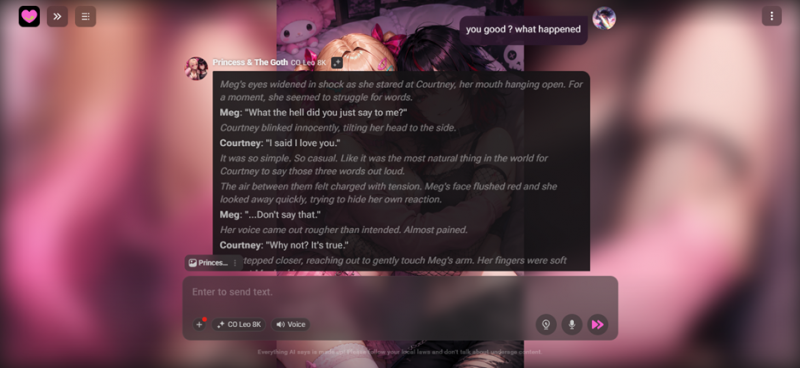
My screenshot: one prompt, a full two-hander. Bolded names, italic narration, and a model selector reading CO Leo 8K.
I typed "you good? what happened" and got a scene. Meg’s eyes widened. "What the hell did you just say to me?" Courtney blinked innocently. "I said I love you." Then the tension, the flush, Meg’s rougher-than-intended "Don’t say that," and Courtney’s "Why not? It’s true." Bold names, italic stage direction, no lag.
The 8K in that model name is the context window, and it is the ceiling on how much of a scene the AI can hold at once. CrushOn advertises up to 24K on eligible Ultra models, and plan comparison lines that up against Character.AI and Janitor AI. Worth knowing before you pick a tier, because the model you can reach is what decides whether a long scene survives.
THE MECHANICS UNDERNEATH Two characters held distinct voices in a single reply from a four word prompt. Formatting stayed consistent throughout. It came back instantly. And down in the toolbar sits CO Leo 8K, a model selector, which means the engine is a choice rather than a mystery. Dopple’s reply in step six was arguably funnier as a piece of character writing. This one is doing more work: managing two personalities, pacing a beat, and holding structure across a long response. If you write scenes rather than exchange lines, that difference compounds fast. |
The pricing page is where CrushOn loses points
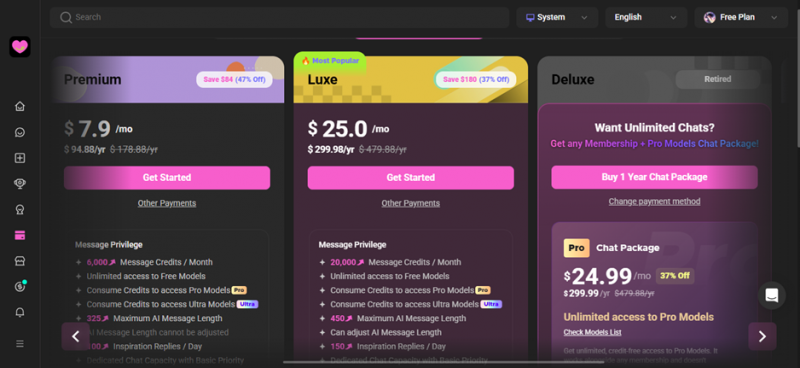
My screenshot: Premium $7.90/mo, Luxe $25/mo, a retired Deluxe tier, and a separate $24.99 Pro Chat Package on top.
Premium at $7.90 a month gives 6,000 message credits, unlimited free models, credit-based access to Pro and Ultra models, and a 325 character maximum AI message length. Luxe at $25 gives 20,000 credits, 450 character length and adjustable message length. There is a Deluxe tier marked Retired. And a Pro Chat Package at $24.99 a month sits alongside all of it.
THE CATCH This took me three passes to understand, and I was reading it carefully. Credits are not messages, they are consumed at different rates depending on the model, so your real monthly volume depends on choices you have not made yet. Message length is capped by tier, which means the plan I pick determines how much the AI is allowed to write back. And the Pro package is a separate purchase stacked on top of a subscription. Dopple’s version of this screen was two numbers. This one is a spreadsheet, and the retired tier still sitting on the page does not help. |
PRICING
What each one actually costs you
Both platforms are free to start and both want you on an annual plan. That is where the similarity ends.
| Dopple+ | CrushOn | |
|---|---|---|
| Free tier | 100/day | Capped, ad-gated |
| Entry paid | $5.99/mo annual | $7.90/mo annual (Premium) |
| Monthly | $9.99/mo | $25/mo (Luxe) |
| Credits | None on the plan screen | 6,000 to 20,000/mo |
| Model choice | Not offered | Free, Pro, Ultra |
| Decisions to make | One | Four, at least |
The part the pricing pages do not say out loud
Dopple's number is the whole number. $5.99 a month annually, or $9.99 if you want to leave whenever. Nothing is metered against a second currency on that screen. If you cancel in month two you have lost the remainder of $71.88 and nothing else.
CrushOn's number is an opening bid. Premium’s 6,000 credits sounds like plenty until you notice credits deplete faster on Pro and Ultra models, which are the ones you will want. Then the 325 character cap on AI replies starts to bite in exactly the long narrative scenes the platform is best at. Luxe fixes both at $25, which is more than four times Dopple’s annual rate. And the $24.99 Pro package sits outside the tiers entirely.
My read: Dopple is cheaper and clearer. CrushOn is more expensive and more capable, and the gap between the sticker price and the real price depends entirely on how heavily you use it. If you are a light user, Premium at $7.90 is fine. If you are running long multi-character scenes daily, budget for Luxe and treat the $7.90 as marketing.
One thing my screenshots cannot show you: both of these ladders are longer than the screen I saw. CrushOn’s tiers run past Luxe into Elite and Imperial, the latter at $199.99 a month for 125,000 credits and up to 30 custom voice slots. If you want the full ladder written out with what each allowance actually buys, Reviewer's CrushOn plan comparison lists every tier from free to Imperial. Dopple’s hidden credit packs get the same treatment in their Dopple+ pricing breakdown.
PRICES MOVE Worth saying plainly: the numbers on my two screenshots are what those pages showed me in July 2026, and they do not match every published figure for these platforms. CrushOn’s Premium has been quoted at $14.99 elsewhere against the $7.90 I was shown, which is regional pricing, promotional pricing, or both. Check the pricing page yourself before you buy. Do not take my screenshot, or anyone’s, as a quote. |
REAL USER REVIEWS
I am one session. Here is what everyone else found
A single run can be a fluke, so before writing my verdict I went through Trustpilot, the app stores, and Reddit to see whether my experience was representative. It was. In Dopple’s case, the wider picture is worse than mine.
| Platform | Source | Score | Note |
|---|---|---|---|
| Dopple | Google Play | 2.7 | Crash complaints |
| Dopple | Trustpilot | 1 review | Billing dispute |
| Dopple | Traffic Jul 25 | 489,000 | Monthly visits |
| Dopple | Traffic early 26 | 170,000 | Down 65 percent |
| CrushOn | App Store | 4.6 | 20,000+ reviews |
| CrushOn | Google Play | 4.3 | 100,000+ reviews |
| CrushOn | Trustpilot | 2.1 | 13 of 14 are 1-star |
| CrushOn | Mozilla privacy | Worst | 45 trackers |
Dopple: the billing complaints are the loudest
Dopple’s Trustpilot page is nearly empty, which is its own signal. The one review sitting on it is brutal and it is about money.
A verified reviewer describes paying £54.81 for an annual Dopple+ subscription, having the money leave their bank account, and then finding nothing had changed from their free account. The site still prompted them to join every time they opened it. Numerous emails to support went unanswered. Their conclusion was that they found it hard to believe the site is not a scam, and they wanted their money back. ★☆☆☆☆ TRUSTPILOT / verified reviewer / dopple.ai |
That is one person, so I checked whether it was isolated. It is not. Many Dopple overview reports the same split across Trustpilot and G2: a polarized audience, with some praising the interaction quality and others citing disappearing chats and absent customer support. Scribe’s 30-day review adds that Trustpilot logs show users charged $54.81 or more without premium features ever going live, with support tickets routinely ignored, and that auto-renewal often fires a full day before the stated date.
On the app side, the reviews match my step four exactly.
One Android reviewer describes going to reply to a bot and having the message turn up blank or simply repeat what they had said. Deleting it made it repeat an earlier message instead, and the bot still would not respond to anything new. They waited a full day and the chat was still stuck in the same state. ★☆☆☆☆ GOOGLE PLAY / via MWM app listing |
Another reviewer reports the AI constantly confusing itself with the user, deciding to roleplay their character for them, and occasionally responding with instructional script instead of dialogue. Their workaround was including both names in every message. Their verdict: a buggy mess, and the worst AI they had used. ★☆☆☆☆ APP STORE / via JustUseApp |
Not everything is negative. The same listings carry reviewers calling it fun with good bot variety, and one noting it is very promising while flagging trouble with quotations and italics. But the Android app sits at 2.7 stars with crash complaints, and MWM’s summary of recent reviews lands where I did: user experience is significantly hampered by recurring technical issues, including frequent bugs, slow loading times, and a problematic daily message limit, which many perceive as a move towards monetization.
CrushOn: the ratings contradict each other, and that is the story
CrushOn’s numbers look strange until you notice who is leaving them. The apps score well across huge samples. Trustpilot is a disaster across a tiny one.
Plisio’s reviewer flags the sample size honestly, then makes the point anyway: 13 of 14 Trustpilot reviews are one star. Zero fives, zero fours, an overall 2.1. Their explanation is that casual free users tap five stars in the app store and move on, while people paying $40 a month for poor responses seek out Trustpilot specifically to warn someone. ★★☆☆☆ PLISIO ANALYSIS / 2.1 from 14 reviews |
The complaints cluster tightly. One paying reviewer described the output as randomly generated nonsense that ignored character specifications entirely. Another paid for Premium and found features they were promised sitting behind closed beta labels, with no path to actually access them, and described support as vague and dismissive.
A Medium reviewer writing as a builder identifies the two patterns the pricing page does not warn you about: memory resets, where paid users lose weeks of character context after unannounced backend model updates, and feature gating, where advertised Premium features sit behind closed beta with no path to access and support tickets go unanswered. ★★☆☆☆ MEDIUM / r/AICompanion threads cited |
The app store reviews are warmer but specific about what broke. One iOS reviewer wrote that since a model was taken away to be fixed and returned, all it does is give low quality responses, and that they preferred it before the update. Another notes that recent updates have made explicit content scarce on characters that used to allow it, met with a warning message instead, while calling the subscription outrageously expensive just for a chat and roleplay app.
And the positive reviews are real too. One reviewer upgraded to the standard plan within a day and described hours of entertainment shared with their wife, praising the ability to create a more complex character profile for the bot as well as their own character. A six-week technical review found the group chat genuinely unlike anything else, running three characters in one thread while each stayed in character the whole time.
The privacy problem I did not see in one session
This one deserves its own heading because no screenshot would ever show it. Mozilla’s Privacy Not Included team gave CrushOn its worst rating, finding 45 trackers, including ad trackers, and a policy that may use your chats to train its AI. An independent audit from VerifyWise graded its data safety an F, flagging training without clear consent and weak deletion rights. There is one bright spot: Mozilla found no known data breach in the last three years.
Dopple is not clean here either. One review notes Dopple states it may share your personal information with third parties without further notice to you, and uses cookies to track browsing activity across other sites for advertising networks.
So the pattern holds in both directions. Dopple’s friction is not bad luck, it is the product, and users have been voting with the back button. CrushOn’s polish is real, its app store scores are earned across six figures of reviews, and its paying customers are the angriest people in the room.
THE HONEST SPLIT
Pick Dopple if
- You want one number on the bill and no credit arithmetic
- You chat in exchanges rather than write long scenes
- The character catalogue matters more to you than the metadata around it
- $5.99 a month is inside your "why not" budget and you will not mourn it
- You can shrug off a broken input box and try again tomorrow
Pick CrushOn if
- You write scenes with multiple characters and want formatting held
- You want to see who built a character and how deep it goes before committing
- Model choice is worth managing credits for
- You will read the pricing page twice and budget for Luxe rather than Premium
- You are comfortable with 45 trackers and chats that may train the model
And skip both if you want a polished, stable, set-and-forget companion. Neither platform is that. Both are creative sandboxes with rough edges, and the rough edges are not going away.
MY VERDICT
CrushOn wins this, and it is not because it is better written
I want to be straight about something first, because it would be easy to read this piece as a hit job on Dopple. It is not. When Dopple finally let me talk to Deadpool, it gave me the single best moment of the whole session. Asked for photos it could not send, it wrote its way around the limitation instead of apologising for it. That is real craft. Nothing CrushOn produced made me grin the way that did.
But I only saw it after seven screens, one paywall I had not earned, one silently broken input box, and one login the interface never bothered to ask for. That is the thing I keep coming back to. Dopple’s problem is not the writing. The writing is fine. Dopple’s problem is that it puts its worst foot forward and buries its best work behind it, and it charges you a countdown timer for the privilege of finding out.
CrushOn did the opposite. It was slower to load, its pricing page is a maze, and I do not love what Mozilla found in its trackers. But it showed me a character’s full dossier before I clicked, gave me an opening scene with an actual hook, let me read all of it, and only then asked me to sign in. By the time it asked, I wanted to say yes. That sequencing is not a small thing. It is the entire difference between a platform that respects your attention and one that tries to charge for it before it has earned any.
One footnote before the recommendation, for anyone weighing these on content freedom rather than polish. Dopple’s NSFW mode is not on by default and is not free: it has to be switched on manually in settings and only works on the premium tier. CrushOn’s moderation is minimal by design and its review notes there is no formal age verification on the site at all. Those are two very different products wearing similar marketing.
So: CrushOn AI, on Premium at $7.90, with your eyes open on two fronts. Know that 6,000 credits is not 6,000 messages, that the 325 character reply cap will frustrate you in exactly the long scenes you came for, and that Luxe at $25 is the tier that actually delivers what the marketing promises. And know that Mozilla rated its privacy the worst in the category. Use a throwaway email. Do not type anything you would hate to see surface later.
And Dopple? Try the free tier, on an account you have already created, and give it twenty minutes. If the input box works and a Dopple improvises at you the way mine did, $5.99 a month annual is genuinely fair, and it is the most honest pricing screen in this entire category. But I cannot recommend sending them $71.88 up front. Not when a verified Trustpilot reviewer paid almost exactly that, got nothing, and could not get a single reply to their emails. That is not a bug I can shrug off the way I shrugged off the chat box.
Both of these platforms can write. Only one of them let me find out without a fight.
Post Comment
Share your thoughts about this article.
Be the first to post a comment!