Table of Content
- Why this is harder than it looks
- Sign 1: Your pipeline is inconsistent and you've already looked at why
- Sign 2: Your SDRs are doing too much — or you don't have any and aren't sure you should hire
- Sign 3: You're moving into a new market
- Sign 4: Your cost per pipeline dollar is going up
- Sign 5: You know exactly who you want to reach but can't get to them at scale
- Sign 6: Your deals involve multiple stakeholders and your outreach doesn't reflect that
- A practical readiness check
- What to look for when you're evaluating partners
- What happens when the timing is off
- The short version
At some point, most SaaS founders have the same thought: should we just bring in someone to do this for us?
Usually it comes after a few months of inconsistent pipeline, or after watching a promising quarter fall apart because the team was too busy generating leads to actually close them. It's a reasonable instinct. But "outsourcing lead generation" covers a lot of ground, and getting the timing wrong in either direction is expensive.
Do it too early and you'll get leads your team can't convert. Do it too late and you've already missed quarters trying to patch things internally. The gap between those two outcomes is narrower than most people assume.
Here's how to tell which side of it you're on.
Why this is harder than it looks
The pitch is simple: pay a specialist, get leads, close deals. The reality inside SaaS is messier.
Your buyers tend to be technical. Your sales cycles run long. Most deals involve multiple stakeholders — Gartner research puts the average B2B buying group at six to ten people for a complex solution. And those people do most of their research before they talk to anyone. The same research found that B2B buyers spend only 17% of their buying time actually meeting with vendors. The rest is self-directed.
That means whoever is generating leads on your behalf needs to understand more than how to send sequences. They need to know your ICP well enough to engage the right person at the right company with the right message — and filter out everyone else before they reach your sales team.
Most generic outreach agencies can't do that. The ones that can are expensive, and they need a solid brief to work from. Which is why your own readiness matters as much as the partner you pick.
Sign 1: Your pipeline is inconsistent and you've already looked at why
Every SaaS company has bad pipeline months. The question is whether the cause is fixable internally.
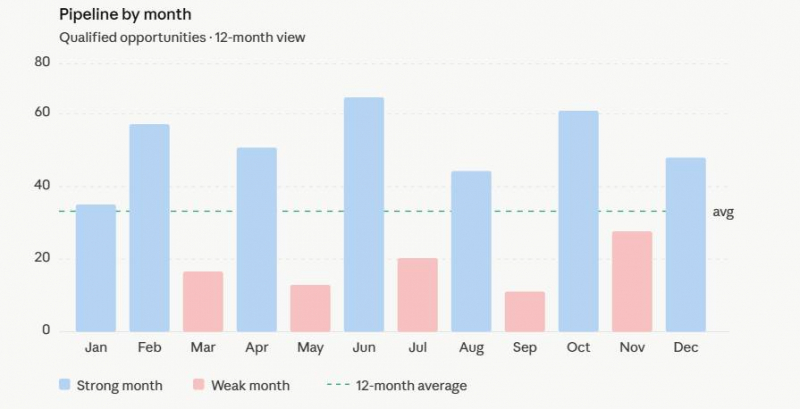
Before deciding you need outside help, check the obvious things first. Is your ICP actually defined, or are your reps chasing a loose category of companies that sort of fit? Is your messaging sharp enough to land with someone who's never heard of you? Do your sales and marketing teams agree on what a good lead looks like? Does your outreach process produce consistent output, or does pipeline health track individual rep motivation?
If you've genuinely worked through those questions and the pipeline is still lumpy — good months and bad months with no clear pattern — that points to a capacity problem, not a process one. You know who you're targeting and roughly how to reach them. You just don't have enough resources to do it consistently.
That's what an outsourced partner actually solves. They bring bandwidth, targeting infrastructure, and usually access to intent data that would take you a long time to build. If that's the constraint, it's a legitimate fix.
If you haven't worked through the internal questions yet, do that first. A partner can't compensate for an undefined ICP or a sales team that can't agree on what to do with a lead when they get one.
Sign 2: Your SDRs are doing too much — or you don't have any and aren't sure you should hire
Building a sales development function in-house is slow and expensive. Hiring, ramping, and managing SDRs takes months before you see consistent output, and the early stages are usually unpredictable even with good people.
There are two situations where outsourcing starts to make sense.
The first is when you have SDRs but they're spending most of their time on work that isn't conversations. Prospecting, list building, data cleanup, personalisation at scale — if your SDRs are buried in that, you're paying conversation-closer money for researcher work. Outsourcing the top of that funnel can give your existing team their time back for the things they're actually good at.
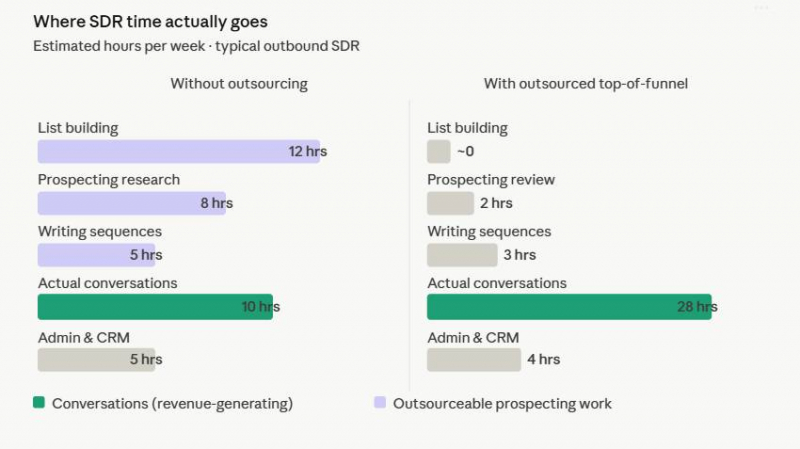
The second is when you don't have SDRs yet and you're weighing whether to hire. For an early-stage company that hasn't fully validated its go-to-market, committing to headcount before you know what your pipeline actually looks like is a real risk. An outsourced engagement can help you test your outbound motion, refine your messaging, and understand what qualified pipeline looks like in practice — before you bet on a team to produce it.
Either way, the framing matters: this isn't a permanent replacement for in-house capability. It's a way to buy time and information while you figure out what you actually need to build.
Sign 3: You're moving into a new market
This one is probably the clearest case for outside help, and the easiest to justify internally.
When you move into a new geography or vertical, you start from zero. No brand recognition, no existing contacts, no feel for local buying norms. Building that from scratch takes longer than most growth targets allow.
A partner who already has presence and infrastructure in that market can shorten that timeline significantly. Instead of spending half a year figuring out who to talk to and how to reach them, you can be running targeted campaigns in weeks. For geographic expansion specifically, where language and cultural nuance matter, that local knowledge is genuinely hard to replicate quickly.
The logic is simple: if you're entering territory where you don't have relationships, data, or market knowledge, outside support reduces both the cost and the timeline of getting there.
Sign 4: Your cost per pipeline dollar is going up
There's a version of growth that looks fine on the surface but isn't sustainable. Revenue climbs, and so does the cost to generate it. More spend, more headcount, more time — but each additional unit of pipeline costs more than the last.
This usually means you've already reached the easier segment of your ICP. The next tier of prospects needs more sophisticated engagement: account-level personalisation, coordinated outreach across multiple contacts, or intent-based targeting to catch buyers when they're actually in-market rather than just theoretically a fit.
If your cost per qualified meeting is trending up while conversion rates stay flat, your current approach has probably hit its ceiling.
Specialist SaaS lead generation partners often work with a level of targeting sophistication — technographic filters, firmographic signals, buying intent data — that's expensive and slow to build internally. Many also operate on cost-per-lead or cost-per-meeting models, which means your spend is tied to output rather than to someone's salary and overhead. That's a meaningful shift in how you buy pipeline.
Sign 5: You know exactly who you want to reach but can't get to them at scale
There's a real difference between not knowing who your ideal customer is, and knowing precisely who they are but not being able to reach them consistently.
A lot of SaaS companies hit the second problem after a few years. The ICP is well defined. The reps know what a good conversation looks like. But brand awareness is still limited, the outbound list is thin, and inbound volume isn't enough to fill the gap.
This is actually a good moment to outsource, because a clear ICP means a partner can work from a strong brief. They don't need months of discovery. They can start targeting accounts that match your specification quickly, and you can evaluate their output against a benchmark you actually understand.
The reverse — outsourcing before your ICP is defined — tends to produce volume without quality, and it's hard to diagnose the problem. Is it the partner? The targeting? The messaging? You usually can't tell. Nail the ICP first, then bring in outside capacity to reach it.
Sign 6: Your deals involve multiple stakeholders and your outreach doesn't reflect that
Mid-market and enterprise SaaS deals rarely close through one relationship. Multiple people are evaluating your product at the same time, each with different concerns, and they often don't talk to each other as much as you'd like.
Managing outreach across an entire buying committee is genuinely hard to do at scale. It's not just about volume — it's about making sure the right person in an account hears the right message without different threads conflicting or creating a disjointed experience.
This is where account-based marketing actually earns its keep, and where the difference between a generic outreach agency and a real SaaS specialist shows up clearly. If your current outreach treats each contact as an individual rather than part of a group decision, you're probably underperforming in your largest deals. A partner with actual ABM capability can change that.
A practical readiness check
Before you start talking to agencies, run through these honestly.
On your ICP and messaging: Can you write a one-paragraph description of your ideal customer that includes specific firmographic criteria, the job titles involved in the decision, and the pain they're trying to solve? Has that description been validated by real buyers, not just internal assumptions? If you handed it to someone outside your company, would they know immediately who to target?
On your process: Do you have a CRM your sales team actually uses? Do you have a defined handoff process between marketing and sales? Do you have a follow-up cadence that doesn't depend on one person remembering to do it?
On your capacity: Is pipeline volume or consistency your biggest growth constraint right now, not something else? Can your sales team actually handle more pipeline if you gave it to them? Do you have a budget for this that's separate from your core team spend?
On timing: Are you entering a new market in the next few months? Have you already tried to solve this problem internally without it sticking? Does your current-quarter revenue target depend on having better pipeline?
The more yes answers, the more ready you are. If you're mostly answering no to the first two sections, fix those before you bring anyone in. A partner can't compensate for a vague ICP or a sales process that doesn't work.
What to look for when you're evaluating partners
Most companies get this part wrong by selecting on brand recognition or pitch quality rather than fit.
The first thing to ask is whether the agency actually specialises in SaaS. SaaS buying dynamics are different from most other industries — longer cycles, more stakeholders, subscription economics that make customer lifetime value the real metric. Partners who work across industries apply generic frameworks. Partners who live in SaaS understand what they're optimising for.
The second thing is how they handle lead quality. Volume is easy to deliver. Quality is not. Ask specifically how they define a qualified lead, what happens if a lead doesn't meet that definition, and whether you pay only for leads you accept. The partners who are confident in their output will offer this. The ones who aren't will hedge.
Third: do they do anything beyond handing over a list? If your sales and marketing teams aren't aligned on what to do with a lead, even good leads will die in the pipeline. Partners who actively support that alignment — not just generate names — tend to produce better outcomes.
Fourth: what does onboarding look like, and can you scale without repeating it? If you have to restart a three-month onboarding every time you enter a new market, that's a tax you'll feel. The better setups let you onboard once and expand from there.
Finally: can you actually see what's working? If a partner can't tell you, at a campaign and lead level, what's performing and what isn't, you can't hold them accountable and you can't learn from it.
If you want a concrete starting point for shortlisting, the best SaaS lead gen agencies have been reviewed and compared across these criteria — ABM specialists, outbound platforms, and everything in between.
What happens when the timing is off
Too early: you get leads your team can't convert. Not because the leads are necessarily bad, but because the follow-up is inconsistent, the messaging in calls doesn't match what the lead was promised, and nobody agrees on what "qualified" means. You end up concluding that outsourced lead gen doesn't work, when the real problem is that you weren't ready for it.
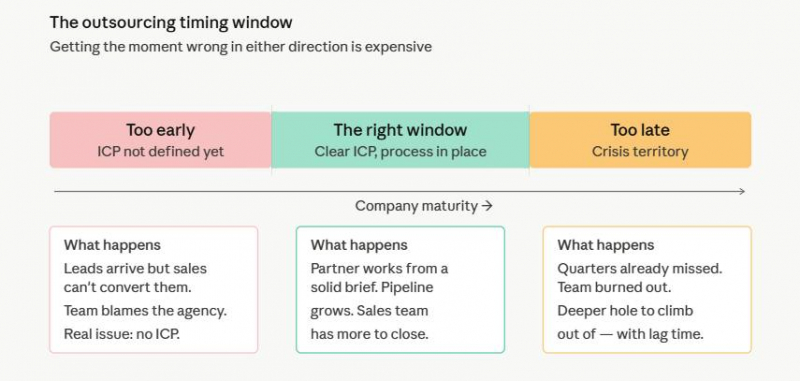
Too late: you've already burned through several bad quarters trying to fix things internally. The pipeline hole is deeper, the team is tired, and you still need ramp time for any new motion to produce results. The cost of waiting compounds.
The window where outsourcing makes sense is when your ICP is clear enough to give a partner a real brief, and your pipeline problem hasn't yet turned into a crisis. That window closes faster than most people expect.
A word on budget
Outsourced lead generation isn't cheap. If an agency is quoting prices that seem surprisingly low, ask exactly where the names come from, how they're qualified, and what conversion rates look like in practice.
The right way to evaluate cost isn't cost-per-lead in isolation. It's cost-per-qualified-meeting, and ultimately cost-per-opportunity. A higher CPL from a partner who delivers real decision-makers who match your ICP will produce better returns than a low CPL from a partner who floods your CRM with contacts your team has to re-qualify from scratch. You end up paying either way — just in different currencies.
Budget will vary depending on your stage, segment, and geography. But treat this as a real line item in your go-to-market budget, not a cheap experiment. The partners worth working with are priced accordingly.
The short version
Outsourcing lead generation works when you know who you want to reach, have a process to handle what comes in, and need more capacity or sophistication than you can build quickly in-house. It doesn't work when you're hoping it will substitute for strategy.
The signals are identifiable: pipeline that's inconsistent for reasons you can't fix internally, SDRs buried in work that isn't conversations, a new market with no existing footprint, rising cost per meeting, or deals that involve buying committees your current outreach isn't set up to handle.
When those are present and your own house is reasonably in order, bringing in a specialist isn't a shortcut. It's just the more efficient path to the pipeline you need.
Post Comment
Share your thoughts about this article.
Be the first to post a comment!