Table of Content
In today’s pharma industry, managing doctor interactions, sample tracking, and salesforce performance all in one place is a big deal. That’s exactly what Phyzii CRM aims to solve.

Designed for pharmaceutical field teams, this tool claims to simplify workflows, boost productivity, and help sales teams engage more effectively.
Let’s look at the real features, user reviews, safety, pricing, and comparisons with other top CRMs.
Phyzii CRM at a Glance
- Developer: Cirrius Technologies Pvt. Ltd
- Use Case: CRM for Pharmaceutical Sales Teams
- Platform: Cloud-based with Android/iOS support
- Industries Served: Pharma, Biotech, Healthcare Field Sales
Top Features of Phyzii CRM
• Doctor Visit Planning: Build visit schedules, track follow-ups
In pharma workflow terms: this is the Monthly Tour Plan (MTP) and Daily Call Plan. Reps map which doctors, chemists, and stockists to meet based on doctor class (A/B/C), visit frequency norms, and territory routes. Managers approve plans in the web portal, and deviations (missed or unplanned visits) are flagged automatically, which is how pharma companies enforce call-average and coverage KPIs.
• Sample Distribution: Log and monitor promotional stock
In workflow terms: sample accountability. Reps receive physical samples and promotional inputs (gifts, literature) from head office, and every handover to a doctor is logged against that doctor’s record. The system reconciles opening stock, distributed quantity, and closing stock, which matters for both cost control and regulatory codes (like UCPMP in India) that restrict what can be given to healthcare professionals.
• Call Reporting: Record every interaction with summaries
In workflow terms: the Daily Call Report (DCR), the single most-used screen in any pharma CRM. After each doctor visit, the rep records products detailed, samples given, doctor feedback, and next-visit objectives, usually in under a minute. Managers use DCR data for joint-visit planning and to compute call averages, and the fact that Phyzii users describe DCR entry as a few clicks is a genuine adoption advantage.
• eDetailing: Digital content presentation on mobile
In workflow terms: Closed Loop Marketing (CLM). Marketing uploads approved brand presentations (Phyzii calls curated sequences a Promotogram), reps present them on a tablet in the doctor’s chamber, and the system records which slides were shown and for how long. That slide-level engagement data flows back to brand teams to refine messaging, closing the loop between marketing and the field.
• Sales Performance Dashboards: Real-time reporting & analysis
In workflow terms: primary and secondary sales analytics. Dashboards combine call activity with sales data (from stockists and distributors) so managers can see coverage, call average, doctor-wise business, and brand performance by territory in real time instead of waiting for month-end Excel consolidation.
• Expense Tracking: Auto-capture rep expenses
In workflow terms: daily allowance (DA) and travel allowance (TA) automation. Expense claims are auto-derived from the day’s reported route and headquarters/ex-headquarters status, then routed to managers for approval, removing a classic source of month-end disputes between field and admin teams.
• Geo-Tracking: Field rep location logs in real-time
In workflow terms: location-validated reporting. Check-ins at doctor visits carry GPS coordinates, which discourages false reporting and lets managers verify territory coverage. Buyers should confirm how the vendor handles employee-privacy consent and whether tracking can be limited to working hours.
• Territory Management: Assign and manage regional activity
In workflow terms: the divisional hierarchy every Indian pharma company runs: MR reports to ASM, ASM to RSM, RSM to ZSM. Phyzii models this hierarchy so doctor lists, targets, and reports roll up correctly, and supports transfers when territories are split or reps change headquarters.
Customer Reviews & Insights
What Users Like
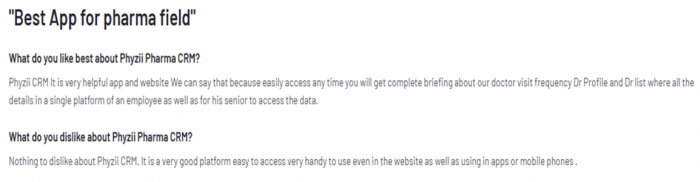
- Ease of Access & Simplicity
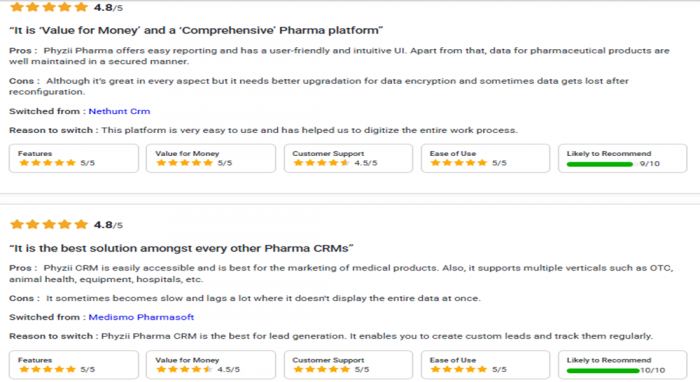
“Very nice and easy to access. I can update all programs, meetings, and reports from my mobile.” - Field Sales Ready
"Better for pharma companies than most generic CRMs. Planning doctor calls and tracking samples is super simple."
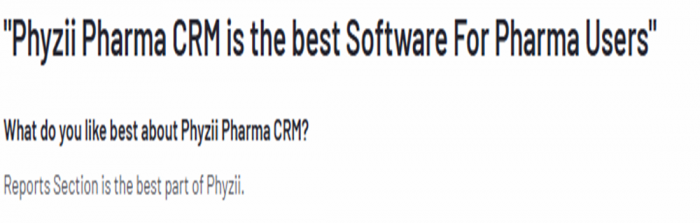
- Reliable Data for Managers
“Real-time insights into our rep activity and daily visit outcomes help us improve our reach.”
What Needs Improvement
- Mobile Glitches
"Sometimes the app hangs or syncs slowly at the end of the day." — Abhimay M., - ERP Integration Missing
"We wish it could connect directly to our ERP. Manual exports are a pain." — User, SoftwareSuggest - Customization Limits
"It covers most pharma needs, but we wanted more flexibility in custom reports." — User, SoftwareSuggest
Phyzii CRM Pros and Cons
| Pros | Cons |
| Purpose-built for pharma field force: DCR, MTP, sample accountability, and doctor hierarchies work out of the box | Quote-based pricing with no public rate card makes budgeting and comparison harder |
| High rep adoption: call reporting takes a few clicks, and reviews consistently praise ease of use | Users report the mobile app can hang or sync slowly at end of day |
| Proven at scale: 100,000+ users, clients like Cipla and Alembic, 20+ countries | No native ERP connectors reported by users; integration may require custom work |
| Modular platform (SFA, CLM, MLR, deduplication, gamification) so you pay only for needed modules | Custom reporting flexibility is limited compared to platform CRMs like Salesforce or Zoho |
| Offline sync and geo-validated reporting suit low-connectivity field territories | Thin public documentation on compliance certifications; buyers must verify in due diligence |
| Vendor handles implementation, training, and lifelong support per Cirrius | Strongest fit is India and emerging markets; US/EU regulatory tooling is less proven than Veeva’s |
Is Phyzii CRM Safe?
Yes. Phyzii CRM is hosted on secure servers, supports HTTPS, and uses access control. However, for companies dealing with highly sensitive data, additional compliance checks (like HIPAA/GDPR certifications) are advised.
Phyzii CRM Pricing
| Plan Type | Price | Included Features |
| Test Plan | Free | Visit planning, reporting, expense, sample, order, customer tracking |
| Enterprise Plan | Custom Quote | Territory structure, advanced analytics, integration, offline sync, tech support |
Pricing Questions to Ask
Phyzii publishes no rate card: pricing is quote-based, typically per user per month billed annually, with modular costs and a one-time implementation fee. A 14-day trial or demo is available on request. Before signing, get written answers to:
• What is the per-user per-month rate at our exact headcount, and where are the volume price breaks?
• Which modules are included in the quoted price (SFA only, or also CLM/eDetailing, MLR, analytics)? What does each additional module cost?
• What is the one-time implementation fee, and what does it cover (doctor master upload, territory mapping, integrations, training)?
• Are manager web-portal seats billed the same as field-rep app seats?
• What are the annual price-escalation terms at renewal, and is there a cap?
• What support tier is included (email/phone, response SLAs), and what does premium support cost?
• Are there charges for API access, data storage, SMS/notifications, or data export at exit?
• Is the 14-day trial run on our own data, and does trial configuration carry into production?
Alternatives to Phyzii CRM
| CRM Tool | Monthly Cost | Key Benefit | Target Industry | Rating |
| Zoho CRM | $14 | Multi-channel sales automation | All Industries | 4.3/5 |
| Bigin by Zoho | $7/year | CRM for small sales teams | SMBs | 4.7/5 |
| Veeva CRM | Custom | Deeply integrated with pharma workflows | Pharma Enterprise | 4.8/5 |
| Salesforce Health | Custom | Healthcare CRM with marketing tools | Healthcare + Pharma | 4.6/5 |
| Carepatron | Custom | Patient-focused task and calendar tool | Health Practices | 4.5/5 |
Final Word: Is Phyzii CRM Worth It?
If you’re managing a pharmaceutical field force and want something built specifically for your workflows, Phyzii CRM is a smart, reliable option. It may not be as flashy as Salesforce, but for pharma field operations, it delivers where it matters.
2026 closing note: that verdict still stands, with sharper boundaries. Phyzii is the pragmatic choice for India-centric and emerging-market field forces that want pharma workflows working in weeks. Enterprises with global compliance needs should shortlist Veeva Vault CRM, ecosystem-heavy enterprises should evaluate Salesforce Life Sciences Cloud, and teams that mainly need a cheap flexible CRM should price out Zoho first. Whatever you choose, get the security and pricing questions above answered in writing before you sign.
Post Comment
Share your thoughts about this article.
Be the first to post a comment!