Table of Content
Joyland AI and CrushOn AI keep landing on the same shortlist because both platforms target adult AI companion users and both surfaced during the migration wave that followed Character.AI tightening its content filters. The pages look similar at a glance: anime-styled characters, NSFW toggles, free tiers with daily caps, and premium plans that promise to remove the friction. The actual products solve different problems.
Joyland AI is an anime-first character chat platform with a strong discovery layer, an interactive fiction feature called Joybook, voice across every tier, and the polish of a casual companion app. CrushOn AI is a roleplay specialist built around model flexibility, longer memory, multi-character group chats, and an explicitly uncensored stance. The difference becomes obvious once a serious user spends a week on either platform, and it is the reason creators picking on aesthetics alone often regret the choice within a fortnight.
Quick verdict: Joyland AI is the stronger choice for anime fans, interactive storytellers, and casual chatters who value polished discovery, voice across all tiers, and a community-driven library. CrushOn AI is the stronger choice for power roleplay users who care about model flexibility, longer memory windows, multi-character group chats, and minimal content filtering. Heavy users with workflows that span both casual and serious roleplay will benefit from running both rather than forcing one platform to do the other’s job.
What Is Joyland AI?
Joyland AI is an AI character chat platform that launched on December 28, 2023, positioning itself as an anime-first companion app with a strong storytelling focus. The platform combines a character library marketed at millions of personas, custom character creation tools, voice features, image generation, and a feature called Joybook that lets users publish their roleplay sessions as interactive story games for the community to play through. Independent coverage on Techi, SeaArt, and Techbeaz consistently describes Joyland as the strongest anime-styled character platform in the casual companion segment.
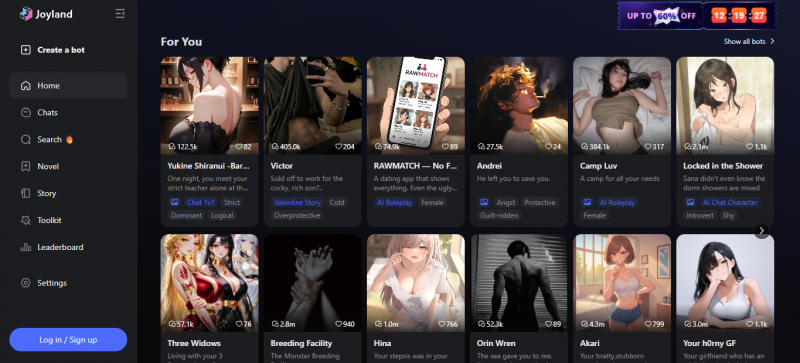
Hands-on use confirms Joyland’s strength sits in discovery and onboarding. The character browser surfaces trending picks, recommended creators, and themed events, and new users can begin chatting within minutes of signup. The Joybook feature is genuinely novel: it transforms private roleplay into shareable interactive fiction, which most competitors do not offer at all. Voice is available across every tier with ten voice options, although users have noted that audio pacing can feel slightly slow.
Where Joyland strains is in extended sessions. RoboRhythms’ review describes the platform as optimized for first-session retention with friction surfacing in the mid-game, and that observation matches direct experience. Memory drift becomes noticeable in long roleplay arcs, the AI occasionally falls into repetition loops, and the NSFW filter is consistently described as more restrictive than the platform’s marketing suggests. The paid tier raises the daily message cap but does not loosen the filter or extend memory significantly, which is the friction most engaged users actually want solved.
What Is CrushOn AI?
CrushOn AI is an AI character chat platform operated by Peekaboo Tech Inc., a Delaware-registered company with co-founder Yue Zhu reportedly based in Shenzhen. The platform launched in 2023 and grew rapidly during Character.AI’s well-publicized content filter tightening, positioning itself explicitly as the uncensored alternative for adult users. Independent coverage from Washington City Paper, StartupHub, and Plisio frames CrushOn as an NSFW-first platform, and the platform itself does not contest that positioning.
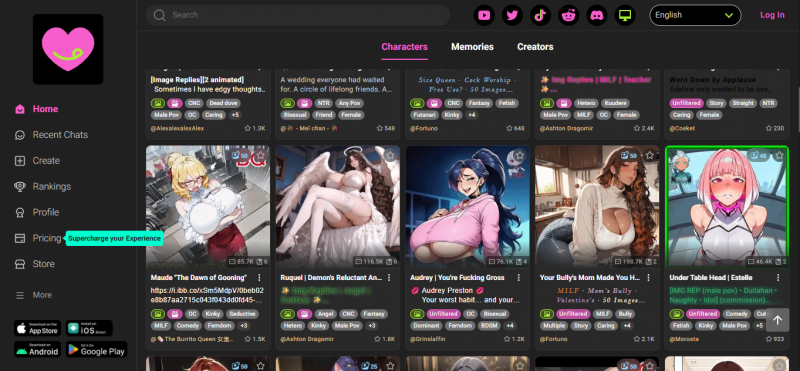
The architectural decision that defines CrushOn is multi-LLM support. Paid users can route a conversation through GPT-4o, Anthropic Claude 3.5 Sonnet, or the open-source MythoMax model and switch between them inside an active chat. That flexibility is rare in the AI companion category, where most competitors lock the user into a single backend. In hands-on use, the practical effect is meaningful: GPT-4o handles complex narrative best, Claude maintains tone consistency under pressure, and MythoMax produces tighter, less filtered roleplay output. Switching mid-conversation is a standard mitigation for repetition loops.
CrushOn supports importing character cards in Pygmalion, TavernAI, and Text Generation formats, which makes it portable for creators arriving from external roleplay ecosystems. Group chat with multiple AI characters is reserved for higher-tier subscribers and works as advertised when active, although it depends on the connected model’s reasoning capacity for coherent turn-taking. The platform was text-first at launch but added image generation and voice messaging in mid-2025; neither matches dedicated tools for those output types but both meaningfully extend the experience.
Side-by-Side Comparison at a Glance
The table below summarizes the most important practical differences between the two platforms. Each row is verified against published materials or directly tested. A deeper feature-by-feature analysis follows.
| Aspect | Joyland AI | CrushOn AI |
|---|---|---|
| Operator | Joyland.ai (independently operated) | Peekaboo Tech Inc., Delaware-registered |
| Launched | Late December 2023 | 2023; grew rapidly after Character.AI tightened content filters |
| Primary Focus | Anime-led character chat, interactive fiction, social discovery | NSFW-permissive AI character chat with multi-LLM backend |
| Character Library | Marketed at millions of characters across genres | Several thousand official and community-built characters |
| LLM Backend | Single proprietary backend; specifics undisclosed | GPT-4o, Claude 3.5 Sonnet, MythoMax (switchable mid-chat on paid plans) |
| Multimedia | Text, image generation, voice (10 voice options), Joybook stories | Image generation (paid), voice messaging, group chat (VIP) |
| NSFW Policy | Toggleable NSFW with age verification; filter described as restrictive by reviewers | Toggleable NSFW filter; explicitly permissive when off |
| Memory | Persistent character memory; reviewers report drift in long roleplay | Context window scales with paid tier; up to roughly 16K reported |
| Character Card Imports | Supports .JSON and .PNG cards from TavernAI and SillyTavern | Supports Pygmalion, TavernAI, and Text Generation formats |
| Free Tier | 50 daily credits, three image messages, limited tools, ads | Roughly 50 messages per day with short-term memory and ads |
| Paid Entry Point | USD 9.99 per month (Standard) | USD 3.99 per month (Basic) or USD 5.99 (Standard) |
| Top Tier | USD 19.99 per month (Premium) | USD 14.99 (Premium) up to USD 29.99–49.90 (Deluxe) |
| Platforms | Web, Android, iOS | Web, iOS, Android |
| Best For | Anime fans, interactive storytellers, casual chatters | Power roleplay users, NSFW workflows, multi-LLM enthusiasts |
Feature Score Comparison
The chart below scores both platforms across nine categories that matter most when evaluating an AI character platform. Scores reflect direct testing across both free and paid tiers, cross-checked against independent third-party reviews and the platforms’ own published documentation.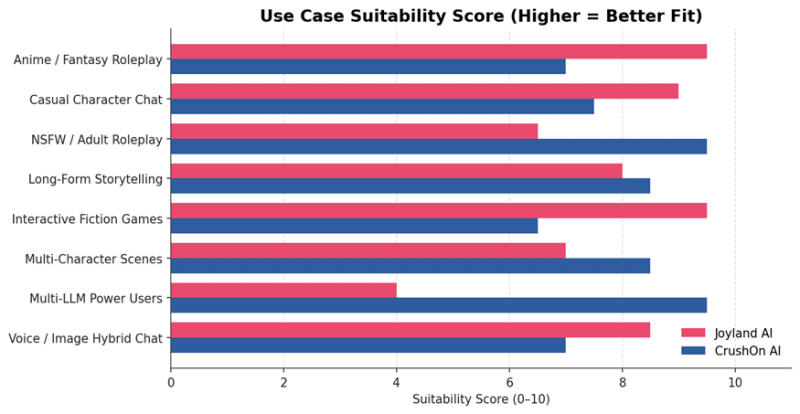
The pattern is consistent. Joyland AI leads on character library breadth, image and voice features, and conversation polish. CrushOn AI dominates on NSFW freedom, multi-LLM support, and memory depth. Privacy and safety remain a weakness for CrushOn, while Joyland edges slightly ahead on that dimension despite its own privacy gaps.
Feature-by-Feature Breakdown
1. Character Library and Discovery
Joyland AI markets a library of millions of characters spanning anime, sci-fi, fantasy, romance, celebrities, Vtuber-style personas, and original works. Discovery is one of the platform’s strongest surfaces: trending categories, recommended creators, themed events, and a comments-and-ratings layer make the experience feel closer to a content discovery app than a build-your-own-companion tool. Reviewers consistently praise this aspect, and hands-on browsing confirms that surfacing high-quality characters takes less effort than on most competitors.
CrushOn’s library is smaller in absolute terms but denser in roleplay-focused archetypes. Categories are organized around scenarios such as romance, fantasy, anime, and original works, with creator profiles visible. The discovery experience rewards users who arrive with a specific scene type in mind. Importing existing character cards from Pygmalion or TavernAI lets writers carry their own catalog onto the platform without rebuilding from scratch, which is particularly useful for users migrating from SillyTavern.
2. Conversation Quality and Memory
Both platforms claim long-term memory. In practice, behavior diverges meaningfully. Joyland’s persistent memory holds running facts and surface character traits, but reviewers across multiple outlets describe drift in long roleplay sessions, with the AI losing track of established plot points or recycling phrasing. RoboRhythms’ review frames this as the platform optimizing for first-session retention rather than long-term roleplay, and direct experience matches that observation.
CrushOn’s memory window scales with subscription tier, with Premium reportedly offering up to roughly 16,000 tokens of context. That depth is meaningful and shows up directly in continuity across longer conversations. The trade-off is that CrushOn’s default models can fall into repetition loops, recycling phrasing and framing devices when scenes run long. Switching to GPT-4o mid-conversation is the standard mitigation and is one of the platform’s most useful operational tricks. For long-form roleplay specifically, CrushOn holds the clearer edge.
3. Customization Depth
Joyland AI customization is comprehensive at the field level. Creators define personality, scenario, greeting messages, lore, and example dialogue through structured text inputs. The Advanced Create tool exposes traits, appearance, behavior, and background stories. The platform also supports .JSON and .PNG character card imports from TavernAI and SillyTavern, which saves significant setup time for migrating users. Free users can create up to 3 personas, Standard subscribers get 20, and Premium users can maintain up to 50 active personas.
CrushOn’s customization sits closer to the open roleplay tradition. Personality is defined through free-text fields covering description, appearance, and scenario, and creators import full character cards from the broader external ecosystem. Voice selection from a library of female voices is available. The interface is less polished than Joyland’s, but it gives writers the granular control they expect from tools like SillyTavern. For users coming from Pygmalion or Text Generation card formats, CrushOn is the more compatible destination.
4. NSFW Policy and Content Freedom
Joyland AI offers a toggleable NSFW mode behind age verification. The marketing describes it as fully unrestricted, but several independent reviews characterize the filter as more restrictive than competitors. Reviewers on AI Girlfriend Scout describe characters comfortable with intimate themes but defaulting to descriptive, thoughtful responses rather than explicit language. RoboRhythms’ review states that the paid tier raises message caps without loosening the filter, which is the friction users actually want solved.
CrushOn applies a clearer policy: a single NSFW filter toggle in chat settings that, once disabled, allows roleplay scenes to run with minimal restriction. The platform leans into this positioning openly. Hands-on use confirms the toggle works as advertised when paired with a permissive backend such as MythoMax. Routing the same prompt through Claude 3.5 Sonnet or GPT-4o reintroduces some refusals because those models carry their own alignment, a quirk the multi-LLM design makes visible to users in real time. For users whose primary interest is unfiltered adult roleplay, CrushOn is the more permissive platform by design.
5. Multimedia: Image, Voice, and Interactive Fiction
This is where Joyland’s product surface is genuinely broader. Image generation works inline through a chat-button workflow, voice features cover ten options across all tiers, and the Joybook feature transforms roleplay sessions into shareable interactive story games. None of these features are necessary for a chat platform, but together they create a more multimedia experience than text-only alternatives.
CrushOn added image generation and voice messaging in mid-2025 after originally launching as text-only. The image generation is context-aware, reading the tone of the conversation to generate matching visuals, and HD images are available on paid tiers. Voice messaging supports both incoming and outgoing audio, with custom character voices available on higher tiers. Group chat with multiple AI characters is the standout multimedia-adjacent feature, and it is rarer in the category than image or voice alone. CrushOn’s multimedia toolkit is solid but lags Joyland’s in breadth.
6. User Interface, Mobile, and Platform Coverage
Both platforms ship native iOS and Android apps in addition to web clients. Joyland’s mobile experience feels more polished, with cross-device sync that works reliably and a discovery interface designed for phone use. The platform leans into a content-discovery aesthetic, and that pays off on small screens.
CrushOn’s mobile clients are functional but feel like compressed versions of the web experience. The web interface is no-frills and loads quickly. Power features such as model switching and group chat are easier to navigate on desktop than on a phone, where the settings layout becomes cramped on small viewports. Creators who chat primarily from mobile should weigh this seriously, particularly if they expect to use the multi-LLM features that are CrushOn’s biggest differentiator.
Pricing Comparison
Pricing is one of the clearest differentiators between the two platforms. CrushOn’s aggressive entry-tier pricing has been part of its growth strategy, while Joyland sits at a more conventional price point with a higher ceiling on credits and image messaging. The chart below visualizes approximate monthly subscription pricing across tiers.
The detailed pricing matrix below adds context on what each tier unlocks and where hidden costs surface during real use. Both platforms layer credit or coin systems on top of subscription pricing, which introduces variable spend that flat subscription comparisons miss.
| Plan Tier | Joyland AI | CrushOn AI | Notes |
|---|---|---|---|
| Free | 50 daily credits, three image messages, limited tools, ads | Roughly 50 messages per day, basic memory, ads | Both free tiers are usable but capped |
| Entry | ~$9.99 / month (Standard) | ~$3.99 / month (Basic) | CrushOn entry price undercuts most competitors |
| Mid | ~$9.99 / month (Standard) with NSFW unlock | ~$5.99 / month (Standard) | CrushOn includes NSFW and group chat at this tier |
| Upper | ~$19.99 / month (Premium) | ~$14.99 / month (Premium) | Both unlock priority access and richer features |
| Top | ~$19.99 / month (Premium) | ~$29.99–49.90 / month (Deluxe) | CrushOn ceiling is steeper for unlimited messaging |
| Annual Discount | Annual billing saves roughly 10–20 percent | Annual billing saves roughly 30 percent across tiers | Verify current pricing at official sites |
| Credit System | Credits gate image generation, regenerate, and other actions | Coin system for daily login bonuses and gift codes | Variable spend; track usage to avoid surprises |
CrushOn’s entry pricing is among the lowest in the AI companion category, undercutting Candy AI, Replika, and Nomi AI on monthly cost. Joyland’s pricing is conventional in the category and is partially justified by its broader multimedia surface area, including the Joybook feature and voice across all tiers. Heavy users on either platform should track actual monthly spend, including credit and coin top-ups, before settling on a tier. Annual billing offers savings on both, with CrushOn’s discount being the more aggressive of the two.
Pros and Cons of Each Platform
Joyland AI
| Joyland AI — Pros | Joyland AI — Cons |
|---|---|
• Strongest anime aesthetic and discovery experience in the category • Joybook lets users publish roleplay sessions as interactive story games • Native iOS, Android, and web clients with cross-device sync • Imports .JSON and .PNG character cards from TavernAI and SillyTavern • Voice features available across all tiers (10 voice options) • Active community with comments, ratings, and creator profiles | • Single LLM backend with no model-switching capability • NSFW filter described by reviewers as more restrictive than CrushOn • Memory drift surfaces in long roleplay sessions even on paid tiers • Reviewers report repetition loops and stuck phrasing • Privacy practices flagged: no clear end-to-end encryption • Premium tier solves message caps but not filter or memory issues |
CrushOn AI
| CrushOn AI — Pros | CrushOn AI — Cons |
|---|---|
• Multi-LLM backend including GPT-4o, Claude 3.5 Sonnet, and MythoMax • Mid-chat model switching is rare in the category and works as advertised • Larger context window than most competitors at the Premium tier • Imports character cards from Pygmalion, TavernAI, and Text Generation formats • Group chat with multiple AI characters available to paid subscribers • Aggressive entry pricing relative to AI companion peers | • Privacy concerns: flagged by Mozilla’s Privacy Not Included program • Independent reviewers report repetition loops and persona drift • Public Trustpilot ratings sit at the low end of the AI companion category • Image generation quality lags purpose-built image generators • Voice library is smaller than character library; mismatches occur • Top-tier pricing is steep relative to demonstrated quality |
Use Case Suitability
Different creators have different priorities. The chart below scores both platforms against eight common use cases that surface in user research and search behavior. Scores reflect both feature presence and tested fit, not only marketing claims.
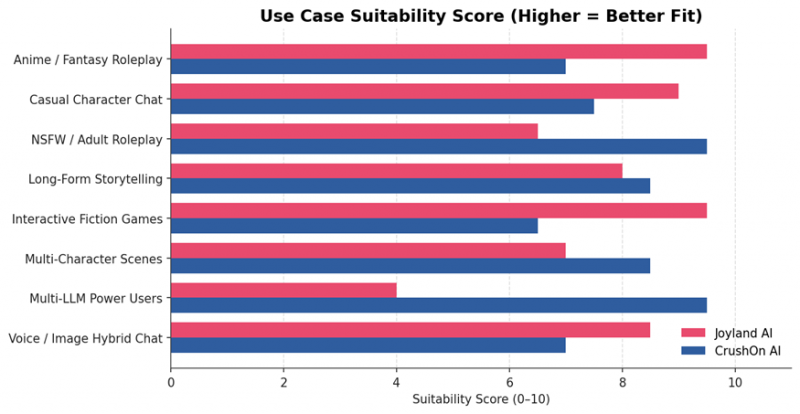
The pattern reinforces the early verdict. Joyland dominates anywhere anime aesthetic, interactive fiction, casual chat, or voice-and-image hybrid use matters. CrushOn dominates anywhere NSFW openness, multi-LLM control, or unfiltered roleplay matters. The two platforms tie on customization depth and split the long-form storytelling and multi-character categories, where the right answer depends on whether voice and image features matter more than memory depth.
Which Platform Suits Which Creator?
Joyland AI is the better fit for:
• Anime fans and visual-style enthusiasts who value the platform’s aesthetic and character library.
• Casual chatters who prefer polished discovery and trending recommendations.
• Interactive fiction creators who want to publish roleplay sessions through Joybook.
• Mobile-first users who value native apps with reliable cross-device sync.
• Creators who want voice features available across every tier without paywalls.
CrushOn AI is the better fit for:
• Power roleplay users who want explicit control over the underlying language model.
• Writers and worldbuilders who need long memory windows and complex character cards.
• Adult creators who prefer a clearer, more permissive content stance.
• Existing SillyTavern, Pygmalion, or TavernAI users who want to import existing character libraries.
• Creators running multi-character group chat scenes with paid backend models.
Privacy, Safety, and Responsible Use
Both platforms collect account metadata and conversation logs to operate their services. Neither offers zero-knowledge privacy, and sensitive personal information should never be entered into prompts or character cards. CrushOn carries the heavier flag here, with documented collection of sensitive data categories and tracker integrations identified by Mozilla. Joyland fares moderately better in third-party reviews but does not commit to end-to-end encryption and shares data with partners and researchers per its own policy.
Standard precautions apply: a strong unique password, two-factor authentication where offered, recognition that uploaded images and persona cards may persist on platform infrastructure, and awareness that adult content carries legal and ethical responsibilities that vary by jurisdiction. Reviewers including AI Companion Guides and Cherrypop recommend a burner email and a VPN for users especially concerned about exposure. Both platforms’ Terms of Service and Privacy Policy documents change without notification and should be reviewed at the source before any meaningful subscription commitment.
Final Verdict
The honest answer to "Joyland AI vs CrushOn AI: which is better" is that better depends on intent, and the question is genuinely close once intent is named. Joyland AI wins for anime-styled casual chat, interactive fiction, image and voice features, and mobile-first use. CrushOn AI wins for power roleplay, multi-LLM flexibility, content freedom, and longer memory windows on paid tiers.
Anyone choosing on price alone will lean toward CrushOn at the entry tier and Joyland at the mid tier. Anyone choosing on aesthetic and discovery alone will lean toward Joyland. Anyone choosing on roleplay depth and content freedom will lean toward CrushOn. Heavy users serious enough to spend on either daily will eventually find that running both produces the strongest workflow: Joyland for casual chat, voice, and Joybook stories; CrushOn for long, structured roleplay scenes that benefit from model switching. Treating the two as complementary rather than substitutes produces the best outcome for creators who can afford both.
Conclusion
Joyland AI and CrushOn AI represent two distinct strategies inside the AI character chat category. Joyland aims at anime-styled casual chat, interactive fiction, and a broad multimedia experience. CrushOn aims at unfiltered roleplay, multi-LLM control, and depth in long sessions. Both ship usable free tiers, both have active communities, and both serve adult creators who want fewer restrictions than mainstream tools provide. Choosing the better platform comes down to whether the next conversation needs creative breadth or roleplay depth.
Whichever platform a creator selects, responsible use, age compliance, and a careful review of each service’s current Terms of Service and Privacy Policy remain essential. The AI companion space evolves rapidly. Pricing, character moderation policies, and model availability shift without notice, and every claim in this guide should be re-verified against the official sources listed in the next section before any meaningful subscription commitment.
Post Comment
Share your thoughts about this article.
Be the first to post a comment!