I ran both from a cold start on the same day. LinkedIn showed me 129 matching roles with salaries attached before it asked me for anything. Leeco asked for my career stage, my salary band, my location, my Google account, and then my card before showing me a single job. That ordering is the entire review.
| THE SCOREBOARD Measured at the point of first job view | |
● Leeco AI $0.01 → $31 Trial is about 1 cent for 7 days, then roughly $2.58/month billed annually. The annual total is the real price, and it lands as one payment. JOBS BEFORE PAYWALL 0 REFUND AFTER CHARGE - None CHROME RATING - 4.56 / 662 | $0 Search, filters, salaries, company pages and Easy Apply all work on a free account. Premium Career is optional and does not gate applying. JOBS BEFORE PAYWALL 129 PREMIUM CAREER - ~$12/mo TRUSTPILOT - Low, see §6 |
How I tested this
No affiliate links, no press accounts, no demo environments. I did what any job seeker would do on a Friday evening: opened both products cold and tried to find a job.
| TEST SETUP | |
| DATE | July 2026, both platforms tested the same day, back to back |
| STARTING POINT | Cold. No existing Leeco account. Search engine to landing page, exactly as a new user arrives |
| ACCOUNTS USED | A real Google account for Leeco. A real LinkedIn account for LinkedIn. No press access, no comped subscriptions, no contact with either company |
| PATH TAKEN | The obvious one. On each product I clicked the primary call to action and followed wherever it led, without hunting for hidden free tiers or workarounds |
| STOP CONDITION | I stopped when the product either showed me jobs or demanded payment. Whichever came first ended that run |
| MONEY SPENT | $0 on both. I did not subscribe to Leeco and did not buy LinkedIn Premium |
| EVIDENCE | Every screen captured at the moment it appeared. All 7 are reproduced in section 2, unedited except for redacting my own profile and account details |
| SAMPLE SEARCH | "app developer", New York, on LinkedIn. Leeco never reached a search, so no equivalent query exists on its side |
The one metric I measured
Both products promise the same outcome, so I needed a single comparable number that did not depend on my taste in jobs. I settled on this: how many relevant jobs can I see before the product asks me for money?
It is a crude measure and I want to be honest about that. It says nothing about match quality, which is the thing you actually care about. But it is the only number I could collect on both platforms without paying, and it turned out to be decisive precisely because one product scored zero. A tool that will not show you its output before charging you has made match quality unmeasurable, and that itself is a finding rather than a gap in the test.
I also logged a second number as a sanity check: steps from landing page to first job. It removes the money question entirely and just asks how much work each product makes you do before it delivers anything.
What I did not do, and why it matters
I did not pay Leeco. That is the central limitation of this article and it shapes every conclusion in it. I cannot tell you whether Leeco’s WhatsApp approvals arrive on time, whether its referral outreach lands, or whether its matches beat LinkedIn’s. To find out I would have had to hand over a year upfront, and Leeco’s own refund policy says that money would not come back. I decided that a review which requires the reviewer to accept a non-refundable annual charge to reach the first data point is telling you something important before it starts.
I did not run a long-term response-rate trial. I did not apply to 100 roles on each and count callbacks over six weeks. That study would be genuinely more useful than this one, and it is not what this is. Where response rates appear in section 4, they come from cited third-party data, not from me.
I did not test Leeco’s LeetCode features. Leeco is two products wearing one name: a study companion and a job agent. I only evaluated the job agent, because that is what the title asks about. This matters when you read its 4.56 rating in section 6, since most of those ratings are for the half I did not test.
WHERE MY OWN BIAS SITS I went in wanting Leeco to win. An agent that does referral outreach for you is a better idea than a job board you scroll manually, and I would rather write about a clever new product than a fifteen-year-old incumbent. The verdict in section 8 is not the one I expected to write when I opened the landing page. The counterweight: LinkedIn is not being graded generously here either. It is free, which is the whole of its advantage in this test. Section 6 contains its own users calling its listings fake, and I left those in. |
How to reproduce this in ten minutes
You do not have to take my word for any of it, and this is the cheapest fact-check in tech journalism. Open a private browser window. Go to Leeco, click Start Now, answer the questions, and count how many jobs you see before the payment screen. Then open LinkedIn, log in, search a role in your city, and count the results. The two numbers you get are the entire article. Mine were 0 and 129.
The Test, screen by screen
Same day, same intent: find relevant jobs. I went in cold on both, clicked the obvious path a normal job seeker would click, and logged what came back. Each step below is tagged with whether the product let me through or stopped me.
Leeco AI: four steps, no jobs
| The pitch: an agent that works while you sleep | OPEN |
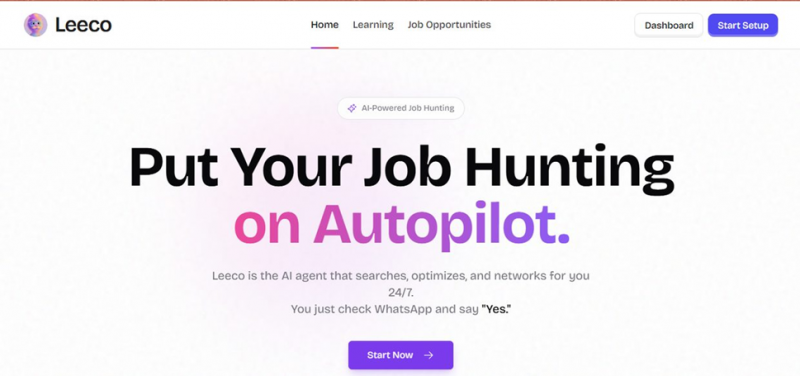
Leeco landing page. One promise, one button, no pricing anywhere in view.
The promise is doing a lot of work here
The headline is "Put Your Job Hunting on Autopilot", and the subhead says Leeco searches, optimizes, and networks for you 24/7 while you just check WhatsApp and say "Yes." The nav has Home, Learning and Job Opportunities. There is no pricing link in the header, and no indication that anything costs money.
Worth knowing before you click: the WhatsApp approval loop is real and is the genuinely interesting idea here. Leeco’s own description says it tweaks your CV for the specific role and asks for your confirmation via WhatsApp, and that for every job you apply to, it scours the web for working professionals at that company and broadcasts a personalized referral request on your behalf.
WHAT THE MISSING PRICE TAG TELLS YOU Nothing wrong with this page, but note what it does not have: a pricing link. When a product hides the price at the top of the funnel, it usually means the price arrives after you have invested effort. Keep a mental stopwatch running from this click. |
| Start Now goes to questions, not results | EFFORT COLLECTED |

Question 1 of several: career stage. More followed on salary and location.
The funnel starts collecting before it gives
"Start Now" does not start a search. It starts an interview. First question is career stage, Fresher or Experienced Professional. After that came the rest: target salary, preferred location, and role direction. This is the part of the flow that most resembles a real product, and it is well built. The mascot is charming, the questions are short, and it takes maybe a minute.
To be fair to Leeco, this data is not pointless. Reviewers who tested the paid product note that people with a clear target role do better with it than people still figuring out what they want, since the matching engine needs direction to work well. The questions feed a real matching engine.
WHY THIS STEP IS THE HOOK This is the sunk-cost step. Every question you answer makes it psychologically harder to walk away two screens later. That is not an accident, it is funnel design, and it is worth naming because the payment ask is coming and you will have already invested effort by the time it arrives. |
| Login wall arrives before any result | ACCOUNT REQUIRED |
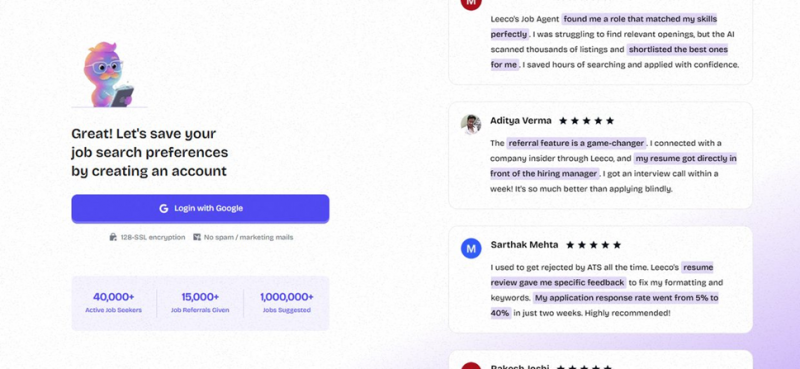
Login with Google, framed as saving your preferences. Social proof runs down the right side.
Your answers are now hostage to a signup
The framing is smart: "Great! Let’s save your job search preferences by creating an account." You are not being asked to sign up, you are being told your work will be preserved. The only option is Login with Google. Reassurances sit underneath: 128-SSL encryption, no spam or marketing mails.
The stats bar claims 40,000+ active job seekers, 15,000+ job referrals given, and 1,000,000+ jobs suggested. The testimonials down the right are all five stars and all specific, including one claiming an application response rate went from 5% to 40% in just two weeks. Note that exact testimonial. It shows up again on the very next screen.
THE COST OF THREE SCREENS OF EFFORT Still no jobs. Three screens in, Leeco has my career stage, my salary expectation, my location and now my Google identity, and has shown me exactly zero listings. Compare that to LinkedIn, where by this point I had already been reading real job descriptions with salary bands. |
| The wall: pay before you see a single job | PAYWALL |
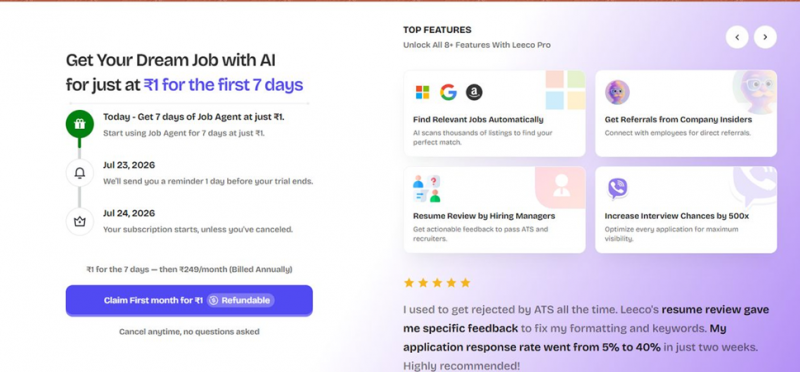
The screen that ends the free experience. Note the "Refundable" badge on the button.
This is the moment the product actually reveals itself
After all that, the thing that "hits you" is a subscription page. About 1 cent for 7 days, then roughly $2.58/month, billed annually, which is about $31 charged upfront. The timeline is honest about the mechanics: trial today, reminder on Jul 23, subscription starts Jul 24 unless cancelled. The button reads "Claim First month for ₹1" (the local-currency figure on the screen, about one US cent) with a Refundable badge, and underneath, "Cancel anytime, no questions asked."
And there is that testimonial again, the 5% to 40% one, now blown up next to the payment button. The same quote that softened me up on the login screen is reused to close the sale.
WHERE I STOPPED, AND WHY THAT DECIDES IT This is where I stopped, and where most people testing "is this tool any good" will stop. I cannot tell you whether Leeco’s matching is better than LinkedIn’s, because Leeco will not show me a single match without a card. That is a product decision, and it is the one that decides this comparison. A tool that asks you to trust its relevance before demonstrating any relevance is asking for faith, not a subscription. |
THE CONTRADICTION WORTH KNOWING BEFORE YOU PAY That button says Refundable. Leeco’s own published refund policy says the opposite. In writing: no refunds will be provided once a subscription charge has been processed, applying to monthly plans, annual plans and renewals, with no partial refunds, prorated refunds, or refunds for unused time. The policy then lists what specifically will not be refunded, and the first item is forgetting to cancel before the trial ends, followed by lack of usage after payment and accidental purchases. It also warns that if you dispute a charge with your bank, Leeco reserves the right to suspend or terminate the associated account. Both things can be technically true: the one-cent trial charge is refundable in the sense that cancelling during the trial costs you nothing. But a badge reading "Refundable" next to a payment button, on a page selling an annual plan, is not how most people will read that word. |
LinkedIn: three steps, 129 jobs
| A login page, and no promises | OPEN |
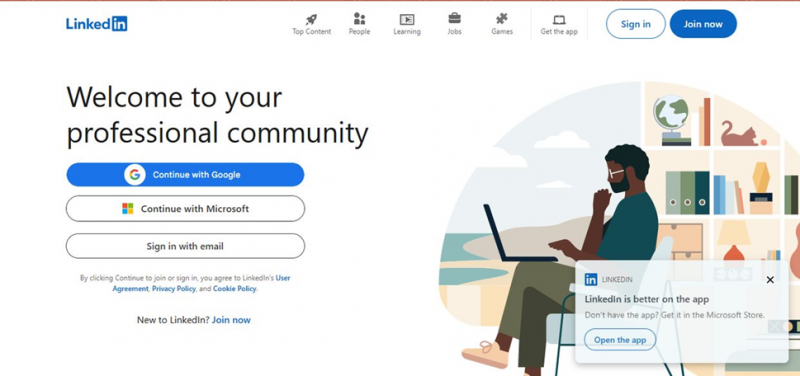
LinkedIn’s front door. Boring, and boring is the point.
Nothing is being sold here
"Welcome to your professional community." Three sign-in options: Google, Microsoft, or email. No AI claims, no autopilot, no stats bar, no testimonials. The only upsell on the page is a nag to install the app.
The contrast with screen L1 is stark and worth sitting with. Leeco opens by telling you what it will do for you. LinkedIn opens by asking who you are. One is a pitch, the other is a door.
A DOOR, NOT A PITCH LinkedIn does not need to convince me at this step because it is not selling me anything at this step. That is a luxury of scale, not virtue. But as a job seeker the practical effect is the same: I am one click from the product instead of one click into a funnel. |
| Logged in: a working feed, no card asked | FREE, FULL ACCESS |
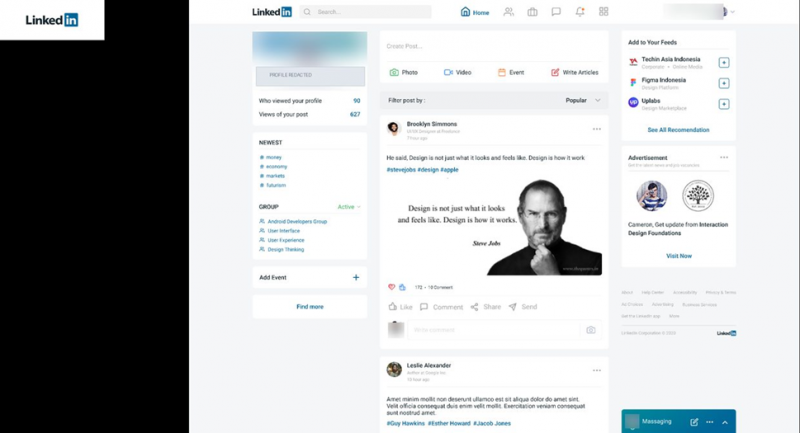
Home feed immediately after login. Profile details redacted. Profile views and post views are visible on a free account.
The product opens all the way up at step two
Log in and you are simply in. Feed, profile, who viewed your profile, post views, groups, recommendations, search. Nothing is greyed out, no timer is running, no card has been requested. LinkedIn has around 1 billion members globally, with India alone accounting for more than 120 million, and none of the core job-search surface is behind a paywall.
The upsell exists, but it is passive: an ad unit in the right rail, and Premium prompts scattered around. Notably, the two numbers a job seeker actually cares about at this stage, profile views and post views, are showing without payment.
THE MIRROR IMAGE OF LEECO STEP 3 This is the exact mirror of Leeco’s step 3. Same point in the journey, opposite direction. Leeco used my login to start charging me. LinkedIn used my login to start showing me things. Whatever else is true about LinkedIn’s flaws, and there are many below, it does not hold the product hostage. |
| 129 results, salaries, filters, and one-click apply | FREE, FULL ACCESS |
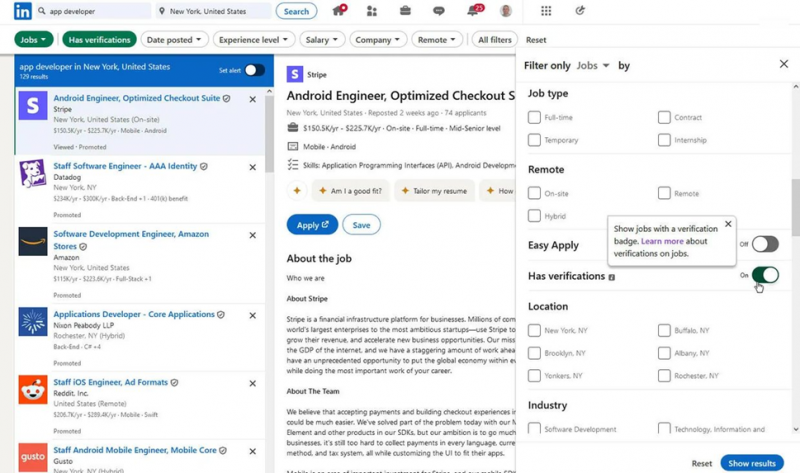
Jobs search: 129 results, salary bands, applicant counts, verification filters, Easy Apply. Account details redacted.
Everything Leeco charged for, visible for free
This is the screen that settles the question in the title. A search for "app developer" in New York returns 129 results, and each card carries what a job seeker needs to triage: company, location, on-site or remote, and a salary band. The Stripe role shows $150.5K to $225.7K, on-site, mid-senior, reposted 2 weeks ago, 74 applicants.
The filter rail is doing serious work: job type, remote/on-site/hybrid, Easy Apply, experience level, salary, company, industry, location. There is a Has verifications toggle, which shows jobs carrying a verification badge, and it is the single most useful anti-ghost-job control on the page. Then there are the AI buttons: "Am I a good fit?", "Tailor my resume", plus Apply and Save.
Two details worth flagging. "74 applicants" and "Reposted 2 weeks ago" are both free signals that tell you whether a role is worth your time. And note the "Promoted" labels down the left rail: several of those top results are paid placements from employers, not pure relevance.
THE BENCHMARK LEECO HAS TO BEAT Every category of thing Leeco wanted $31/year to do, finding relevant roles, filtering out noise, resume tailoring, is present here on a free account in some form. It is not as automated, and nobody is messaging me on WhatsApp. But I can see the jobs, and I can apply to them, at zero cost, in under two minutes from a cold start. That is the benchmark Leeco has to beat, and it did not let me test whether it can. |
What each one actually costs
The headline numbers on both sides are misleading in opposite directions. Leeco’s looks smaller than it is. LinkedIn’s looks bigger than it needs to be.
● Leeco AI ~$31 /year Advertised as about $2.58/month, billed annually. The billing is annual, so this is the number that leaves your account in one go. Billed in Indian rupees, so expect a foreign-transaction fee if your card is not INR. TRIAL: About $0.01 for 7 days, card required upfront TRIAL ENDS: Reminder 1 day before; auto-charges on day 8 unless cancelled REFUND: None after charge. No partial, prorated, or unused-time refunds NOT REFUNDED: Forgetting to cancel, not using it, accidental purchase CHARGEBACK: May result in account suspension or termination JOBS BEFORE PAY: 0 | $0 for job search Search, filters, salary bands, company research, Easy Apply and profile views are all free. Premium Career is an optional add-on. PREMIUM CAREER: India: about $10.40/mo before GST, roughly $12 with it. Some trackers cite $25 to $29/mo instead. Verify at checkout GLOBAL PRICE: $29.99 to $39.99/mo, or about $19.99/mo billed annually ($239.88/yr) TRIAL: 1 month free for eligible accounts REFUND: Possible. Reported within ~7 days of billing, varies by region WHAT YOU GET: 5 InMails, profile viewers, applicant insights, 25,000+ Learning courses JOBS BEFORE PAY: All of them |
THE ONE-CENT TRIAL, DECODED "7 days for a rupee" and "$2.58/month" are both true and both misleading. You are not buying a $2.58 month. You are buying a $31 year, and that one cent buys you a 7-day window to change your mind. Miss the window and the full annual charge lands, and by Leeco’s own policy the money is gone: forgetting to cancel is explicitly on the do-not-refund list. This matters more than usual because of who Leeco targets. Screen L2 sorts you into "Fresher" or "Experienced Professional." A fresher, by definition someone with no salary yet, is asked to commit a full year upfront to a tool that has not shown them one job. LinkedIn Premium Career, at roughly $12/mo in India, lets you leave after one month. Leeco does not offer that exit. |
To be fair on price-per-feature: if Leeco’s agent works as advertised, $31/year is genuinely cheap for automated applications plus referral outreach. One reviewer who paid and ran it for six weeks reported application volume tripled and that at the equivalent of a few dollars a month the cost barely registers against what a faster job search is worth. The problem is not the amount. It is that you must pay it to find out.
Which one finds raelevant jobs
The actual question in the title. Since Leeco would not show me results without payment, this section compares what each one claims and what independent testing found.

How they differ mechanically
LinkedIn is a search engine you drive. You type a query, apply filters, and read results. Relevance is your job; the platform gives you tools. From screen Li3: salary bands, applicant counts, repost dates, a verification toggle, and an "Am I a good fit?" check. Nothing happens unless you do it.
Leeco is an agent that drives for you. You define preferences once, then it scans listings in the background, scores them against your profile, and surfaces only the ones that clear a relevance threshold. For each match, it rewrites your resume to mirror the language in that specific job description, checks for referral contacts at the company, and queues the whole package for your approval over WhatsApp.
These are genuinely different products aimed at the same outcome. Leeco’s model is better in theory, because the highest-value thing in a job search is not searching, it is the referral. Leeco’s own pitch cites the reason: cold applications have a less than 1% success rate, and referrals boost that by 70%. If it delivers on referral outreach at scale, that beats manually trawling LinkedIn.
What the numbers say about LinkedIn
LinkedIn’s relevance is mediocre in absolute terms but strong relative to its peers. Tracking across job platforms found users typically see 1 to 3% response rates on Indeed versus 5 to 10% on LinkedIn for comparable roles, and that for a targeted search, Indeed’s signal-to-noise ratio is the worst of the top three. LinkedIn is where the recruiters actually are.
The ghost-job problem is real and industry-wide, not LinkedIn-specific. Roughly 1 in 3 employers admit posting jobs with no current intent to hire, and the hires-per-posting ratio has halved since 2019. There is also a structural lag: when a company closes a role in its own system, LinkedIn and Indeed receive feed updates later, sometimes 24 to 72 hours later, and sometimes not at all if the integration is stale, which means a listing marked "Just Posted" can already be dead. That "Has verifications" toggle on screen Li3 is the practical defence, and it is free.
THE HONEST LIMIT OF THIS TEST I cannot benchmark Leeco’s match quality against LinkedIn’s, because Leeco gated results behind payment and I did not pay. Anyone claiming a definitive relevance comparison without subscribing is guessing, which is why section 1 states plainly that I did not pay. What I can tell you is the cost of finding out: about $31, non-refundable once charged, versus $0 to evaluate LinkedIn’s results yourself in two minutes. |
Full comparison table
Everything from the test plus verified pricing and ratings, July 2026.
| CRITERION | LEECO AI | WHO WINS | |
|---|---|---|---|
| Jobs visible before paying | 0 | 129 in my test search | |
| Steps from landing to first job | Blocked at step 4 | 2 | |
| Entry price | ~$0.01 / 7 days, card required | $0, no card | |
| Real cost | ~$31/yr charged upfront | $0, or ~$12/mo optional | |
| Refund after charge | None, per published policy | Reported ~7-day window, varies | |
| Automation | Full agent, WhatsApp approve-to-apply | Manual, plus AI assist buttons | Leeco |
| Referral outreach | Automated on your behalf | Manual, or 5 InMails on Premium | Leeco |
| Resume tailoring | Per-role rewrite, reviewer cites 47% to 95% ATS | "Tailor my resume" AI button | Leeco |
| Anti-ghost-job tooling | Claims link verification | Has verifications filter, applicant counts, repost dates | |
| Scale of listings | Aggregates other boards | 1B+ members, 120M+ in India | |
| Independent rating | 4.56 Chrome, 662 ratings | Capterra 93% positive; Trustpilot low | Split |
| Privacy footprint | Critical permissions flagged by Chrome-Stats | Standard platform tracking |
What real users say
Both products have loud defenders and loud critics. The pattern in each set of complaints is more useful than the average score.
| LEECO AI Chrome Web Store - 4.56 from 662 ratings |
“Feels like a mentor when I am solving any questions on leetcode or reading any blog like geeksforgeeks. A must try toool” CHROME WEB STORE POSITIVE |
“A really handy tool to use while solving leetcode. The best part is it does not directly jump to the solution, instead gives us hints to ponder on more than one ways of solving the problem.” CHROME WEB STORE POSITIVE |
“I wasn’t aware of the auto-renewal, and I’d like to request a refund for the amount charged and also know how to unsubscribe from the yearly plan since there seems to be no proper assistance from the support team.” CHROME WEB STORE NEGATIVE |
“I do not feel that there is need for you to collect all this data, nor I can trust any extension that do so! To Developers: This is a horrible practice.” CHROME WEB STORE NEGATIVE |
| Read the split carefully, because it is not about job search. Almost every positive review is about LeetCode tutoring, not job matching. Aggregated review analysis confirms it: users frequently praise Leeco AI for helping with DSA/LeetCode problem solving, while recurring issues include not working reliably, occasional lag, and answers that are incorrect. Customer support is often criticized as unresponsive, and several reviews note the extension is costly. Summaries of the same listing add that reviews warn about costly pricing, auto-renew billing issues, refunds, and weak customer support. That 4.56 is largely a rating of a study aid, not of the job agent you are being asked to pay for, which is why section 1 scopes this test to the job agent only. |
A PERMISSIONS NOTE WORTH TWO MINUTES OF YOUR TIME Chrome-Stats flags the Leeco extension as requiring some sensitive permissions that could impact your browser and data security, and rates the concern Critical, specifically that it grants access to browser tabs, which can be used to track user browsing habits and history, presenting a privacy concern. That is consistent with the angriest user review above. This is not proof of wrongdoing, and any auto-apply tool needs broad permissions to function. But it is a real trade you are making, and it deserves to be a conscious one rather than a surprise. |
| LINKEDIN Capterra - 93% positive of 5,929 reviews / Trustpilot much lower |
“Main thing is that you can easily apply for a job and every time I got the good job through LinkedIn.” CAPTERRA, VERIFIED REVIEWER POSITIVE |
“Most jobs are ghost jobs. I applied nearly 100s of jobs, none got a reply ever. No filters for job posters to add faulty jobs.” CAPTERRA, VERIFIED REVIEWER NEGATIVE |
“When I search "Account Executive" and results for "Software Developer", I’m frustrated!” CAPTERRA, VERIFIED REVIEWER NEGATIVE |
| Capterra’s aggregate is 93% positive, 6% neutral, 1% negative across 5,929 reviews, with listed pros being a comprehensive career development tool and global professional connection hub, and listed cons being excessive spam and irrelevant emails and high cost and restricted access. Note the second complaint above is a four-star review that still says every posting is fake, which tells you people tolerate LinkedIn rather than love it. Independent analysis of the category is blunter, describing job-app one-star reviews as reading like field notes from a broken system: postings that were filled in 2023 still sitting at the top of the feed, "easy apply" buttons that send resumes into a void, and premium paywalls that hide the one thing you actually need. |
Final verdict
The title asks which is better for finding relevant jobs. After running both, the answer is decided less by matching quality than by which product let me evaluate it at all.
| WINNER FOR FINDING RELEVANT JOBS | Not because its matching is impressive. It is mediocre, its feed is full of ghost jobs, and its own users leave four-star reviews saying every posting is fake. LinkedIn wins because it showed me 129 real roles with salary bands, applicant counts and a verification filter before asking me for anything, and because response rates on LinkedIn run 5 to 10% versus 1 to 3% on Indeed for comparable roles. It is where the recruiters are, and evaluating whether it works for you costs nothing but two minutes. Fair warning: free does not mean good. Expect ghost jobs, promoted listings in your top results, spam, and irrelevant matches. Use the Has verifications toggle and check repost dates. |
| BETTER IDEA, WORSE DEAL | Leeco AI The concept is genuinely better than LinkedIn’s. Automated referral outreach on every application attacks the real bottleneck in a job search, and the WhatsApp approve-to-apply loop is a smarter interface than any job board. At $31/year, if it works, it is cheap. I want this product to be good. Fair warning: zero jobs before payment, an annual charge dressed as a $2.58 month, a "Refundable" badge contradicted by a no-refunds policy, Critical-rated browser permissions, and a 4.56 rating that mostly measures its LeetCode tutor. Too many asks before any proof. |
| IF YOU TRY LEECO ANYWAY | Do these three things 1. Set a calendar reminder for day 6, not day 7. Forgetting to cancel is explicitly non-refundable. 2. Install the extension in a separate browser profile, given the tab-access permissions. 3. Only subscribe if you already know your exact target role, since the matching engine needs direction and freshers are the worst-fit users for it. And keep LinkedIn open alongside it. Leeco aggregates from boards like LinkedIn anyway; it is not a replacement for the network, it is a layer on top. |
THE ONE-LINE ANSWER For finding relevant jobs, use LinkedIn, because it proves it works before charging you. Leeco is a better idea with a worse deal: it asks for your career stage, your salary, your location, your Google account and your card, in that order, and shows you a job only after all five. Any tool confident in its relevance would lead with the matches. Leeco leads with the invoice. |
Post Comment
Share your thoughts about this article.
Be the first to post a comment!