One search box, one Lady Gaga track, and every feature poked at. Here is what actually happened, screen by screen.
Songtell kept showing up every time I searched for what a song was really about, so I finally sat down and put it through a proper test instead of skimming it. The pitch is simple: it is an AI tool that explains the meaning behind song lyrics, then layers on extras like a theme breakdown, an emotional map and a quiz.
To keep this fair I picked one song and followed the whole path, from the front page to the feedback box at the bottom. The track was Die With a Smile by Lady Gaga and Bruno Mars. Everything below is what I actually saw, screen by screen. All the scoring is gathered at the end, so the notes along the way can stay pure observations.
How I actually ran it.
I went in as a first-time visitor with no account, on a standard desktop browser, and used the site the way any curious listener would rather than poking at it like a reviewer. I ran a single search, generated one interpretation, and captured a screenshot at every step so nothing here is rebuilt from memory. The scores further down reflect that one hands-on session, not weeks of use, so treat them as a first impression from a real sitting.
GETTING IN THE DOOR
Finding it was the first speed bump
Here is the odd part. I could not find a clean direct link to Songtell from a normal search. I ended up clicking through from a completely different blog that happened to link to it. For a tool that looks this polished, that is a strange first impression, and it is the first thing I would fix.
The landing page itself is lovely once you arrive. A dark, cosmic purple field with a few faint stars, a headline reading Unravel the meanings behind the lyrics you love, and one line underneath promising AI-powered analysis and community insights. There is a single Sign in button in the corner and nothing else fighting for attention.
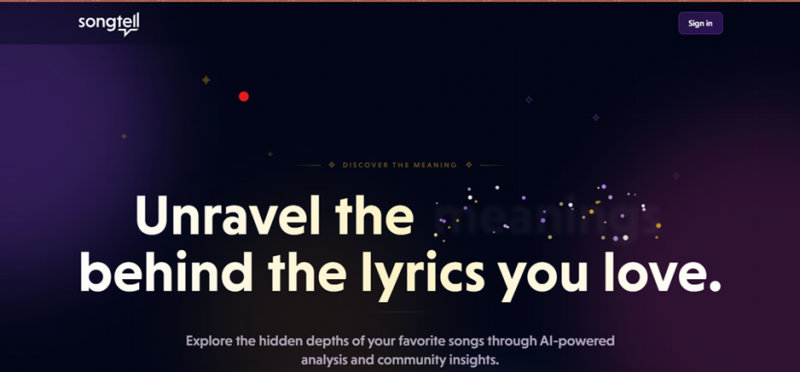
The landing page. Beautiful and minimal. My problem was getting here in the first place.
MY OBSERVATION The page itself is calm and confident, so my friction was entirely about reaching it. A normal search never surfaced a clean route to the site, and clicking in through a third-party blog is not how a tool this good should be found. |
THE SEARCH
One box, no clutter, which I liked
There is exactly one search field and that is the whole interface. I typed die with smile and let it work. No advanced filters, no genre pickers, nothing to configure. For a tool aimed at casual curiosity, keeping it this bare is the right call.
Underneath the box there is a Most Unraveled This Week list showing what other people are decoding right now, with ranked entries at the top. It is a small bit of social proof and a decent way to fall into a song you were not looking for.
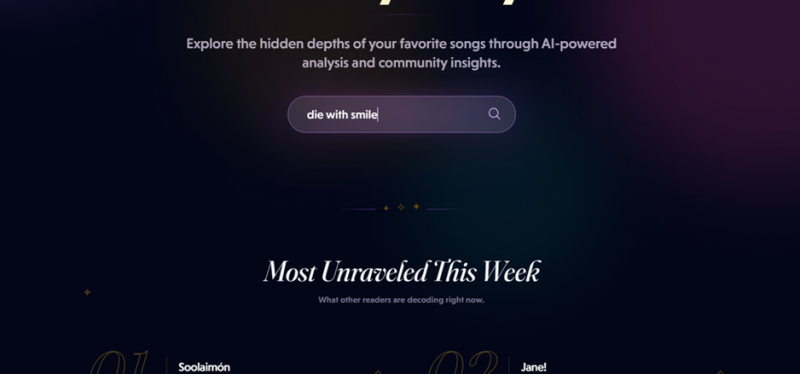
Type a title, hit search. The trending list below is a smart way to keep people browsing.
MY OBSERVATION Keeping everything to a single box felt right for casual use. The one thing I kept reaching for and not finding was a way to filter, which turned out to matter on the very next screen. |
RESULTS
The results were a bit of a mess
This is where it wobbled. My query pulled back a stack of songs, and a lot of them were near-duplicates of the same Juice WRLD and The Weeknd track with slightly different artist labels stacked one after another. There was also a completely different song called Want to die with smile, and a Die with a Smile by FKJ, mixed in.
The version I actually wanted, Die With a Smile by Lady Gaga and Bruno Mars, was sitting near the bottom of the list rather than the top. On the plus side, every result has a clear Generate button, which is honest about the fact that the analysis is built on demand rather than sitting there pre-written.
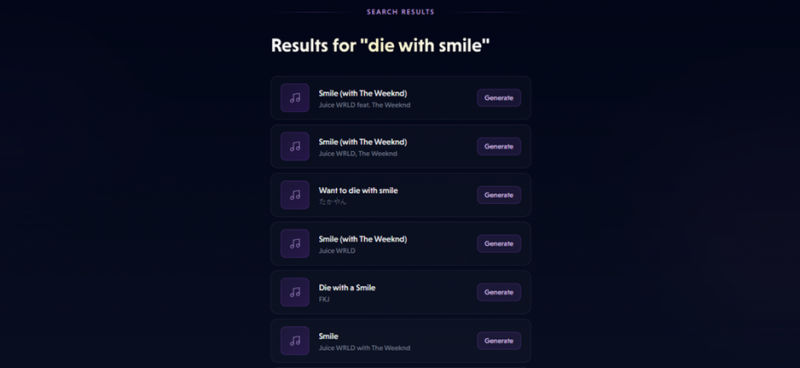
Fuzzy matching is generous, maybe too generous. Note the repeated near-identical entries.
MY OBSERVATION The matching was generous, maybe too generous. Several near-identical entries crowded the top while the Lady Gaga and Bruno Mars version I wanted sat near the bottom, so I had to scroll past the noise to find it. |
THE INTERPRETATION
Then it earned all the goodwill back
I hit Generate on the Lady Gaga and Bruno Mars track, and this is the moment Songtell justifies itself. The opening summary reads like something a real music writer would file. It framed the song as stark, pre-apocalyptic devotion and an emotional anchor in a world that feels increasingly unmoored, then backed it up with paragraphs on the retro-soul production and the controlled, breathy tension in both vocals.
On the right there is a tidy panel with a Pop genre tag, a 4:12 duration, the 2024 year, the single it came from, and a More from Lady Gaga list. It is the kind of context you would otherwise open three tabs to gather, sitting in one place.
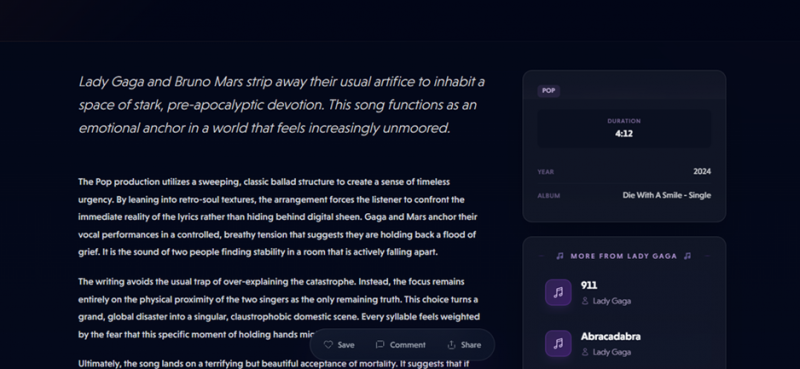
The main event. This reads nothing like the auto-generated filler on most lyric sites.
MY OBSERVATION This was the moment the tool clicked for me. The writing was specific and considered rather than generic, and having the genre, length, year and related songs in one panel meant I never needed to open anything else for context. |
THEMES AND LYRIC
Themes you can skim, plus a lyric worth pausing on
Scroll on and the interpretation breaks into labelled Themes, each with a colour-coded bar and a single line of explanation: Finite time, Domestic sanctuary and Existential defense. It is an easy way to grab the argument without reading every paragraph.
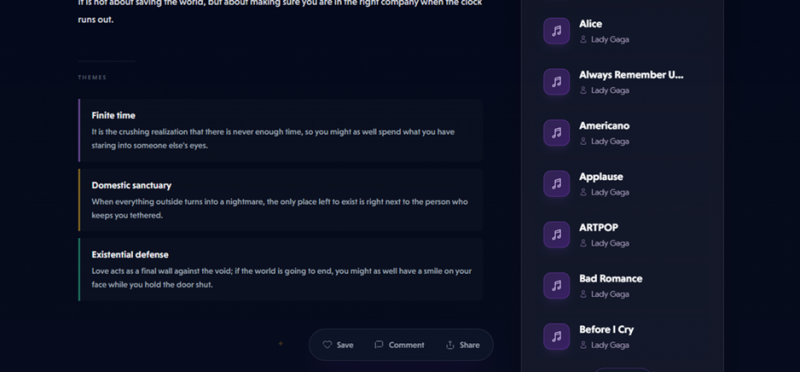
Three themes, one line each, colour tagged. Fast to read, easy to remember.
Then it does something small but classy. It pulls a single lyric out of the song, sets it in large type like a quote card, and explains why that one line reframes everything else.
“And our love’s the only war worth fighting for”
SONGTELL’S HIGHLIGHTED LINE
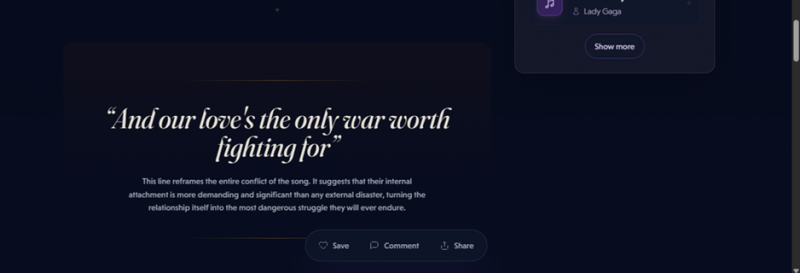
Pulling one key line and analysing it is a nice, considered flourish.
MY OBSERVATION The colour-tagged themes made the argument quick to scan, and pulling one lyric out as a quote card felt like a deliberate design choice rather than filler. Small touches, but they added up. |
THE EXTRAS
The extras are where it pulls ahead
Songtell does not stop at a written take, and this is what separates it from a plain lyrics page. There is an Emotional Arc that maps the song from Verse 1 to the Outro, labelling each beat: Uneasy wakefulness, Defiant tenderness, Heightened urgency, Total surrender, and finally Hollow peace.
Right below it sits a Test Your Ear quiz that asks about the narrator's motivation, with a progress bar and multiple choice answers. It is a fun way to check whether you actually followed the reading.
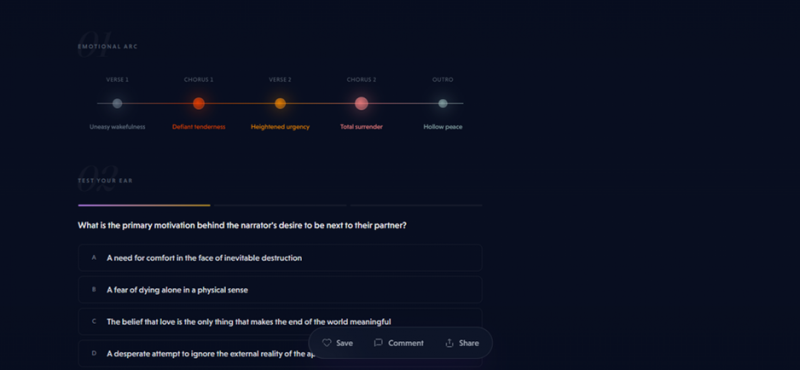
The Emotional Arc, top, is my favourite feature. The quiz underneath is a light bonus.
Keep going and there is a Play This When section with three oddly specific mood scenarios, like watching a storm roll in from a cold porch, or sitting in the dark when the power goes out on a winter night. Then, to its real credit, comes The Other Reading, an alternative interpretation arguing the opposite case: that the song is about avoidance rather than romance.
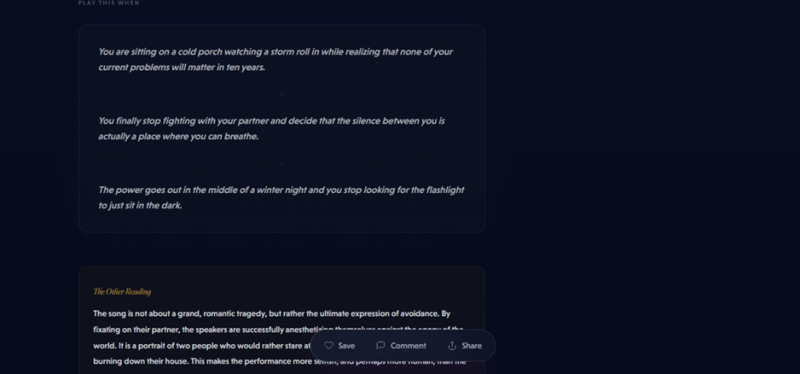
Play This When sets the mood. The Other Reading argues against itself, which is rare and welcome.
MY OBSERVATION The emotional arc was the feature I did not expect and ended up liking most. The counter-interpretation under The Other Reading mattered even more, because it showed the tool was willing to argue against its own take instead of pretending there is one correct answer. |
Community
The community layer is a promise, not a feature yet
The last section is the social one. Songtell wants readers to add their own insights, vote on them, and get credited when a good one gets merged into the main interpretation. The little Share, Vote, Merge and Credit flow explains the idea well, and there is a purple Add your insight button front and centre.
The catch is that on the song I tested it read 0 contributions and No contributions yet. So right now this is an empty room with a good idea painted on the wall. If it fills up, it could become the best part of the site.
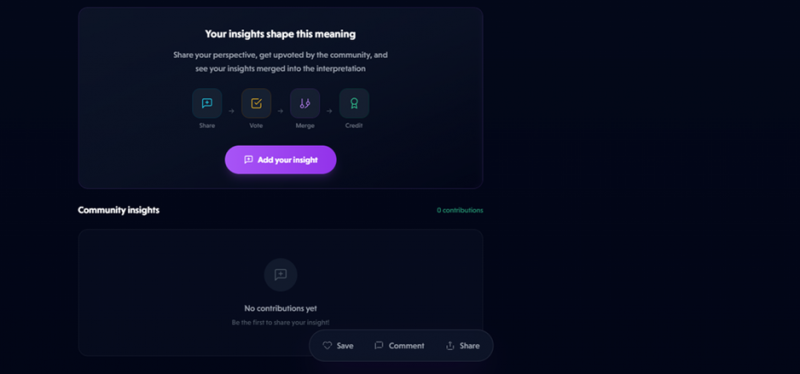
The concept is strong. The reality, for now, is zero contributions.
MY OBSERVATION The idea here is strong, but the section was completely empty on the song I looked at. For now it is a well-designed placeholder rather than something I could actually use. |
How Songtell scored in my test
With the walkthrough done, here is how each part held up, scored out of ten.
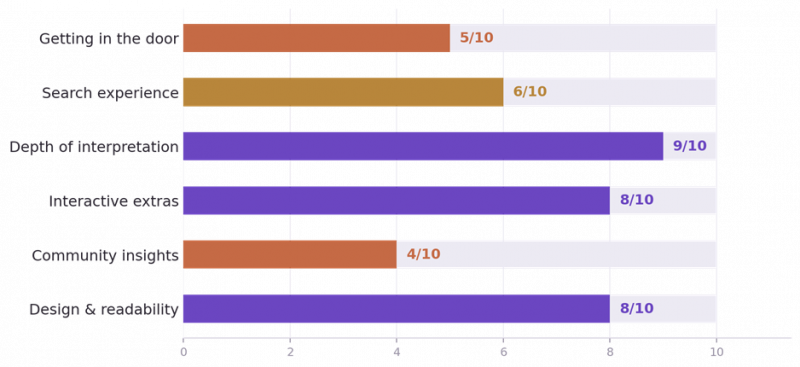
Raw average lands around 6.7. I am rounding to 7 out of 10 because the thing Songtell is built to do, interpret a song, it does better than anything else I have tried. The pieces holding it back, discoverability and an empty community, are both fixable without touching the part that already works.
THE WHOLE TEST AT A GLANCE
Feature by feature
| FEATURE | WHAT IT DOES | MY TAKE | SCORE |
|---|---|---|---|
| Landing page | The front door and pitch | Beautiful, but hard to find | 5 /10 |
| Search | Find a song by title | Fast, no filters | 6 /10 |
| Results ranking | Match your query to tracks | Cluttered with duplicates | 6 /10 |
| Interpretation | The written meaning | The main event, well written | 9 /10 |
| Themes | Labelled ideas in the song | Skimmable and clear | 8 /10 |
| Key lyric callout | Analyses one standout line | A classy flourish | 8 /10 |
| Emotional arc | Maps mood across the song | Cleverest feature here | 9 /10 |
| Test Your Ear quiz | Checks your understanding | Fun, optional | 7 /10 |
| Play This When | Mood scenarios for the song | Oddly specific, charming | 7 /10 |
| The Other Reading | Offers a counter-take | Rare and welcome maturity | 9 /10 |
| Community insights | Reader contributions | Empty right now | 4 /10 |
THE VERDICT
So, should you use Songtell?
| 7 /10 | OVERALL SCORE A sharp brain behind a hard-to-find door. |
If you care about what a song is actually saying, yes. The interpretation quality is the whole reason to be here, and it is a real step above the recycled explanations you get elsewhere. The emotional arc and the willingness to argue against its own reading pushed it from a novelty into something I would open again.
The reasons to hold off are practical, not creative. You have to fight to find the site, the search buries the exact track behind duplicates, and the community section is empty. None of that touches the writing, which is what matters most, so I land on a confident 7 out of 10 with room to climb.
USE IT IF You want a thoughtful read on what a song means, you enjoy seeing a track's mood mapped out, or you like a second opinion that questions itself. Great for curious listeners, students and anyone who writes about music. | SKIP IT IF You only want plain lyrics with no interpretation, you need deep coverage of very obscure tracks, or you were hoping for an active community today. The reading engine is strong, the surrounding pieces are still catching up. |
Post Comment
Share your thoughts about this article.
Be the first to post a comment!