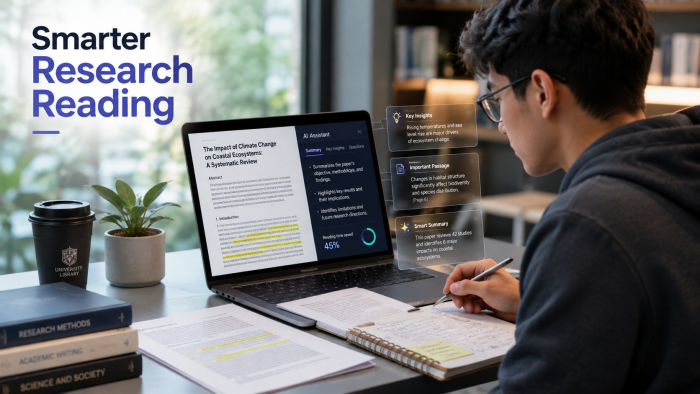
A practical, data-backed workflow for turning a blank title field into a shortlist of headlines worth testing. Built for marketers, bloggers, and anyone whose first line has to earn the next one.
| Number | What it shows | Source |
|---|---|---|
| 5x | as many people read the headline as read the body copy | David Ogilvy |
| 94% | of marketers plan to use AI in content creation this year | HubSpot 2026 |
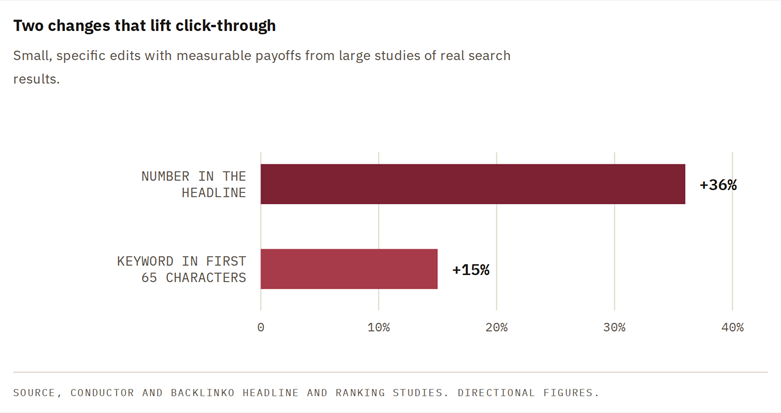
| +36% | more clickthroughs when a headline uses a number | Conductor via Backlinko |
| 6 hrs | saved per week by the average marketer using AI | HubSpot 2026 |
Your headline is the highest-leverage sentence you will write all day. The advertising executive David Ogilvy found that roughly five times as many people read the headline as read the body copy, which means most of your effort is already spent, or wasted, the moment someone finishes that first line. AI does not change that math. It changes how quickly you can find the headline that earns the click.
This guide walks through a repeatable way to generate headlines with AI, grounded in what the numbers actually reward. You will get the criteria that separate strong headlines from weak ones, a six-step workflow, prompts you can paste, and a formula table you can use today.
Five times as many people read the headline as read the body. By the time they finish it, most of the budget is spent.
Paraphrased from David Ogilvy
The landscape
AI is now the default drafting partner
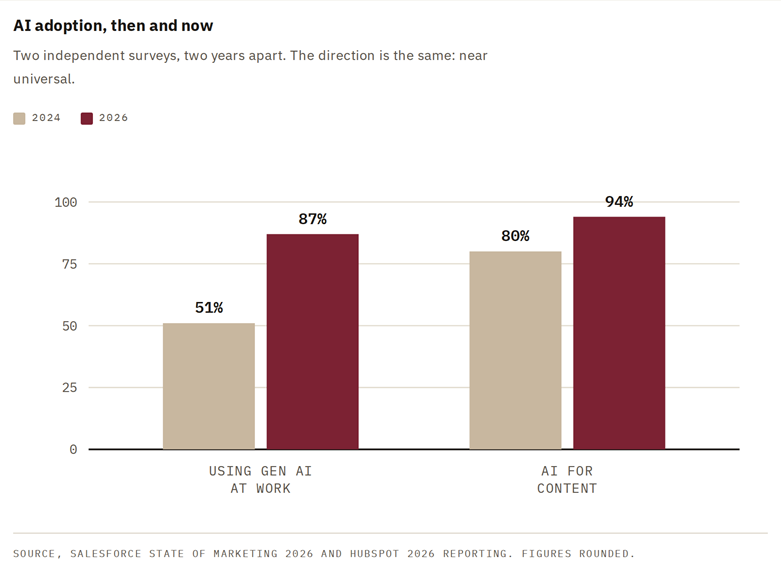
Using AI for content is no longer an edge. It is the baseline. HubSpot's 2026 figures put the share of marketers planning to use AI in their content work at around 94 percent, up from roughly 80 percent two years earlier. Salesforce's 2026 data tells a similar story, with about 87 percent of marketers now using generative AI in at least one workflow, compared with just over half in 2024.
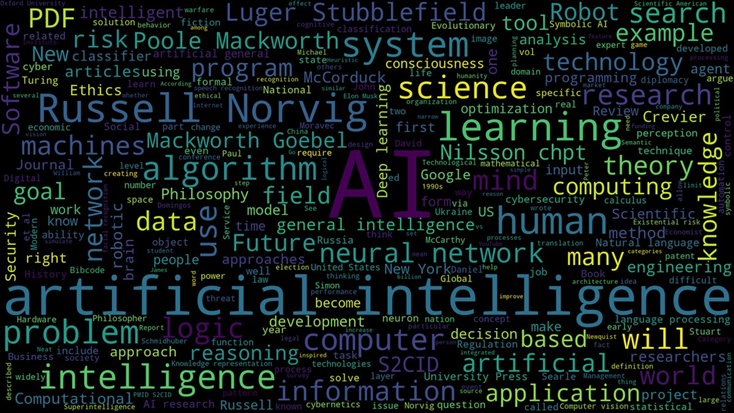
The vocabulary of modern AI. For headlines, the useful part is narrow: fast generation, tone shifting, and near infinite variations. Image, Madhav-Malhotra-003 via Wikimedia Commons, released under CC0.
Here is the honest framing. AI is excellent at generating range, remixing proven structures, and adapting tone for different platforms. It is not the final judge of whether a headline is true, on brand, or worth the promise it makes. That judgment stays with you. Treat AI as the drafting engine, and yourself as the editor who protects the reader's trust.
What the data actually rewards
Before you prompt anything, you need to know what good looks like, because each pattern below becomes an instruction you can hand to the model. These are the signals that show up again and again in headline research.
2 to 3x Headlines built on concrete numbers, emotional words, and strong verbs can outperform generic ones by two to three times on click-through. Source, Backlinko analysis of search results |
Put those signals together and you have a brief. Take a plain title and sharpen it: add a specific number, lead with a clear benefit, keep the visible length near sixty characters, and choose words that carry a little heat without overpromising. Here is what that looks like in practice, annotated the way a headline analyzer would score it.
ANATOMY OF A HEADLINE THAT WORKS Cut Your Email Prep Time by 73% With One Simple Change A strong verb up front POWER WORD, a specific, believable figure NUMBER, and a clear reader benefit PAYOFF. Nothing here overpromises, and the article can deliver on every part of it. |
A six-step workflow
Great headlines are selected, not written on the first try. This is the loop that turns AI from a novelty into a dependable part of your process.
01 - Brief the AI properly
Context beats cleverness. Before you ask for a single line, give the model your audience, the angle of the piece, your primary keyword, the platform, and the goal, whether that is clicks, search ranking, or shares. The more you specify, the less generic filler comes back.
02 - Generate in volume
The newsroom habit of drafting ten to twenty-five options per piece exists for a reason: the winner is rarely the first idea. Ask for fifteen to twenty-five at once. It costs you seconds and gives you range to choose from.
03 - Steer toward what the data rewards
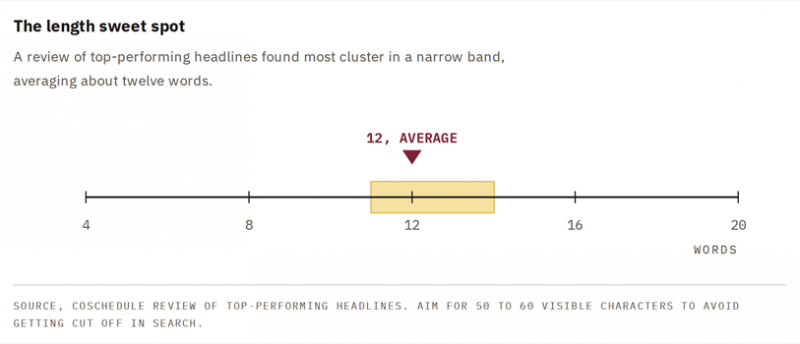
Turn the signals above into constraints inside the prompt. Ask for a specific number where it fits, a clear benefit, a length near sixty characters, and a ban on hype words like revolutionary or game changing. Request a mix of styles so you can compare.
04 - Score and tighten
Run your shortlist through a headline analyzer such as CoSchedule Headline Studio, which scores word balance, sentiment, and length. Check the character count so nothing gets truncated. Then read each option aloud, because if it feels clunky in your mouth it will feel clunky on the page.
05 - Test the top two
An analyzer predicts, but real clicks decide. Where your platform allows it, run an A and B test between your two strongest options and let the audience vote. Match matters too: the headline has to deliver what the body actually contains.
06 - Feed winners back in
Keep a swipe file of headlines that performed well for you. Paste your best performers back into the model and ask for more in that proven direction. Over time you build a feedback loop that sharpens with every campaign.

Prompts you can paste
Copy one of these, drop in your details, and you are running the workflow. Use the first to create range, the second to break out of a rut, and the third to sharpen your finalists.
Prompt 1, generate with context You are a headline strategist. Write 20 headlines for a blog post about [topic]. Audience, [who they are and what they care about]. Primary keyword, [keyword]. Goal, [clicks, SEO, or shares]. Keep each headline under 60 characters, include a specific number where it fits, lead with a clear benefit, and avoid hype words. Give me a mix of how-to, list, and question styles. |
Prompt 2, expand the angle Give me five different angles for a headline about [topic], one emotional, one data-led, one contrarian, one straightforward how-to, and one urgency-based. Then tell me which is strongest for a [platform] audience, and why. |
Prompt 3, refine and pressure-test Here are my three favorite headlines, [paste them]. For each one, tell me its main strength, curiosity, clarity, or search value, rewrite it to be more specific, and flag any headline that promises more than a typical article could deliver. |
Seven formulas that keep performing
Give the model a formula and it fills the blanks with surprising range. Each row below pairs a proven structure with an example an AI can draft on request.
| Formula | How it is built | Example an AI can draft |
|---|---|---|
| The How-To | How to [outcome] without [pain point] | How to Cut Your Email Prep Time Without Hiring a Writer |
| The List | [Number] [adjective] ways to [outcome] | 7 Proven Ways to Grow Your Email List in 30 Days |
| The Question | Are you [making a common mistake] | Are You Making These 5 Landing Page Mistakes |
| The Guide | The complete guide to [topic] for [audience] | The Complete Guide to AI Headlines for Busy Marketers |
| The Data Hook | [Specific result] with [method] | We Increased Signups 73 Percent With One Headline Change |
| The Face-Off | [Option A] vs [Option B], which wins for [goal] | Long vs Short Headlines, Which Wins More Clicks |
| The Warning | [Number] mistakes that [bad outcome] | 5 Headline Mistakes That Quietly Kill Your Click Rate |
Common mistakes to avoid
- Prompting too vaguely
Write me some headlines gets you generic output. A specific brief gets specific results.
- Letting AI overpromise
A curiosity gap the article cannot fill wins the click but breaks trust, which shows up later as weak conversions.
- Ignoring the character limit
A line that reads well in your editor can get cut off in search or a social preview. Check the count.
- Skipping message match
If the headline says one thing and the body delivers another, your bounce rate climbs. The headline is a promise.
- Generating once and stopping
The first batch is a starting point, not a finish line. Iterate, score, and test before you commit.
- Trusting one score blindly
Analyzers predict performance, they do not guarantee it. Use them as a guide, then let real clicks settle it.
Checklist
Before you publish
- Run through these before you publish. If all seven hold, your headline is ready.
- You briefed the AI with audience, keyword, platform, and goal
- You generated at least fifteen options and chose from range
- Your finalist includes a specific number or a concrete benefit
- The visible headline sits near 50 to 60 characters
- The keyword appears early, ideally within the first 65 characters
- The headline honestly matches what the article delivers
- You tested your top two where the platform allowed it
Final Verdict
AI has made it faster than ever to produce a long list of options, and the data is clear that the marketers who use it well ship quicker and report stronger results. But the winning headline still comes from a human process. Brief the model with real context, push it toward the patterns the research rewards, generate in volume, and let honest testing choose the finalist. The tool writes the drafts. You keep the promise. That combination is where the clicks live.
None of this works if you skip the last step. The temptation with a fast draft pipeline is to trust the output that sounds best and move on, but "sounds best" is exactly the judgment AI is worst at improving , it optimizes for what reads well, not for what your specific audience actually clicks. Set up the test, give it enough traffic to mean something, and keep a record of what won. Over time that record becomes the real asset: a house-specific sense of what your readers respond to, which is something no model ships with out of the box.
Post Comment
Share your thoughts about this article.
Be the first to post a comment!