The Flashcard Renaissance and Why Gizmo Isn't the Last Word
Every student has felt it: the sinking realisation that you've highlighted an entire chapter, reread your notes twice, and still can't recall the key concepts when it counts. Passive studying doesn't work. That's not a new insight - the cognitive science on active recall and spaced repetition has been settled for decades. What's new is that AI has finally made the gold standard of studying accessible without hours of manual preparation.
Gizmo AI arrived as one of the first tools to genuinely democratise this workflow. Upload your lecture slides, drop in a YouTube video link, paste your PDF notes - and within seconds, you have a curated deck of flashcards built on scientifically proven retention techniques. For millions of students, that's transformative.
But Gizmo isn't the only tool at this table, and in several important respects, it's not even the best one. Its free tier frustrates more than it helps, its spaced repetition algorithm has gaps that power users notice immediately, and the weekly pricing model stings when you compare it to the alternatives.
This guide cuts through the noise. We'll look honestly at what Gizmo does well, diagnose exactly where it falls short, and then spend the bulk of our time on six alternatives - each occupying a distinct, genuine position in the study-tool landscape. Whether you're a medical student, a casual self-learner, a language enthusiast, or a student on a tight budget, one of these tools is almost certainly a better fit than Gizmo for your specific situation.
Also Read - Gizmo AI
4.8★ Gizmo App Store Rating 9,000+ reviews (iOS) | $3.5M Seed Funding Raised Backed by NFX (Google alumni) | 86% Students Use AI Tools Digital Education Council 2024 | 200% Retention Improvement Spaced repetition vs. passive re-read |
Gizmo AI: The Full Picture
Let's start with credit where it's due. Gizmo AI, developed by Cambridge alumni and launched in 2023, tackled the most tedious part of flashcard-based studying: creating the cards in the first place. The platform accepts PDFs, PowerPoint files, YouTube video links, typed notes, audio recordings, and even handwritten scans. Its AI parses the content and generates question-answer pairs in seconds - a workflow that genuinely saves hours during exam season.
The spaced repetition algorithm schedules reviews at scientifically optimised intervals, the gamified quiz modes (including a multiplayer "Gizmo Live" feature) make daily practice feel less like a chore, and the clean, minimalist interface is one of the best-designed in the category. With over a million public decks available to browse and import, it also has the community depth that makes it immediately useful even before you've uploaded a single document.
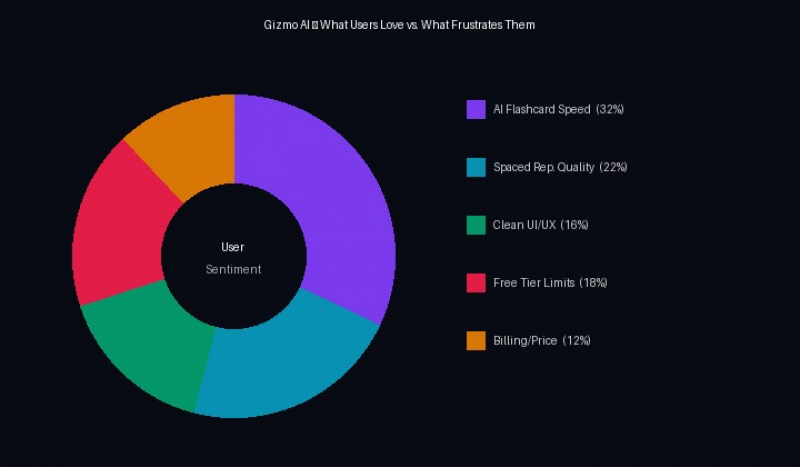
Figure 1: Gizmo AI user sentiment breakdown - what users praise and what frustrates them most
What Gizmo Gets Right
• The AI flashcard generation from multi-format sources (PDF, YouTube, PPT, audio) is genuinely best-in-class for speed and ease of use
• Spaced repetition and active recall are baked into every study session, not bolted on as an afterthought
• The gamified elements - streaks, leaderboards, Gizmo Live - create the daily habit loop that passive study never achieves
• Quizlet and Anki deck imports mean you're not starting from zero if you're migrating
• The AI tutor provides step-by-step explanations when you answer a card incorrectly, not just the answer
Where Gizmo Falls Short
The criticisms are specific enough to be actionable. The most consistent user complaint - across App Store reviews, Reddit threads, and independent testing - is the free tier's life system. Run out of lives mid-session (easily done by getting a few answers wrong), and you face a forced 10-minute lockout. That kind of interruption during an intensive exam cram is more than annoying - it actively breaks the study rhythm that spaced repetition depends on.
Second, the spaced repetition algorithm, while present, is noticeably less sophisticated than Anki's FSRS (Free Spaced Repetition Scheduler). Several users who migrated from Anki specifically flagged that Gizmo over-repeats recently-learned cards and is slow to surface older material that genuinely needs review. For subjects with large card volumes - medicine, law, advanced languages - this matters enormously.
Third, AI-generated cards occasionally lack the nuance required for clinical or applied reasoning. Dense technical content sometimes produces shallow question-answer pairs that test recall but not comprehension. That's fixable with manual editing, but it adds a curation step that undermines the "instant flashcard" promise.
| What It Does Well | Where It Falls Short |
| Fastest multi-format AI flashcard generation in the category | Free tier's life system forces disruptive lockouts during study sessions |
| Spaced repetition + active recall built in from day one | Spaced repetition algorithm weaker than Anki's FSRS for large decks |
| Gamified study modes build consistent daily habits | Weekly pricing ($13.99/wk) is expensive without an annual commitment |
| Clean, minimal UI with very low learning curve | AI cards can be shallow on dense or technical content |
| Quizlet & Anki deck imports; 1M+ public decks available | No offline mode - requires internet connection throughout |
| Step-by-step AI tutor explanations on wrong answers | Spaced repetition repeats recent cards too often; slow to surface older material |
“Gizmo is genuinely capable if you're willing to pay for it. But the free tier is designed to push you toward a subscription rather than to actually serve your learning.”
Anki
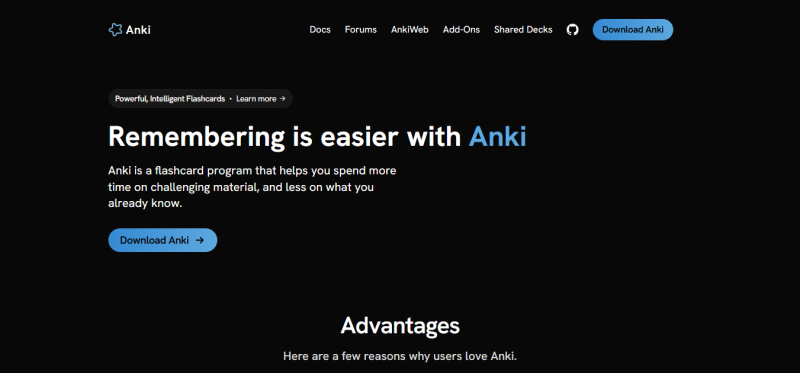
Best for: Serious learners who want the most powerful spaced repetition algorithm available - free
Anki is the benchmark. It has been for fifteen years. Built by a programmer who wanted a better way to study Japanese, it has since become the de facto standard tool for medical students, language learners, and anyone who needs to retain large volumes of information over months and years. If Gizmo is the stylish newcomer, Anki is the battle-hardened veteran - less beautiful, harder to set up, and demonstrably more effective for power users.
The engine underneath Anki is now FSRS - a machine-learning scheduling algorithm trained on hundreds of millions of real reviews. It is, by most objective measures, the most sophisticated spaced repetition implementation available to consumers. Cards surface at precisely the right intervals to prevent forgetting without wasting time on material you already know. Over large decks (the AnKing medical deck alone has over 30,000 cards), that precision translates directly into better exam performance with fewer total review hours.
What Anki Does Better Than Gizmo
• The FSRS algorithm is the gold standard of spaced repetition - more precise and efficient than Gizmo's implementation, especially for large decks
• Completely free on desktop and Android; no paywalls, no life systems, no forced interruptions
• A massive, 15-year-old community has produced thousands of pre-made decks for medicine, law, languages, and more
• Deep customisation - card layouts, add-ons, scheduling parameters - for users who want full control
• Offline functionality works without internet; your cards and schedule are always available
Where Anki Still Falls Short
• No built-in AI flashcard generation - creating cards manually from PDFs or lectures is slow and tedious
• The interface is famously dated and requires significant setup time before it becomes comfortable
• Mobile iOS app costs $24.99 (a one-time fee, but a barrier for budget-conscious students)
• No collaborative features; Anki is fundamentally a solo study tool
Anki - Quick Stats • Pricing: Free on desktop and Android; $24.99 one-time iOS purchase • Best for: Medical students, language learners, and serious exam prep with large card volumes • Algorithm: FSRS (machine-learning spaced repetition - the most sophisticated available) • Standout feature: A 15-year community of shared decks, add-ons, and institutional knowledge that no newer tool can replicate |
| Verdict: Anki wins on algorithm depth and cost. If you can handle the setup curve and don't need AI card generation, it's the most powerful free study tool on the market. |
Quizlet
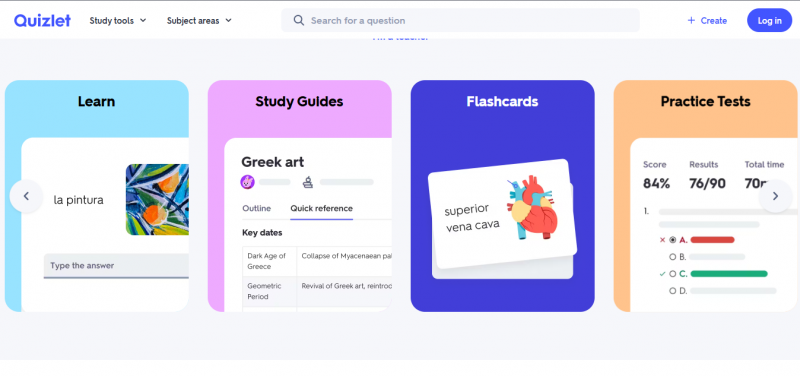
Best for: Students who want the largest shared deck library and varied study modes in one familiar platform
Quizlet is the name most students encounter first when they go looking for flashcard tools. With hundreds of millions of study sets created by students, teachers, and professionals over more than a decade, its library is the deepest in the category. If someone has studied your subject before, there's a good chance a Quizlet deck already exists for it.
Quizlet's recent AI upgrades have meaningfully closed the gap with newer tools. The platform now offers AI-generated flashcard creation from notes and uploaded content, adaptive practice modes, and AI-powered explanations - features that were absent or weak just two years ago. The variety of study modes (Learn, Test, Match, Gravity, Live) also gives learners more ways to engage with material than Gizmo currently offers.
What Quizlet Does Better Than Gizmo
• The largest shared study set library in the world - hundreds of millions of decks across virtually every subject
• Multiple study modes cater to different learning styles: flashcards, written recall, matching, and timed tests
• Classroom and teacher features make it one of the best tools for collaborative academic settings
• AI flashcard generation from notes has significantly improved and rivals Gizmo's quality
• Strong mobile apps with a polished, familiar interface that requires no learning curve
Where Quizlet Still Falls Short
• AI features are locked behind a paid subscription - the free tier no longer includes AI generation
• The spaced repetition implementation is less rigorous than Anki's or RemNote's FSRS
• An increasing number of ads and upsell prompts on the free tier make the experience feel cluttered
• Pricing has crept up significantly - some users report the annual plan reaching $35.99/year
Quizlet - Quick Stats • Pricing: Free (limited AI); Plus approx $35.99/year; Teacher plans available • Best for: Students who want community-built decks and varied study modes alongside AI features • Algorithm: Spaced repetition present but less sophisticated than FSRS-based tools • Standout feature: The world's largest student-created study set library - unmatched for common subjects |
| Verdict: Quizlet wins when you need instant access to pre-made decks for common subjects, or when you're studying in a classroom context that already uses the platform. |
RemNote
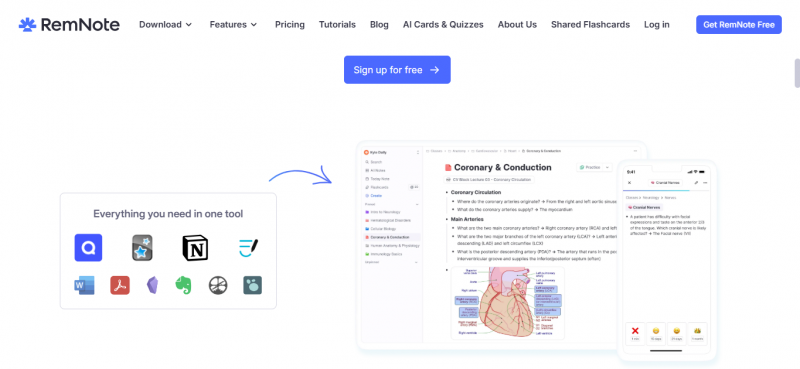
Best for: Students who want notes and flashcards in a unified knowledge graph - particularly in STEM and medicine
RemNote solves a problem that Gizmo doesn't even address: the disconnect between note-taking and flashcard review. On most platforms, you write your notes somewhere (Notion, OneNote, your notebook), then separately create flashcards from those notes in another app. RemNote collapses this into a single system - you write your notes in an outliner, highlight any sentence or concept, and it becomes a flashcard automatically.
This means your flashcards live in context. When you review a card about the Krebs cycle, you can jump directly to the surrounding notes that give that card meaning. For subjects that require conceptual understanding rather than isolated recall - biochemistry, law, philosophy, advanced mathematics - this linked structure is genuinely superior to standalone flashcard apps.
What RemNote Does Better Than Gizmo
• Notes and flashcards are the same system - cards are created directly from your notes and link back to their context
• Supports both FSRS and SM-2 scheduling algorithms - more sophisticated than Gizmo's implementation
• Knowledge graph and backlink features build a network of understanding, not just isolated recall
• Anki, Notion, and Roam imports supported - existing study infrastructure can migrate in
• PDF annotation with flashcard creation directly from highlighted text is a standout workflow
Where RemNote Still Falls Short
• The learning curve is steeper than Gizmo - it rewards investment but isn't instantly usable
• AI flashcard generation from uploaded content (PDFs, videos) is less polished than Gizmo's
• The interface can feel complex and note-heavy for students who just want a simple flashcard app
• Free tier limitations can be frustrating for heavy users; the paid plan is needed for full AI features
RemNote - Quick Stats • Pricing: Free (limited AI); Pro from $8/month (annual billing) • Best for: STEM and medical students who want notes and flashcards integrated into a knowledge graph • Algorithm: FSRS and SM-2 supported - among the best scheduling available outside of Anki • Standout feature: Context-linked cards - every flashcard connects back to the notes it came from |
| Verdict: RemNote wins for concept-heavy subjects where understanding the relationship between ideas matters as much as isolated recall. It's the best notes-plus-flashcards integration available. |
Brainscape
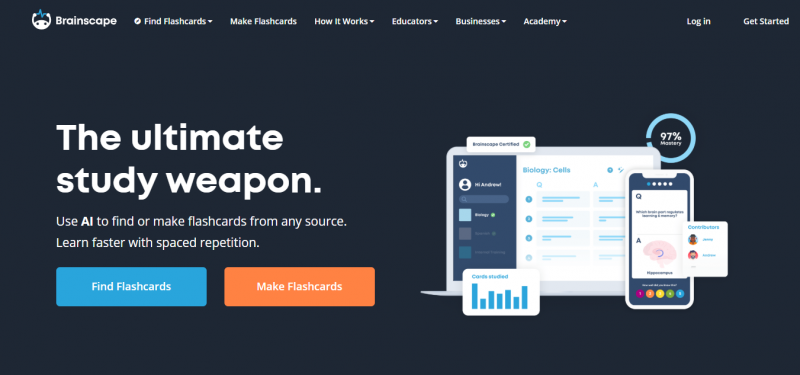
Best for: Students preparing for professional licensing exams who want expert-curated, certified content
Brainscape's differentiator isn't AI card generation - it's the quality of its pre-built content. The platform hosts certified decks for professional and licensing exams: USMLE, MCAT, Bar Exam, CPA, GRE, real estate licensing, and more, all written by subject matter experts and reviewed for accuracy. If you're preparing for a specific high-stakes exam and want curated content you can trust without building decks yourself, Brainscape's library is the best in the business.
The scheduling approach is also distinctive: instead of a behind-the-scenes algorithm, Brainscape uses Confidence-Based Repetition (CBR). After each card, you rate your confidence on a scale of one to five. The algorithm uses those ratings to schedule the next review. The approach is research-backed and has been shown to be highly effective - and it gives learners more conscious awareness of their own knowledge gaps than systems that schedule reviews invisibly.
What Brainscape Does Better Than Gizmo
• Expert-certified decks for USMLE, MCAT, Bar Exam, and CPA are unmatched in quality - far more reliable than AI-generated or user-created cards
• Confidence-Based Repetition gives learners conscious insight into their own weak areas
• The "most effective app for learning" has a peer-reviewed research basis that most competitors lack
• Clean, focused interface optimised specifically for flashcard review - no distracting features
• Available across web, iOS, and Android with good sync reliability
Where Brainscape Still Falls Short
• No AI flashcard generation from PDFs or videos - you build your own cards or rely on pre-made decks
• The best content (certified professional exam decks) requires a paid subscription
• Less suitable for subjects outside its curated exam library
• CBR is less precise for long-term retention than FSRS in head-to-head algorithmic comparisons
• Limited collaboration features compared to Quizlet or classroom-focused tools
Brainscape - Quick Stats • Pricing: Free tier; Pro at $9.99/month; Class plans for educators • Best for: Students preparing for USMLE, MCAT, Bar Exam, CPA, and other professional licensing exams • Algorithm: Confidence-Based Repetition (CBR) - research-backed and intuitive • Standout feature: Expert-certified exam decks - the most reliable pre-made content library for professional exams |
| Verdict: Brainscape wins for professional exam candidates. If you're studying for USMLE, the Bar, or MCAT, its certified content is more trustworthy than anything AI can generate. |
Knowt
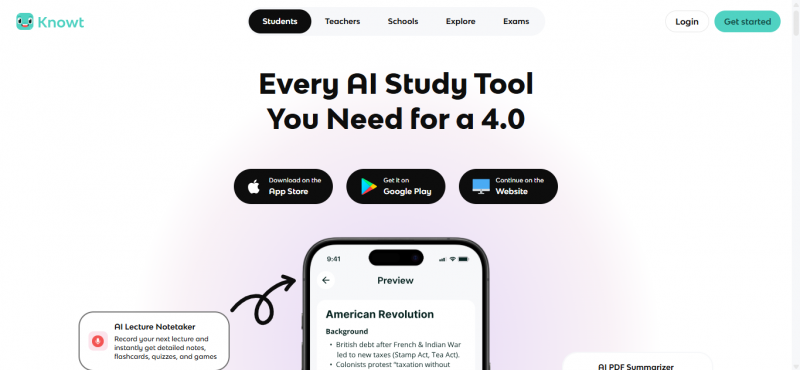
Best for: Budget-conscious students who want strong AI flashcard generation without paying a subscription
Also Read - Knowt
Knowt is arguably the most compelling free Gizmo alternative available. It generates AI flashcards from notes, PDFs, YouTube videos, and webpages, includes spaced repetition, and keeps the full suite of study modes - learn mode, practice tests, matching games - free for all users. Over five million students and teachers have already adopted it, and during the May 2025 AP exam season alone, over 700,000 students used it for test preparation.
The value proposition is hard to argue with: you get most of what Gizmo offers on its free tier without the life system and lockout frustrations. The AI quality for standard academic content (textbook chapters, typed notes, standard PDFs) is solid and consistently accurate. A Chrome extension also enables one-click import from existing Quizlet sets, meaning the transition from either Gizmo or Quizlet is virtually frictionless.
What Knowt Does Better Than Gizmo
• Essentially all core study features are free - no life systems, no lockouts, no forced upgrades mid-session
• AI flashcard generation from PDFs, notes, YouTube, and webpages available on the free plan
• One-click Quizlet import via Chrome extension makes migration painless
• Over 5 million users means a growing shared deck library across common student subjects
• Teacher-student features for classroom use are built in and free
Where Knowt Still Falls Short
• AI-generated cards can be shallower than Gizmo's on dense or technical content requiring more curation
• The spaced repetition algorithm is functional but less sophisticated than Anki's FSRS
• Free AI generation quotas can limit high-volume users during intensive exam preparation
• Fewer gamification features than Gizmo - the experience is solid but less engaging for habitual daily use
• Less refined aesthetics and UI polish compared to Gizmo's minimal design
Knowt - Quick Stats • Pricing: Free (core AI features included); Pro plans from $5/month for advanced features • Best for: Budget-conscious students who want AI flashcard generation without subscription pressure • Algorithm: Spaced repetition included on free tier • Standout feature: The most generous free tier in the AI flashcard category - genuinely useful without paying |
| Verdict: Knowt wins on value. If Gizmo's free tier frustrates you and you're not ready to pay, Knowt is the most practical free upgrade available right now. |
StudyFetch
Best for: Students who want AI-generated flashcards, notes, quizzes, and an AI tutor - all from lecture recordings
Also Read - StudyFetch
StudyFetch approaches the study-tool problem from a different angle. Where Gizmo focuses primarily on flashcards and spaced repetition, StudyFetch is more of a complete lecture-to-study-session pipeline. Upload or link a lecture recording, and the platform generates AI notes, a summary, flashcards, and a quiz - all from a single audio or video source. The integrated AI tutor can then answer questions directly from that content.
This makes StudyFetch particularly valuable for students who attend lectures, record seminars, or study from educational YouTube content. Instead of manually distilling two hours of recorded content into study materials, the platform does it automatically. The AI tutor component also goes further than Gizmo's step-by-step explanation feature - it can handle follow-up questions and work through confusion in natural conversation.
What StudyFetch Does Better Than Gizmo
• Full lecture-to-study-session pipeline: notes, flashcards, quiz, and AI tutor from a single recording upload
• The AI tutor handles conversational follow-ups - not just "here's the answer" but genuine back-and-forth explanation
• Better handling of audio and video content with more nuanced extraction than Gizmo's video import
• Integrated AI-generated notes and summaries alongside flashcards - a more complete study ecosystem
• Particularly strong for students in lecture-heavy university courses who record sessions
Where StudyFetch Still Falls Short
• Pricing at $14/month positions it at the expensive end of the category for students
• The spaced repetition system is less developed than Anki's or RemNote's - functional but not sophisticated
• Less gamification than Gizmo - daily habit formation is less naturally encouraged
• Smaller public deck library than Quizlet; less community infrastructure than established tools
• Best value comes from lecture recording workflows; less ideal for students who primarily work from PDFs
StudyFetch - Quick Stats • Pricing: Free limited tier; paid plans from approximately $14/month • Best for: University students who record lectures and want automatic notes, flashcards, and quizzes from audio • Algorithm: Spaced repetition included; less configurable than Anki or RemNote • Standout feature: Full lecture-to-study pipeline - one recording becomes notes, flashcards, quiz, and AI tutor simultaneously |
| Verdict: StudyFetch wins for lecture-heavy learners. If you record your classes and want the most complete AI processing of that audio, no tool in the category does it better. |
The Full Picture: Charts, Comparisons and How to Choose
With six alternatives now on the table, the right question isn't "which tool is best" - it's "which tool is best for my situation." The charts below visualise the key dimensions: feature depth, pricing, and use-case fit.
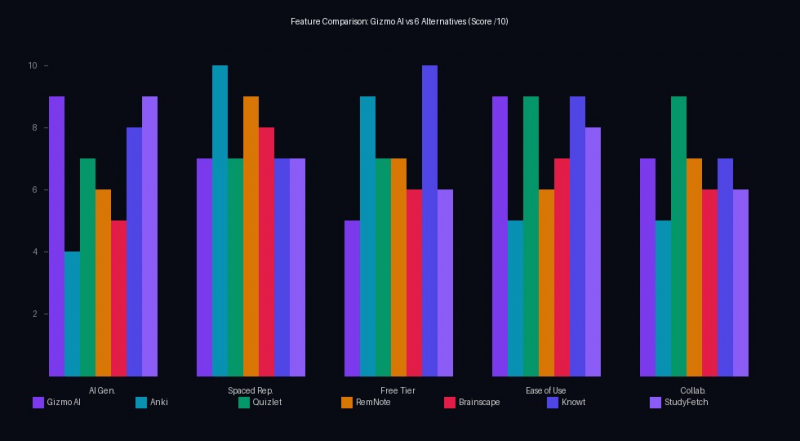
Figure 2: Feature score comparison - AI generation, spaced repetition quality, free tier generosity, ease of use, and collaboration (rated 1-10)
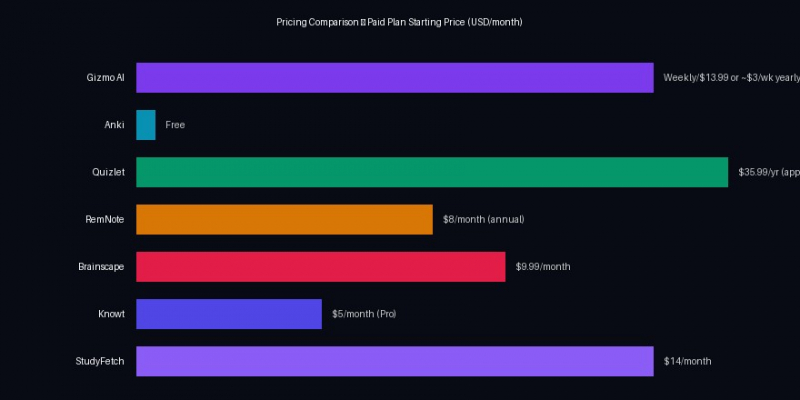
Figure 3: Starting price of paid plans - Anki is free; Knowt offers the most generous free tier among AI tools
How to Pick the Right Tool for You
• Serious exam preparer: You need the most rigorous spaced repetition, free, and can handle a setup curve - Anki. No question.
• Budget student: You want AI card generation but can't justify Gizmo's pricing right now - Knowt. Most generous free AI tier in the category.
• Note-taker: You write detailed notes and want those notes to become flashcards automatically - RemNote. The best notes-flashcards integration available.
• Professional exam candidate: You're preparing for USMLE, MCAT, Bar, or CPA - Brainscape. Expert-certified content that no AI can reliably replicate.
• Casual student: You want existing decks for common subjects plus varied study modes - Quizlet. Deepest community library by far.
• Lecture-first learner: You record your lectures and want the full pipeline automated - StudyFetch. The best lecture-to-study-session tool available.
Final Thoughts: Study Smarter, Not More
Gizmo AI solved a real problem. The grind of creating flashcards from scratch is real, and the app's ability to automate it from multiple content formats genuinely changed the studying experience for a lot of students. The 4.8-star rating on the App Store isn't manufactured - for the right student with the right workflow, it earns every point.
But the market has caught up. Knowt offers comparable AI generation almost entirely for free. Anki's FSRS algorithm runs circles around any competitor for spaced repetition precision. RemNote has created a genuinely better workflow for note-heavy learners. Brainscape has built the most trustworthy content library for professional exams. Quizlet has more decks than anyone. And StudyFetch has built the most complete lecture-processing pipeline in the category.
The honest conclusion is this: if Gizmo's free tier frustrates you, or if your pricing expectations run headlong into the $13.99-per-week model, you don't have to accept the trade-off. There is a tool in this list that does what you specifically need - and in most cases, does it better.
Pick the tool that removes friction from the part of studying you most want to avoid. The research on spaced repetition and active recall is clear: the system you actually use every day will always outperform the theoretically superior system you abandon by week three. Consistency beats perfection. Availability beats algorithm.
“The best study tool isn't the one with the smartest AI. It's the one you'll actually open at 10pm the night before an exam - and trust.”
Post Comment
Share your thoughts about this article.
Be the first to post a comment!