Both promise a human sounding voice from typed text. One of them made me stop and replay the clip to check it was really synthetic. The other still owns the part of the job that matters most if you are cloning a real person.
There is a version of this comparison where the expensive tool wins because it is expensive, and I fully expected to write it. Then a free account, on a default model, handed back a 19 second clip that I played three times before accepting that nobody had recorded it. The tool that produced it charges 5.5 dollars a month for roughly eight times the credits its rival gives you at the same price. So the interesting question stopped being which one sounds better and became something sharper: if the cheap one already sounds like a person, why would anyone still pay for the other?
There is an answer, and it is sitting in one struck out line on a pricing page that most people scroll straight past. Everything below is me finding it the slow way, screen by screen, through both products.
How the test was set up
Same route through both products, so the comparison is about the tools and not about two different workflows.
The ElevenLabs side comes from a two week run documented separately, where the account went from signup through voice selection, script tagging, generation and a full voice clone built from around 90 minutes of clean audio. The Fish Audio side was run fresh the same way: land on the public site first, sign up, open text to speech, feed it an expressive script full of inline tags, leave the model on whatever the free plan gives you, and press generate.
Text to speech was the shared benchmark because it is the one screen both products put in front of you first, and because it is where you actually hear whether a voice engine understands emotion or just pronounces words. Cloning is then judged on a second axis: not the demo reel, but what each plan genuinely unlocks and what it locks away.
TRACK 01
Getting through the front door
This is the first real difference, and it is a smaller one than the marketing implies.
ElevenLabs / Channel A
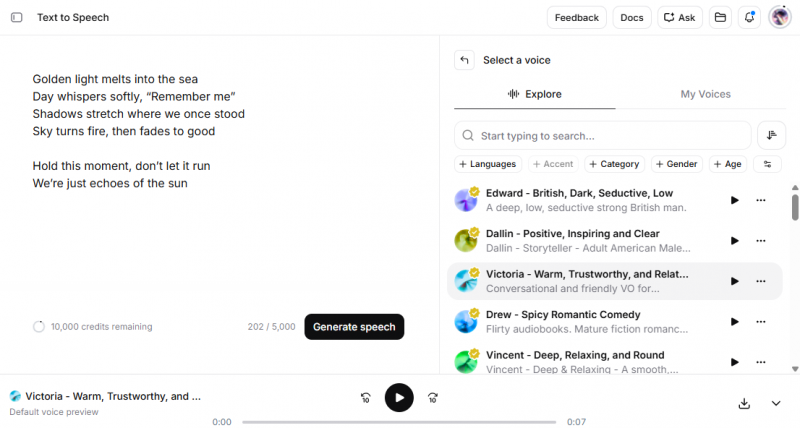
ElevenLabs after signup, with the text to speech and voices sections open.
Account first, then the workspace. You create a free account at elevenlabs.io and go straight to either text to speech or the voices library. Nothing hidden, nothing to configure before the first generation.
Fish Audio / Channel B
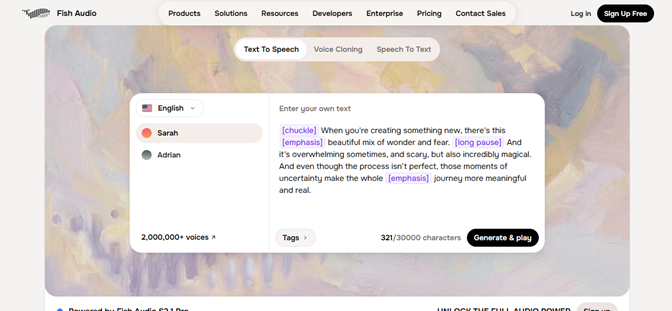
The Fish Audio landing page, with Text To Speech, Voice Cloning and Speech To Text tabs and a sample script already loaded.
The landing page looks like a playground. English is preselected, Sarah and Adrian sit in a voice list, the script arrives pre written with tags such as chuckle, emphasis and long pause already placed, and the counter reads 321 of 30,000 characters. It reads like an open sandbox, but the Generate and play button is where the sandbox stops and the signup starts.
WORTH FLAGGING
Fish Audio advertises more than 2,000,000 voices on that same screen, which is a very different scale claim from the 10,000 plus voices ElevenLabs quotes. That gap is not a quality gap, it is a difference in what counts as a voice: one number is a curated library, the other is an open community pool.
TRACK 02
The workspace you land in
Once you are inside, the two products reveal how differently they think about scope.
Fish Audio home: two headline cards, then Story Studio, Audio Separation, Speech to Text, Voice Changer and Sound Effect in a single row.
Fish Audio opens on a home screen that puts Text to Speech and Create Voice as the two large cards, then lines up five more tools underneath. The left rail splits into Products and Platform, so generation tools sit apart from billing, team settings and the developer section. The empty Projects area belongs to Story Studio, which stitches text, audio and sound effects onto a multi track timeline. A tutorials column runs down the right with entries for the S2 model, a tags tutorial and a team plan explainer, which tells you the tag system is central enough to need its own documentation.
ElevenLabs voice selection, where you either pick from the library or start a clone.
ElevenLabs presents the same territory with a narrower opening move: pick a voice or create a clone, and the rest of the suite waits behind that. Its breadth is real, covering speech, music, dubbing, sound effects, Scribe v2 transcription and the ElevenAgents side for real time voice bots, but the first screen does not try to show you all of it. Fish Audio does the opposite and puts nearly everything on the surface immediately.
Neither approach is wrong. Fish Audio is faster to survey. ElevenLabs is faster to start.
TRACK 03
The script and the emotion tags
This is where the test gets interesting, because both platforms let you write emotion directly into the text instead of dragging a slider and hoping.
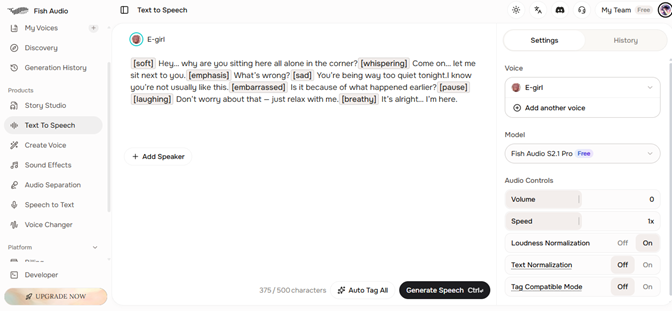
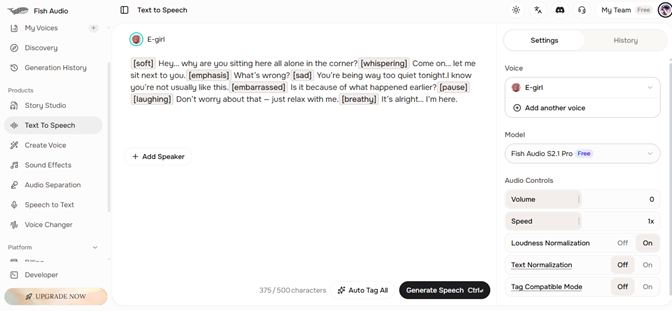
Fish Audio text to speech, running the E-girl voice on Fish Audio S2.1 Pro with soft, whispering, emphasis, sad, embarrassed, pause, laughing and breathy placed through the script.
I wrote a deliberately emotional script, the kind that fails badly on weak engines: a quiet character noticing someone sitting alone, shifting between soft, whispering, sad, embarrassed and laughing inside a single paragraph. Eight tag types went into 375 characters. Fish Audio marks each tag inline in the editor so you can see the emotional map of the script at a glance, and an Auto Tag All button will place them for you if you would rather not think about it.
The hard limit shows up in the same corner of the screen: 375 of 500 characters. On the free plan, a single generation stops at 500 characters, so anything longer than a short paragraph has to be split, generated in pieces and stitched together later. That is a real workflow tax, not a cosmetic one.

ElevenLabs handles the same job with a combination of tags and sliders, and its free tier is measured in credits rather than a per generation character wall, which means long scripts go in whole. The credits themselves are the constraint instead, and they drain fast during the experimenting phase.
THE TRADE
Fish Audio limits how much you can say at once. ElevenLabs limits how many times you can say it. On free plans, the first one interrupts your workflow more often, the second one ends your session sooner.
TRACK 04
The controls on the right
Fish Audio keeps its settings in a fixed panel beside the editor, which stays visible while you write.
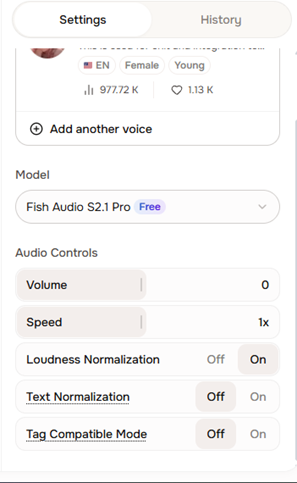
The settings column: model selection, volume, speed, and three normalization toggles.
The panel is short and readable. Volume sits at 0 and speed at 1x by default. Three toggles do the interesting work: Loudness Normalization is on out of the box, Text Normalization is off, and Tag Compatible Mode is off. That last one matters for the kind of script I was running, because it changes how literally the engine treats bracketed tags. Above the controls, the voice card carries community data rather than studio data, showing the voice as EN, female, young, with 977.72K generations and 1.13K likes behind it. You are picking from a leaderboard, not a catalogue.
ElevenLabs puts tone and emotion controls next to the script in the same spirit, then keeps a separate Studio editor for the finer pass once a draft exists. If you are producing something long, that second editing surface is a genuine advantage, and Fish Audio’s equivalent is Story Studio, which is a timeline rather than a script editor.
TRACK 05
What came out of the render
Generation took a few seconds, and then Fish Audio did something I did not expect on a free plan.
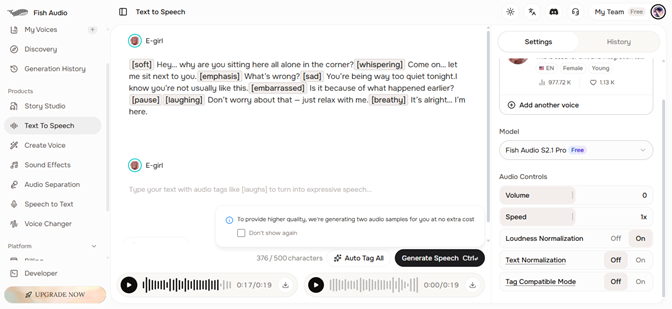
Two audio versions of the same 376 character script, both 19 seconds, generated at no extra cost.
It returned two versions of the same script instead of one, with a notice explaining that a second sample is produced at no extra cost to raise the odds of a usable take. Both clips ran 19 seconds. Having two reads to compare is the sort of thing paid tools usually charge for, and on a free tier capped at 8,000 credits it is a meaningful gesture.
The audio itself was the surprise. The tags did not behave like switches, they behaved like direction. The soft opening genuinely sat back in the throat, the whisper dropped in volume and changed texture rather than just getting quieter, the embarrassed line carried hesitation, and the laugh landed inside the sentence rather than being pasted onto the front of it. On a free account, on the default S2.1 Pro model, with no fine tuning, it sounded like a person acting rather than a model reading.
ElevenLabs sets a high bar on the same test. Across two weeks of use, narrations with its newest model and tags read like a voice actor working from a script, custom character voices generated from text prompts held up for creative work, dubbed clips kept lip sync and emotional tone, and transcription stayed accurate with background noise present. The clone built from roughly 90 minutes of clean audio convinced people who knew the person until they were told.
WHERE I LANDED ON RAW OUTPUT
For short expressive dialogue, Fish Audio closed the gap far more than the price difference suggests. For long form narration held together across paragraphs, ElevenLabs still sounds more consistent, and consistency over length is exactly what audiobooks, courses and dubbing need.
The cloning question
The title of this piece asks about cloning specifically, so it deserves to be separated from general text to speech quality. Cloning is decided by three things: how good the clone sounds, how many clones you are allowed to keep, and whether you are legally allowed to use them.
VOICE CLONING, COMPARED ON ACCESS RATHER THAN MARKETING
| Question | ElevenLabs | Fish Audio |
|---|---|---|
| Cloning on the free plan | Not available at all. The free tier is for testing generation only. | Enhanced voice cloning is struck out on the Free plan, and commercial use is struck out with it. |
| Cheapest paid entry to cloning | Starter at 5 dollars a month, which unlocks instant cloning and commercial rights. | Plus at 5.5 dollars a month, which unlocks unlimited public plus 10 private voice slots after a 5 day free trial. |
| Highest quality cloning tier | Professional cloning from the Creator plan upward, with Business including 3 professional clones. | 15 professional voice slots on the Max plan at 749 dollars a month. |
| How many voices you can keep | Governed by clone type and plan rather than a published slot count on lower tiers. | Counted openly in slots: 3 public on Free, unlimited public plus 10 private on Plus, unlimited voice slots on Pro. |
| Evidence of clone quality | A clone built from about 90 minutes of clean audio was mistaken for the real person in testing. | Not testable without paying, since the free plan removes enhanced cloning before you can judge it. |
That last row is the honest limitation of this comparison and also the most useful finding in it. ElevenLabs lets you build a real conclusion about its cloning for 5 dollars. Fish Audio asks you to trust its cloning before you can hear it, because the feature it gates is the feature the question is about. If cloning is your reason for signing up, that difference in evidence matters more than any spec line.
Pricing, tier by tier
Both platforms bill in credits, but the credits are not the same unit, so comparing the numbers directly is misleading. ElevenLabs treats credits as roughly equal to characters. Fish Audio publishes credits alongside a generation time in minutes, which is the more useful figure for anyone producing audio rather than counting text.
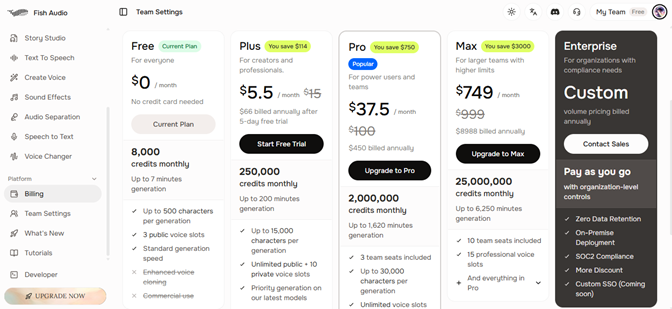
Fish Audio billing page showing Free, Plus, Pro, Max and Enterprise.
FISH AUDIO PLANS
| Plan | Monthly | Credits and output | Per generation limit | Voices and seats |
|---|---|---|---|---|
| Free | 0 | 8,000 credits, up to 7 minutes | 500 characters | 3 public voice slots, no commercial use |
| Plus | 5.5, was 15 | 250,000 credits, up to 200 minutes | 15,000 characters | Unlimited public plus 10 private slots |
| Pro | 37.5, was 100 | 2,000,000 credits, up to 1,620 minutes | 30,000 characters | Unlimited voice slots, 3 team seats |
| Max | 749, was 999 | 25,000,000 credits, up to 6,250 minutes | Everything in Pro | 15 professional voice slots, 10 team seats |
| Enterprise | Custom | Volume pricing billed annually | Custom | Zero data retention, on premise deployment, SOC2 |
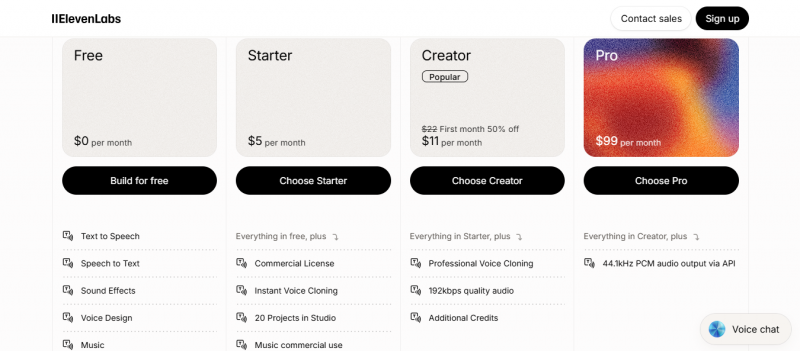
ElevenLabs pricing across Free, Starter, Creator, Pro, Scale, Business and Enterprise.
ELEVENLABS PLANS
| Plan | Monthly | Credits | Cloning | Seats |
|---|---|---|---|---|
| Free | 0 | 10,000 | None | 1 |
| Starter | 5 | 30,000 | Instant | 1 |
| Creator | 11 first month, then 22 | 100,000 | Professional | 1 |
| Pro | 99 | 500,000 | Professional | 1 |
| Scale | 330 | 2,000,000 | Professional | 3 |
| Business | 1,320 | 11,000,000 | 3 professional clones | 5 |
| Enterprise | Custom | Custom | Custom | Custom |
What the same money actually buys
| Budget | ElevenLabs gives you | Fish Audio gives you |
|---|---|---|
| Nothing | 10,000 credits and no cloning of any kind. | 8,000 credits, about 7 minutes of audio, 500 characters per generation, no commercial use, and two takes returned per render. |
| Around 5 dollars | Starter, 30,000 credits, instant cloning and the start of commercial rights. | Plus, 250,000 credits and about 200 minutes, 15,000 characters per generation, 10 private voice slots. |
| Around 22 to 37 dollars | Creator at 22, 100,000 credits with professional cloning on a single seat. | Pro at 37.5, 2,000,000 credits and about 1,620 minutes with 3 team seats. |
| Around 99 to 330 dollars | Pro at 99 for 500,000 credits, or Scale at 330 for 2,000,000 credits and 3 seats. | Nothing between 37.5 and 749, so this range is simply a gap in the Fish Audio ladder. |
| Enterprise scale | Business at 1,320 for 11,000,000 credits and 5 seats before custom pricing. | Max at 749 for 25,000,000 credits and 10 seats, then Enterprise with zero data retention and on premise deployment. |
Read across those rows and the shape becomes clear. On raw volume for the money, Fish Audio is not slightly cheaper, it is aggressively cheaper, and its Plus plan carries roughly eight times the credit count of the ElevenLabs plan at the same price. ElevenLabs answers that with plan granularity: it has five meaningful steps between free and enterprise, while Fish Audio jumps from 37.5 dollars straight to 749. If your usage grows past Pro but nowhere near Max, that jump is expensive.
One more line item deserves attention. Fish Audio’s Enterprise column lists zero data retention, on premise deployment and SOC2 compliance as the headline features rather than as footnotes, with custom SSO marked as coming soon. That is a specific pitch toward companies that cannot send voice data to a shared cloud, and it is a different sales argument from the one ElevenLabs makes with its startup grant of up to 33 million characters for qualifying agent builders.
The scorecard
| Area | Winner | Why |
|---|---|---|
| Free plan usefulness | Fish Audio | Two generated takes per render and a pro grade model on a zero dollar account, though capped at 500 characters per go. |
| Short expressive dialogue | Fish Audio | Inline tags shaped delivery rather than toggling it, and the emotional transitions inside one paragraph held together. |
| Long form narration | ElevenLabs | Consistency across paragraphs and pages, backed by two weeks of audiobook length testing. |
| Voice cloning | ElevenLabs | Cloning starts at 5 dollars with commercial rights, and a 90 minute clone was mistaken for the real voice. |
| Credits per dollar | Fish Audio | 250,000 credits at 5.5 dollars against 30,000 credits at 5 dollars, with output also stated in minutes. |
| Plan flexibility | ElevenLabs | Five priced steps between free and enterprise instead of a jump from 37.5 to 749 dollars. |
| Breadth on first screen | Fish Audio | Story Studio, audio separation, speech to text, voice changer and sound effects all visible from the home dashboard. |
| Depth of the wider suite | ElevenLabs | Dubbing with lip sync, Scribe v2 transcription and real time agents form a production pipeline, not a tool row. |
| Team and compliance | Fish Audio | 10 seats at 749 dollars, plus zero data retention and on premise deployment stated openly at enterprise level. |
| Commercial safety on day one | ElevenLabs | Commercial rights begin at the first paid tier and the free tier does not pretend otherwise. |
CHOOSE FISH AUDIO IF
You produce short form content in volume, you write dialogue with emotional turns inside it, you want the largest credit balance per dollar, or you need on premise deployment and zero data retention at organisation level.
CHOOSE ELEVENLABS IF
Cloning a specific real voice is the point, you narrate long scripts that must stay consistent, you need commercial rights confirmed from the first paid tier, or you want dubbing, transcription and voice agents on one pipeline.
My verdict after running both
I went into the Fish Audio test expecting to write a polite paragraph about a cheaper alternative. That is not what happened. The clip it produced from a free account, on the default S2.1 Pro model, with eight emotion tags in 375 characters, sounded convincingly human. Not impressive for the price. Convincing.
But the question in the title is about cloning, and on that specific question my answer is not the same as my answer on voice quality.
For voice cloning, ElevenLabs
It puts cloning behind a 5 dollar plan with commercial rights attached, and there is evidence behind it: a clone from about 90 minutes of clean audio passed as the real person. Fish Audio strikes enhanced cloning off its free tier entirely, so you have to pay before you can evaluate the exact feature you came to evaluate. When a clone has to hold up against people who know the voice, I would rather buy the one I have already heard working.
For everything around cloning, Fish Audio
For generated speech that is not impersonating a specific person, it is the better value by a wide margin. Two takes per render on a free account, 250,000 credits at 5.5 dollars, and emotion tags that shape delivery instead of switching it. The 500 character ceiling on free is annoying and the leap from 37.5 to 749 dollars is awkward, but neither undoes what the audio actually sounded like.
What I would do with a real budget
Run both. Fish Audio Plus at 5.5 dollars for bulk generation, character work and anything short and expressive. ElevenLabs Starter or Creator for the cloned voice and long form narration where consistency across ten minutes matters more than cost per minute. Together that is under 30 dollars a month and it covers more ground than either platform does alone at three times the price.
If you are only picking one and cloning is genuinely the job, take ElevenLabs. If cloning is a nice to have and what you really need is a lot of good sounding audio without watching a credit counter drain, Fish Audio earned that recommendation on the first render.
Post Comment
Share your thoughts about this article.
Be the first to post a comment!