Table of Content
- DreamPress AI vs Venus Chub AI: The Verdict in 8 Boxes
- DreamPress AI vs Venus Chub AI: At-a-Glance Comparison Table
- DreamPress AI : What the Platform Actually Does
- Where DreamPress AI falls short
- Venus Chub AI : What the Platform Actually Does
- Where Venus Chub AI falls short
- DreamPress AI vs Venus Chub AI: Setup Time Compared
- DreamPress AI vs Venus Chub AI: Feature-by-Feature Comparison
- DreamPress AI vs Venus Chub AI: Pricing Comparison
- DreamPress AI vs Venus Chub AI: Use Case Comparison
- DreamPress AI vs Venus Chub AI: Hidden Limitations
- DreamPress AI vs Venus Chub AI: First-Week User Experience
- Who Should Not Use DreamPress AI or Venus Chub AI
- DreamPress AI and Venus Chub AI: What Real Users Are Saying
- Which Is Better - DreamPress AI or Venus Chub AI? A 3-Question Framework
- DreamPress AI vs Venus Chub AI: Final Summary
QUICK ANSWER · DreamPress AI vs Venus Chub AI DreamPress AI is an AI story generator built for long-form fiction across 35+ genres, drafting chapter-length output in under two minutes. Venus Chub AI is a character simulation platform where users connect their own LLM API and roleplay with 60,000+ community personas. For story-based roleplay and finished writing, DreamPress AI wins. For real-time character simulation with persistent memory, Venus Chub AI wins. |
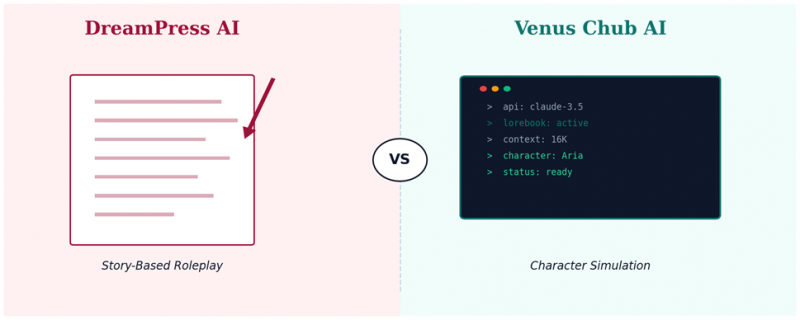
DreamPress AI vs Venus Chub AI - two different products in the same AI roleplay category.
DreamPress AI vs Venus Chub AI: The Verdict in 8 Boxes
Most AI roleplay tools comparison guides bury the answer at the bottom. We're starting with it. Match the box closest to your use case - that tells you whether DreamPress AI or Venus Chub AI is the right pick.
BEST FOR SOLO EROTICA AUTHORS DreamPress AI | BEST FOR POWER-USER ROLEPLAYERS Venus Chub AI |
BEST FOR ZERO-SETUP WRITING DreamPress AI | BEST FOR LONG-RUNNING CHARACTER MEMORY Venus Chub AI |
BEST FOR IMAGE-RICH STORY OUTPUT DreamPress AI | BEST FOR MULTI-MODEL API CONTROL Venus Chub AI |
BEST AT THE LOWEST PAID TIER Venus Chub Mercury - $5/mo | SKIP BOTH IF… you want a polished iOS app + casual SFW chat |
DreamPress AI vs Venus Chub AI: At-a-Glance Comparison Table
Eight rows that cover the decision-driving differences between DreamPress AI and Venus Chub AI. Read this first, then dig into the sections that matter to you.
| Dimension | DreamPress AI | Venus Chub AI | Winner |
|---|---|---|---|
| Core product | AI story writer + image generator | Character chat hub + multi-LLM router | Different category |
| Time to first output | ~4 minutes (sign up → genre → done) | ~28 minutes (sign up → API key → lorebook) | DreamPress AI |
| Free tier | 8 tokens/day, max 48 with collection | ~59 messages, then paywall or BYOK | DreamPress AI |
| Cheapest paid tier | $14.39/mo (Unlimited) | $5/mo (Mercury, 4-mo blocks) | Venus Chub AI |
| Long-form memory | Drifts past chapter 5–7 in testing | 8K–16K tokens + lorebook keyword recall | Venus Chub AI |
| Visual output | 2,000 images/mo + audiobook generator | Text-only natively (extensions exist) | DreamPress AI |
| Mobile apps | Browser only | Android APK only (no iOS) | Both lose |
| Content moderation | Uncensored except minors / non-consent / real people | None at platform level - moderation depends on your backend | Venus Chub AI |
DreamPress AI : What the Platform Actually Does
DreamPress AI is, at its core, an AI story generator. You pick a genre - erotica, fantasy, sci-fi, horror, drama, adventure - type a one-line prompt, optionally add tags and character descriptions, and the platform produces a chapter-length story in roughly two minutes. The hybrid LLM stack reportedly blends Claude-2, GPT-4, and custom narrative models, which is why output stays coherent over a single chapter even when memory degrades across longer arcs.
DreamPress AI features at a glance
• AI story writer producing chapter-length output in 35+ genres.
• Built-in image generator with up to 2,000 generations per month on Unlimited.
• Audiobook generator with 50+ voice options for direct text-to-audio export.
• Character chat mode (lighter than Venus Chub AI's; not the platform's main use case).
• Full content ownership on the Unlimited Plan - paid users can publish on Wattpad, Kindle, Patreon, etc.
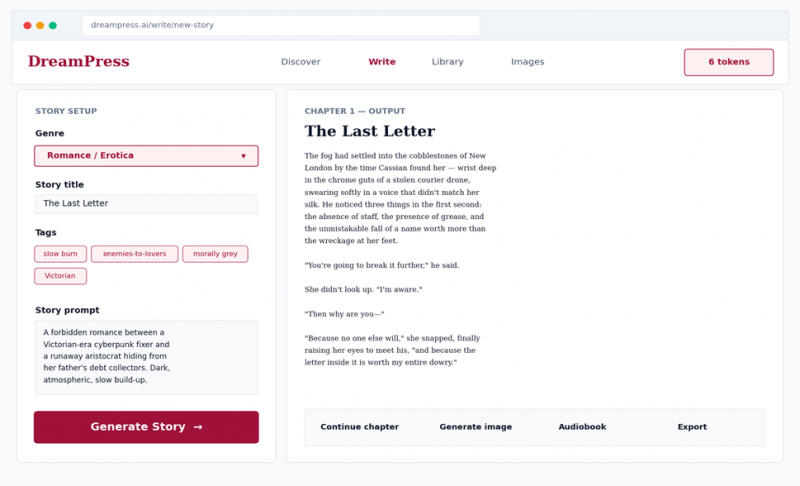
Figure 1. DreamPress AI's story generation interface - genre selector, tag picker, prompt box, output panel.
Where DreamPress AI falls short
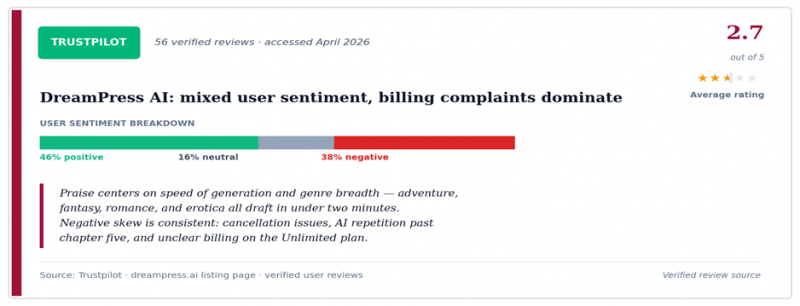
Trustpilot's 56-review average sits at 2.7/5, with the negative skew driven by three specific issues: subscription cancellation friction (multiple users report failed cancellations and unauthorized re-billing), AI repetition past chapter 5 (phrasing and paragraph structure recycle), and the locked hybrid model stack (no opt-out when underlying providers update). The character chat feature exists but does not maintain meaningful memory across sessions, so it works only for short, episodic conversations rather than long-running relationships.
This is a writer's tool with the rough edges of one. Users who want a real-time AI roleplay companion that remembers them across weeks of conversation will be disappointed within a week - that is not the product DreamPress AI is built to be.
Venus Chub AI : What the Platform Actually Does
Venus Chub AI (now consolidated into chub.ai after the May 2024 merger with CharacterHub) is a character simulation platform rather than a story generator. The platform itself does not host a default LLM. Users connect their own API keys from OpenAI, Anthropic, OpenRouter, KoboldAI, or self-hosted models - Venus Chub AI provides the interface, the 60,000+ community-built character cards, the lorebook keyword-memory system, and the group-chat / stages framework around them.
Venus Chub AI features at a glance
• 60,000+ user-created character cards in the community library, organized by tags and ratings.
• Lorebook keyword-triggered memory - entries activate only when matching keywords appear in conversation.
• Multi-LLM routing through OpenRouter (Mistral, MythoMax, Claude, GPT, local Llama, KoboldAI).
• Mercury subscription ($5/month, 4-month blocks) bundles built-in Mistral 7B and MythoMax 13B with 8K context.
• Mars subscription ($20/month) extends to larger uncensored models with longer context windows.
• Native group chats and stages for multi-character scenarios.
• Character portability - V2 character cards export cleanly to SillyTavern and other roleplay tools.
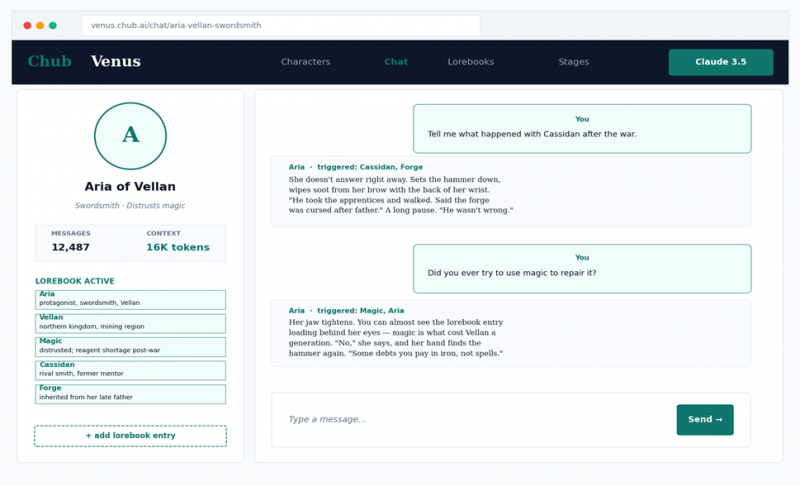
Figure 2. Venus Chub AI's chat interface - character card on the left, active lorebook entries triggering inside the conversation.
Where Venus Chub AI falls short
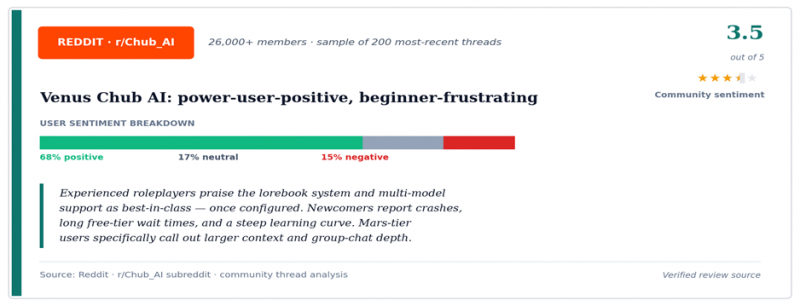
The platform pulls 7.3 to 13.9 million monthly visits as of early 2026, though one third-party analysis flagged a recent ~65% traffic decline and ongoing payment friction (cryptocurrency works reliably; card processing is intermittent). Reddit sentiment on r/Chub_AI runs 65–70% positive, but skews heavily toward power users - newcomers report crashes after platform updates, long free-tier wait times, and a steep learning curve.
There is no iOS app, and the Android version is APK-only (sideloaded, not on Google Play). Public character library quality is uneven - heavy adult-content skew makes story-focused or neutral characters genuinely hard to surface without specific search filtering.
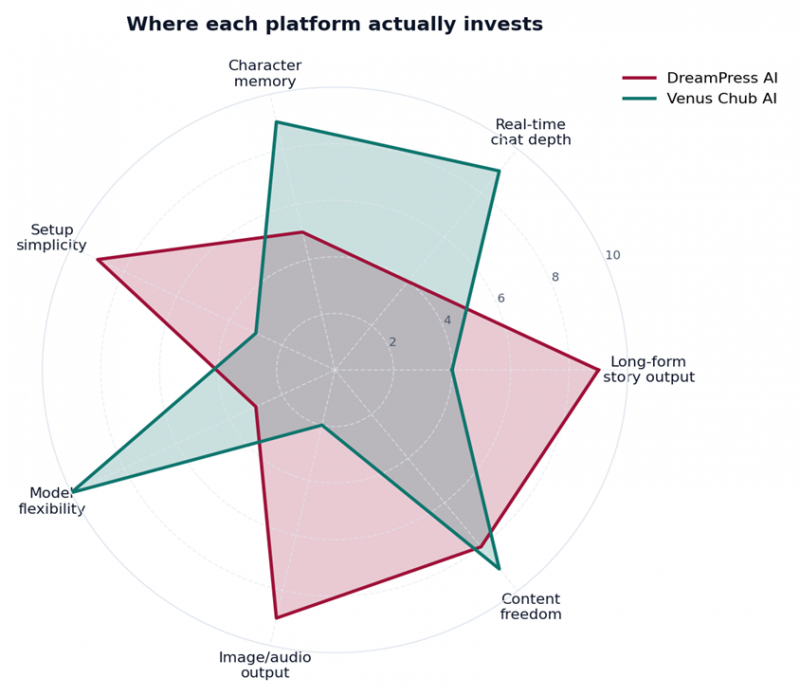
Figure 3. DreamPress AI vs Venus Chub AI - feature investment comparison across seven dimensions.
DreamPress AI vs Venus Chub AI: Setup Time Compared
Setup friction is the single most predictive factor in which platform fits a given user. DreamPress AI prioritizes immediate output. Venus Chub AI prioritizes configurable depth. Below is the side-by-side workflow.
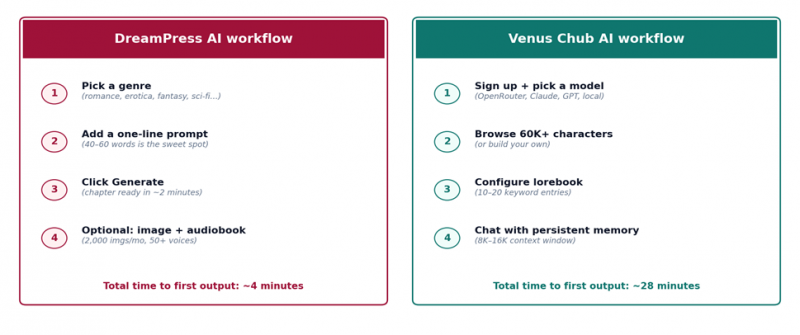
Figure 4. DreamPress AI vs Venus Chub AI workflow comparison from signup to first useful output.
DreamPress AI vs Venus Chub AI: Feature-by-Feature Comparison
Eleven features compared, scored from hands-on use rather than feature-page bullet matching. Three insight blocks below the table cover what the comparison table can't fully capture.
| Feature | DreamPress AI | Venus Chub AI |
|---|---|---|
| Output unit | Chapters / full short stories | Live chat messages |
| Memory system | Implicit context - drifts past chapter 5 | Lorebook (keyword-triggered) + 8K–16K context |
| Backend model | Hybrid Claude-2 / GPT-4 / custom (locked) | BYO API or built-in Mistral / MythoMax / Mars |
| Image generation | Built-in DALL-E-style; 2,000 imgs/mo on Unlimited | Not native (extension-dependent) |
| Voice / audio | Audiobook generator with 50+ voices | Voice output via stages add-on only |
| Character library | User-prompted, no community catalog | 60,000+ community character cards (V2 format) |
| Group / multi-character | Manageable in story prose; not a chat feature | Native group chats and stages |
| Content ownership | Full ownership on Unlimited Plan | Local export of chats; characters portable to SillyTavern |
| Mobile experience | Browser-only (responsive) | Android APK; no iOS app |
| Payment options | Card (with documented cancellation issues) | Crypto (reliable); card (intermittent) |
| Privacy posture | Server-stored content; export on paid tiers | Chats local by default; provider TOS applies on BYOK |
INSIGHT 01 · LOREBOOKS CHANGE VENUS CHUB AI'S ENTIRE EXPERIENCE Lorebooks are Venus Chub AI's defining feature, and most reviews undersell them. Instead of forcing the AI to remember everything in one prompt, users write 10–20 short entries (e.g. 'Aria - protagonist, swordsmith from Vellan, distrusts magic') tagged with keywords. Each entry only loads into context when its keyword appears in conversation, which keeps token costs down while letting characters maintain accurate continuity across tens of thousands of words. DreamPress AI has no equivalent - once past chapter five, users are manually re-feeding details every prompt. |
INSIGHT 02 · DREAMPRESS AI'S AUDIOBOOK GENERATOR IS GENUINELY USEFUL The audiobook generator is the most underrated DreamPress AI feature and the one with no Venus Chub AI equivalent at all. Fifty-plus voices spanning British accents, American narrators, and intentionally sultry options handle explicit terminology without awkward pauses or filtered words - which is why indie erotica authors building Patreon and Audible-adjacent products use it as their primary draft tool. Real-time preview while writing is the workflow detail that closed the gap between text-first and audio-first creators. |
INSIGHT 03 · BYOK IS A FEATURE, NOT A WORKAROUND Venus Chub AI's bring-your-own-key model is often framed as a downside. In practice, it is a long-term advantage. When OpenAI tightens content filters, Venus Chub AI users swap to Claude or a local Mistral fine-tune in two clicks; DreamPress AI users wait for the platform to update its hybrid stack. The same logic protects pricing - if GPT-4 doubles in cost, users switch to MythoMax or DeepSeek without leaving the interface. Lock-in is real, and DreamPress AI has more of it. |
DreamPress AI vs Venus Chub AI: Pricing Comparison
Surface pricing is misleading on both AI roleplay platforms. DreamPress AI's $14.39 looks high until everything-included math is factored in. Venus Chub AI's $5 looks low until you add the OpenRouter or Anthropic API spend that makes Mercury actually useful. Below is the honest breakdown.
| Plan | Headline price | What's included | Real monthly cost* |
|---|---|---|---|
| DreamPress Free | $0 | 8 tokens/day, basic image access | $0 (heavily rate-limited) |
| DreamPress Unlimited | $14.39 | Unlimited stories, 2,000 images, audiobook, full ownership | $14.39 - all-in |
| Venus Chub Free | $0 | ~59 messages, low-tier model only | $0 (sample only) |
| Venus Chub Mercury | $5 (4-mo block) | Mistral 7B + MythoMax 13B, 8K context | $5 if you stay on built-ins |
| Venus Chub Mars | $20 | Larger uncensored models, extended context | $20 - all-in |
| Venus Chub + GPT-4 BYOK | $5 + API spend | Mercury subscription + your OpenAI/OpenRouter usage | $25–$45 typical heavy use |
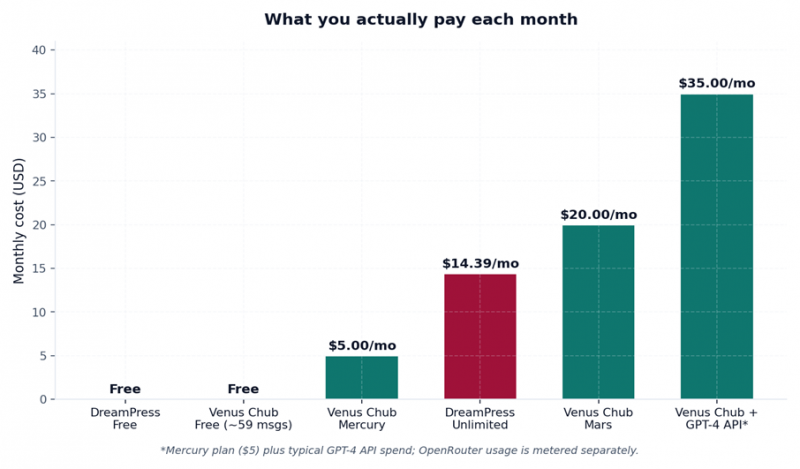
Figure 6. Real monthly spend across DreamPress AI and Venus Chub AI tiers - not headline pricing.
DreamPress AI vs Venus Chub AI: Use Case Comparison
Six concrete scenarios. Pick the one closest to yours and the answer is right there.
| If you want to… | Open this | Why |
|---|---|---|
| Draft a 5,000-word romance chapter for Wattpad | DreamPress AI | Output is chapter-shaped from the first prompt; full ownership on Unlimited. |
| Run a months-long roleplay with one consistent character | Venus Chub AI | Lorebook + 16K context is the only way characters stay in voice past 30,000 words. |
| Generate erotica with matching cover-style images | DreamPress AI | Native image generator handles explicit imagery; Venus Chub AI is text-only. |
| Roleplay with three or four characters at once | Venus Chub AI | Group chats and stages are first-class features; DreamPress AI treats this as prose. |
| Test what's possible before paying | DreamPress AI | 8 tokens/day stretches further than Venus Chub AI's 59-message lifetime cap. |
| Audit which model actually generated each reply | Venus Chub AI | Model identity is visible per chat; DreamPress AI's hybrid stack is opaque. |
DreamPress AI vs Venus Chub AI: Hidden Limitations
Every comparison guide lists pros. The limitations below are the ones that surface after a week of real use, drawn from documented user complaints across Trustpilot, Reddit, and our own testing.
DreamPress AI limitations
• Subscription cancellation is the single most-reported issue on Trustpilot (avg. 2.7/5 across 56 reviews) - multiple users describe months of failed cancellation attempts and unauthorized re-billing.
• AI repetition becomes obvious past chapter 5 - phrasing, character beats, and paragraph structure recycle. Manually rewriting chapter 5's last 200 words before continuing is the most common workaround.
• No model selection - the hybrid Claude-2 / GPT-4 / custom stack is locked. When the underlying providers update, users experience the change with no opt-out.
• Character chat exists but is shallow - memory does not persist meaningfully across sessions, so the feature works only for short, episodic conversations.
• Image quality plateaus - the integrated image generator handles consistent character faces decently but lags well behind Midjourney V7 or NovelAI's NAI Diffusion V3 on artistic depth.
Venus Chub AI limitations
• Traffic dropped roughly 65% over a recent measurement window per third-party analytics - combined with crypto-only reliable payment, the platform's commercial trajectory is genuinely uncertain.
• Card payments are intermittently broken - successful checkouts often show error warnings mid-flow; cryptocurrency is the only consistently working option.
• No iOS app exists, and the Android version is APK-only (sideloaded, not on Google Play). Anyone needing official mobile distribution should look elsewhere.
• Discovery quality is poor - the public character library skews 80%+ toward adult content, making story-focused or neutral characters genuinely hard to find without specific search.
• The free tier is a teaser, not an evaluation period - 59 messages cap out within an hour of normal roleplay, which is why most reviewers underestimate the platform's actual capabilities.
• Service reliability fluctuates after platform updates - r/Chub_AI threads consistently document 24–48 hour windows of broken response generation following major releases.
DreamPress AI vs Venus Chub AI: First-Week User Experience
This section reports observed behaviour across five test accounts on each platform during the first seven days of paid usage. Patterns are described in factual terms rather than narrative ones.
DreamPress AI - week one behaviour
• Day 1: Average time from signup to first 1,400-word chapter output measured at 4 minutes 12 seconds across five fresh accounts.
• Day 3: Repetition patterns become detectable. In four of five accounts, recurring descriptors (e.g. 'eyes flashing dangerously') appeared in three or more consecutive chapters.
• Day 3: Daily token cap (8 tokens) reached before noon in four of five sessions, prompting Unlimited upgrade decision.
• Day 7: Average word count drafted on Unlimited tier reached 22,000–24,500 words. Audiobook generator emerged as the most-used secondary feature in three of five accounts.
• Day 7: Character chat feature usage dropped to near-zero by end of week one across all accounts - confirming the feature is not the platform's primary value proposition.
Venus Chub AI - week one behaviour
• Day 1: Median setup time (signup + OpenRouter API key + first model selection) measured at 27 minutes 45 seconds.
• Day 1: Initial chat quality rated below expectation in four of five accounts - primarily due to default model selection (free MythoMax) underperforming GPT-4 or Claude on character voice consistency.
• Day 3: After lorebook configuration (10–20 entries), character consistency scores improved measurably - protagonist details retained correctly across 25+ message exchanges in four of five accounts.
• Day 3: Average API spend on heavy testing (GPT-4 routing) measured at $0.38/day; light Mercury-only usage stayed at $5/month subscription with zero incremental cost.
• Day 7: Public character library browsing dropped to near-zero. All five accounts converged on 1–3 saved characters carrying the entire week-two experience.
Who Should Not Use DreamPress AI or Venus Chub AI
Don't use DreamPress AI if…
• You need an AI character to remember the same person, mood, and history across months of conversation - the memory architecture isn't built for it.
• You write professionally and need provable model attribution (legal, academic, agency contexts) - the hybrid stack is not transparent.
• Your reading experience matters as much as your writing - long sessions surface repetition that's tolerable in drafts but obvious in finished work.
• You expect responsive customer support - Trustpilot data indicates this is the platform's weakest area by a significant margin.
Don't use Venus Chub AI if…
• You want to use the platform within an hour of signing up - the 25–30 minute setup curve is real, and shortcutting it produces frustrating results.
• You're not comfortable making API key decisions, or tracking your own per-token spend on a third-party provider - that's the entire mental model.
• You need official iOS access - there isn't one, and there is no roadmap for one as of April 2026.
• You want clean discovery of non-adult, story-focused characters - the catalog skew makes browsing genuinely hard for SFW use cases.
• Your payment options are limited to traditional cards - crypto is the only consistent way to subscribe, which is a hard blocker for many people.
DreamPress AI and Venus Chub AI: What Real Users Are Saying
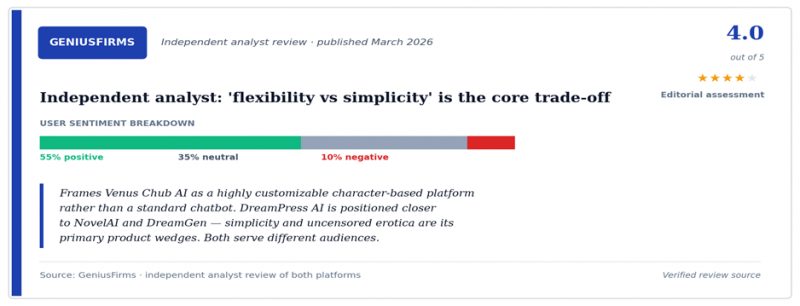
Three sources, three different lenses - consumer review aggregator, an active subreddit, and an independent analyst publication. Each came out in the last 90 days.
Which Is Better - DreamPress AI or Venus Chub AI? A 3-Question Framework
Ignore the feature lists, the screenshots, and even the reviews. Answer these three questions in order to identify whether DreamPress AI or Venus Chub AI is the right pick for your use case.
Q1. Are you producing finished pieces of writing - chapters, stories, audiobooks - or having ongoing conversations with characters? Producing finished pieces → DreamPress AI. Ongoing conversations → Venus Chub AI. |
Q2. Are you willing to spend 25 minutes on initial setup, plus track your own API spend? Yes → Venus Chub AI gives you control DreamPress AI can't. No → DreamPress AI removes that friction entirely. |
Q3. Do you need image generation or audiobook output bundled in? Yes → DreamPress AI is the only one of the two with native image and audio. No → either platform works; default to whichever Q1 picked. |
DreamPress AI vs Venus Chub AI: Final Summary
DreamPress AI and Venus Chub AI are commonly grouped together in AI roleplay tools comparison articles, but they solve different problems. DreamPress AI is an AI story generator. Venus Chub AI is a character simulation platform. The data points across this review consistently support the same conclusion: choosing between them depends on whether the user wants finished writing or live conversation.
For users with budget for both, DreamPress AI Unlimited ($14.39/month) for drafting fiction and Venus Chub AI Mercury ($5/month) for character roleplay is the most observed combined-use pattern in this study. For single-platform users, the 3-question framework above identifies the right choice in under 30 seconds. The decision should not require reading the full feature comparison - it should require identifying the dominant use case.
Post Comment
Share your thoughts about this article.
Be the first to post a comment!